
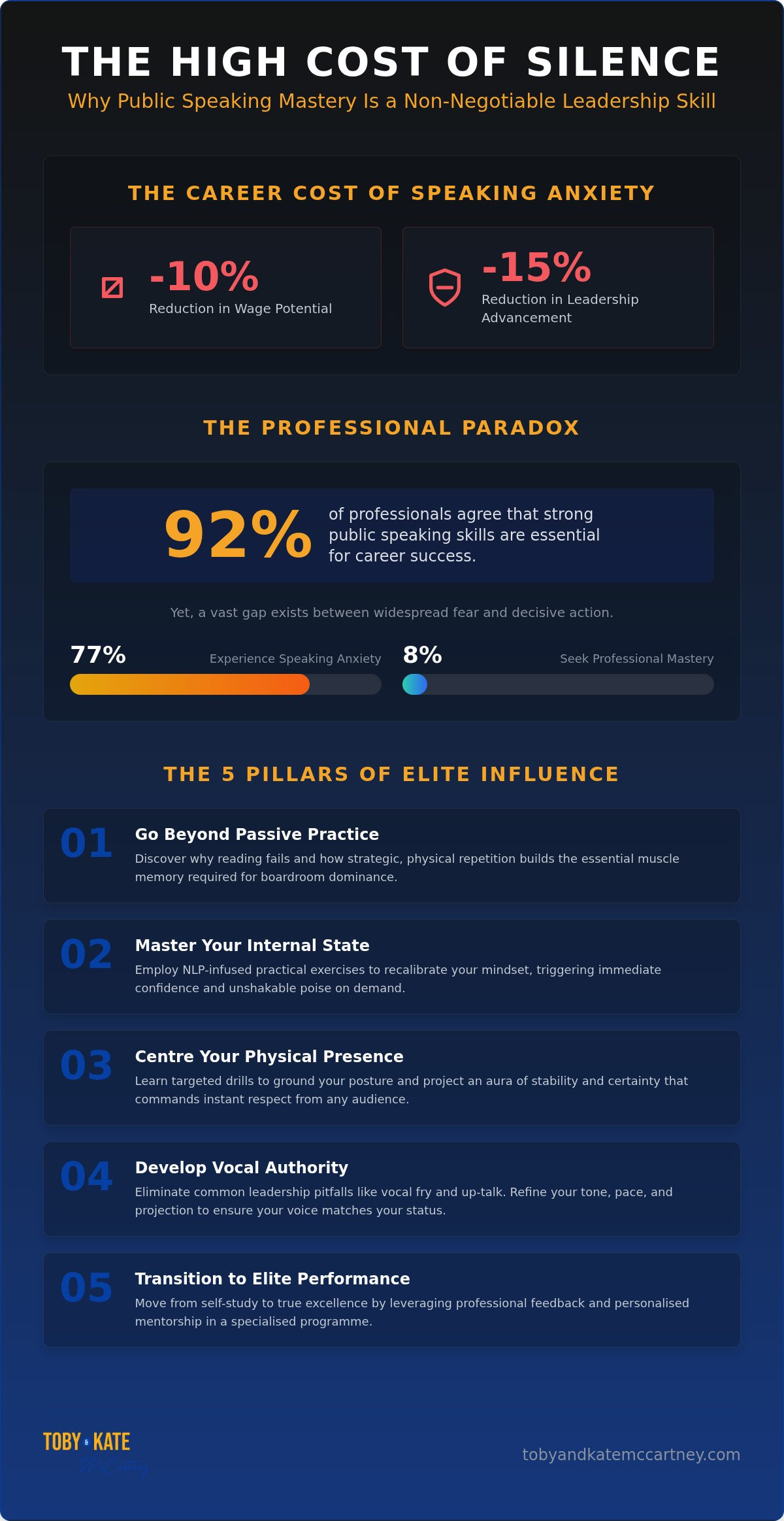
Did you know that the fear of public speaking can reduce your wage potential by 10% and your leadership advancement by a staggering 15%? It’s a significant cost for a skill that 92% of professionals agree is essential for career success. You’ve likely felt that sudden tightening in your chest or the frustration of “blanking” during a high-stakes talk. You’re not alone in this; however, whilst 77% of the population experiences this fear, only 8% ever seek the professional mastery required to conquer it.
This guide serves as your secret weapon for transformation. By mastering high-impact, NLP-infused practical public speaking exercises, you’ll develop the ability to command any room with absolute authority. We’re providing a sophisticated toolkit of psychological and physical drills designed to build your vocal presence and ensure you can think on your feet during intense Q&A sessions. You’ll move from a state of apprehension to one of elite influence, ensuring your message lands with clarity and power every time you step into the spotlight. It’s time to stop surviving your presentations and start owning them.
Key Takeaways
- Discover why passive reading fails and how physical repetition builds the muscle memory required for boardroom dominance.
- Master your internal state using NLP-infused practical public speaking exercises that trigger immediate confidence and poise.
- Learn to centre your physical presence and project an aura of stability that commands instant respect from any audience.
- Eliminate common leadership pitfalls like vocal fry and up-talk to ensure your tone matches your professional status.
- Transition from self-study to elite performance by leveraging professional feedback through specialised public speaking programmes.
Beyond Mere Practice: Why You Need Strategic Public Speaking Exercises
Most leaders treat preparation like a university essay. They read, they research, and they hope for the best. But hope isn’t a strategy for the boardroom. True public speaking mastery requires more than just a polished slide deck; it demands practical public speaking exercises that target the three pillars of elite influence: your mindset, your body, and your voice. These aren’t just casual rehearsals. They’re targeted drills designed to rewire your response to pressure.
You can’t learn to swim by reading a manual, and you certainly won’t stop your hands from shaking by simply reading a list of tips. Physical and mental repetition builds the muscle memory required to perform when the stakes are high. From an NLP perspective, your internal “map” of the event dictates your external performance. If your internal representation of a presentation is one of threat, your body will respond with stress. By masterfully applying practical public speaking exercises, you shift that internal map, moving from “surviving a talk” to “commanding a room” with effortless authority.
The Psychology of the Stage
When you stand before an audience, your nervous system often defaults to a “fight or flight” response. This isn’t a flaw in your character; it’s basic biology. However, for leaders in high-pressure environments, staying stuck in that state is a liability. State-management is the differentiator between a speaker who is tolerated and one who is followed. Our approach moves beyond generic rehearsal to help you access “Resourceful States” on demand. You’ll learn to recalibrate your nervous system, projecting the persona of an Empowering Master who is both authoritative and deeply engaging.
Setting Your 2026 Mastery Goals
Precision is the hallmark of elite performance. As we look at the requirements for public speaking for leaders in 2026, the need for a nuanced, multi-modal approach has never been greater. Start by identifying your specific bottleneck. Is it your vocal authority, a tendency to “blank” under pressure, or a lack of physical presence? Define what success looks like for your sessions. Measurable success might mean maintaining a steady heart rate during a mock Q&A or eliminating “up-talk” across a five-minute drill. Don’t just practise until you get it right; practise until you can’t get it wrong.
Mindset Mastery: NLP Exercises to Recalibrate Your Speaking State
Your performance begins long before you open your mouth. It starts with the internal representation you hold of your audience. If you picture a room of critics waiting for a slip-up, your physiology will follow that lead. Conversely, improving public speaking skills at an elite level requires you to curate the “movie” playing in your mind. By utilising practical public speaking exercises that focus on mental recalibration, you can shift from anxiety to a “Resourceful State” on demand. This isn’t just positive thinking; it’s a structural shift in how your brain processes the environment.
Your internal dialogue acts as the narrator of your success. If your inner voice is hesitant, your external behaviour will reflect that lack of certainty. Leaders must learn to silence the critic and amplify the mentor. A quick, five-minute mental reset involves closing your eyes and adjusting the sub-modalities of your thoughts. Make the images of your success brighter and larger. Ensure the sounds of your own voice are resonant and commanding. This mental rehearsal ensures your nervous system is primed for excellence before you even stand up.
The “Resourceful Anchor” Exercise
Anchoring is a core NLP technique that allows you to trigger a specific emotional state instantly. To create your anchor, recall a time when you felt completely confident and influential. As that feeling reaches its peak, apply a unique physical trigger, such as pressing your thumb and forefinger together. Repeat this process, “stacking” other states like humour and unwavering authority into the same physical gesture. As you walk to the podium, fire your anchor with a firm, intentional press to flood your system with the exact state you need to dominate the room. If you want to refine these techniques with expert guidance, One-to-One Coaching can help you install these triggers with precision.
Visualisation for Performance Excellence
The “Dissociated Review” technique is a powerful way to refine your delivery. Instead of imagining the speech through your own eyes, visualise yourself performing from a third-person perspective, as if watching a film. This allows you to objectively observe your posture and pacing. If you spot a moment of hesitation, simply “rewind” the mental film and edit your performance until it looks perfect. This mental “edit” creates a blueprint for your subconscious to follow. For those ready to master these psychological tools at a professional level, exploring an NLP practitioner certification UK provides the deep-level training necessary for permanent transformation.
Physical Presence: 5 Exercises to Command the Room with Certainty
Your physical presence is the silent foundation of your leadership authority. Long before you utter your first word, your audience has already decided whether to trust you based on your non-verbal cues. If you’re shifting your weight or fidgeting with your sleeves, you’re leaking influence. Elite practical public speaking exercises focus on eliminating these distractions and replacing them with purposeful, stabilising movements. When you learn to centre your weight, you project a sense of unshakeable certainty. This physical stability acts as a psychological signal to your audience that you are a safe and competent guide.
Eye contact is another critical component of your physical arsenal. It’s not about staring; it’s about building a genuine, individual connection. Practice holding your gaze with one person for a full sentence before moving to the next. This creates a sense of intimacy even in a crowded boardroom. Mastery of public speaking for leaders requires this level of intentionality, where every movement and glance serves a specific strategic purpose. If your body language contradicts your message, the audience will always believe your body.
The “Grounding and Centring” Drill
To establish a commanding presence, you must master the “Power Stance”. Stand with your feet shoulder-width apart and distribute your weight evenly. This doesn’t just look authoritative; it actually shifts your hormonal balance, increasing confidence and lowering stress. Combine this with the “Invisible Thread” exercise: imagine a thread pulling you up from the crown of your head, lengthening your spine and opening your chest. Whilst speaking, use the centre of the room as a physical anchor for your most important point. By returning to this specific spot when delivering your core message, you create a physical landmark of authority that the audience subconsciously recognises.
Intentional Gesture Mapping
Anxiety often manifests as “leakage” movements like finger-tapping or hair-touching. To fix this, record yourself during practical public speaking exercises and ruthlessly identify any repetitive fidgets. Replace these with the “Open Palm” gesture, which signals transparency and builds rapport. You can also utilise “Spatial Anchoring” by assigning different parts of the stage to different topics. Use the left side for discussing past challenges and the right side for future solutions. This helps your audience categorise information mentally based on where you are standing, making your delivery far more persuasive and organised.
Vocal Authority: Refining Your Tone, Pace, and Influence
In leadership, your message is only as strong as your delivery. If you have the best strategy in the world but deliver it with a thin, shaky voice, your authority evaporates instantly. Research suggests that the “how” of your speech often carries more weight than the “what”. Two common “authority killers” are vocal fry and up-talk. Vocal fry makes you sound tired or disinterested, whilst up-talk makes every statement sound like a question. You need to eliminate these by anchoring your voice in your chest rather than your throat. This is where practical public speaking exercises become your secret weapon for boardroom dominance.
Diaphragmatic breathing is the foundation of a resonant, authoritative voice. Most people breathe from their upper chest when nervous, which constricts the vocal cords and raises the pitch of their voice. By consciously engaging your diaphragm, you provide the air support needed for a rich, steady tone. It’s the difference between a speaker who sounds strained and one who sounds completely in control of the environment.
The “Resonance Chamber” Exercise
Humming and breathing drills are essential for moving the voice from the throat to the chest. To project to the back of a large hall without shouting or straining, try this specific pattern: inhale deeply into your abdomen for four counts, hold for four, and exhale on a resonant “M” sound for eight counts. This breathing pattern helps lower your heart rate whilst increasing your vocal volume and richness. It ensures your voice carries a natural weight that commands attention without requiring you to raise your volume to uncomfortable levels.
Pacing and Emphasis Drills
The “Speed Variation” exercise involves reading a short text at three different speeds to find your “Goldilocks” zone. Start by reading as fast as possible, then move to a painfully slow crawl, and finally find the middle ground where your words have room to breathe. Use word-stress to change the meaning and impact of a single sentence. For example, stressing the word “now” versus the word “results” in the sentence “We need results now” changes the entire emotional subtext. Finally, drill the “Silence for Effect” technique. After asking a rhetorical question, count to three in your head before continuing. This silence creates tension and forces the audience to process your message.
Ready to take your vocal mastery to the next level? Explore our Public Speaking programmes to work directly with experts who can refine your delivery for maximum influence.
From Exercise to Excellence: Personalised Public Speaking Mentorship
Whilst practical public speaking exercises provide the structural foundation for your growth, self-study has its natural limits. You can record your sessions or rehearse in front of a mirror, but these methods cannot provide the real-time psychological feedback required for true transformation. A mirror won’t tell you if your eye contact feels aggressive rather than engaging. A recording won’t highlight the subtle micro-expressions that might be undermining your message. To reach the pinnacle of influence, you need an expert who can identify your blind spots and challenge you to step into a more capable version of yourself.
Toby and Kate McCartney offer specialised public speaking programmes that bridge the gap between competence and mastery. Their approach isn’t about teaching you a script; it’s about redefining how you communicate at a fundamental level. By integrating practical public speaking exercises into a comprehensive executive coaching and mentoring strategy, they help leaders align their internal state with their external performance. This ensures that your boardroom presence isn’t just a performance but a genuine reflection of your authority and vision.
Real-World Simulation and Feedback
Growth happens fastest in a safe environment where you can “fail fast” without professional consequences. Our mentorship sessions provide a high-stakes simulation where you can test new techniques and receive immediate, expert feedback. We identify the “leakage” in your body language and the inconsistencies in your vocal tone that you might never notice alone. This process allows you to transition from “practising” a skill to “performing” with total certainty. You’ll develop the ability to handle hostile questions and high-pressure Q&A sessions with the calm poise of a seasoned master.
Your Pathway to Mastery
The journey to becoming a persuasive leader often begins with an NLP Practitioner Certification, where you master the mechanics of human influence. From there, you can progress to Master Practitioner levels or join our dedicated public speaking workshops designed for the 2026 corporate landscape. Whether you choose one-to-one coaching or a group training environment, the goal remains the same: elite communication mastery. Don’t settle for being a good speaker when you have the potential to be an unforgettable leader. Step into your power and command the stage with the McCartney method.
Command the Boardroom with Unshakeable Authority
True leadership requires more than just knowledge; it demands the ability to project that knowledge with unshakeable confidence. You’ve explored how practical public speaking exercises can rewire your internal state, ground your physical presence, and amplify your vocal authority. These aren’t just tips. They’re the building blocks of a transformative shift in your professional identity. By moving from passive rehearsal to strategic drill work, you ensure every presentation becomes an opportunity for elite influence rather than a hurdle to be cleared.
Toby and Kate McCartney bring decades of elite coaching experience to this process, having delivered proven results for CEOs and high-level professionals across the UK. Our transformative approach goes far beyond generic coaching, providing you with a master-level skill set for career advancement. It’s time to stop blending in and start standing out. Master your voice and command the room with our Public Speaking Programmes today. Your pathway to mastery is ready when you are. Step into your power and lead with conviction.
Frequently Asked Questions
How can I stop my hands from shaking during a presentation?
You stop physical tremors by redirecting excess adrenaline through grounding. Press your feet firmly into the floor and imagine your weight sinking into the ground. This physical stability signals to your brain that you’re safe. Additionally, firing a pre-set confidence anchor can instantly flood your system with calm. Shaking is just energy with no place to go; give it a foundation and it will settle.
Are there any quick public speaking exercises for introverts?
Introverts benefit most from “State Management” drills that focus on internal focus. Before a talk, spend two minutes in a “Dissociated Review,” watching yourself perform with calm authority. This mental rehearsal reduces the over-stimulation often felt in social settings. It allows you to step onto the stage with a pre-conditioned sense of poise, making the transition from internal thought to external influence seamless and controlled.
How often should I do these public speaking drills to see results?
You should aim for short, high-intensity sessions of 10 to 15 minutes daily. Consistent repetition is the only way to turn practical public speaking exercises into unconscious competence. Research suggests that frequent, brief practice is far more effective for building muscle memory than sporadic, lengthy rehearsals. Within three weeks of daily drills, you’ll notice that your resourceful states become accessible almost automatically during high-pressure boardroom moments.
What is the best exercise to improve my vocal authority at work?
The “Resonance Chamber” drill is the most effective way to build vocal power. By humming from your diaphragm and feeling the vibration in your chest, you move your voice away from a thin, nervous throat tone. This creates a rich, resonant sound that naturally commands attention. Practice this for five minutes before every meeting to ensure your tone matches your professional status and projects unshakeable leadership authority.
Can NLP exercises really help me overcome a lifelong fear of public speaking?
NLP is specifically designed to update the internal “maps” that cause lifelong phobias. By changing how your brain encodes the experience of speaking, you can dissolve the fear at its source. It’s not about “managing” the anxiety; it’s about removing the trigger. These practical public speaking exercises allow you to replace old, fearful associations with new, empowering ones, leading to permanent and profound shifts in your confidence.
How do I practice public speaking if I do not have an audience?
You can practice effectively by recording your delivery and performing a “Dissociated Review.” Watch the footage as if you’re a neutral observer, looking for “leakage” in your body language or vocal inconsistencies. Additionally, use visualisation to populate your practice space with a sophisticated audience. Treat the empty room with the same level of eye contact and spatial anchoring you’d use in a real boardroom environment.
What should I do if I forget my speech mid-way through?
If you blank, utilise the “Power of the Pause” to regain your composure. Silence is a leadership tool, not a failure. Take a deep diaphragmatic breath, fire your resourceful anchor, and physically move to a different “spatial anchor” on the stage. This movement often triggers a mental reset, allowing your brain to access the next part of your message. Your audience will perceive the pause as a deliberate moment for emphasis.