
What if the way to deal with a difficult boss isn’t to win every disagreement, but to shape your interactions and protect your options? You can’t control your manager’s behaviour. You can respond calmly, ask for clearer expectations and take practical steps to safeguard your wellbeing.
When priorities keep changing or a conversation feels risky because your boss controls your work, it’s understandable to feel stuck. You may be weighing up whether to raise the issue, keep a record or look elsewhere. You don’t have to rush into a decision or assume that every difficult interaction leaves you with no choices.
This guide explains how to deal with a difficult boss with greater confidence. It covers clear communication, keeping a useful record, checking workplace reporting procedures and seeking guidance from Acas about UK workplace issues. You’ll also find ways to weigh up staying, escalating a concern or moving on, so you can choose a next step based on what’s happening and what you need.
Key Takeaways
- Describe specific actions and their impact on your work, rather than relying on labels or assumptions about your manager’s personality.
- Explore how to deal with a difficult boss by focusing on what you can influence, while recognising that workplace pressures don’t excuse harmful behaviour.
- If speaking up feels risky, consider lower-risk clarification, a supported conversation or a formal reporting route before deciding what feels appropriate.
- Use a clear conversation plan: prepare, describe the behaviour, explain its impact, make a request and follow up on what was agreed.
- Assess whether the situation is improving, staying the same or getting worse, then consider workplace procedures, suitable support or moving on.
How to deal with a difficult boss: recognise what is happening
Unpredictable or dismissive management can leave you second-guessing your work and bracing for the next interaction. That strain is real, but a useful first step is to separate what you observed from what you suspect. Instead of deciding that your boss is “toxic” or guessing why they act a certain way, describe the behaviour and its effect on your work.
This gives you a clearer basis for deciding how to deal with a difficult boss. One tense exchange or disagreement may be uncomfortable without indicating a lasting pattern. Look at what happens over time, and whether it repeatedly makes expectations unclear, obstructs your work or affects your wellbeing.
What makes a boss difficult to work with?
Examples include changing priorities without explaining what should take precedence, giving feedback that is too vague to act on, checking every small decision or dismissing questions before you can explain them. Context matters: a pressured day can affect a conversation, but it doesn’t establish whether the behaviour is persistent.
Make your account specific. Note the date, what was said or done, who was present and how the work was affected. For example, “The deadline changed after I had completed the first task, and I wasn’t told which assignment to pause” is more useful than “My manager is impossible”. The research term Abusive supervision describes a topic studied in relation to harmful workplace behaviour; it isn’t a label you need to apply to your boss.
Difficult management is a recurring pattern of behaviour that affects your work or wellbeing; a poor working relationship may involve tension without that pattern.
Is it conflict, poor management or a serious concern?
Compare what’s happening with the expectations you’ve been given and the policies that apply at work. Is feedback consistently unclear, or was there one misunderstanding? Are instructions changing without warning, or has your team’s priority genuinely shifted? These questions don’t excuse poor treatment. They help you define the issue and decide what information or support might help.
If you notice repeated conduct, keep a factual record and check your organisation’s procedures for raising concerns. Threats, discriminatory treatment or behaviour that raises a safety concern call for more urgent attention. Consider seeking appropriate support through a workplace reporting route or an external source such as Acas. You don’t need to diagnose your manager or make a legal judgement before asking for guidance.
Why difficult-boss behaviour persists and what you can influence
Once you’ve identified a recurring pattern, it’s natural to wonder why it keeps happening. Possible workplace factors include competing deadlines, unclear responsibilities, pressure from senior colleagues or a mismatch in communication styles. These are possibilities, not confirmed explanations of your manager’s motives, and they don’t excuse behaviour that undermines your work or wellbeing.
Harvard Business School’s discussion of understanding and navigating difficult manager behaviour considers how employees might respond to challenging management. A practical starting point is to clarify what can be clarified, rather than trying to guess what’s driving someone else’s actions.
How unclear expectations can create repeated friction
If a deadline, priority or responsibility is ambiguous, you and your manager may leave the same conversation with different understandings. A task due “soon”, for instance, could mean today to one person and later in the week to another. If a new urgent request arrives, it may be unclear which existing task should move down the list.
Use calm, neutral questions to make the work explicit: “Which task should I prioritise first?” or “Could we confirm the deadline and who’s handling each part?” Afterwards, summarise the agreed actions, owners and timescales in a brief email or message. This creates a shared reference point without accusing either person of causing the confusion.
What you can control in the working relationship
You can prepare for a conversation, keep your tone measured, state what you need and maintain a factual record. You can also decide whether a direct discussion feels safe or whether it would be wiser to seek support through an appropriate workplace route. The power imbalance matters: your manager may influence your workload or opportunities, so speaking up won’t feel equally safe for everyone.
You can influence how clearly you communicate and which options you explore; you cannot control your manager’s response. If they react defensively, that doesn’t automatically mean you asked badly. Stay focused on the work issue, avoid making promises you can’t keep, and consider what support or boundary would help you move forward.
Practising assertive language can help you prepare for a difficult conversation. One-to-one coaching or communication development may offer space to reflect and rehearse, but it isn’t a replacement for workplace procedures or specialist advice. Explore one-to-one coaching and communication development as an optional form of personal development.
What if your difficult boss reacts badly when you speak up?
Worrying about retaliation is understandable, especially when your manager influences your workload, performance assessment or opportunities. Speaking directly to them isn’t the only way to respond, and it isn’t always the safest first step. How to deal with a difficult boss depends partly on the behaviour, your past experiences with them and the support available at work.
How to judge whether a direct conversation feels safe
Before deciding what to do, consider how serious the behaviour is and how your boss has responded to questions or concerns in the past. If you fear an angry reaction, detrimental treatment or an immediate safety risk, pause before confronting them. Seek guidance first, and ask whether a union representative, colleague or other support person can accompany you if your workplace process allows it.
You have several possible routes, each with a different purpose:
- Lower-risk clarification: Ask a focused question about a task or expectation, if that feels safe. Keep the exchange centred on the work.
- Supported conversation: Get advice from a trusted representative or appropriate colleague before deciding whether to speak with your manager.
- Formal reporting: Use the relevant workplace procedure if the behaviour is serious or keeps happening. Check who receives the report and what the process involves.
These options don’t guarantee confidentiality or a particular outcome. If you’re unsure, ask how information may be shared before providing details. HR can explain internal processes, though its role is within your organisation. A union representative may be able to support you, while Acas offers workplace advice in Great Britain.
When to document concerns or seek formal support
Keep factual notes as events happen: dates, times, what was said or done, anyone who witnessed it and how it affected your work. Save relevant messages or instructions where workplace rules allow, and store your notes securely. Avoid speculation about motives. A clear record can help you explain the pattern if you decide to ask for advice or make a report.
Check your employer’s policy for raising concerns, including any steps for informal resolution, grievances, harassment or health and safety. Acas guidance can help you understand workplace options before escalating; follow the guidance that applies to your situation and check for updates. Policies and processes vary, so don’t assume a route used by a colleague will fit your circumstances.
Threats, discriminatory treatment or a concern about immediate safety warrant prompt attention. Consider contacting an appropriate workplace contact, representative or external advice service rather than handling the issue alone. If you feel at risk of immediate harm, prioritise your safety and contact emergency services.
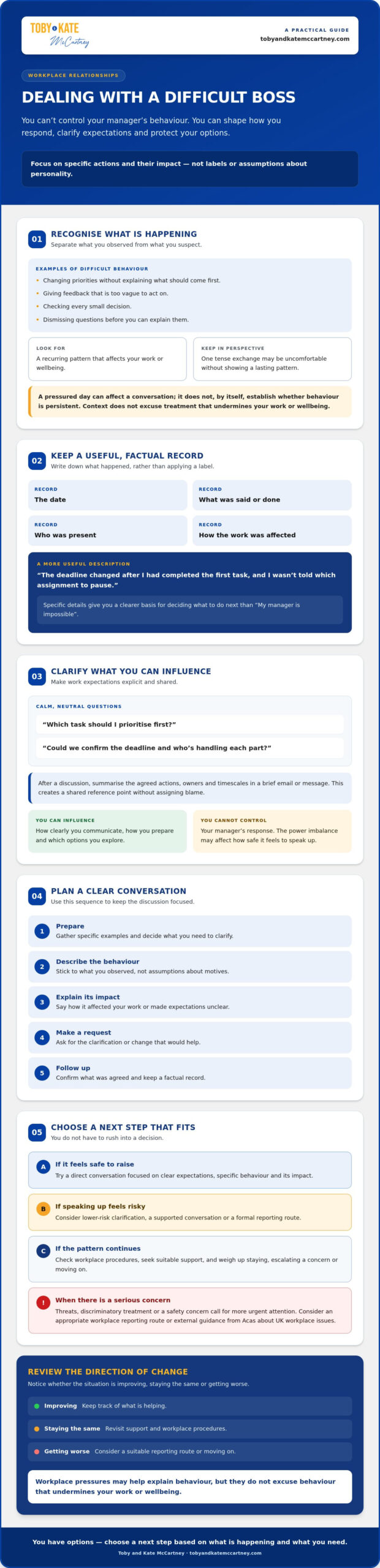
How to deal with a difficult boss: a practical conversation plan
A clear structure can help you raise a work issue without turning the conversation into a debate about personalities. If a direct discussion feels safe and appropriate, ask for a private meeting and suggest a focused agenda. Keep the aim practical: clarify what’s happening, agree a workable next step and check that you’ve understood one another.
Use this sequence to prepare:
- Prepare: Choose one specific example and decide what change would help.
- Describe: State what happened without adding labels or guessing at intent.
- Ask: Explain the work impact and make a clear, reasonable request.
- Agree: Confirm the next action, who owns it and any relevant timescale.
- Follow up: Send a short written summary and review whether things improve.
How to raise a concern without escalating tension
Keep your wording neutral and centred on the work. For example: “In Monday’s meeting, the deadline for the report changed, but I wasn’t sure which task should take priority. I spent time progressing both, so neither was ready for review. Could we agree which task comes first when deadlines conflict?”
This approach names an observable event, its effect and a specific request. Adapt it to the issue: “Could you give me one or two examples of what needs changing in this draft?” or “Can we agree which decisions I can make independently?” Practising clear, assertive language can help you prepare. Explore advanced communication skills training if you’d like to develop your communication approach.
How to follow up and keep a useful record
After the meeting, send a brief, professional note: “Thanks for meeting. My understanding is that I’ll complete the client summary first, and we’ll review the draft on Thursday.” This confirms responsibilities and gives both of you a shared reference point. If your manager disagrees with your summary, invite them to correct it.
Keep your record factual. Note agreed actions, any changes and whether the arrangement helped, without speculating about motives or using inflammatory language. If the same problem continues, your notes can help you explain what you tried and what remains unresolved. Knowing how to deal with a difficult boss doesn’t mean you must solve everything alone. For a space to reflect on your next steps, consider one-to-one coaching and mentoring.
When to escalate, seek coaching or leave a difficult boss
You don’t have to make a permanent decision after one difficult conversation. Look at the pattern and its effect over time: is the situation improving, staying much the same or becoming more harmful? Consider whether agreed changes are happening, expectations are clearer and your work or wellbeing continues to suffer. If the behaviour involves threats, discrimination or safety concerns, seek appropriate support promptly rather than waiting to see if it settles.
How to decide whether to raise a grievance or seek outside guidance
Before choosing a formal route, review your employer’s policies and organise relevant facts, such as dates, messages, witnesses and previous steps taken. Procedures vary, so check your organisation’s guidance rather than assuming a grievance is the only option. A workplace representative, such as a trade union representative where available, may help you understand the process and prepare.
For current workplace guidance in Great Britain, consult Acas. If the situation involves serious allegations or questions about your legal rights, consider seeking independent professional advice. This article isn’t legal advice, and the right next step depends on your circumstances.
When leaving may be part of a considered plan
Leaving can be a valid option, not a personal failure. If the situation remains unchanged or is taking a growing toll, weigh your wellbeing, finances, available alternatives and whether you’ve been able to access reasonable support. Where you feel safe, planning can give you time to explore roles, review practical commitments and decide what you want from your next workplace. If immediate safety is at risk, prioritise getting appropriate help rather than following a routine career plan.
There’s no obligation to keep trying the same approach if it isn’t helping. The question of how to deal with a difficult boss can lead to different choices: continue with boundaries, use a formal process, seek advice or plan a move. Broader development, such as business leadership training in the UK, may also help you reflect on your direction, but it doesn’t replace workplace procedures or specialist advice.
If personalised support would help you reflect on your options and professional goals, explore executive coaching and mentoring as an optional development resource.
Take your next step with clarity and confidence
Knowing how to deal with a difficult boss starts with separating observable behaviour from assumptions, then deciding what you can influence and what support you may need. A calm, specific conversation can clarify expectations when it feels safe to speak directly. If the behaviour continues, becomes more harmful or raises serious concerns, review workplace procedures and seek appropriate guidance rather than handling it alone.
Your next step doesn’t have to be a dramatic one. It might be keeping a clearer record, asking for support or considering whether this role still works for you. Focus on the option that best protects your wellbeing and helps you make an informed decision.
If you’d value support developing your communication or reflecting on your professional direction, Toby and Kate McCartney offer one-to-one coaching, leadership training and mentoring, alongside NLP and public speaking programmes. These are optional development resources, not a substitute for workplace procedures or specialist advice. Explore coaching and development options and choose a path that feels right for you.
Frequently Asked Questions
How do you deal with a difficult boss?
Start by identifying specific behaviour and its effect on your work, rather than labelling your manager. Decide what you need to change, then prepare one clear example and a reasonable request. If a conversation feels safe, keep it focused and confirm any agreement in writing. If the behaviour continues, becomes more serious or affects your wellbeing, check your workplace procedures and seek suitable support, such as a representative, HR or Acas.
What should you say to a difficult boss?
Describe one observable event, explain its impact and make a practical request. For example: “The deadlines changed this week, so I’m unsure which task to prioritise. Could you confirm what should come first?” Calm, direct wording keeps the discussion focused on the work rather than assumed motives. If you think a direct conversation could make matters worse, you don’t have to proceed alone. Seek advice or support before arranging it.
Should you tell HR about a difficult boss?
It depends on the behaviour, its impact and your employer’s process. For a recurring issue, keep factual notes and check the relevant workplace policy before deciding how to raise it. HR can explain internal procedures, but it may not act as an independent adviser. You could also speak with a suitable workplace representative or consult current Acas guidance for workplace options in Great Britain. If serious allegations or legal rights are involved, consider independent professional advice.
How do you protect yourself from a difficult boss at work?
Keep factual records of relevant instructions, agreed deadlines and incidents, using secure and appropriate workplace channels. Confirm important decisions in writing and ask for priorities when instructions conflict. Follow your employer’s policies, and don’t remove confidential information improperly. If you fear retaliation, face threats or experience discriminatory treatment, consider seeking suitable guidance before choosing a response. A clear record can help you explain what happened without relying on memory alone.
Can a difficult boss affect your mental health?
Ongoing workplace stress can affect how you feel and function, though people’s experiences differ. Notice changes in your sleep, concentration or mood, and consider speaking with a healthcare professional or appropriate workplace support. This article can’t assess your health or replace professional advice. If your manager’s behaviour is contributing to distress, you may also wish to record work-related concerns and explore safe, suitable ways to address them through your organisation or an appropriate advice service.
When should you leave a job because of a difficult boss?
There’s no single point that applies to everyone. Consider whether the behaviour is changing, what support is available, how the situation affects your wellbeing and the practical consequences of leaving. If it’s safe to do so, plan ahead and explore alternatives before resigning. If you face an immediate safety risk or serious misconduct, prioritise appropriate support and current professional guidance. Your decision can be deliberate, informed and based on what you need next.