
Resilience coaching for leaders can help you examine how pressure affects your decisions and communication, then practise responses that fit your role. Resilience isn’t about avoiding pressure or having every answer. It’s about building repeatable behaviours that help you think clearly, make considered decisions and lead well when demands rise.
If pressure is making it harder to focus, or good leadership habits keep slipping when work intensifies, you’re not alone in facing that challenge. Coaching, resilience training and wellbeing support are often discussed together, but they serve different purposes. Identifying the challenge you want to address is a practical first step towards choosing the right support.
Resilience coaching offers a personalised route to explore your responses, strengthen self-awareness and practise practical ways to lead through pressure. This guide compares coaching with training and other forms of development, so you can choose an approach that fits your needs or your organisation’s priorities.
You’ll also see how communication, influence and decision-making connect to resilience in everyday leadership. The aim isn’t to promise a pressure-free role. It’s to identify support that can turn useful insight into behaviours you can apply when it matters.
Key Takeaways
- Identify the specific pressure points affecting your leadership, then define a behaviour you want to practise in response.
- Resilience coaching for leaders offers personalised reflection and practical development, whilst training can build shared skills across a team.
- Compare support by its relevance to your workplace, the learning format and how easily you can apply it in day-to-day responsibilities.
- Set realistic expectations: focus on behaviours to practise and review, rather than guaranteed changes or constant calm.
- Consider whether one-to-one coaching or leadership training from Toby and Kate McCartney best fits your next development step.
What resilience coaching for leaders helps you do under pressure
Resilience coaching for leaders is personalised development that helps you recognise pressure, reflect on your responses and practise considered ways to lead through challenge and change. The focus is not on becoming permanently calm or unaffected. It’s on developing observable behaviours that support clear decisions, constructive communication and recovery after demanding periods.
Resilience is not simply enduring an excessive workload or hiding difficult emotions. It involves noticing what is happening, recognising how it may influence your choices and deciding what response best serves the situation. The Psychological Resilience overview explores resilience as a response to adversity, rather than an absence of difficulty.
In leadership, resilience can show up in small but consequential actions: pausing before replying to a challenging message, clarifying priorities when plans change, or making space to hear a colleague’s concern. These choices can help you communicate with care and make decisions using the information available, even when the outcome remains uncertain.
What does resilience mean in a leadership role?
Imagine a project falling behind just as your team is adapting to a new process. You may feel pressure to issue an immediate instruction. A resilient response could be to establish what has changed, ask what is blocking progress and agree the next priority. That doesn’t remove the challenge, but it creates an opportunity to respond deliberately rather than react automatically.
When might a leader benefit from coaching?
Coaching may be useful when a challenge keeps recurring. Perhaps difficult conversations are being postponed, change is creating friction, or sustained responsibility is making it harder to protect time for reflection and recovery. Start by identifying the work situation and leadership behaviour you want to examine, rather than labelling yourself or trying to diagnose a condition.
A coach can provide a focused space to explore your assumptions, communication and options, then connect reflection to actions in your role. For example, you might work on how you set expectations during change or respond when priorities conflict. The value lies in applying learning to real responsibilities, not in expecting pressure to disappear.
If you’re weighing up personalised development for a leadership challenge, explore this guide to executive coaching and mentoring. It offers further context for considering how coaching and mentoring can support your development.
How to assess resilience coaching: outcomes, method and fit
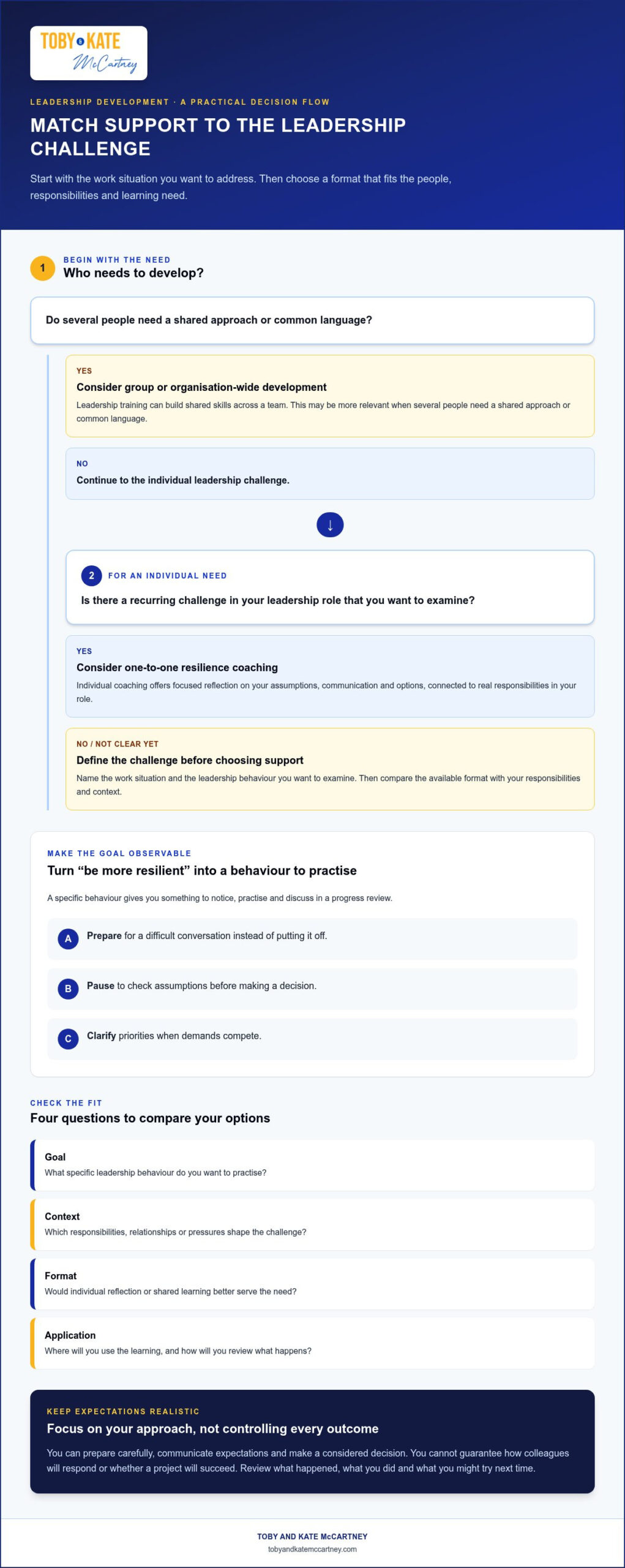
Choose support by starting with the leadership challenge you want to address, rather than a broad promise to become more resilient. A useful assessment connects four things: a clear goal, your workplace context, a suitable format and a way to apply learning in your role. The Importance of Resilience in Leadership includes a university perspective on how resilience relates to leadership practice.
Which outcomes make a coaching goal useful?
“I want to be more resilient” may express a real need, but it’s difficult to review. Make the goal observable: prepare for a difficult conversation instead of putting it off, pause to check assumptions before a decision, or clarify priorities when demands compete. These are behaviours you can practise and reflect on.
A well-defined coaching goal makes progress reviews more useful because it gives you a specific behaviour to notice, practise and discuss. Review examples from your working week: what was happening, what did you do, and what might you try next time? A coach can help you examine patterns without treating any single result as proof of success or failure.
Keep the goal within your influence. You can prepare carefully, communicate expectations and make a considered decision. You can’t guarantee how colleagues will respond or whether a project will succeed. Progress is about strengthening your approach, not controlling every outcome or promising a complete transformation.
How should the coaching approach fit your role?
Consider the pressures built into your responsibilities: the decisions you own, the relationships you need to manage and the changes affecting your team. A leader facing a recurring one-to-one challenge may value the focus of individual coaching. If several people need a shared approach or common language, group or organisation-wide development may be more relevant. Whichever format you choose, connect learning to real work so that it is easier to apply.
Before deciding, consider:
- Goal: What specific leadership behaviour do you want to practise?
- Context: Which responsibilities, relationships or pressures shape the challenge?
- Format: Would individual reflection or shared learning better serve the need?
- Application: Where will you use the learning, and how will you review what happens?
For broader development needs, Toby and Kate McCartney provide leadership training as well as personalised support. If individual reflection is the better fit, explore one-to-one coaching and leadership development to shape goals around your role.
Resilience coaching vs employee training: which approach fits?
Coaching and training can both support leadership development, but they serve different needs. Individual coaching gives a leader space to examine personal goals and working context. Employee training can help a group build shared understanding and practise together. Self-directed development offers flexibility, but relies on you to choose relevant resources and apply them consistently.
| Approach | Personalisation | Shared learning | Workplace relevance and application |
|---|---|---|---|
| One-to-one coaching | Centred on the leader’s goals and context. | Limited group discussion; reflection is individual. | Can focus on specific responsibilities and situations. The leader applies insights between conversations. |
| Employee training | Usually organised around learning needs shared by a group. | Creates opportunities to discuss ideas and practise together. | Works best when content connects with team responsibilities and there is room to use the learning at work. |
| Self-directed development | You select what to explore and how to approach it. | Depends on whether you choose to learn with colleagues. | Flexible, though applying ideas and reviewing progress require personal initiative. |
When is one-to-one resilience coaching a better fit?
One-to-one resilience coaching for leaders may suit a challenge that needs personal reflection: preparing for a difficult conversation, examining how you respond to uncertainty or considering how your communication affects a working relationship. Sessions can focus on goals the leader brings and connect learning to day-to-day responsibilities. Coaching is developmental support, not clinical mental health treatment.
When might resilience training for employees suit a team?
Training may be a better fit when employees or a leadership group need to explore common challenges, develop shared language or practise approaches together. Group discussion helps participants consider how ideas apply across their workplace. It may not address the particular circumstances of each leader, so it may not replace individual support for a specific challenge.
Can organisations combine coaching and training?
Yes. Shared learning can establish concepts and invite team-wide practice, while individual coaching gives leaders room to reflect on how those ideas apply to their responsibilities. The key is alignment: connect development activity to real workplace expectations and make it clear how participants can put learning into practice. For a related perspective, read about building resilience in leadership.
How to choose resilience coaching that translates into daily leadership
Useful development should carry beyond a coaching conversation or training session and into the decisions, conversations and pressures that shape your working week. Use this four-step process to identify what you need and how you’ll recognise its practical application.
- Name the recurring challenge. Start with a situation, not a broad wish to feel more resilient. Perhaps senior stakeholders regularly change a deadline, leaving you to reset your team’s priorities at short notice.
- Define a behaviour to practise. Choose a response within your influence, such as clarifying what takes priority, explaining the trade-offs and agreeing the next action. Focus on what you can do, rather than expecting other people or circumstances to change.
- Choose a relevant format. Consider whether the challenge is specific to you, shared by your team or affecting the wider organisation. For individual coaching, think about how confidentiality will work, particularly if development is employer-sponsored. For team learning, consider whether people will have space to practise together.
- Review what happens at work. Return to concrete examples. Did you communicate the revised priorities clearly? What response did you notice, and what still felt difficult? Use reflection to adjust your approach, not to demand a perfect result.
How do you turn a leadership challenge into a coaching goal?
Make the goal specific enough to guide practice. “Handle change better” could become “pause to identify the decision needed, then explain the reasoning to my team when plans shift”. That gives you a behaviour to try in a real situation and a useful starting point for reviewing what happened. Resilience coaching for leaders is most relevant when its focus connects with the pressures and responsibilities of the role.
How can you tell whether development is being applied?
Look at decisions, communication and responses to pressure across relevant workplace examples. A leader might reflect on whether they raised a risk sooner, listened before responding or reset expectations more clearly. Attendance and a temporary lift in confidence can be encouraging, but they don’t by themselves show whether new approaches are becoming part of everyday leadership.
What should organisational buyers consider?
First, distinguish an individual development need from a shared team or organisation-wide priority. Then consider whether leaders can practise the chosen behaviours in their roles, and whether expectations from managers support that application. If communicating clearly under pressure is a key goal, public speaking for leaders may be a related development area. Toby and Kate McCartney provide public speaking programmes alongside leadership training and one-to-one coaching.
To explore personalised coaching or leadership development connected to your next step, read about coaching and leadership development.
Build leadership resilience with coaching tailored to your next step
The right development route starts with a clear picture of what you want to strengthen, how you prefer to learn and where you’ll put that learning into practice. If a challenge is specific to your role, one-to-one coaching can provide space to focus on your goals and professional growth. If several people share a development need, leadership training can create opportunities to learn together.
What can tailored leadership coaching support?
Resilience coaching for leaders can offer a focused opportunity to explore how you respond to pressure, communicate with others and make decisions in demanding situations. The emphasis is on self-awareness and considered action, not becoming immune to stress or expecting difficult circumstances to disappear.
For example, you might want to understand what makes a challenging conversation difficult, prepare how to express your position or reflect on how you respond when priorities shift. These are possible areas for development, not promised outcomes. The aim is to connect reflection with behaviours that matter in your role and consider how to practise them at work.
Toby and Kate McCartney provide personalised one-to-one coaching and leadership training. Their professional development programmes also include Neuro-Linguistic Programming (NLP) Practitioner, Master Practitioner and Trainer Training certifications. These programmes are part of their wider work in personal and professional development.
What is a useful next step for a leader or organisation?
If you’re considering support as an individual, identify one recurring pressure point and one behaviour you’d like to develop. For instance, you might want to pause before responding to unexpected changes or communicate a decision more clearly to colleagues.
For an organisation, distinguish between a need specific to an individual leader and one shared across a team. Individual coaching can focus on personal goals and role-specific challenges; leadership training can support shared development. Either way, consider how participants will have the opportunity to apply learning in their responsibilities.
You don’t need to solve every leadership challenge at once. Start with one practical next step, then choose development that fits your goal and working context. Explore coaching and leadership development with Toby and Kate.
Choose a practical next step for stronger leadership
Resilience isn’t about avoiding pressure. It’s about recognising how it affects your leadership and practising responses that support clearer decisions, constructive communication and thoughtful action. The right support depends on your goal: one-to-one coaching can focus on an individual challenge, whilst training can help develop shared skills across a team.
Make your next step specific. Name one recurring pressure point, choose a behaviour you want to develop and consider how you’ll apply it in your role. Progress is best explored through real examples, not promises of constant calm or guaranteed transformation.
Toby and Kate McCartney offer personalised one-to-one coaching and leadership training, alongside NLP certification programmes. If you’re ready to explore a development route that fits your needs, visit Toby and Kate’s coaching and leadership development page.
With a clear goal and practical support, resilience coaching for leaders can be a considered step towards leading with greater clarity under pressure.
Frequently Asked Questions
What is resilience coaching for leaders?
Resilience coaching for leaders is personalised development that helps you notice how pressure affects your thinking and behaviour, then practise considered responses. It can focus on leadership goals such as communicating clearly during change, preparing for a challenging conversation or reviewing decisions. The aim isn’t to avoid pressure or remain calm at all times. It’s to build self-awareness and behaviours you can apply in your working role.
How does resilience coaching help leaders at work?
Coaching can help leaders reflect on recurring workplace situations and explore practical ways to respond. For example, if shifting priorities make it difficult to guide a team, you might examine how you clarify what matters, explain decisions and listen to concerns. You can then reflect on real examples from work and consider what to practise next. The process supports development, but it can’t guarantee a particular response from colleagues or a specific business outcome.
Is resilience coaching different from resilience training for employees?
Yes. One-to-one coaching centres on an individual leader’s goals, responsibilities and working context. Employee training usually brings people together to explore shared ideas, develop common language and practise as a group. Self-directed learning is another option, but you take responsibility for selecting resources and applying them. These approaches can complement each other: group learning may address shared needs, whilst coaching allows for individual reflection.
Can resilience coaching help with leadership under pressure?
It can support you to examine how you respond to demanding situations and develop behaviours to practise. You might work on pausing before a decision, setting priorities when deadlines change or approaching a difficult conversation with greater preparation. The focus is on skills within your influence, not removing pressure or guaranteeing stress-free leadership. If ongoing distress is affecting your wellbeing, coaching should not be treated as clinical mental health care.
How do I choose a resilience coach or coaching approach?
Start by naming a recurring challenge and the behaviour you want to develop. Consider whether individual reflection, shared training or self-directed learning best fits that goal and your workplace context. Think about how learning will connect with your responsibilities, how you’ll apply it and how progress can be reviewed through relevant examples. A useful approach focuses on practical development, with realistic goals rather than promises of guaranteed transformation.
What should organisations look for in leadership resilience support?
Organisations should first distinguish individual needs from priorities shared across a team or the wider organisation. Consider whether leaders need personal coaching around specific responsibilities, or whether employees would benefit from shared learning and practice. Make room for participants to apply ideas at work, and connect development goals with everyday expectations. Progress can be explored through examples of communication, decisions and responses to pressure, rather than attendance alone.
Can resilience coaching be combined with leadership training?
Yes. Leadership training can help a group explore shared concepts and practise together, whilst one-to-one coaching can give an individual space to connect development with their goals and role. Toby and Kate McCartney provide personalised coaching and leadership training, alongside NLP certification programmes. Combining formats can make sense when both shared learning and individual reflection are relevant to the development need.