
A team won’t feel safe to speak up just because its leader says, “My door is always open.” The answer to how to build psychological safety in a team is to respond constructively when people contribute, treat mistakes as chances to learn, make expectations for respectful behaviour clear, and give people regular opportunities to share concerns and ideas. Psychological safety means team members can ask for help, raise difficult issues and admit mistakes without fearing that they’ll be dismissed or blamed.
People do their best work when they feel heard and respected, but that principle needs to show up in everyday conversations, especially when opinions differ or something goes wrong. This article sets out four practical ways to build psychological safety in a team: invite honest input, learn openly from mistakes, set clear standards and build trust through consistent leadership. Small changes to how you listen and respond can strengthen candour, accountability and shared progress.
Key Takeaways
- Invite quieter voices into discussions and respond to difficult feedback with curiosity rather than defensiveness.
- Turn errors into useful debriefs by focusing on what happened, what the team learned and what could change next time.
- Make respectful behaviour and role expectations clear, then revisit them through practical conversations and feedback.
- Use consistent one-to-ones and transparent explanations to help people understand decisions and contribute with confidence.
1. Responding positively to people who speak up
For leaders asking how to build psychological safety in a team, the first response matters. When someone flags a risk, thank them, ask what they have noticed, then agree on the next action. Do not blame the messenger or dismiss the concern before understanding it. A psychologically safe meeting makes it possible to raise difficult issues, admit mistakes and ask for help without being treated as a problem. Leaders can also speak last, so their position is less likely to shape everyone else’s answer.
Use post-it notes when a topic feels sensitive or the quickest voices tend to dominate. Ask each person to write down one concern, idea or question, then collect and read the notes without naming their authors. Group similar points and discuss what action could help. A team dealing with a delayed project might uncover a hidden dependency this way. Offer spoken and written ways to contribute, so participation does not depend on feeling comfortable addressing the whole room.
Encourage everyone to contribute instead of relying on volunteers. Invite each person to share one observation, while letting anyone pass or add their view afterwards. Ask quieter colleagues what they think without putting them on the spot, and allow written follow-up. A practical way to build psychological safety in a team is to respond respectfully when views differ. Acknowledge the useful information in a challenge, even if it does not determine the final decision.
Make asking for help part of everyday work. A leader might say, “I’m stuck on this handover. Who can help me spot what I’ve missed?” That example makes it easier for others to raise a risk before it becomes a failure. When a colleague shares a difficult issue, listen fully, clarify what support they need and agree who will act next. The NHS Freedom to Speak Up policy supports speaking up and challenging inappropriate behaviour.
2. Learning from mistakes
A mistake becomes useful when a team can examine it without turning the discussion into blame. After a project setback, bring the people involved together to establish what happened, what influenced the outcome and what could change next time. Separate the decision from the person who made it. If a handover fails, for example, trace where information was missed, then agree who will update the process. This response shows respect, supports learning and makes it safer to share concerns.
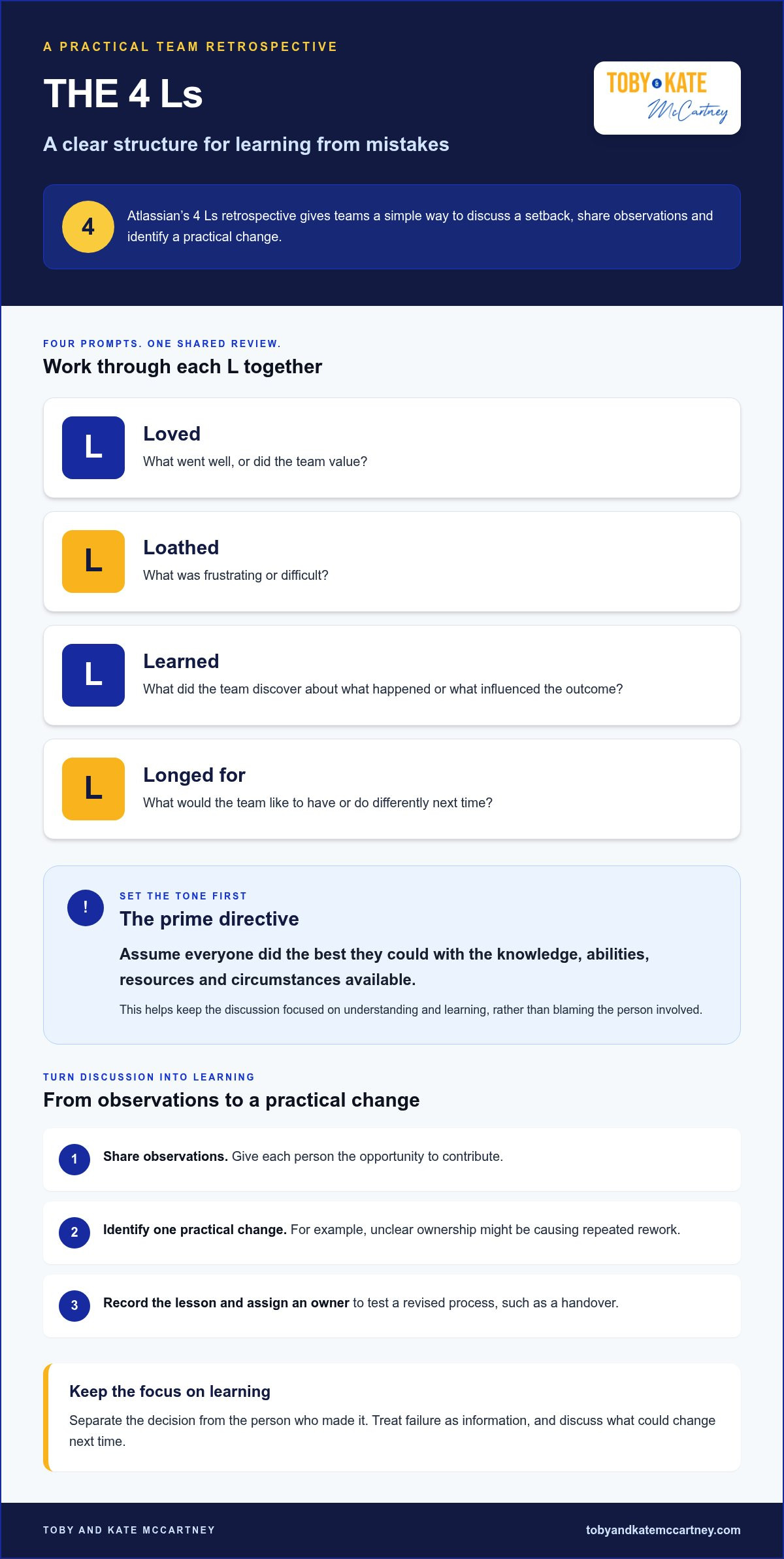
Atlassian’s 4 Ls retrospective gives teams a clear structure: discuss what they loved, loathed, learned and longed for. Before starting, state the prime directive: assume everyone did the best they could with the knowledge, abilities, resources and circumstances available. Ask each person to share observations, then identify one practical change. A team might discover that unclear ownership caused repeated rework. Record the lesson and assign an owner to test a revised handover.
Treat failure as information, not automatic proof of incompetence. Leaders can model this by admitting a mistake, describing what they learned and explaining what they will do differently. At work, that could mean saying, “I underestimated how long this task would take. Next time I’ll ask for an early progress update.” Recognise thoughtful risk-taking and the learning it produces, not reckless decisions or outcomes alone. This makes it easier for colleagues to discuss uncertainty and ask for support.
Learning also needs ethical boundaries. Before testing a new approach, clarify its purpose, consider who may be affected, and seek consent where appropriate. Give people the resources and time to reflect, rather than demanding innovation whilst penalising every imperfect result. Add a lessons-learned discussion to project close, then revisit actions during the next planning meeting. Leaders looking to strengthen everyday communication can explore practical communication development as part of that learning journey.
3. What Is Psychological Safety at Work?
Amy C. Edmondson coined “team psychological safety” in the 1990s for workplaces where people can speak up without fear of retribution. In practice, look for shared behaviours: colleagues discuss concerns, ask questions and offer feedback respectfully. It develops over time, through repeated interactions rather than a single team-building exercise.
In UK workplaces, practical steps include setting clear expectations for respectful behaviour and training people to recognise and address bullying, harassment and microaggressions. Psychological safety is associated with stronger employee engagement, a better workplace culture, and improved wellbeing and mental health. It supports open discussion, but it does not remove accountability or change who makes decisions.
Common barriers include status differences, dismissive responses and unclear standards. Address them by inviting input across roles, explaining decisions and responding consistently to persistent harmful behaviour. If interruptions repeatedly silence one colleague, for example, name the behaviour, restate the meeting expectation and follow up privately. Respectful, structured feedback should describe specific actions and their effects, rather than label someone’s character.
In remote and hybrid teams, make participation possible across working arrangements and communication styles. Share meeting questions in advance, invite spoken or written responses, and provide a shared channel for follow-up. A manager can notice whose contributions are missing from online discussions, then offer a one-to-one way to raise concerns. These steps reduce the risk of office-based voices dominating.
Practise these behaviours and assess whether they change everyday interactions. In meetings, notice whether team members ask for help, challenge assumptions, acknowledge uncertainty and build on one another’s ideas. Use an anonymous survey to ask whether people feel able to raise mistakes or disagree, then discuss the themes and agree actions with the team. Revisit the questions later and compare responses alongside observable behaviours. Treat feedback as a prompt for improvement, not a way to rank individuals. This keeps measurement focused on the culture the team shares and wants to foster.
4. Regular one-to-ones, clear goals and transparent leadership
Managers can build psychological safety through regular one-to-ones, clear responsibilities and open explanations of decisions. Ask each employee what is helping their work, where they feel blocked and what support would make a difference. Agree on a practical action and revisit it. This gives team members a direct way to raise interpersonal or mental pressures before they affect collaboration.
Use these conversations to clarify goals, not just monitor progress. Explain what a successful handover includes, who owns each step and when colleagues should flag a risk. Invite questions before putting the plan into action. If you reject a suggestion, explain why and describe any constraints. People can accept a decision more readily when they understand how it was made and what informed it.
Leaders set the tone through their own behaviour. In a difficult discussion, listen without interrupting, summarise the concern and ask what would help. Show humility by acknowledging uncertainty or a mistake, then describe what you will do next. This makes vulnerability part of normal work, rather than a weakness employees should hide. Recognise different perspectives and make sure remote, new and less senior team members can contribute.
Make commitment visible through consistent actions. State that respectful challenge is welcome, respond constructively when it happens, and address behaviour that undermines colleagues. Ask the team to help define what good collaboration looks like, then use those shared expectations in meetings and one-to-ones. Leaders who want to strengthen these skills can explore leadership training to develop practical ways to guide conversations and support team members.
Toby and Kate McCartney: NLP Practitioner Certification
Toby and Kate McCartney’s NLP Practitioner Certification can help you develop communication skills for more open team conversations. If you want to practise listening, understand how language shapes interactions and build confidence in your professional communication, the certification offers a personal development pathway to explore. These skills can complement practical steps such as setting clear expectations and responding constructively when colleagues raise concerns.
For further development, Toby and Kate McCartney also offer NLP Master Practitioner Certification, Public Speaking programmes and NLP Trainer Training. Choose the learning pathway that fits your goals, whether you want to communicate with greater confidence or develop your ability to guide others.
Visit tobyandkatemccartney.com to explore your next step.
Make your next conversation a turning point
A more open team culture grows from choices repeated in ordinary moments. Your next step could be to invite a different perspective in your next meeting or ask a colleague what would make it easier to raise concerns. Keep listening, notice what changes and adjust your approach as your team’s needs evolve. That is how to build psychological safety in a team: as a continuing leadership practice, not a one-off initiative.
To strengthen the communication skills behind this work, Toby and Kate McCartney offer NLP Practitioner Certification, NLP Master Practitioner Certification and Public Speaking programmes. These learning pathways can help you develop how you communicate and lead, supporting the practical work of creating more constructive conversations.
Contact Toby and Kate McCartney to explore a development pathway that fits your goals. Start with one thoughtful action, and build from there.
Frequently Asked Questions
What Is Psychological Safety at Work?
Psychological safety at work is the shared confidence that people can take interpersonal risks without humiliation or retaliation. That might mean questioning a proposed deadline, admitting uncertainty about a task or flagging a possible oversight. It is not the absence of disagreement. It is the ability to discuss differences while maintaining respect, responsibility and focus on the work.
What is psychological safety in a team?
In a team, psychological safety shows in how members treat one another during everyday collaboration. A new colleague, for example, can ask why a process exists, and an experienced colleague can explain it without belittling them. The team can still set demanding goals and make firm decisions while ensuring people can contribute information that improves those decisions.
How can leaders encourage people to speak up and share ideas?
Leaders can make invitations specific and easy to answer. Instead of asking, “Any thoughts?”, try, “What might make this handover fail?” or “Which customer need have we missed?” Give people time to think before responding, and accept contributions through an agreed digital channel after the meeting. A clear follow-up showing how suggestions were considered helps people see that sharing has purpose.
How should teams respond to mistakes, disagreements and bad news?
Respond to the information before judging the person. If a colleague reports a missed requirement, clarify the impact, address any immediate issue and establish what information is still needed. In a disagreement, summarise both positions fairly before deciding. If a mistake involves repeated or deliberate misconduct, address the behaviour through appropriate workplace processes. Learning does not mean ignoring accountability.
What team meeting practices help build psychological safety?
Send an agenda with decision points in advance, so people can prepare rather than improvise under pressure. Rotate the meeting facilitator to share responsibility for managing discussion, and keep a decision log of the choice, rationale and unresolved questions. In hybrid meetings, invite remote participants to contribute first on key topics instead of leaving them to compete with in-room conversation.
How can psychological safety be measured or assessed?
Assess psychological safety by combining anonymous team feedback with observable patterns. Ask whether people can question a decision, request support and acknowledge uncertainty, then look for evidence in project discussions and handovers. Compare themes over time, not individual scores, and protect confidentiality when sharing results. If survey responses are positive but concerns never surface, explore whether people trust the process enough to answer candidly.