
To think more strategically at work, look beyond the immediate task: connect decisions to wider goals, examine evidence and consider what could happen next. It’s a skill you can develop, not a quality reserved for senior leaders. Start by pausing before you act and asking whether your choice solves the right problem.
Good decisions need clear thinking, but deadlines, competing priorities and familiar assumptions can push you towards the quickest answer. A more deliberate approach helps you weigh options with confidence and spot possibilities you might otherwise miss.
Strategic thinking involves reflecting on evidence, considering opposing views and recognising cognitive biases. You can strengthen it by connecting day-to-day work with longer-term goals, asking sharper questions and turning new insight into practical decisions.
Key Takeaways
- Use “What Would Have to be True?” to test the assumptions behind a proposal before committing to it.
- Turn reports, feedback and observations into useful insight by looking for patterns and exceptions.
- Invite opposing perspectives and examine your own biases to uncover risks or options you may have missed.
- Connect immediate decisions to longer-term goals so your actions support the direction you want to take.
1. What Are Strategic Thinking Skills?
Strategic thinking skills combine analysis, planning, problem-solving, communication and management. They help leaders connect immediate decisions with future developments, rather than treating each challenge in isolation. A delayed project, for example, might signal a process issue, changing customer needs or a mismatch with organisational priorities. Leaders use these skills to understand the wider situation before choosing a response.
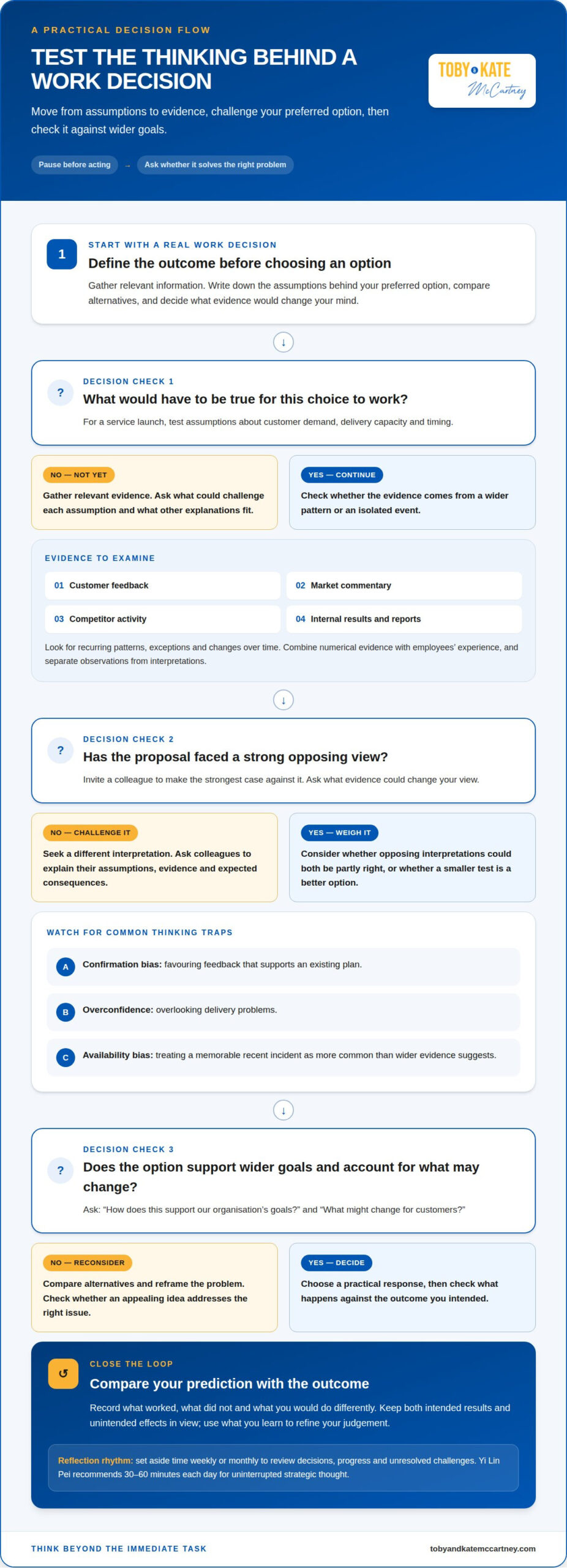
Test a proposal by asking, “What would have to be true for this choice to work?” If a team plans to launch a service, examine assumptions about customer demand, delivery capacity and timing. Ask what evidence supports each assumption, what might challenge it and what other explanations fit. This makes the idea testable before resources are committed.
Learning how to think more strategically starts with a real work decision. Define the outcome, gather relevant information and write down the assumptions behind your preferred option. Compare alternatives and decide what evidence would change your mind. This process makes your reasoning clearer and helps you improve your judgement through experience.
To identify industry trends, risks and opportunities, review customer feedback, market commentary, competitor activity and internal results. Look for recurring patterns as well as exceptions. For instance, rising demand alongside delivery delays may signal both an opportunity and a capacity risk. Comparing sources helps distinguish a wider shift from an isolated event.
Big-picture questions connect a project to its wider context: “How does this support our organisation’s goals?” and “What might change for customers?” To think more strategically, ask challenging questions too: “What are we assuming?” and “What if the opposite is true?” These prompts can reveal whether an appealing idea addresses the right issue.
Managers can encourage strategic thinking by inviting employees to question assumptions and offer different interpretations. Before changing a process, for example, ask customer service and operations colleagues to identify possible effects on customers and workload. Their perspectives can help the team spot consequences one department might miss.
2. Reflective observation and data analysis
Reflection turns a busy week into useful evidence. Choose a recent decision and record its intended outcome, the action taken and what happened. If a revised handover reduced repeated work but delayed approvals, for instance, note both results instead of labelling the change simply successful or unsuccessful.
Combine numerical evidence with employees’ experience. A work report might show a recurring delay, while customer feedback or colleague observations could help explain it. Look for patterns, exceptions and changes over time, then decide which finding could shape your next action. Separate observations from interpretations so a first impression doesn’t become an unsupported conclusion.
Make reflection a regular part of your working mindset. Reserve time weekly or monthly to review decisions, progress and unresolved challenges. Yi Lin Pei recommends setting aside 30-60 minutes each day for uninterrupted strategic thought; a shorter regular session can still help you examine evidence consistently. Use a private journal to capture what worked, what didn’t and what you’d do differently.
To balance long-term strategy with day-to-day tasks, connect each priority to a broader objective before acting. When resolving a recurring customer issue, for example, consider how it supports a longer-term service goal. Then handle the immediate case and record what it reveals.
Practise at work by choosing a live project and reviewing its reports, feedback and outcomes. Identify a trend, an exception and a question for colleagues, then use those findings to shape a practical next step. Track a relevant performance indicator to see whether your action changes results.
Reflective habits become more powerful when paired with leadership development that strengthens communication and perspective. Leadership development can support leaders seeking to turn considered thought into clear action with their teams.
Ground your strategy in facts by observing and reflecting on the situation. Keep a journal of objective analyses of both successes and failures.
3. Considering opposing views and cognitive biases
Invite a colleague to challenge a proposal before the team commits. Ask them to make the strongest case against it, then identify what evidence could change your view. Playing devil’s advocate can reveal risks hidden by enthusiasm and help distinguish a compelling vision from an idea that has survived meaningful scrutiny.
Common mistakes include treating supporting evidence as proof, dismissing awkward information and confusing confidence with accuracy. Confirmation bias can lead a leader to favour feedback that supports an existing plan. Overconfidence can obscure delivery problems, while availability bias can make a memorable recent incident seem more common than the wider evidence suggests.
Consider customer needs, competitor activity and your organisation’s capacity together. A new service might meet a customer need but stretch employees, while leaving a competitor free to improve its offer. Mapping these factors side by side reveals trade-offs and shows how creating value in one area might cause problems elsewhere.
When colleagues disagree, don’t rush to favour the more senior person’s view. Ask each to explain their assumptions, evidence and expected consequences. Then consider whether both interpretations could be partly right. This may reveal a third option, such as testing a smaller change before wider implementation.
After a decision, compare your original prediction with the outcome. If a recruitment plan assumed one skill would drive success, review whether that skill addressed the team’s actual need. Record what the evidence supports and what remains uncertain. This habit helps leaders refine their judgement across projects and career decisions.
To reduce bias, write down your preferred choice and the strongest opposing argument before deciding. Ask a colleague with a different perspective to identify overlooked opportunities, risks and effects on the team. Recording your reasoning makes it easier to revisit the decision when circumstances change, rather than defending it simply because it was yours.
4. Definition and value of strategic thinking at work
Strategic thinking connects an organisation’s choices with the value it aims to create. Felix Oberholzer-Gee defines strategy as a plan to create value, while Roger Martin distinguishes strategy from a plan. In practice, a schedule lists actions; strategy explains why those actions should move the organisation in its chosen direction.
This matters because leaders work amid changing customer expectations, competitor decisions and internal constraints. If sales slow, a tactical response might increase promotions. Strategic thinking examines whether the offer, customer experience or market position needs to change. The right response depends on how these factors interact, not on one number alone.
Strategic thinking links long-term intent to everyday decisions. Assess a proposed project by asking whether it supports organisational priorities, what success would look like and which resources it requires. If an initiative boosts short-term output but weakens customer retention, consider that trade-off before teams commit their effort.
Strategic thinking is not prediction for its own sake. Leaders consider possible futures, notice shifts in their organisation’s context and prepare adaptable responses. A team anticipating changing customer demand, for example, could explore service options, identify what each requires and agree which signals would prompt a change in direction.
The value lies in making choices with a clearer rationale, then learning from what happens. Eric Partaker states that 70% of strategic initiatives fail, a reminder to connect ambitions with execution, ownership and review. Translate a goal into initiatives, assign resources and timelines, then revisit progress as circumstances change. This turns strategy into an ongoing dialogue, rather than a document that sits untouched.
For leaders ready to strengthen how they set direction and communicate priorities, develop your strategic leadership skills through focused professional development.
Toby and Kate McCartney
Toby and Kate McCartney offer leadership training and mentoring to help people strengthen how they think, communicate and lead. If you want to connect everyday decisions with a wider direction, their development programmes support more considered leadership and stronger team conversations.
Their programmes include NLP Practitioner Certification, NLP Master Practitioner Certification, Public Speaking programmes and NLP Trainer Training. Choose a route that matches the skills you want to develop, whether you’re aiming to communicate ideas clearly, explore different perspectives or strengthen your leadership.
To discuss developing your strategic thinking and leadership skills, contact Toby and Kate McCartney.
Put your next strategic decision into practice
Your next decision is an opportunity to make reflection a leadership habit. Before acting, define what a useful outcome would look like and how you’ll assess it afterwards. This gives you a reference point for learning, even if the result differs from your expectations.
Learning how to think more strategically isn’t about having every answer in advance. It means staying curious, making deliberate choices and adjusting your approach as you learn. Choose an upcoming decision, make your reasoning clear and review what the experience teaches you.
If you’d like support developing your leadership approach and putting new skills into practice, contact Toby and Kate McCartney. Take the next step with confidence: stronger strategic thinking grows through the decisions you make every day.
Frequently Asked Questions
What Are Strategic Thinking Skills?
Strategic thinking skills help you connect decisions with wider organisational aims and likely future conditions. They include analysis, planning, problem-solving and communication. For example, a project manager deciding whether to add a feature can weigh customer value, delivery capacity and the effect on other priorities, rather than judging the idea on enthusiasm alone.
What frameworks help with strategic thinking, such as SWOT or systems thinking?
SWOT helps organise an organisation’s strengths, weaknesses, opportunities and threats. Systems thinking adds a way to trace how connected parts affect one another. A change to delivery processes, for example, may influence customer satisfaction, staff workload and repeat business. Use SWOT to map the factors, then consider their relationships before choosing an action.
What questions do strategic thinkers ask before making a decision?
Strategic thinkers ask what outcome matters, who will be affected and what trade-offs a decision creates. They might ask, “Which priority would this delay?”, “What could make this choice difficult to reverse?” and “What would we stop doing to make room?” These questions reveal consequences and opportunity costs before a team commits.
How can I use data and evidence to make better strategic decisions?
Start with the decision you need to make, then choose relevant evidence. If you’re considering a change to customer support, compare recurring complaint themes with response records and feedback from frontline employees. Check whether different sources support the same explanation and note where they disagree. Use the combined picture to decide what to test or adjust next.