
Networking isn’t about collecting business cards. It’s about building professional relationships through genuine conversations, shared interests and thoughtful follow-up. Learning how to network effectively at events starts with preparing a clear introduction, listening with purpose and making a relevant connection after you meet.
If starting conversations feels awkward, you’re not alone. You don’t need to work the whole room or deliver a perfect pitch. One focused exchange can be a strong start. Approach people with curiosity and give them room to share what matters to them.
This guide shows you how to prepare before an event, connect confidently while you’re there and follow up in a way that keeps the relationship moving. You’ll also learn how to find events and build connections online, so networking becomes a practical skill you can use on your own terms.
Key Takeaways
- Build professional relationships through genuine conversation, not a race to collect contacts.
- Make events feel more manageable by arriving early and aiming for a few thoughtful one-to-one conversations.
- Research speakers and attendees beforehand so you can start conversations with a clear point of connection.
- Keep promising connections alive with a personalised follow-up and explore relevant ways to connect online.
1. How can introverts network effectively at events?
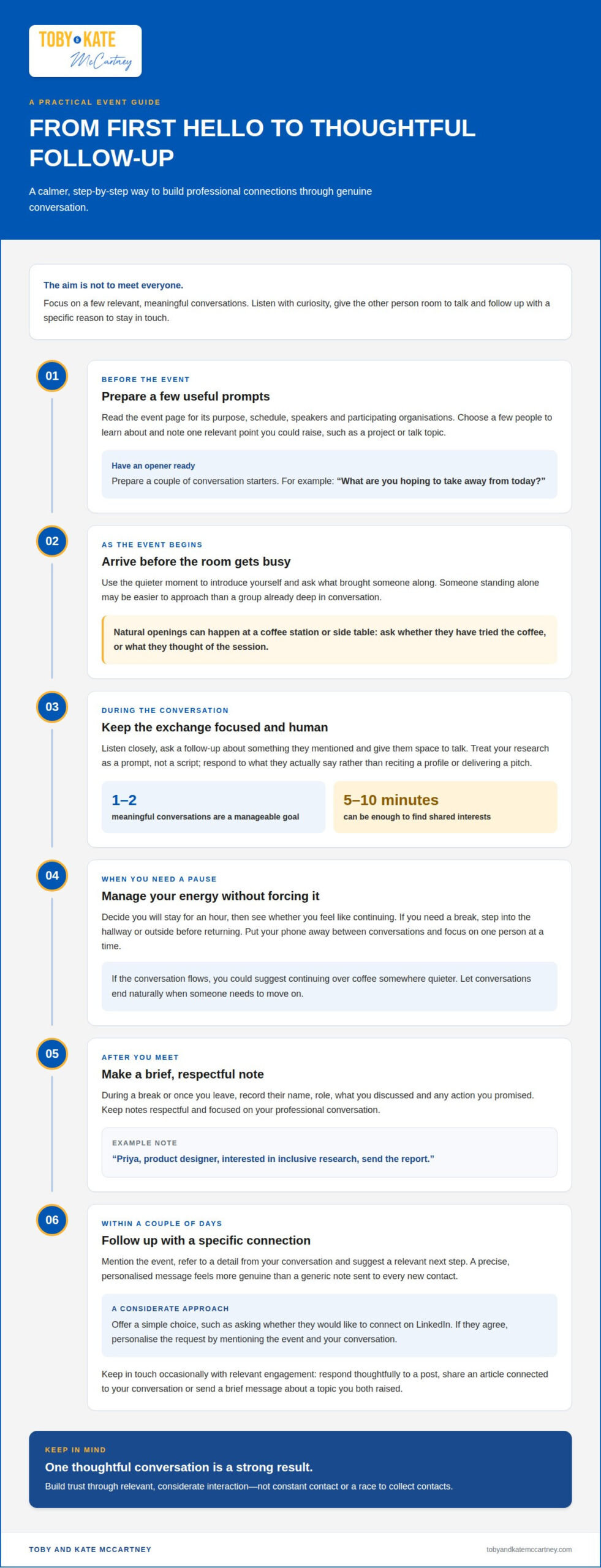
Arrive as the event begins, before the room gets busy. Use the quieter moment to approach someone, introduce yourself and ask what brought them along. A simple opener such as “What are you hoping to take away from today?” gives them room to talk. Prepare a couple of conversation starters beforehand so nerves don’t leave you searching for words.
Make your goal manageable: aim for one or two meaningful conversations rather than trying to meet everyone. A chat of five to ten minutes can be enough to find shared interests and decide whether to stay in touch. Listen closely, then ask a follow-up about something they mentioned. Give them space to talk instead of turning the exchange into a pitch.
Choose an easier setting. Someone standing alone may be more approachable than a group already deep in conversation. Coffee stations and side tables also create natural openings: ask whether they’ve tried the coffee or what they thought of the session. If the conversation flows, suggest continuing over coffee somewhere quieter.
Manage your energy with a clear exit plan. You might decide to stay for an hour, then see whether you feel like continuing. If you need a pause, step into the hallway or outside before returning. Put your phone away between conversations, make culturally sensitive eye contact and focus on one person at a time. These small choices help you stay present without forcing a performance.
Common mistakes include aiming to meet everyone, scrolling on your phone or dominating the conversation with a rehearsed pitch. Don’t treat contacts as leads to collect. Focus on whether the exchange is relevant to both of you. If you lose your footing, ask an open question, listen and follow up with genuine curiosity. One thoughtful conversation is a strong result.
2. Following up by email or LinkedIn
Send a personalised follow-up within a couple of days, while the conversation is still easy to remember. Mention the event, refer to a specific detail and suggest a relevant next step. For example: “It was good meeting you at the leadership event. I enjoyed hearing about your team’s mentoring project. Here’s the article I mentioned.” A precise note feels more genuine than a generic message sent to every new contact.
Make useful notes after each conversation, during a break or once you leave. Record the person’s name, role, what you discussed and any action you promised. A note such as “Priya, product designer, interested in inclusive research, send the report” gives you a clear follow-up prompt. Keep your notes respectful and focused on your professional conversation.
To exchange contact details without being pushy, offer a simple choice: “Would you like to connect on LinkedIn?” You can also share your email address or LinkedIn profile and let them decide whether to follow up. If they agree, personalise your connection request by mentioning the event and your conversation.
After connecting, keep the relationship active with occasional, relevant engagement. Respond thoughtfully to a LinkedIn post, share an article related to your conversation or send a brief message about a topic you both raised. Avoid repeated messages asking for a favour without context. Useful connections grow through considerate interaction, not constant contact.
Some opportunities emerge well after an event. One attendee contacted a conversation partner six months later to request studio time, showing why useful connections can remain relevant. If a role, project or introduction comes to mind later, refer to your original discussion and explain the link clearly. Forcing an immediate outcome can weaken trust. A timely, specific message gives the relationship room to develop.
Clear introductions and thoughtful follow-up both rely on confident communication. Explore confident professional communication as a way to strengthen how you present your ideas and build connections.
3. Researching attendees and speakers beforehand
Before attending, read the event page for its purpose, schedule, speakers and participating organisations. At a career fair, the company list can help you identify representatives whose work matches your interests. Choose a few people to learn about, then note one specific point you could raise, such as a recent project or talk topic. Focused research gives your conversations direction without making them feel scripted.
Look at public professional profiles, including LinkedIn, to understand someone’s role, interests and recent posts. A shared connection or recent project can give you a natural opening: “I saw your post about accessible design. What has your team learnt from that work?” If you already know someone will attend, message them beforehand and say you’d be pleased to say hello. Keep it friendly, relevant and free of demands.
Research the event’s dress expectations through its invitation, organiser information or event photographs. A formal industry conference and a relaxed creative meet-up may call for different choices. If the guidance is unclear, use the venue, programme and professional context to choose smart, comfortable clothing. Aim to feel prepared and focus on the people you’re meeting, not on adjusting your outfit.
Good UK event etiquette starts with respecting other people’s time and attention. Introduce yourself clearly, listen without interrupting, and let a conversation end naturally when someone needs to move on. Match the pressure of a handshake, and consider cultural differences around eye contact. Carry at least one business card if you use them, but offer it only when it supports an ongoing conversation.
Use your research as a prompt, not a script. Prepare an opening question for a speaker, then listen and respond to what they actually say. Avoid reciting someone’s entire profile or asking questions the event page answers clearly. A thoughtful reference to one talk, company or shared interest shows attention while leaving room for a genuine exchange.
4. Finding networking events and making online connections
Start with a clear aim: find people, ideas or organisations relevant to your work. Search LinkedIn, industry newsletters, event organisers’ listings and recommendations from colleagues or friends. For example, a project manager could look for project-management meet-ups, sector conferences or online panel discussions. Check the event’s theme and format before booking, then choose gatherings where conversation could lead to useful professional connections. Knowing how to network effectively at events also means choosing rooms where your interests overlap with other attendees’ work.
Use the organiser’s updates to understand who the event is for and how people will meet. A conference may centre on talks and informal breaks, while an online session may include attendee discussions. If existing groups feel too large or formal, consider organising a small gathering around a shared topic, such as a current industry challenge. A clear theme gives people an easy reason to join.
Online networking can begin before an event. Follow the organiser or event hashtag on LinkedIn, respond to a relevant post and introduce yourself with a specific reason for attending. A message such as “I’m joining the session on sustainable design and look forward to hearing different approaches” opens a conversation without demanding a reply. Keep your profile current so people can understand your professional interests. For anyone learning how to network effectively at events, online engagement can bridge the gap to in-person conversations.
At virtual or hybrid events, prepare as you would for an in-person discussion: identify the sessions that matter and think of a question beforehand. During a live talk, use the event chat to respond to a speaker’s point or ask a concise question. In a breakout group, introduce yourself briefly, then invite others to share their perspectives. At hybrid sessions, engage with remote and in-room attendees rather than focusing on only one group.
Afterwards, continue talking online by referring to a shared session or idea. Thoughtful participation builds confidence and makes your connections more memorable than sending generic requests. If you want to strengthen your professional communication, develop your communication confidence through focused practice.
Toby and Kate McCartney
Toby and Kate McCartney can help you strengthen the communication skills behind confident networking. If you want to go beyond event-by-event tips, their NLP training and Public Speaking programmes help you develop how you express ideas, listen and connect with others. This may suit you if nerves make introductions difficult or you want to contribute more confidently in professional conversations and presentations.
The strategies in this guide give you a starting point; structured learning can help you practise and develop those skills further. Explore the NLP Practitioner Certification or Public Speaking programmes to find a pathway that fits your development goals. To discuss your next step, contact Toby and Kate McCartney.
Make your next connection count
Choose one action to take into your next professional gathering: introduce yourself to someone new, contribute a useful idea or follow up on a promising conversation. Small, deliberate steps help you build an authentic networking style instead of copying someone else. Learning how to network effectively at events is an ongoing practice, shaped by how you communicate and the relationships you choose to nurture.
If you’re ready to develop greater confidence in how you express yourself and connect with others, explore a structured pathway that supports your professional growth. Contact Toby and Kate McCartney to discuss your next step. Your next meaningful connection can start with one clear, confident introduction.
Frequently Asked Questions
What is Networking?
Networking is the process of building and maintaining professional relationships through useful, two-way interaction. It can happen at an industry event, in an online community or through an introduction from a colleague. The aim isn’t simply to collect contacts. It’s to exchange perspectives, understand what others do and lay the foundations for future collaboration, advice or shared opportunities.
How can introverts network effectively at events?
Introverts can choose a role that creates a natural reason to interact, such as welcoming attendees or supporting a discussion. A networking buddy can also help with introductions and keep conversations moving. Plan a quiet pause between busy parts of the event, then return with energy to engage thoughtfully. A focused approach can suit your style without requiring you to perform extroversion.
How do you prepare for a networking event?
Decide what you want from the event before you go: perhaps insight into a particular role, feedback on an idea or a useful professional connection. Prepare a brief description of your work and one example of what you contribute. Check practical details, such as the venue or joining instructions, and bring a way to record useful names and follow-up actions.
What should you say when introducing yourself at an event?
Give your name, describe your work in plain language and add a detail that invites a response. For example: “I’m Sam, a project manager helping teams improve their delivery process. I’m interested in how organisations share knowledge across departments.” This gives the other person an easy way into the conversation. Adapt the example to your role and the event instead of memorising a rigid pitch.
How do you start and sustain conversations with strangers?
Use something you share in the moment as your opening, such as a session topic, the event format or a display you’re both viewing. After they answer, respond with a related observation or a brief detail about your own experience. If the exchange stalls, introduce someone nearby or close politely by saying you’ll let them continue with the event. This keeps the interaction easy and respectful.
What are good questions to ask at networking events?
Ask open questions that invite an answer beyond yes or no. Try “What’s a challenge your team is working through at the moment?” or “What skill has been most useful in your current role?” Follow the answer with a specific question about what interests you. Avoid probing for confidential details or turning every reply into an opportunity to promote yourself.