
A business strategy can only take you so far if the beliefs and habits behind your decisions keep holding you back. Mindset coaching for entrepreneurs helps you recognise those patterns, examine limiting beliefs and choose more deliberate responses to the pressures of running a business. It connects the way you lead your work with the life you want to build.
If you’re capable and ambitious but keep procrastinating, second-guessing decisions or struggling with the emotional demands of growth, that tension is real. Coaching gives you space to examine what’s getting in your way and turn greater self-awareness into practical action.
Here, you’ll learn what mindset coaching involves, how it can support entrepreneurs and freelancers as they grow, and how to choose an approach that fits your goals. The focus isn’t simply on thinking more positively. It’s on building the clarity, self-regulation and confidence to move forward with purpose.
Key Takeaways
- Separate practical business problems from the beliefs or habits that may be influencing your decisions.
- Spot self-sabotaging patterns by noticing when hesitation, avoidance or perfectionism repeatedly gets in the way.
- Use self-awareness and emotional regulation to respond more thoughtfully to the pressures of growth and working with others.
- Consider one-to-one coaching when you want structured support to turn personal insight into clearer action.
What is Mindset Coaching?
Mindset coaching explores how your beliefs, emotions and habits shape business decisions. It connects practical goals with the thinking patterns that can support or hinder progress.
Psychological Barriers Behind Business Challenges
A new sales plan won’t necessarily resolve reluctance to promote your work. If fear of rejection leads you to avoid outreach, the barrier may sit beneath the tactic. Coaching can help you identify the thought, notice when it appears and practise a different response. For example, set a manageable outreach goal and review what you learn instead of waiting to feel completely confident.
Limits of Traditional Business Coaching
Traditional business coaching can focus on strategy, operations and measurable targets. That’s useful, but a plan may stall if stress, indecision or conflicting priorities affect how you act. Choose a coach whose approach fits your goals, explains how sessions work, and helps you track practical changes. To find a qualified coach in the UK, look for relevant training, clear experience and an approach you understand; no single credential guarantees a fit.
In the UK, coaching costs depend on the coach’s approach, session format and support offered, with a quote provided after a request. Compare what the work includes, not just the session price.
Growth Aligned with Personal Strengths
Growth doesn’t mean copying another founder’s leadership style. Coaching can help you identify your strengths, values and business mission, then shape goals around them. A naturally analytical freelancer, for instance, might create a decision-making process to reduce reactive choices. For UK tax purposes, whether coaching fees are allowable depends on their purpose and your circumstances, so keep a clear record of the business rationale.
Coaching for Entrepreneurs and Business Owners
Entrepreneurs, freelancers and business owners can use coaching to examine how their mindset affects leadership, focus and growth. A session might identify a current challenge, explore the beliefs or emotions involved, then agree on a practical action to review later. Results depend on your goals, consistency and willingness to apply what you learn; coaching doesn’t guarantee a particular outcome. It relies on reflection and action, and it isn’t a substitute for clinical mental health care.
Limiting beliefs and self-sabotaging patterns
Limiting beliefs can turn everyday business decisions into recurring mental blocks. Entrepreneurial coaching helps you notice the pattern, test its assumptions and choose an action that better serves your purpose.
Identifying Limiting Beliefs and Mental Blocks
Start with a specific moment: perhaps you delay sending a proposal because you expect rejection. Note the situation, the thought that appears and what you do next. You may uncover a belief such as “my work isn’t worth that fee”, rather than a lack of business knowledge. A coach can use reflective questions, reframing and goal-setting to explore the belief and how it affects your behaviour.
Look for a repeated pattern, not just one difficult day. A business owner might keep postponing marketing, explaining the delay as a need for more preparation. Compare that explanation with what happens: which task was avoided, what followed, and what alternative response could move the work forward? This can help distinguish a practical obstacle from a belief-driven block.
Overcoming Self-Sabotaging Patterns
Changing a pattern takes practice, not a demand to “think positively”. Choose a manageable action to test the belief. If you assume a potential client will reject your proposal, make a clear offer and record the actual response. The aim is to learn from experience, build resilience and make decisions based on evidence, rather than letting an untested prediction set the limit.
Entrepreneurial mindset coaches can combine reflection, belief reframing, visualisation and action planning. The useful technique depends on the pattern and the business goal. Review what happened after each action: did you follow through, what felt difficult, and what will you adjust? For ongoing support in turning insights into purposeful steps, structured mentoring can provide a space to reflect and stay accountable.
Emotional intelligence, self-regulation and empathy in scaling
As a business grows, your responses shape decisions, relationships and working culture. Emotional intelligence can help you recognise those responses and lead with greater clarity.
Boundaries and Self-Care to Prevent Burnout
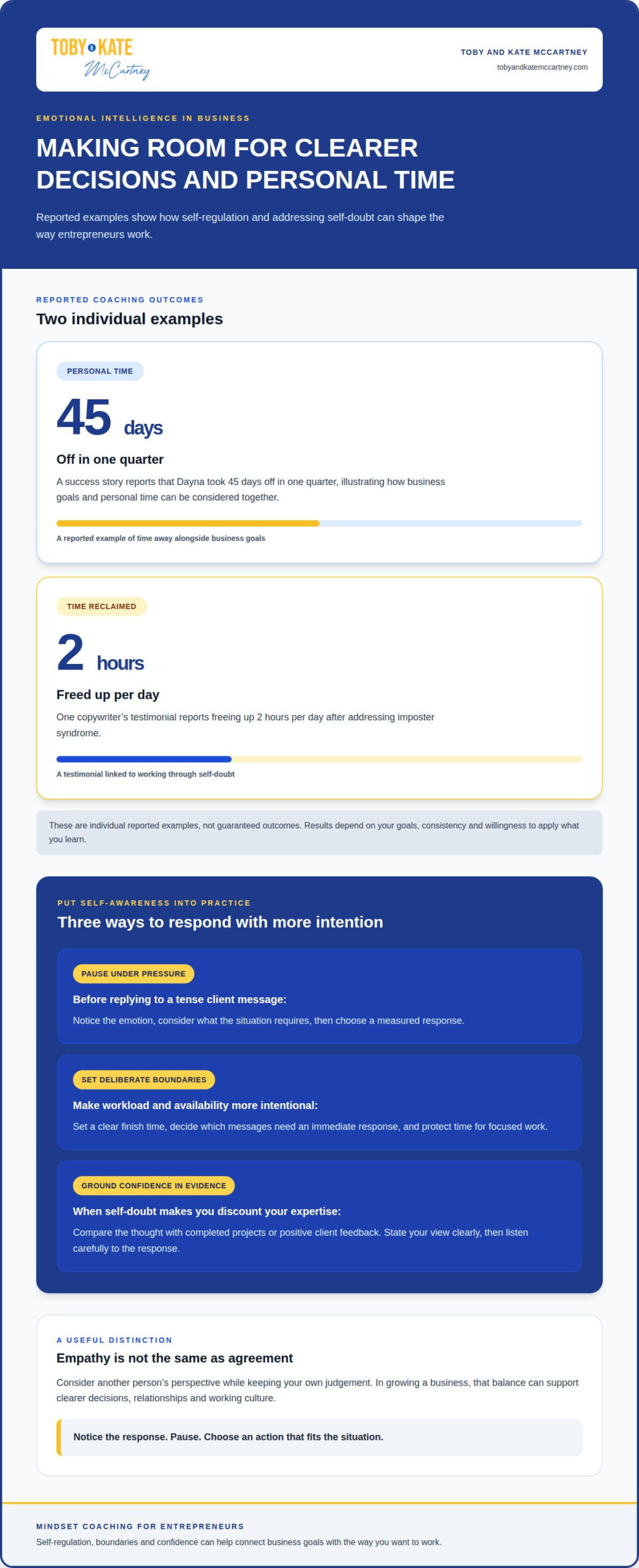
Boundaries make your workload and availability more deliberate. For example, set a clear finish time, decide which messages need an immediate response and protect time for focused work. These choices can help you notice when pressure is shaping your behaviour instead of treating exhaustion as an unavoidable part of ambition.
Self-regulation adds a pause between pressure and action. Before replying to a tense client message, take a moment to identify your emotion, consider what the situation requires, then choose a measured response. A success story reports that Dayna took 45 days off in one quarter, illustrating how business goals and personal time can be considered together.
Imposter Syndrome and Self-Doubt
Imposter syndrome can make capable professionals discount their expertise, over-prepare or avoid opportunities. Coaching can help you uncover the thought behind that reaction and compare it with evidence, such as completed projects or positive client feedback. One copywriter’s testimonial reports freeing up 2 hours per day after addressing imposter syndrome.
Confidence also grows through authentic self-expression. If you soften every recommendation to avoid disagreement, clients may struggle to understand your value. Practise stating your view clearly, then listen carefully to the response. Empathy doesn’t mean agreeing with everyone. It means considering another person’s perspective while keeping your own judgement.
During growth, these skills matter in everyday leadership moments: setting expectations with a new team member, hearing a client’s concern without becoming defensive, or explaining a difficult decision. A presentation can help people explore how to handle pressure and reduce damaging relationship patterns. The practical aim is clearer communication, steadier responses and stronger working relationships.
Entrepreneur and freelancer mindset coaching
Mindset coaching can help entrepreneurs and freelancers develop ways of working that support their ambitions. The process starts with a goal, then focuses on the thinking and decisions shaping progress.
A freelancer might want to move from irregular projects towards steadier client work. An entrepreneur preparing to delegate may need to shift from doing every task personally to setting expectations and trusting others. These goals call for different development, even when both involve confidence and decision-making.
A useful coaching process turns a broad ambition into a practical focus. First, define the outcome you want, such as making time for business development. Next, identify what currently takes your energy or delays action. Then agree on a small experiment, such as setting aside time for outreach, and review what happened. This links reflection to observable behaviour instead of relying on motivation alone.
Client stories illustrate how varied those goals can be. Ashlee reported freeing up 15 hours per week after shifting her mindset. Janet Johnson said she achieved her three-year goals in 18 months through coaching. These are individual accounts, not a standard timetable or promised result. They show why progress should be measured against your own priorities.
An independent professional might review whether time spent on low-value tasks supports the business they want to build. For a growing company—whether an independent consultancy or practical trade operators such as fencing contractors townsville—the focus might be how the founder’s decisions affect delegation and team development. Clear measures keep coaching focused: record the action taken, what changed and what to adjust next.
Choose support that keeps your business goals central while making room for personal learning. To take a purposeful next step, explore a coaching conversation.
Toby and Kate McCartney: One-to-One Coaching
Toby and Kate McCartney offer One-to-One Coaching for entrepreneurs seeking focused support with business and personal development. It can be a natural next step when you’ve identified a recurring challenge and want guided space to work through it, then turn your insights into purposeful action.
Bring a specific focus, such as leadership confidence, a difficult decision or the demands of business growth. Coaching can help you explore what influences your choices and clarify the direction you want to take. The work is shaped around your goals, giving you space to reflect and develop new ways to approach challenges.
If you’re ready to discuss your goals and whether one-to-one support fits, contact Toby and Kate McCartney.
Put your next step into motion
Your next stage of growth can begin with one clear decision: what do you want to approach differently? Choose a business priority that matters now, then consider what kind of development would help you pursue it with greater purpose. Mindset coaching for entrepreneurs can support that reflection, connecting your ambitions with the actions you’re ready to take.
If you want to develop your coaching skills, Toby and Kate McCartney offer NLP Practitioner Certification and NLP Master Practitioner Certification. Their public speaking programmes offer another route to strengthening how you communicate ideas and lead with presence. Choose the path that matches the skill or change you want to focus on next.
You don’t need to map out every future decision before you begin. Start with the challenge or opportunity most relevant to your business, then take a deliberate step towards it.
Contact Toby and Kate McCartney to discuss your next step. Your growth can start with a purposeful conversation.
Frequently Asked Questions
What is mindset coaching for entrepreneurs?
Mindset coaching for entrepreneurs provides goal-focused support to examine how your thinking affects business decisions. For example, if you keep delaying a recruitment decision, coaching might help you clarify the concern, consider the evidence and decide on a next step. It links personal reflection with business action rather than replacing practical planning, such as budgeting, customer research or operational advice.
How can mindset coaching help entrepreneurs overcome self-doubt and fear of failure?
Coaching can help you treat self-doubt as something to examine, rather than an instruction to stop. A coach might help you define a small, low-risk way to test an idea, such as presenting a draft offer to a potential customer you trust. You can then assess the response and refine your next move. This builds experience and makes future decisions less dependent on imagined outcomes.
What qualifications or accreditation should a UK mindset coach have?
Look for training relevant to the coach’s methods, practical experience with business goals, and a clear explanation of their professional boundaries. Ask how they structure sessions, handle confidentiality and assess progress. Accreditation can indicate training or membership of a particular organisation, but its meaning depends on that organisation. Choose a coach whose approach you understand and whose experience fits your needs.
How does mindset coaching compare with business coaching or therapy?
Mindset coaching usually focuses on how beliefs and behaviour affect your goals, while business coaching may concentrate more directly on strategy, operations or commercial decisions. Therapy serves a different purpose and may address mental health concerns or distress. These approaches can overlap, but they aren’t interchangeable. If you need support with a mental health concern, seek a suitably qualified mental health professional.