
The difference between NLP and hypnosis isn’t simply whether you close your eyes. If you’re asking what the difference is between NLP and hypnosis, the key distinction is their focus: NLP works with language, thought patterns and behaviour, while hypnosis uses focused attention and suggestion, often alongside relaxation. NLP techniques can be used in an ordinary waking state; hypnosis typically involves a more focused state of attention.
Both approaches use language to support change, so it’s understandable that their boundaries can seem blurred. The better fit depends on what you want to work on and which methods feel comfortable to you.
This article explains how NLP and hypnosis differ in focus and language, where they overlap, and how to choose an approach that suits your needs, comfort and goals. You’ll have a clearer basis for deciding what to do next.
Key Takeaways
- See how NLP works with language, thoughts and behaviour, while hypnosis centres on focused attention and suggestion.
- Recognise where the approaches overlap and how NLP techniques can complement hypnotic methods.
- Match an approach to your goals and comfort, including whether you prefer direct suggestions or a more conversational style.
- Explore how NLP training can help you develop communication and personal-growth skills.
Choosing an approach based on needs, comfort and goals
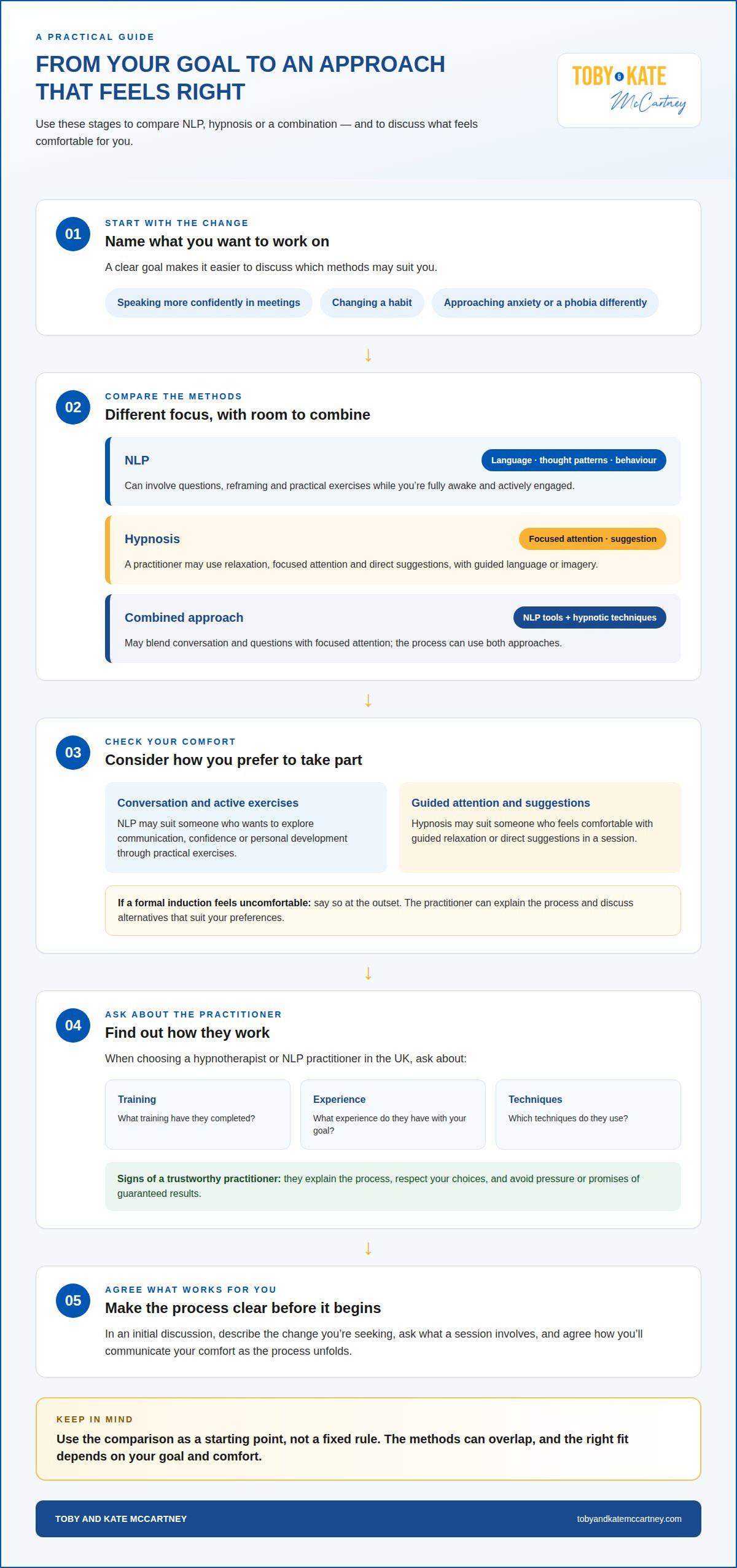
Start by naming the change you want. You might want to speak more confidently in meetings, change a habit, or approach anxiety or a phobia differently. A clear goal helps you discuss whether NLP, hypnosis or a combination of approaches may suit your needs.
Your comfort matters too. During hypnosis, you may be guided towards focused attention and respond to suggestions. NLP techniques can involve questions, reframing and practical exercises while you’re fully awake. If a formal induction feels uncomfortable, say so at the outset. The practitioner can explain the process and discuss alternatives that suit your preferences.
When choosing a hypnotherapist or NLP practitioner in the UK, ask about their training, experience with your goal and the techniques they use. A trustworthy practitioner explains the process, respects your choices and avoids pressure or promises of guaranteed results.
| Approach | Typical focus | May suit you if |
|---|---|---|
| NLP | Language, thought patterns and behaviour | You want to explore communication, confidence or personal development through active exercises. |
| Hypnosis | Focused attention and suggestion | You’re comfortable with guided relaxation or direct suggestions in a session. |
| Combined approach | NLP tools alongside hypnotic techniques | You want a flexible process that can include both conversation and focused attention. |
Use the table as a starting point, not a fixed rule. If you want to feel more confident when presenting, you might prefer NLP exercises that examine your self-talk, hypnosis with suggestions, or a combination. If you’re seeking help with anxiety or a phobia, describe your goal and ask how the practitioner works, including what happens if a technique feels uncomfortable.
Choose the approach whose methods make sense for your goal and feel acceptable to you. In an initial discussion, describe the change you’re seeking, ask what a session involves, and agree how you’ll communicate your comfort as the process unfolds.
NLP’s focus on conscious thoughts and behaviour
Neuro-Linguistic Programming, usually shortened to NLP, explores how language, thought patterns and behaviour relate. Its techniques can be used while you’re awake and actively engaged, without requiring a trance-like state. A practical starting point is to notice the words you use about a situation. “I always get this wrong” makes an experience sound fixed; examining that statement can reveal a pattern you may want to change.
Reframing is one way to explore that pattern. It changes the perspective or context attached to an experience, which may shift how you respond. For example, someone who sees a difficult conversation as proof they lack confidence could view it as a chance to practise a specific skill. The event stays the same, but its meaning and the choices available may change.
NLP’s Meta-Model uses targeted questions to clarify broad or incomplete statements. If you say, “Nobody listens to me”, a practitioner might ask who you mean or what happened in a particular conversation. The questions can make assumptions visible instead of treating them as established facts. Another technique, anchoring, links an emotional state with a physical trigger. Someone might practise recalling a calm, focused state while making a deliberate gesture, then use that cue in a relevant situation.
These methods involve paying active attention to language and responses. Before making a decision, for instance, you could identify the belief shaping your options, examine its evidence and consider a more useful perspective. NLP is also used in coaching and leadership, where communication patterns can influence how someone gives feedback or responds to a challenge.
For a speaking example, notice whether “I’m nervous” becomes “I’m preparing to contribute”, then identify one behaviour that supports your aim, such as pausing before answering. Building confident communication can involve this kind of focused attention to language and choices. NLP offers a framework for examining patterns, not a requirement to think positively or deny difficult experiences.
Differences between hypnosis and NLP
If you’re asking what the difference between NLP and hypnosis is, it comes down to their methods and structure. Both can support people working towards new behaviours or thought patterns, but neither suits every goal in the same way. Someone preparing for a challenging conversation, for example, might use either approach to explore a more confident response.
In a traditional hypnosis session, a practitioner may use relaxation, focused attention and direct suggestions. The client listens and responds to guided language or imagery. NLP may instead explore the language patterns and beliefs shaping a response. A practitioner could ask what someone means by “I can’t speak up”, then help them consider a different perspective or behaviour.
The distinction isn’t absolute. NLP techniques can include metaphor and indirect suggestion, and some NLP practitioners incorporate brief hypnotic inductions. NLP hypnosis combines NLP tools with conversational approaches to trance. A session may blend focused attention with questions or reframing instead of following only one method from start to finish.
Anchoring shows how NLP can apply a specific technique to change work. It links an emotional state with a physical trigger, which may later serve as a cue for that state. Hypnosis, by contrast, often centres more directly on suggestions delivered during focused attention. Not every practitioner follows the same process.
For clients, the practical difference lies in how they take part. Someone who prefers exploring beliefs through conversation may value NLP methods; someone comfortable receiving guided suggestions may prefer hypnosis. Practitioners can also combine methods, adapting the process to a person’s goal and responses. Understanding what the difference between NLP and hypnosis means in practice can help you decide which style feels more suitable.
What is hypnosis and how does it work?
According to the NHS, hypnosis involves focused attention, reduced awareness and an enhanced capacity to respond. It isn’t the same as falling asleep. During a session, a therapist may invite you to concentrate on particular ideas or images, aiming to influence perceptions, feelings, thoughts or behaviour.
A hypnosis session often begins with a spoken induction. A hypnotherapist might guide you through progressive relaxation, for example, asking you to notice your breathing and release tension. This can narrow your attention towards the therapist’s words. The practitioner may then offer suggestions linked to an agreed goal, such as responding more calmly before a presentation.
Suggestion and imagery are central tools. A therapist might ask you to picture entering a meeting, speaking clearly and managing a pause. The image gives your attention a specific focus; the suggestion offers a response to consider. Hypnosis doesn’t mean losing all awareness or control. You remain involved in the process and respond to the guidance.
There isn’t one universally accepted explanation for hypnosis. Some accounts emphasise increased suggestibility; others describe altered states of consciousness. These differences matter because hypnosis is a real experience, but its mechanism is understood through more than one theoretical framework. In practice, the process still centres on focused attention and suggestions tailored to the session’s purpose.
After offering suggestions, a practitioner may guide you back to ordinary attention and discuss what you noticed. You might reflect on whether imagining a presentation changed how you felt about it. This conversation can help shape the next step, rather than assuming every session follows a fixed script. Depending on the process, the approach may use direct suggestions, imagery or gradual relaxation.
If you want to build communication skills through structured learning, explore NLP training as a practical next step.
Toby and Kate McCartney
Toby and Kate McCartney offer practical NLP learning for personal and professional development. Their NLP Practitioner and NLP Master Practitioner certifications help you develop your understanding of NLP methods and communication. Public Speaking programmes may suit you if you want to communicate with greater confidence, while NLP Trainer Training is for those who want to develop their ability to teach NLP.
These programmes focus on learning and skill development, rather than hypnosis sessions. Consider which goal matters most to you: applying NLP techniques, strengthening your speaking or developing as a trainer. Defining your goal can help you choose a relevant next step without assuming NLP and hypnosis are interchangeable.
If you’d like to discuss your learning goals, contact Toby and Kate McCartney.
Take your next step with clarity
Understanding the difference between NLP and hypnosis gives you a useful starting point. Your next move can be smaller and more practical: identify the situation where you want to respond differently. You might want to contribute more clearly in a meeting, prepare for a presentation or build skills you can use at work. Decide whether you want to learn techniques for personal development, communicate more effectively or apply NLP to your professional growth. A defined outcome makes your next conversation more focused.
You don’t need to settle every question before exploring your options. A conversation can help you connect your goal with relevant learning and decide what kind of development feels right for you. If you’re interested in NLP learning or stronger communication, contact Toby and Kate McCartney to discuss a suitable next step. Let your goal guide you, and take the next step with confidence.
Frequently Asked Questions
What is the difference between hypnosis and NLP?
Hypnosis centres on guided attention and suggestion, while NLP uses a broader set of communication and behaviour-change techniques. That distinction can affect what you do during a session. A hypnotic exercise might guide you through imagining a calm response to a challenging moment; an NLP exercise might explore the words and assumptions shaping your current response.
Can NLP and hypnosis work together?
Yes. Depending on the goal and process, a practitioner may combine NLP tools with hypnotic methods. A session could begin by clarifying the language someone uses about a difficult situation, then use focused imagery to practise a different response. The approaches can complement each other, but the practitioner should explain how each technique supports the agreed aim.
Effectiveness and depth: which works better?
Neither approach is automatically better for every person or goal. Relevant factors include the person’s suitability, the quality of the working relationship, the technique used and whether changes continue beyond a session. For a specific aim, such as preparing for a difficult conversation, consider whether you prefer actively practising new responses or working with guided suggestions.
Why compare NLP hypnosis with classical hypnosis?
Comparing the approaches can clarify what a practitioner means by “hypnosis”. Classical hypnosis often follows a more formal structure, with an induction and direct suggestions. An NLP-informed hypnotic process may add conversational techniques or explore beliefs and perspectives. Knowing the distinction helps you understand what a session involves and whether its style fits your preferences.
What are the main differences between NLP and hypnosis?
The main difference is the breadth and structure of the methods. NLP can be used through conversation and exercises without a formal trance process. Hypnosis typically centres on focused attention and suggestion. For example, someone might use an NLP exercise to prepare for a negotiation, while a hypnosis session could use guided imagery to rehearse feeling composed beforehand.
What does the scientific evidence say about NLP and hypnosis?
Scientific evidence should be considered separately for each method and the outcome being assessed. A finding about hypnosis does not automatically establish the effectiveness of NLP or of combining the two. Useful questions include how a study defines the technique, who took part, what outcome it measured and whether the change lasted beyond the intervention.