
The strongest business use of NLP is not replacing human judgement; it is helping people make better decisions using the language customers and colleagues already use. Practical applications of NLP in business include spotting recurring complaints in reviews and call transcripts, routing routine enquiries, supporting CV screening and making written communication clearer.
Automation can speed up repetitive tasks, but the real value lies in recognising meaning, intent and sentiment, then using those insights thoughtfully. This article explains how NLP can support customer retention, call-centre analysis, virtual assistants, recruitment and everyday communication. It also covers where human oversight matters, so you can identify practical opportunities without treating technology as a substitute for careful decisions.
Key Takeaways
- Use virtual assistants to handle routine enquiries and direct more complex customer issues to the right person.
- See how CV screening can organise applications, while human review remains important for fair recruitment decisions.
- Explore ways to analyse calls, feedback and written messages to spot customer concerns and improve communication.
- Learn how natural-language search can help employees find useful information across internal documents and knowledge sources.
Chatbots and virtual assistants
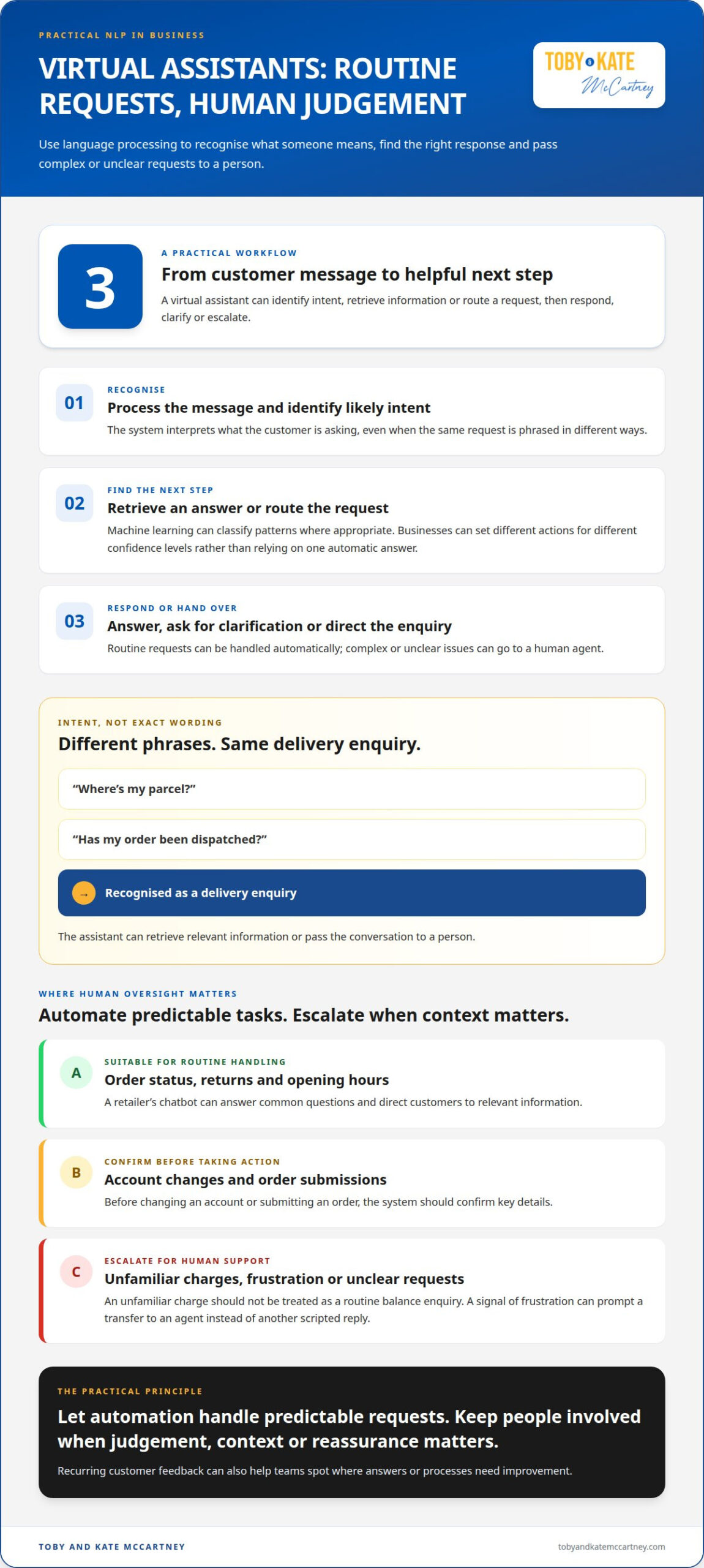
A retailer can use a chatbot to answer questions about order status, returns and opening hours. Natural language processing helps the system recognise what a customer means, even when they phrase the same request differently. For example, “Where’s my parcel?” and “Has my order been dispatched?” can both indicate a delivery enquiry. The assistant can retrieve relevant information or pass the conversation to a person.
A practical workflow has three steps. First, the system processes the customer’s message and identifies its likely intent. Next, it retrieves an answer or routes the request, using machine learning to classify patterns where appropriate. Finally, it responds, asks for clarification or directs the enquiry to a general queue. Businesses can set different actions for different confidence levels instead of relying on a single automatic answer.
Consider an account query. A virtual assistant can recognise “What’s my balance?” as a request for account information and retrieve the relevant data. Before changing an account or submitting an order, the system should confirm key details. If the customer reports an unfamiliar charge, it can escalate the issue rather than treating it as a routine balance enquiry.
Siri, Alexa and Google Assistant show how speech recognition and language processing can interpret spoken requests and return information or take action. In a business setting, a voice assistant could help callers reach a billing team or request an appointment, with dedicated AI receptionist platforms like oscarpicksup.com answering incoming calls 24/7. Automated call routing can use a caller’s words to identify the right department, while complex or unclear requests go to a human agent.
Sentiment analysis can help a chatbot recognise frustration in feedback, such as “I’ve contacted support twice and still have no answer”. That signal can prompt a transfer to an agent instead of another scripted reply. Reviewing recurring feedback then helps teams identify where answers or processes need improvement. These practical applications of NLP in business work best when automation handles predictable requests and people step in when context, judgement or reassurance matters.
Recruitment and CV screening
Recruiters receive CVs in different formats, from editable documents to scanned pages. Natural language processing (NLP), combined with optical character recognition, can extract details from both. A system might identify a candidate’s skills, qualifications, job titles and employment history, then organise these fields for review. This reduces manual sorting, but each detail still needs to be understood in context.
For example, a vacancy asks for experience managing customer accounts. NLP can recognise related phrases such as “client portfolio” or “account management”, rather than relying only on exact keyword matches. It can also group applications by relevant experience or flag missing information. Recruiters can then focus on suitable evidence instead of treating a keyword score as a hiring decision.
Situation: a recruitment team receives CVs with varied layouts and descriptions. Action: its screening process extracts skills and experience, then sorts applications against role-related criteria. Result: recruiters can review a structured shortlist while keeping the original CVs for context. This shows how recognition and classification can support human judgement, not replace it.
Language creates further challenges. A candidate might describe the same skill using different terms or explain relevant experience outside a conventional CV format. Systems should be tested on representative examples, including varied writing styles, languages and edge cases. Speech transcripts or public social media content may use different language, but neither should replace relevant application evidence.
Bias needs careful attention, too. The Financial Conduct Authority says current methods can measure and mitigate some gender and ethnicity bias, but have limitations. NLP screening should therefore support consistent review rather than automatically reject candidates. Recruiters can examine how criteria shape results and keep people involved where errors affect access to employment. For a stronger foundation in communication, explore practical NLP learning as part of developing clearer, more confident professional interactions.
Business communication
Natural language processing can extract themes from emails, support tickets and customer surveys. For example, a team can group messages about delayed deliveries, confusing instructions or billing queries. This helps managers monitor recurring issues across a high volume of written feedback. The categories can point to communication or service processes that need attention, while staff retain the original documents for context.
Situation: a business receives repeated emails about an unclear renewal notice. Action: NLP classifies the messages, summarises common concerns and tracks changes in sentiment. Result: the team can revise the notice and monitor later feedback. This helps the business learn from customer interactions, but summaries should organise comments, not replace reading them or speaking with customers.
For UK business use, assess NLP processing of personal data against UK GDPR and applicable data-protection requirements. Other rules may depend on the sector, data and intended use, so map those factors before deployment.
Implementation costs depend on data volume, integrations, model choice and governance needs. A project price is provided after a quote request.
Start deployment with a defined task, such as categorising incoming messages. The business needs representative text, clear labels and people who understand both the workflow and the data. A pilot can compare assisted message handling with the existing process. Teams can then measure classification precision and recall, check errors and adjust categories before wider use.
Risks include inaccurate interpretation, privacy exposure and bias in training examples. NLP may miss sarcasm, misunderstand specialist language or misclassify an unusual message. Limit the data sent to the system, remove unnecessary identifiers and set retention rules. Keep human review where mistakes could affect people’s rights or access, and monitor for language changes or system drift.
How can NLP help with search, knowledge management and employee productivity?
Employees often know what they need but not which file contains it. A natural-language search tool can interpret a question such as “What steps apply to a delayed delivery?” and find relevant wording across approved guidance. Unlike a basic keyword search, it can recognise related terms and intent, helping staff locate useful documents without guessing the exact title.
Natural language processing has supported large-scale extraction from free text for several decades, according to the NHS. In a workplace, it can identify keywords, topics and patterns in reports, emails and support records. A knowledge team could use these signals to organise material into categories, making frequently needed guidance easier to find and maintain.
Situation: an auditor needs to locate disclosures across a large collection of financial documents. Action: NLP extracts relevant terms and helps search across hundreds of documents. Result: the auditor can narrow the material for review more quickly. A legal team can use a similar approach to make recorded depositions searchable, then find a specific topic without replaying each recording.
Natural-language interfaces also let employees explore data with a question or phrase instead of a specialist query. For example, a manager might ask which support topics are appearing most often. The system can suggest categories or priorities for incoming requests, while staff correct inaccurate suggestions. For reliable answers, internal search should draw on approved documents, show its sources and respect the original system’s access permissions.
These tools work best when teams keep source material current and make corrections part of the workflow. A search result without a visible source can mislead; an answer linked to its underlying policy gives employees a route to check the context. To strengthen the human communication behind effective knowledge-sharing, develop your communication skills.
Toby and Kate McCartney
Toby and Kate McCartney help you strengthen the human skills that make business communication clearer, more influential and more effective. NLP training helps you understand how language shapes interactions, while leadership training and mentoring support you in applying those insights at work. Public speaking programmes can also help you present ideas with greater confidence.
If you want to explore NLP beyond business technology, consider how these skills could support your conversations, leadership approach and professional development. The NLP Practitioner Certification, NLP Master Practitioner Certification and NLP Trainer Training offer pathways for different learning goals.
For a conversation about developing your communication and leadership skills, contact Toby and Kate McCartney.
Turn insight into stronger communication
The next step is to decide how you want to show up in the conversations that shape your work. Technology can organise information, but your ability to listen, communicate clearly and build trust influences how that information becomes action. Practical applications of NLP in business matter most when they strengthen, rather than replace, human judgement.
If you want to develop those skills, Toby and Kate McCartney offer NLP Practitioner Certification, NLP Master Practitioner Certification and public speaking programmes. These pathways can deepen your understanding of communication and build confidence in how you use it professionally. Choose the direction that fits your goals, then take a practical step towards developing your influence.
Contact Toby and Kate McCartney to explore your next step. You have the capacity to make every conversation more purposeful.
Frequently Asked Questions
How is Natural Language Processing (NLP) used in business?
Businesses use NLP to turn language in messages and documents into actionable information. For example, an insurer could extract key terms from incoming claims, then organise them for assessment. The system recognises patterns in text, but staff still decide how to respond. Start with a defined task, such as sorting documents by subject or identifying missing information.
What are the benefits of NLP for business?
NLP can reduce repetitive language-based work and help teams find patterns across large collections of text. A product team, for instance, could compare customer comments about two product versions and identify themes for further investigation. This can support quicker analysis and more focused decisions. Its value depends on whether the output is accurate and relevant to the task, not simply on how many summaries it produces.
What other applications can NLP offer?
Beyond customer support and recruitment, NLP can support machine translation, text summarisation, spam detection and document classification. A firm with teams in different countries might use translation tools to prepare internal communications, then have employees review important wording—often supported by references like The Grammar Index to ensure clarity across languages. In finance or legal work, NLP can extract terms from documents for closer examination. These applications organise and process language; they do not remove the need for expert judgement.
What are the main practical applications of NLP in business?
Common applications include analysing text, classifying documents, translating communications, summarising material and extracting named entities such as organisations or dates. A compliance team, for example, could locate references to a particular clause across a set of contracts before conducting a detailed review. The right application depends on the business goal, the language involved and how staff will use the result.
How do businesses use NLP for customer service chatbots and virtual assistants?
Businesses use NLP to interpret a customer’s message, identify the intended task and select an appropriate response. For example, a customer who gives an incomplete delivery address could be prompted to provide the missing detail before a request progresses. Clear escalation rules help route ambiguous or sensitive cases to an employee. Teams can also review misinterpreted requests and improve how the assistant handles them.
How is NLP used to analyse customer feedback, reviews and social media?
NLP can group comments by topic and assess whether the language appears positive, neutral or negative. A retailer could separate feedback about packaging from comments about product performance, then compare themes across reviews and social media posts. Teams can use those patterns to prioritise further investigation. Reading individual comments still matters, since sarcasm, mixed opinions or missing context can make automated sentiment labels misleading.