
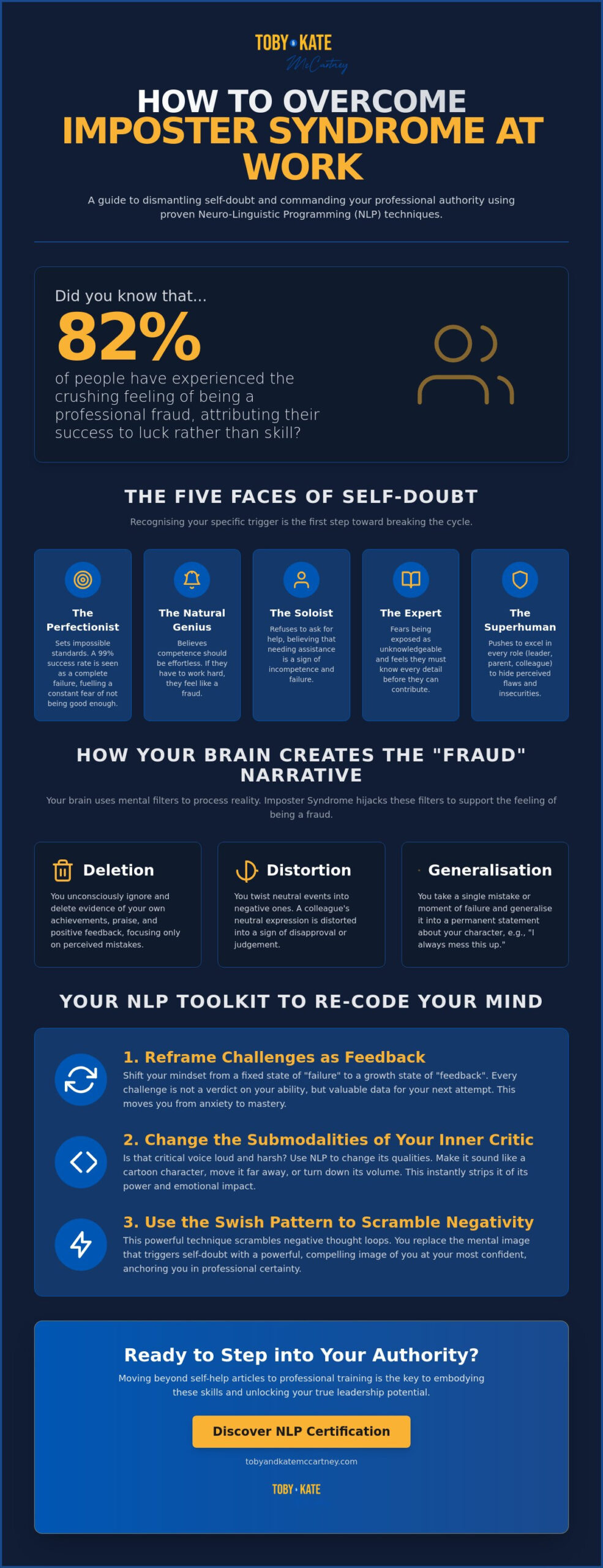
Did you know that 82% of people have experienced the crushing weight of feeling like a professional fraud? Despite your accolades and hard-won achievements, that persistent internal voice suggests you’re just one meeting away from being “found out”. Learning how to overcome imposter syndrome at work isn’t merely about positive thinking. It’s about re-coding the very architecture of your professional identity. You’ve likely attributed your greatest successes to mere luck whilst burning out from over-preparing to mask a perceived inadequacy. It’s an exhausting cycle that keeps even the most brilliant leaders playing small.
You deserve to own your space with unshakeable self-belief. I’m going to show you how to dismantle those linguistic patterns of self-doubt and replace them with absolute professional authority using proven NLP techniques. We’ll explore the specific “secret weapon” strategies that allow you to command any room with certainty. This is your journey towards a sustainable path to leadership, free from the heavy burden of self-doubt. Let’s begin the process of unlocking your true potential and mastering the internal dialogue that defines your success.
Key Takeaways
- Understand why high achievement often triggers deeper self-doubt and how to break the “Success-Anxiety Paradox” for good.
- Discover how to overcome imposter syndrome at work by re-programming the internal dialogue and mental imagery that fuel your feelings of inadequacy.
- Master the art of reframing every professional challenge as feedback rather than failure, shifting from a fixed mindset to one of absolute mastery.
- Learn immediate, practical NLP techniques like the Swish Pattern to scramble negative thought loops and anchor yourself in professional certainty.
- Recognise the transformative power of moving beyond self-help articles to truly embody these skills through professional NLP certification.
What is Imposter Syndrome and Why Does it Target High-Achievers?
You’ve climbed the corporate ladder, secured the promotions, and delivered the results. Yet, sitting in the boardroom, a cold realisation hits: you’re convinced you don’t belong. This is the core of What is Imposter Syndrome?; a persistent inability to internalise your own successes despite objective evidence of your competence. It’s a psychological pattern where you credit your achievements to luck, timing, or charming others, rather than your own skill. High-achievers are particularly susceptible because of the “Success-Anxiety Paradox.” The higher you rise, the more there is to lose, and the more you feel like a fraud waiting for the mask to slip. Understanding this paradox is the first step in learning how to overcome imposter syndrome at work.
Rather than a sign of weakness, this internal conflict often signals immense potential. You wouldn’t feel like an imposter if you weren’t constantly pushing into new, challenging territories. However, left unchecked, it manifests as self-sabotage, chronic over-working to “compensate” for perceived flaws, and a refusal to own your expertise. It’s an exhausting way to lead, but it is a pattern that can be broken.
The Five Faces of Professional Self-Doubt
Self-doubt wears many masks. The Perfectionist sets impossible standards, viewing a 99% success rate as an absolute failure. The Natural Genius believes mastery should be effortless; if they have to work hard at a skill, they assume they’re a fake. The Soloist operates under the crushing fear that asking for help proves incompetence. We also see the Expert, who feels they must know every single fact before speaking, and the Superhuman, who pushes to excel in every role to hide their perceived flaws. Recognising these archetypes allows you to pinpoint your specific triggers.
The Impact on Workplace Performance in 2026
In 2026, where 62% of knowledge workers report these feelings according to data from Speakwise, the cost to business is staggering. It’s not just about personal discomfort. It’s about the “identity concealment” that happens in high-stakes leadership roles. When you’re busy hiding your perceived inadequacies, you stop taking the bold risks required for true innovation. Traditional management training often fails here because it focuses on external skills whilst ignoring the internal neurological patterns. Mastering how to overcome imposter syndrome at work requires a deeper shift in how you process your own value and authority.
The NLP Perspective: How Your Internal Dialogue Creates the “Fraud” Narrative
Neuro-Linguistic Programming is the study of your subjective experience. It’s the manual for your mind that you were never given. It reveals how you construct your reality through “Internal Representations”, which are the mental pictures, sounds, and feelings you generate. If you want to know how to overcome imposter syndrome at work, you must first understand that your “fraud” narrative is a carefully constructed, albeit unconscious, mental production. You aren’t actually a fraud; you’re simply running a highly efficient “fraud” programme in your head.
Your brain processes millions of bits of data every second. To survive, it uses three primary filters: Deletion, Distortion, and Generalisation. When you’re trapped in an imposter cycle, you delete your achievements. You distort a colleague’s neutral expression into a sign of disapproval. You generalise a single mistake into a permanent character flaw. This isn’t reality. It’s a filtered version of it that keeps you small whilst ignoring the evidence of your brilliance. By mastering how to overcome imposter syndrome at work, you learn to interrupt these filters and see your value clearly.
Decoding Your Inner Critic
Is your inner critic a booming voice or a heavy feeling in your chest? In NLP, we look at sub-modalities. These are the fine details of your internal representations. If that critical voice is loud, harsh, and coming from right behind your ear, it has immense power. NLP re-codes these internal signals by changing their qualities, such as moving the voice further away or making it sound like a cartoon character, providing immediate relief.
The Power of Belief Filters
Beliefs act as selective filters. If you believe “I am a fraud,” your brain will hunt for evidence to support it whilst ignoring everything else. This creates a massive gap between “knowing” you have the qualifications and “feeling” like you belong in the room. You can audit these filters through executive coaching and mentoring to ensure your mental maps align with your actual professional excellence.
Your language shapes your reality. When you describe a success as “just being lucky,” you’re telling your neurology that you aren’t responsible for your results. By mastering these linguistic structures, you can reclaim your authority. If you’re ready to move beyond managing symptoms, exploring an NLP Practitioner Certification can provide the tools to re-programme these loops permanently.
Reframing Failure and Success: Moving from Anxiety to Mastery
One of the most liberating principles in Neuro-Linguistic Programming is the presupposition: “There is no failure, only feedback.” For anyone struggling with how to overcome imposter syndrome at work, this is a total game-changer. When you view every outcome as data rather than a verdict on your character, the fear of being “found out” loses its grip. You stop seeing a missed deadline or a difficult meeting as proof of your inadequacy. Instead, you see it as a signal to adjust your strategy. This shift turns a threatening environment into a laboratory for professional growth.
Leaders who command rooms with certainty operate from a “Mastery Mindset” rather than a “Fixed Mindset.” An imposter believes their intelligence and skill are static, leading to a constant need to prove themselves. A master knows that capability is fluid and developed through iteration. To step into your authority, you must decouple your self-worth from your latest project outcome. You are the director of your results, not the results themselves. By maintaining this healthy distance, you gain the emotional clarity needed to lead with impact.
High-achievers often fall into the trap of moving the goalposts the moment they succeed. You hit a target and immediately focus on the next challenge, never pausing to internalise the win. In NLP, we emphasise the importance of “celebrating the win” to neurologically anchor success. If you don’t consciously acknowledge your achievements, your brain never stores the evidence of your competence. You must train your neurology to recognise your excellence as a permanent trait rather than a series of lucky flukes.
The Linguistic Shift: From “But” to “And”
The word “but” acts as a linguistic eraser. When you say, “I led a great presentation, but I missed one question,” you’ve effectively deleted the success. Your brain only focuses on the perceived flaw. Start using “and” to integrate complexity without diminishing your value. “I led a great presentation, and I’ve identified a specific area to research further for next time.” This simple swap preserves your authority whilst allowing for continuous improvement. Practice this in your emails and meetings to start shifting your internal map of reality.
Visualising the Future Self
The “As If” frame is a powerful tool for rapid state change. Imagine stepping into the shoes of your most confident future self. How do they stand? How do they breathe? By acting “as if” you already possess absolute professional certainty, you create a neurological blueprint for that behaviour to become real. This technique is a cornerstone of public speaking for leaders, where reframing nervous energy into presence allows you to command any audience. You can also create a “Resource Anchor”—a physical trigger that instantly recalls a state of peak confidence—to use whenever you feel the weight of self-doubt creeping back in.
Practical NLP Techniques to Overcome Imposter Syndrome Today
Theory alone won’t change your state. To truly master how to overcome imposter syndrome at work, you must move from intellectual understanding to neurological application. These five steps provide a high-level “secret weapon” to dismantle the fraud narrative in real-time. We’re moving beyond simple tips and into the realm of mental mastery.
- Step 1: Identify the Trigger. Pinpoint the exact moment the doubt creeps in. Is it a specific tone of voice from a director? The sight of a calendar invite? Recognising the cue allows you to interrupt the loop before it gains momentum.
- Step 2: Scramble the Pattern. Use the “Swish Pattern”. Visualise the “fraud” image as dull and small, then create a “mastery” image that is bright and bold. Mentally “swish” them so the certain version of you replaces the doubt instantly.
- Step 3: Anchor a Resource State. Recall a time you felt absolute certainty. As that feeling peaks, press your thumb and forefinger together. You’re creating a physical trigger to recall that power on demand during any high-pressure situation.
- Step 4: Future Pace. Mentally rehearse your next high-stakes meeting whilst firing your anchor. See yourself commanding the room with ease. This prepares your neurology for success before you even step through the door.
- Step 5: Audit Your Language. Eliminate weak qualifiers. Replace “I think I might be able to” with “I am” and “I will”. Your external vocabulary dictates your internal professional reality.
The “Circle of Excellence” Technique
Imagine a circle of brilliant light on the floor in front of you. This is your mental space of absolute capability. Step into it and feel your posture change, your breathing deepen, and your focus sharpen. This technique works faster than traditional CBT-based approaches because it bypasses the “why” and goes straight to the “how” of your neurological state. Use this before any presentation to ensure you’re operating from peak performance. If you want to deepen this mastery, consider our NLP Practitioner Certification to gain full control over your mental state.
Perceptual Positioning
Break the emotional loop of self-criticism by shifting your perspective. View your performance from the “third position” of a neutral observer. What would a mentor say about your achievements? By gaining objective distance, you decouple your identity from the performance. You’ll see that the “fraud” is a fabrication, whilst your results are tangible and real. This mastery over your internal focus is the definitive way to secure your path to leadership and permanent professional certainty.
Stepping into Your Authority through Professional NLP Training
Reading about techniques is a vital first step, but it’s only the beginning of your transformation. To truly master how to overcome imposter syndrome at work, you must move beyond intellectual curiosity and into the realm of embodiment. There’s a massive difference between knowing about a technique and being able to fire a resource anchor whilst standing in a high-stakes boardroom. You don’t just want to “manage” your doubt; you want to delete the neurological programme that creates it entirely. This requires immersive, professional training that shifts your identity at a fundamental level.
Toby and Kate McCartney act as the catalysts for this profound professional shift. We don’t just teach you the “what”; we show you the “how” of human excellence. By working with experts who have already navigated the elite levels of corporate influence, you gain access to a high-level “secret weapon” that most of your peers will never discover. Professional certification provides the tangible, evidence-based proof your internal “imposter” needs to finally fall silent. It replaces the “luck” narrative with a deep, grounded certainty in your own mastery.
The NLP Practitioner Pathway
Choosing an NLP practitioner certification UK provides you with a comprehensive toolkit for life. This journey takes you from “overcoming” a problem to “mastering” a skill set that defines elite leadership. In the 2026 corporate landscape, where 45% of employees avoid promotions due to self-doubt, the ROI of professional confidence is immeasurable. You aren’t just attending a course; you’re investing in a permanent state of authority. You’ll learn to organise your thoughts, influence others, and maintain peak performance regardless of the external pressure.
Your Journey to Elite Performance
Your path to mastery is supported by customised mentoring and the power of learning amongst a community of like-minded achievers. There is immense strength in being surrounded by people who refuse to settle for “good enough”. We provide the structure and the strategy required to eliminate the “fraud” narrative permanently. It’s time to stop playing small and start commanding the room with the certainty you’ve already earned. Step into the version of yourself that is ready to lead without apology. Your journey to absolute professional certainty begins here.
Master Your Professional Reality
You now possess the blueprint to dismantle the “fraud” narrative for good. By understanding the linguistic filters that have kept you small, you can begin to re-code your subjective experience for absolute certainty. Mastery isn’t about the absence of challenge. It’s about having the neurological tools to handle any room with poise. Learning how to overcome imposter syndrome at work is a journey from anxiety to authority, and you’ve already taken the first step by recognising your inherent value.
Toby and Kate McCartney have spent decades perfecting the art of human influence since 2003, helping elite leaders across the UK achieve measurable success through transformative NLP techniques. You’ve earned your seat at the table. It’s time to feel like you belong there. Master your mindset and eliminate self-doubt with our NLP Practitioner Certification. Your path to unshakeable professional certainty is ready for you to take it. Step into your power and lead with conviction.
Frequently Asked Questions
Is imposter syndrome a mental health condition?
No, imposter syndrome is not a clinical mental health diagnosis. It’s a psychological pattern where individuals doubt their skills and talents despite evidence of their success. Whilst it can cause significant anxiety, it’s best understood as an internalised struggle with self-worth rather than a medical condition. Recognising it as a neurological loop is the first step towards mastering your professional state.
Can NLP really stop me from feeling like a fraud instantly?
Yes, NLP techniques can provide immediate relief by interrupting the neurological triggers of self-doubt. By changing the sub-modalities of your internal dialogue, such as the volume or location of your inner critic’s voice, you can shift your emotional state in seconds. This rapid intervention is a cornerstone of how to overcome imposter syndrome at work and reclaim your authority in high-pressure moments.
How do I know if I have imposter syndrome or if I am actually underqualified?
The distinction lies in the objective evidence. If you have the qualifications, positive performance reviews, and a track record of results, yet you still feel like a fake, you’re experiencing imposter syndrome. If you truly lack the skills required for a role, that’s a simple training gap. Imposter syndrome is specifically the inability to internalise success that you’ve already achieved.
Why do successful women often experience imposter syndrome more acutely?
Societal expectations and systemic biases often make it more challenging for women to own their professional excellence. According to data from Speakwise in April 2026, 75% of female executives have experienced imposter syndrome in their careers. This heightened prevalence is often linked to the “Success-Anxiety Paradox,” where higher levels of achievement trigger a greater fear of being “found out” in traditionally male-dominated environments.
Can I use NLP techniques on my own or do I need a coach?
You can certainly use foundational techniques like anchoring and basic reframing on your own. Many professionals find immediate value in practicing the “Circle of Excellence” before meetings. However, for a permanent shift in your professional identity, working with a master-level coach or attending a certification programme provides the elite-level feedback required to re-programme deep-seated belief filters.
What is the first thing I should do when I feel like an imposter during a meeting?
Fire your resource anchor and change your physiology immediately. Sit up straight, broaden your shoulders, and take a deep, controlled breath to interrupt the neurological “fraud” loop. By physically shifting your state, you tell your brain that you’re in a position of power. This simple action allows you to stay present and command the room whilst the feeling of doubt dissipates.
How long does it take to see results with NLP for imposter syndrome?
State changes are often instantaneous. You can feel more confident and certain within minutes of applying a technique like the Swish Pattern. For long-term transformation, consistent practice over several weeks allows your neurology to form new, empowering habits. This creates a sustainable path to leadership where how to overcome imposter syndrome at work becomes a natural, unconscious competence.
Is imposter syndrome common amongst CEOs and senior leaders?
It’s incredibly common at the highest levels of leadership. A 2021 KPMG study found that 82% of people have experienced imposter syndrome. Senior leaders often feel the weight of responsibility more acutely, which can fuel the internal narrative of being a fraud. Reaching the C-suite doesn’t automatically silence the inner critic; it requires a conscious strategy to master your internal representations.