
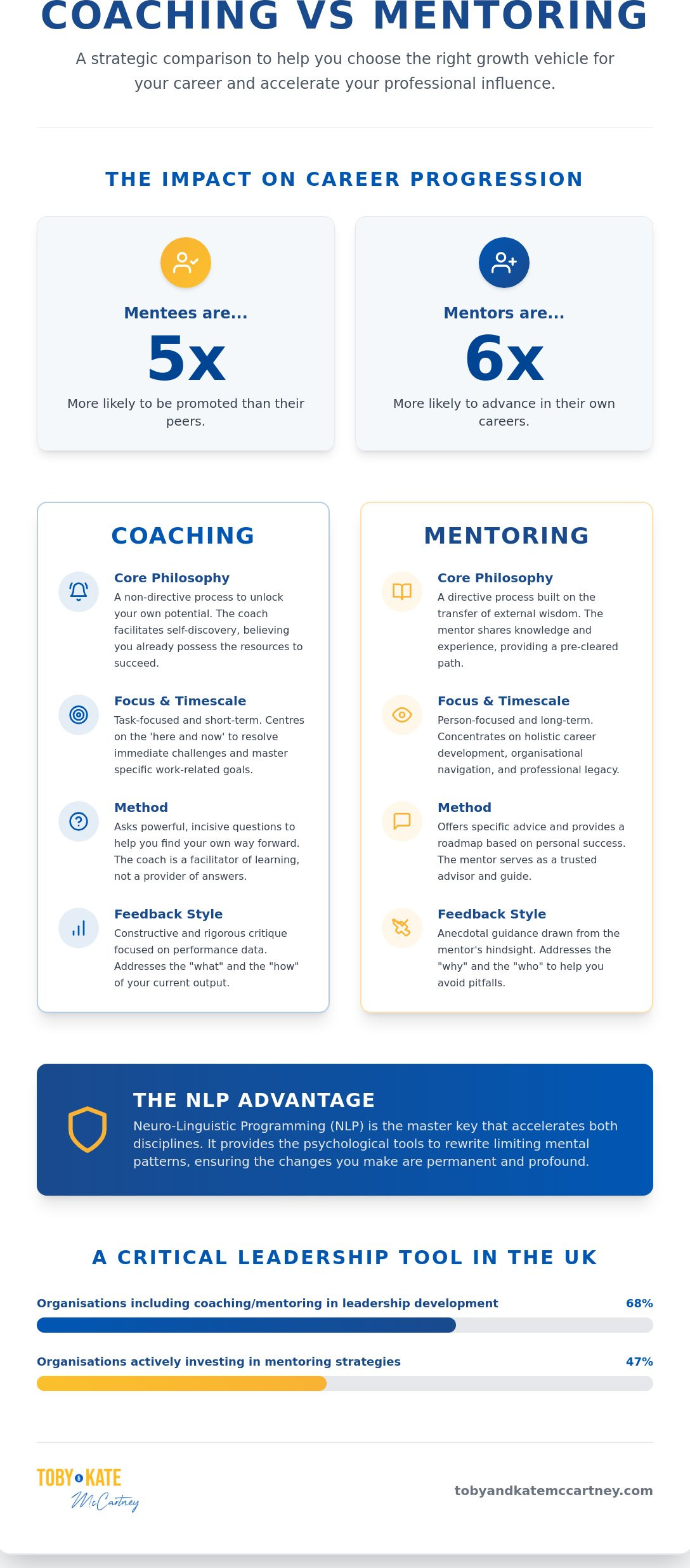
If you knew that mentees are five times more likely to be promoted than their peers, whilst mentors themselves are six times more likely to advance, would you still be sitting on the fence? You’re likely feeling the weight of untapped potential, caught in the confusion of choosing between coaching vs mentoring without knowing which one actually moves the needle for your career. It’s frustrating to feel your growth has stalled; it’s even worse to fear investing in a “talk-only” solution that lacks measurable results.
Discover the critical distinctions between these two disciplines and identify the precise developmental pathway to accelerate your professional influence. You’ll gain a clear decision-making framework and the immediate confidence to invest in your future with certainty. We’ll explore how to integrate elite-level mastery techniques and NLP-driven strategies to ensure your professional trajectory remains unchallenged in 2026.
Key Takeaways
- Understand the fundamental difference between non-directive performance unlocking and experience-led guidance to select your ideal growth vehicle.
- Identify the core distinctions of coaching vs mentoring to decide if you need immediate task-based results or a holistic, person-centred career strategy.
- Adopt a strategic framework that evaluates your entry state, ensuring you invest in the pathway that offers the highest return on your professional influence.
- Learn why NLP is the master key that bridges the gap between these disciplines, providing the psychological tools required for permanent behavioural change.
- Discover how to audit your current leadership needs against the mastery matrix to select a developmental partner who delivers measurable excellence.
Defining the Disciplines: What is Coaching vs Mentoring?
Your choice between coaching vs mentoring isn’t just a matter of semantics; it’s a strategic decision that dictates the speed of your professional evolution. As we move through 2026, the demand for high-level guidance has never been greater. Yet, many leaders still conflate these two distinct pathways. To master your field, you must first understand the fundamental shift in energy between them. One focuses on your internal capacity, whilst the other provides an external roadmap.
Coaching is fundamentally a non-directive process designed to unlock your potential. It operates on the belief that you already possess the resources required to succeed; you simply need the right facilitation to access them. Mentorship, on the other hand, is built on the transfer of external wisdom. It is a relationship where a more experienced individual shares their knowledge, skills, and hard-won experience to help you grow. It’s about following a path someone else has already cleared.
The distinction matters because your time is your most valuable asset. If you are looking for a blueprint, you need a mentor. If you are looking to sharpen your own internal operating system; you need a coach. In a professional landscape where 68% of UK organisations now include these disciplines in their leadership development, knowing which lever to pull is the difference between stagnation and mastery.
The Core Philosophy of Coaching
Coaching centres on the ‘here and now’. It doesn’t dwell on past mistakes or get lost in vague future fantasies. Instead, it focuses on specific work-related goals and performance metrics that you can measure today. Your coach acts as a facilitator of learning, not a provider of answers. They use powerful, incisive questioning to help you find your own way forward. This approach builds self-reliance and ensures that when the session ends, the breakthrough belongs entirely to you. It’s about maximising performance through self-discovery.
The Wisdom of Mentoring
A mentor serves as a trusted advisor who provides a roadmap based on their personal success. They help you navigate organisational culture and provide ‘tacit knowledge’; these are the subtle nuances of leadership and networking that can’t be found in textbooks or online courses. It is a person-focused journey that looks at the holistic development of your career over the long term. Because a mentor has walked your path, they can offer specific advice on career longevity and influence. In 2026, where 47% of UK organisations are actively investing in these strategies, choosing the right path is essential for your professional influence. Understanding the nuance of coaching vs mentoring is your first step toward elite-level mastery.
The Mechanics of Growth: Task vs. Person-Centred Development
The role of feedback varies significantly between these two paths. In a coaching relationship, you’ll receive constructive, often rigorous critique focused on performance data. It’s about the “what” and the “how” of your current output. Mentoring offers anecdotal guidance. It’s about the “why” and the “who”, drawing on the mentor’s hindsight to help you avoid the pitfalls they’ve already encountered. This distinction is one of the key differences between coaching and mentoring that determines how quickly you can pivot in a fast-paced market.
Neuro-Linguistic Programming (NLP) serves as the master key that accelerates both. By addressing the underlying mental “programmes” that drive your behaviour, NLP ensures that the changes you make aren’t just temporary fixes. Whether you’re being coached or mentored, understanding how your mind processes information allows you to rewrite limiting patterns and step into a more capable version of yourself. If you’re seeking this level of transformation, our leadership training provides the framework to start your journey.
Coaching for Elite Performance
Elite leaders use coaching to master high-stakes skills like public speaking for leaders. It’s about the “inner game”. Through targeted questioning, a coach helps you dismantle the self-limiting beliefs that hold you back from commanding the room. Whilst coaching is results-oriented, tracking your ROI is straightforward. You measure success through tangible outcomes: clearer communication, faster decision-making, and measurable improvements in team performance metrics.
Mentoring for Strategic Influence
Mentoring is your secret weapon for building a “favourite” professional reputation amongst your peers. It’s less about the task and more about the politics of high-level leadership. A mentor helps you navigate the subtle nuances of organisational culture that aren’t written in any handbook. Through mentored networking, you gain access to circles that would otherwise remain closed. It’s a tool for long-term legacy building, ensuring your influence extends far beyond your current role.
Comparison Framework: Which Pathway Accelerates Your Success?
Choosing between coaching vs mentoring isn’t just about selecting a service; it’s about defining the speed of your professional evolution. To make the right call, you must first identify your “Entry State”. Are you currently solving a specific, immediate problem, or are you seeking a long-term vision for your career? This distinction is the foundation of your developmental ROI.
Think of the expertise gap in terms of a mirror versus a map. A coach acts as a high-definition mirror. They reflect your behaviours, blind spots, and internal narratives back to you, allowing you to self-correct and innovate from within. A mentor, however, provides a map. They’ve already traversed the terrain you’re entering and can point out the shortcuts and pitfalls. If you need to master the “how” of your own performance, you need the mirror. If you need the “where” of your industry, you need the map.
Timescale is your second filter. Coaching typically targets immediate skill acquisition and performance breakthroughs. It’s built for the high-achiever who needs to see results by the next quarterly review. Mentoring is a slower burn, often spanning years or even decades. It’s focused on legacy, networking, and navigating the complex social architecture of elite leadership. Your choice here determines whether you’re sprint-training or preparing for a marathon.
Choose Coaching When…
- You need to master a specific, high-impact behaviour, such as advanced communication skills, to influence stakeholders more effectively.
- You’re transitioning into a new role and need to rapidly define your own unique leadership style rather than imitating someone else’s.
- Your professional performance has plateaued. You need a catalyst to break through the mental glass ceiling that’s keeping you at your current level.
Choose Mentoring When…
- You’re entering a new industry or high-level circle where “who you know” is just as vital as “what you know”.
- You want to model the specific success of a master who has already achieved the exact goals you’ve set for yourself.
- You need a trusted sounding board for long-term strategic decisions that will affect your career trajectory over the next five to ten years.
The NLP Advantage: Bridging the Gap for Elite Leaders
Many professionals invest heavily in development only to find themselves reverting to old habits within weeks. This occurs because traditional coaching vs mentoring frameworks often address the surface level of behaviour whilst ignoring the neurological architecture beneath. To achieve permanent shifts, you need more than just advice or accountability; you need a way to rewrite the subconscious programmes that dictate your responses under pressure. Without this psychological foundation, even the best strategic advice remains temporary.
Neuro-Linguistic Programming (NLP) acts as the essential operating system for elite performance. It provides the tools to bridge the gap between knowing what to do and actually doing it. When an NLP Master Practitioner facilitates your growth, they don’t just help you set goals. They help you align your internal values and beliefs with those goals, ensuring your path to mastery is frictionless. It is the master key that makes every coaching session more incisive and every mentoring relationship more transformative.
Reprogramming for Results
Mentoring becomes far more potent when you understand the language of influence. By using NLP techniques, you can decode the specific mental strategies of a mentor and install those same thought patterns in your own mind. This is how you break the cycle of “shaking during presentations” or second-guessing your authority in the boardroom. You aren’t just learning to act like a leader; you are reprogramming your mindset to be one. Neuro-Linguistic Programming is the study of excellence in human behaviour.
The Hybrid Model: Executive Coaching and Mentoring
The most successful UK leaders refuse to choose between these pathways. They recognise that a rigid adherence to one discipline limits their potential. Instead, they embrace a hybrid model that combines tactical coaching with strategic mentorship, all underpinned by NLP. This is the McCartney “Empowering Master” approach. It balances professional authority with deep personal empowerment, creating a bespoke journey tailored to your unique identity. We help you move from seeking answers to becoming the person who has them. If you’re ready to step into this level of leadership, explore our NLP-driven mentorship services today and begin your journey toward mastery.
Taking the Lead: Your Next Steps Toward Mastery
The choice between coaching vs mentoring is no longer a theoretical debate; it’s the catalyst for your next professional breakthrough. You’ve explored the mechanics of growth and the psychological edge provided by NLP. Now, you must evaluate your current leadership needs against the matrix we’ve established. If you’re facing a specific performance plateau, you need the surgical precision of a coach. If you’re looking to navigate the complex social architecture of your industry over the next decade, you need the wisdom of a mentor. In 2026, the only guaranteed return on investment is the one you make in your own capacity for influence.
Preparing for your first session is just as vital as choosing the right path. To guarantee a measurable ROI, don’t just show up with a vague desire for “improvement”. Set a concrete agenda that identifies the specific behavioural shifts you want to achieve. Whether you’re refining your executive presence or dismantling a long-standing fear of public speaking, clarity is your greatest ally. When you partner with an expert who holds an NLP Practitioner Certification, you ensure that every conversation is geared toward permanent, neurological change rather than temporary motivation.
Finding Your Empowering Master
Your developmental partner must possess more than just a list of credentials. Look for integrity, a proven track record of success, and an energy that challenges you to step up. The chemistry of the relationship is non-negotiable; you need someone who speaks with the conviction of an authority whilst maintaining the empathy of a guide. Toby and Kate McCartney’s programmes are designed for those who refuse to settle for the status quo. We provide a high-energy environment where professional authority meets personal empowerment, ensuring you don’t just learn new skills but embody a new level of excellence.
Commit to the Journey
Breakthroughs don’t happen in the comfort zone. They happen when you move from curiosity to decisive action. Investing in yourself is the “secret weapon” that separates elite leaders from the rest of the pack. It’s time to stop wondering about your potential and start manifesting it through a structured, high-level developmental journey. Your path to mastery is waiting. Discover how Toby and Kate McCartney can transform your professional trajectory today.
Claim Your Path to Professional Mastery
Your professional evolution is too important to leave to chance. We’ve dissected the critical distinctions of coaching vs mentoring, showing you that whilst coaching sharpens your current performance, mentoring builds your long-term legacy. The real secret weapon is the integration of NLP. It ensures that your growth is hard-wired into your neurological architecture; this moves you beyond temporary fixes to permanent mastery.
Since 2003, we’ve acted as national UK experts in the psychology of influence, helping high-achievers secure measurable leadership success. As elite NLP Practitioner and Master Practitioner certification providers, we know that the right developmental partner is the catalyst for your next big shift. It’s time to stop wondering about your potential and start embodying it. You have the inherent value; we provide the flexible, multi-modal journey to unlock it.
Accelerate your growth with elite Executive Coaching and Mentoring
Step into the most capable version of yourself today. Your journey to excellence is just one decision away.
Frequently Asked Questions
What is the main difference between coaching and mentoring in a business context?
The primary difference between coaching vs mentoring lies in the specific focus and duration of the engagement. Coaching is a structured, task-oriented process designed to unlock your potential and improve performance in specific areas. Mentoring is a relationship-based journey where a more experienced individual shares their wisdom and networking power to guide your long-term career development. One provides the tools for immediate results, whilst the other offers a map for your future legacy.
Can the same person be both my coach and my mentor?
You can certainly work with a professional who adopts a hybrid approach to your development. This “Empowering Master” model allows you to benefit from tactical, skill-based coaching whilst also receiving the strategic advice and hindsight of a mentor. It is often the most efficient way to accelerate your growth because it addresses both your current performance gaps and your long-term professional trajectory simultaneously.
How do I know if I need an NLP coach or a traditional business mentor?
Choose an NLP coach if you need to dismantle self-limiting beliefs or resolve behavioural patterns that are stalling your progress. A traditional business mentor is more suitable when you need industry-specific networking or a roadmap for navigating complex corporate politics. If you want to change the “how” of your internal thinking, go with NLP; if you want to know the “who” of your industry, find a mentor.
Is mentoring better than coaching for long-term career progression?
Mentoring is specifically designed for long-term progression, but it is rarely enough on its own to reach elite levels of mastery. Whilst a mentor provides the map of the terrain, coaching provides the engine and the psychological skills required to drive through it. For sustained career success in 2026, the most effective UK leaders use both to ensure they are high-performing today whilst preparing for the challenges of tomorrow.
What are the typical costs of executive coaching and mentoring in the UK?
How long does a typical coaching or mentoring engagement last?
A typical coaching engagement usually lasts between three and six months to achieve specific, measurable performance goals. Mentoring relationships are often more fluid and can extend for a year or even longer as they focus on broader development and holistic career shifts. The duration should always be dictated by the complexity of the transformation you are seeking and the speed at which you want to achieve mastery.
What happens if the chemistry with my coach or mentor isn’t right?
If the chemistry isn’t right, you must address it immediately to protect your developmental investment. A successful relationship in this field requires deep trust and a shared sense of conviction. Without that alignment of energy and professional authority, you won’t achieve the psychological breakthroughs required for elite-level mastery. Professional practitioners will always prioritise your success and support a transition if the fit isn’t perfect.
Can coaching and mentoring help with fear of public speaking?
Coaching is exceptionally effective for overcoming the fear of public speaking, particularly when it integrates NLP techniques. By addressing the neurological triggers of anxiety, a coach helps you reset your mindset and build the physiological confidence to command any room. It moves you from a state of fear to a state of high-impact influence, ensuring your message is delivered with authority and clarity.