
What if everything you’ve been taught about leadership is missing the most critical ingredient: your own psychology? You can master every framework, attend every seminar, and still walk into a high-stakes boardroom feeling like an imposter. That’s the gap NLP for leadership development was built to close.
You already know that something needs to shift. The stress that creeps in before difficult conversations, the communication breakdowns with team members who simply don’t respond to your style, the quiet frustration of knowing you’re capable of more but not quite knowing how to access it. These aren’t character flaws. They’re patterns, and patterns can be reprogrammed.
This article will show you exactly how Neuro-Linguistic Programming transforms leadership from a title you hold into a psychological state you inhabit with unshakeable confidence. You’ll discover the core NLP techniques that elite leaders use to build instant rapport, communicate with precision, and make clear decisions under pressure. Whether you’re leading a small team or an entire organisation, what follows is a practical, psychology-backed pathway to a more influential, more effective version of you.
Key Takeaways
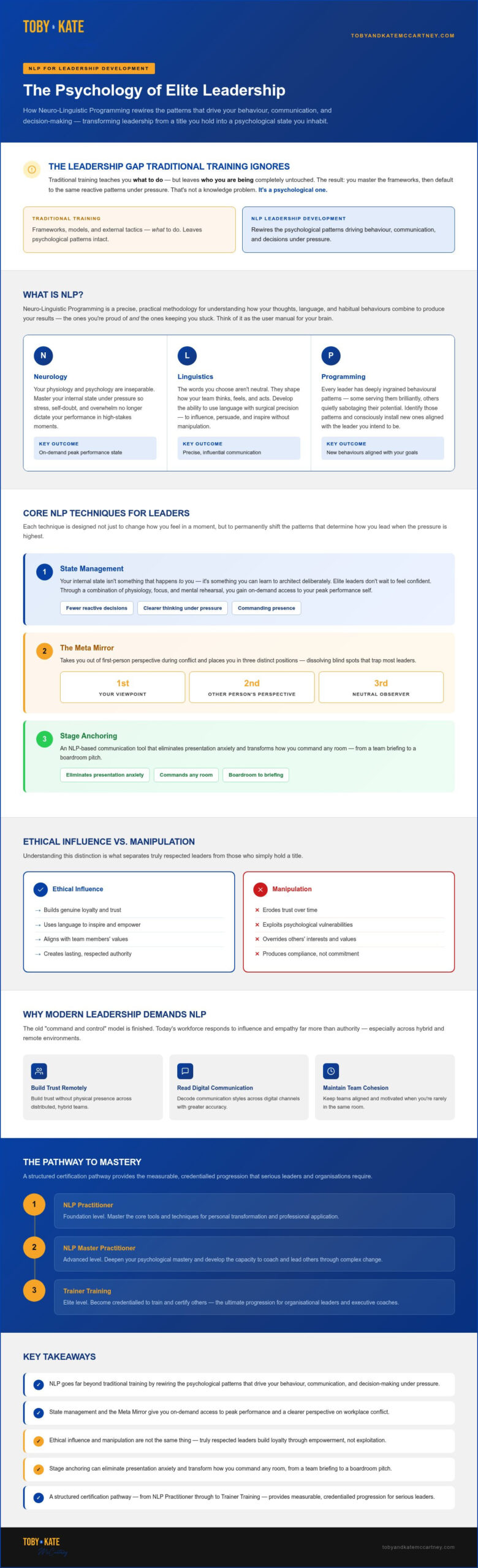
- NLP for leadership development goes far beyond traditional training by rewiring the psychological patterns that drive your behaviour, communication, and decision-making under pressure.
- Practical NLP techniques — including state management and the Meta Mirror — give you on-demand access to peak performance and a clearer perspective on workplace conflict.
- Ethical influence and manipulation are not the same thing; understanding the distinction is what separates truly respected leaders from those who simply hold a title.
- Stage anchoring and other NLP-based communication tools can eliminate presentation anxiety and transform how you command any room, from a team briefing to a boardroom pitch.
- A structured certification pathway — from NLP Practitioner through to Trainer Training — provides the measurable, credentialled progression that serious leaders and organisations require.
What is NLP for Leadership Development?
Think of your brain as the most sophisticated operating system ever created. Now imagine running it without a user manual. That’s what most leaders are doing every single day. Neuro-Linguistic Programming (NLP) is that manual: a precise, practical methodology for understanding how your thoughts, language, and habitual behaviours combine to produce your results, both the ones you’re proud of and the ones keeping you stuck.
Traditional leadership training is built on a fundamental flaw. It teaches you what to do whilst leaving who you are being completely untouched. You absorb the frameworks, practise the models, and return to work with the best of intentions, only to find yourself defaulting to the same reactive patterns under pressure. That’s not a knowledge problem. It’s a psychological one. And it’s precisely why nlp for leadership development exists as a distinct discipline rather than just another module in a management course.
The leaders who consistently inspire loyalty, navigate complexity with clarity, and command genuine respect aren’t simply more knowledgeable than their peers. They’ve achieved psychological mastery. They’ve become what we call the Empowered Leader: someone whose internal state is as deliberately cultivated as their strategic thinking. NLP is the secret weapon that elite UK executives use to get there.
The Three Pillars of NLP Leadership
NLP operates across three interconnected dimensions, each one essential to the whole:
- Neurology: Your physiology and your psychology are inseparable. This pillar gives you the tools to master your internal state under pressure, so that stress, self-doubt, and overwhelm no longer dictate your performance in high-stakes moments.
- Linguistics: The words you choose aren’t neutral. They shape how your team thinks, feels, and acts. This pillar develops your ability to use language with surgical precision, to influence, persuade, and inspire without manipulation.
- Programming: Every leader has deeply ingrained behavioural patterns, some serving them brilliantly, others quietly sabotaging their potential. This pillar is about identifying those patterns and consciously installing new ones that align with the leader you intend to be.
Why 2026 Demands a New Psychological Approach
The old “command and control” model is finished. Today’s workforce, distributed across hybrid environments and driven by purpose, responds to influence and empathy far more than authority. Managing a remote team requires a completely different psychological toolkit: the ability to build trust without physical presence, to read communication styles across digital channels, and to maintain team cohesion when you’re rarely in the same room.
NLP for leadership development addresses precisely these modern complexities. Put simply: it’s the mastery of your internal state to drive exceptional external results.
Core NLP Techniques to Organise Your Leadership Success
Tools without context are just tricks. What separates genuinely transformative nlp for leadership development from a list of clever techniques is understanding how each method connects to a specific leadership outcome. Every technique below is designed not just to change how you feel in a moment, but to permanently shift the patterns that determine how you lead, communicate, and perform when the pressure is highest.
State Management is where it begins. Your internal state isn’t something that happens to you; it’s something you can learn to architect deliberately. Elite leaders don’t wait to feel confident before a board presentation. They trigger it. Through a combination of physiology, focus, and mental rehearsal, state management gives you on-demand access to your peak performance self, regardless of what’s happening in the room around you. The business outcome? Fewer reactive decisions. Clearer thinking under pressure. A presence that your team can feel before you’ve said a word.
The Meta Mirror takes you out of the first-person perspective of a conflict and places you in three distinct positions: your own viewpoint, the other person’s, and that of a neutral observer. Most leaders get stuck in position one. They’re so invested in their own interpretation of a disagreement that they miss the dynamics driving it. The Meta Mirror dissolves that blind spot. It’s one of the most powerful tools for resolving team conflict quickly and without the emotional residue that poisons working relationships for months.
Anchoring works on a simple neurological principle: your nervous system links emotional states to specific stimuli. You’ve experienced this already, perhaps a particular song that instantly transports you back to a defining moment. Anchoring harnesses that mechanism intentionally. Before a high-stakes negotiation, a specific physical gesture or touch point fires a pre-installed state of calm authority. It’s not a placebo. It’s applied neuroscience.
Reframing is the technique that separates leaders who are energised by challenges from those who are drained by them. A reframe doesn’t deny a problem’s reality; it shifts the context around it to reveal the opportunity embedded within it. A failed product launch becomes market intelligence. A resistant team member becomes a signal that your communication approach needs refining. This isn’t positive thinking. It’s strategic perception.
Mastering Rapport and Sensory Acuity
Rapport is widely misunderstood. Most training reduces it to mirroring body language, which is surface-level at best and patronising at worst. Genuine rapport is a state of mutual trust that you create through precise sensory acuity: the ability to notice micro-shifts in tone, posture, and energy before they become explicit. Research into the psychology of influence in leadership consistently shows that warmth and trust must precede authority for influence to land. NLP gives you the tools to build that trust rapidly and authentically, even in difficult conversations where the stakes are high and the other person is guarded.
The Power of Modelling Excellence
Every exceptional leader you admire has a replicable structure behind their success. NLP modelling is the discipline of deconstructing that structure: identifying the specific beliefs, mental strategies, and behavioural sequences that produce outstanding results, then installing those patterns in yourself. It goes far beyond observation. It’s a systematic methodology for accelerating your own development by standing on the shoulders of those who’ve already mastered what you’re building towards. For leaders ready to take this to an advanced level, the NLP Master Practitioner Certification provides the structured framework to develop elite modelling skills with expert guidance.
If you’re ready to move from understanding these techniques intellectually to embodying them as a leader, exploring Toby and Kate McCartney’s NLP leadership training programmes is a natural next step.
Ethical Influence vs. Manipulation: The Leadership Debate
Let’s address the elephant in the room. The moment you mention NLP in a corporate setting, someone will raise an eyebrow and ask: “Isn’t that just about manipulating people?” It’s the most common objection, and it deserves a direct, honest answer rather than a defensive sidestep.
No. And here’s the distinction that matters: manipulation is self-serving. It bends another person’s thinking to serve your agenda, regardless of the cost to them. Influence, by contrast, is goal-aligned. It creates conditions where both parties move towards outcomes that genuinely serve them. The difference isn’t a technicality. It’s the entire ethical foundation on which nlp for leadership development is built.
The most respected leaders aren’t those who’ve learned to steer people like chess pieces. They’re the ones who’ve developed the psychological depth to understand what their team members truly need, and then communicate in a way that unlocks it. That’s not manipulation. That’s catalytic leadership: positioning yourself as the force that activates the potential already present in the people around you.
The Integrity of Intent
NLP has a built-in ethical safeguard called the ecology check: a deliberate pause before any significant decision or intervention to ask, “Does this serve the whole system, not just the immediate goal?” In leadership terms, that means examining whether a communication strategy, a structural change, or a team intervention genuinely benefits the organisation, not just your own position within it. When your intent is authentic, NLP amplifies it. When it isn’t, the cracks show quickly. Colleagues are far more perceptive than most leaders realise, and trust, once eroded, is extraordinarily difficult to rebuild. Empathy isn’t a soft skill in this context; it’s the mechanism through which genuine influence operates.
Building Resilience through Mindset
There’s a pressure that comes with leadership that rarely gets discussed openly: the loneliness of it. The weight of decisions that can’t be shared, the performance expected even on your worst days, the quiet accumulation of stress that eventually becomes burnout. Resilience isn’t something you either have or you don’t. It’s a practised behaviour, built through deliberate psychological conditioning over time.
NLP provides the internal architecture for that conditioning: the ability to reprocess setbacks without rumination, to maintain clarity when the pressure peaks, and to lead from a place of genuine groundedness rather than performed composure. For leaders who want to build this at a personalised level, executive coaching and mentoring offers the tailored, one-to-one environment where the deepest mindset shifts happen fastest.
Ethical influence and psychological resilience aren’t separate conversations. They’re two sides of the same coin. When you’re genuinely secure in yourself, you don’t need to manipulate. You simply lead.
Commanding the Room: NLP for Public Speaking and Presentations
Your technical expertise means nothing if you can’t communicate it with authority. Every leader, at every level, will face a moment where the room is watching, the stakes are high, and the quality of their delivery determines whether a vision becomes reality or evaporates into silence. This is where nlp for leadership development moves from the internal world of psychology into the visible, high-pressure arena of public performance.
And here’s the uncomfortable truth: most leaders are far better thinkers than they are communicators. The gap between what you know and what your audience receives is almost always a psychological one, not an intellectual one.
Stage anchoring closes that gap immediately. Building on the anchoring principle introduced earlier, stage anchoring applies the same neurological mechanism specifically to your performance state before and during a presentation. You identify the precise emotional state you need, whether that’s calm authority, magnetic energy, or grounded confidence, and install a physical trigger that fires it on demand. The moment you step onto a platform or into a boardroom, that anchor activates. Anxiety doesn’t disappear; it converts into presence. That’s not a metaphor. It’s applied neuroscience.
Spatial marking is a technique that most leaders have never heard of, yet every great speaker uses instinctively. By physically moving to different positions on a stage or in a room whilst speaking, you unconsciously assign meaning to each location. One position becomes associated with data and logic; another with vision and inspiration; a third with challenge and direct address. Your audience’s nervous system registers these distinctions without conscious awareness. You’re not just occupying space; you’re orchestrating the emotional experience of the room.
The Language of Influence adds a further dimension. Structuring your talks to bypass conscious resistance means understanding how the mind processes information at a deeper level. Strategic use of embedded commands, presuppositions, and carefully constructed metaphors allows your message to land not just in the intellect, but in the belief systems of the people listening. This is the difference between a presentation that informs and one that genuinely moves people to act.
The CEO’s Guide to High-Stakes Talks
When a crowd challenges you, most leaders either capitulate or become defensive. Neither serves you. NLP gives you a third option: grounded, non-reactive authority. By maintaining your physiological state under pressure and using metaphor and storytelling to embed your leadership vision at a deeper cognitive level, you don’t just answer a challenge; you reframe the entire conversation. For leaders who want to master this at a professional level, public speaking for leaders provides a structured, expert-led pathway to genuine platform mastery.
Overcoming the Fear of Visibility
Presentation anxiety is rarely about the future. It’s almost always rooted in a past experience that your nervous system filed under “dangerous.” NLP offers precise techniques to re-script those memories, not by pretending they didn’t happen, but by changing the emotional charge attached to them. Alongside this, developing a deliberate professional persona for public-facing duties gives you a consistent, grounded identity to inhabit when the spotlight is on. Practical grounding exercises, such as controlled breathing sequences, physical posture resets, and pre-performance state anchors, ensure your energy is centred and intentional before you say a single word.
If commanding any room with unshakeable confidence is your next goal, explore Toby and Kate McCartney’s public speaking and leadership programmes and discover how quickly that transformation can begin.
The Pathway to Mastery: Certification and Beyond
Knowledge fades. Credentials endure. For corporate leaders and ambitious professionals, the difference between attending a workshop and completing a structured certification programme isn’t merely academic; it’s the difference between a conversation piece and a career-defining credential. This is where nlp for leadership development stops being a concept and becomes a measurable, progressive journey with clear milestones at every stage.
NLP Practitioner: The Foundation of Leadership
The NLP Practitioner Certification UK is where your transformation begins in earnest. At this level, you build the core competencies that immediately reshape your daily management style: the ability to build genuine rapport at speed, to manage your internal state under pressure, and to use language with far greater precision and intention. These aren’t abstract skills. Within days of completing the programme, you’ll notice the quality of your difficult conversations shifting, your ability to read a room improving, and your decision-making becoming noticeably less reactive. That’s the immediate return on a Practitioner-level investment.
Master Practitioner and Trainer Levels
Elite mastery requires a deeper layer. The Master Practitioner level is where advanced modelling and organisational transformation become your domain. You’re no longer just applying techniques to your own performance; you’re developing the capacity to diagnose systemic patterns within teams and organisations, and to intervene at a level that produces lasting structural change. It’s the distinction between being a skilled leader and being a genuine architect of culture.
The Trainer Training level takes that capability further still. When you qualify as a Trainer, you gain the ability to lead your own internal leadership academies, embedding NLP principles directly into your organisation’s development infrastructure. The return on that investment compounds over time as the people you develop go on to develop others.
Choosing between one-to-one coaching and a group certification programme depends entirely on your current context. One-to-one coaching accelerates deeply personal mindset shifts with precision and confidentiality. Group programmes build the interpersonal skills that leadership demands, offering real-time practice with diverse personalities in a structured, expert-facilitated environment. Toby and Kate McCartney offer both, with flexible, multi-modal learning options built around the realities of a senior professional’s schedule.
Over two decades of experience and a rigorous, results-focused methodology sit behind every programme they deliver. The pathway is clear. The next step is yours to take. Book a consultation with Toby and Kate to map your leadership journey and discover exactly which programme will unlock the next level of your potential.
Your Leadership Transformation Starts Now
Everything covered in this article points to a single, undeniable truth: the most significant competitive advantage you’ll ever develop isn’t a new strategy or a sharper skillset. It’s psychological mastery. NLP for leadership development gives you the internal architecture to lead with genuine authority, communicate with precision, and influence with complete integrity, whether you’re navigating a boardroom crisis or inspiring a distributed team across time zones.
The techniques are proven. The pathway is clear. What changes everything is the decision to actually walk it.
Toby and Kate McCartney bring over two decades of high-level leadership coaching experience to every programme they deliver, from NLP Practitioner Certification through to Trainer Training and elite public speaking development. Their approach bridges psychology and business in a way that produces results you can measure, not just feel.
The leader you’re capable of becoming isn’t some distant, aspirational version of yourself. That version is already there, waiting for the right tools to emerge. Explore Toby and Kate’s UK NLP Certification programmes and take the first step towards mastering your leadership psychology today.
Frequently Asked Questions About NLP for Leadership Development
Is NLP for leadership development suitable for new managers or just CEOs?
NLP for leadership development is genuinely valuable at every career stage. New managers benefit enormously from building rapport skills, state management, and communication precision early, before reactive patterns become deeply ingrained. Senior executives use the same tools to operate at greater complexity and scale. The techniques don’t change; what changes is the context you apply them to.
Toby and Kate McCartney work with professionals across the full leadership spectrum, from those stepping into their first management role to seasoned directors navigating organisational transformation. The starting point is always where you are now, not where you think you should be.
How quickly can I expect to see results from NLP leadership training?
Many participants notice measurable shifts in their communication style and self-awareness within the first few days of a Practitioner programme. Difficult conversations feel less charged. Reactive decision-making starts to settle. These aren’t gradual improvements you notice months later; they’re immediate behavioural changes that colleagues often remark on before you’ve even finished the course.
Deeper structural shifts, particularly around long-held beliefs and habitual leadership patterns, consolidate over the weeks following training. The combination of a structured certification programme with one-to-one coaching tends to accelerate that integration significantly.
What is the difference between standard leadership coaching and NLP-based coaching?
Standard leadership coaching typically focuses on behaviour, strategy, and goal-setting at a conscious level. It’s valuable, but it often leaves the underlying psychological patterns untouched. NLP-based coaching works at the level of those patterns directly, addressing the beliefs, internal representations, and habitual responses that drive your behaviour before you’ve even made a conscious choice.
The practical difference is this: conventional coaching might help you plan a better approach to a difficult conversation. NLP coaching changes how you feel walking into it. That’s a fundamentally different level of intervention, and it produces results that are far more durable under pressure.
Can NLP techniques help with conflict resolution in a difficult team?
Absolutely. The Meta Mirror technique alone can transform how you approach entrenched team conflict by giving you genuine perceptual flexibility rather than a fixed first-person interpretation of the situation. Alongside this, precision rapport-building and reframing give you the tools to de-escalate tension without capitulating or becoming defensive.
The most significant shift NLP produces in conflict situations is internal. When you’re no longer emotionally reactive to a difficult team dynamic, you stop adding fuel to it. That physiological groundedness is often enough to shift the entire relational pattern within a team, without a single formal mediation session.
Are Toby and Kate McCartney’s NLP courses accredited in the UK?
Toby and Kate McCartney deliver NLP Practitioner, Master Practitioner, and Trainer Training certifications through their programmes. For specific accreditation details, recognised bodies, and how their credentials align with professional development requirements in your sector, we’d recommend contacting them directly to get accurate, up-to-date information relevant to your situation.
What’s confirmed is that their methodology is built on over two decades of applied experience bridging psychology and business leadership, with a results-focused approach that serious professionals and organisations return to repeatedly.
Do I need any prior psychological training to start an NLP programme?
No prior psychological training is required. The NLP Practitioner Certification is specifically designed as an entry point for professionals who are new to the field. The concepts are introduced progressively, grounded in practical application from the outset, and explained without dense academic jargon. You don’t need a psychology background; you need a genuine commitment to developing yourself as a leader.
What participants do find useful is arriving with an open mind and a willingness to examine their own patterns honestly. That disposition matters far more than any prior qualification.
How does NLP help with decision-making under high pressure?
Poor decisions under pressure are almost never an intelligence problem. They’re a state problem. When your nervous system is in a stress response, your access to clear, strategic thinking narrows considerably. NLP’s state management techniques give you the ability to interrupt that physiological cascade deliberately and return to a resourceful internal state before making a critical call.
Beyond state management, NLP develops your capacity to hold multiple perspectives simultaneously, your own, your stakeholders’, and a broader systemic view. That perceptual flexibility is precisely what separates reactive decision-making from genuinely considered leadership judgement.
Is it possible to learn NLP for leadership online or must it be in person?
NLP training can be delivered effectively across multiple formats, and Toby and Kate McCartney offer flexible, multi-modal learning options designed around the realities of a senior professional’s schedule. The specific formats available for each programme, whether online, in-person, or blended, are best confirmed directly with them to ensure you’re matched to the right delivery mode for your learning style and commitments.
What’s worth knowing is that certain elements of NLP training, particularly those involving live practice with other participants, do carry distinct benefits that a purely self-directed online format can’t fully replicate. The interpersonal dimension of leadership development is, after all, the whole point.