
What if the conflict keeping you awake at night isn’t actually about the project deadline, but a simple misalignment in the mental maps you and your team are using? You’ve likely felt that familiar spike of anxiety before a high-stakes meeting or found yourself trapped in circular arguments that lead nowhere. It’s exhausting to feel as though you’re either being too soft or coming across as overly aggressive just to be heard. Mastering specific nlp techniques for difficult conversations at work is the catalyst you need to step into a more capable, assertive version of your professional self.
This guide provides the psychological tools required to transform workplace friction into collaborative breakthroughs. We’re moving beyond basic active listening to explore the elite frameworks that de-escalate tension and command respect. You’ll gain access to mental models that stop repetitive arguments and scripts that validate your authority as a leader. It’s time to reorganise conflict and start the journey toward a recognised certification that proves your mastery over human influence. Let’s turn your most challenging interactions into your greatest leadership assets.
Key Takeaways
- Understand that conflict is a communication structure that can be reorganised by recognising that “the map is not the territory” within your team.
- Gain mastery over nlp techniques for difficult conversations at work, including pacing and leading, to influence outcomes whilst maintaining professional authority.
- Implement a preparation checklist that uses resource anchors to ensure you remain calm and focused during high-pressure confrontations.
- Evaluate the long-term career benefits of a professional NLP Practitioner Certification versus temporary workshops to secure your future as an elite leader.
- Discover how to read subtle non-verbal cues through sensory acuity to address hidden resistance before it stalls your project’s progress.
The Psychology of Workplace Conflict: Why Conversations Stall
Conflict in the office isn’t usually born from malice. It’s born from a clash of realities. In the field of Neuro-linguistic programming, we work from a core presupposition: the map is not the territory. Your staff aren’t reacting to the world as it is; they’re reacting to their internal representation of it. When a manager fails to grasp this, conversations stall. You find yourself stuck in a loop of circular arguments because you’re arguing about the territory whilst looking at two completely different maps.
Unresolved conflict carries a heavy price tag. It isn’t just about the awkward silence in the lift. It’s about the erosion of team productivity and the slow decay of your own mental wellbeing. When you understand that most “difficult” personalities are simply individuals with mismatched communication styles, you stop taking the friction personally. You start seeing these moments as opportunities to apply specific nlp techniques for difficult conversations at work. Mastery begins when you stop viewing conflict as a problem to be solved and start seeing it as a communication structure to be reorganised.
The Internal Map: Why Your Staff See Things Differently
Every employee filters information through their unique set of values, beliefs, and past experiences. These filters create a “defensive map” when they feel threatened. You’ve likely seen a team member shut down or lash out during a performance review. They aren’t being “difficult” for the sake of it; their internal map is telling them they’re under attack. Bridging this gap requires more than just patience. It demands advanced communication skills training to help you decode these filters in real time. Recognising a defensive map allows you to pivot your strategy before the conversation becomes unsalvageable.
The High Cost of Avoidance in Leadership
Sweeping tension under the carpet is a fast track to losing your authority. Leaders often avoid confrontation because they fear being perceived as aggressive, but silence is often interpreted as weakness or indifference. This creates a ripple effect. One avoided conversation can poison the morale of an entire department, leading to a culture of passive-aggression. True mastery involves stepping into these moments with poise. Using nlp techniques for difficult conversations at work ensures you can address the issue directly without breaking the professional bond. You aren’t just managing a problem; you’re reorganising the communication structure of your team to ensure long-term success.
Core NLP Techniques for De-escalating Difficult Conversations
You cannot lead someone if you aren’t standing next to them. This is the essence of pacing and leading. When an employee is agitated, matching their intensity level briefly creates a psychological bridge. Once that bridge is built, you can begin to lead them toward a more constructive emotional state. It’s a precise application of nlp techniques for difficult conversations at work that ensures you maintain control without appearing dismissive or detached.
Sensory acuity is your internal radar. It’s the ability to notice the subtle shift in skin colour, the shallowing of breath, or the tightening of the jaw before a conflict erupts. By reading these non-verbal cues, you gain the split-second advantage needed to reframe the situation. Reframing isn’t about sugar-coating; it’s about changing the context. You take a “problem” and re-categorise it as a “structural challenge”. This shifts the focus from blame to collaboration, turning a potential argument into a strategic session.
To do this effectively, you must anchor your own state of calm. If you are triggered, you lose your mastery. Establishing a resource anchor, which is a physical trigger for a state of peak composure, allows you to remain the eye of the storm whilst a colleague vents. If you’re ready to move from theory to elite implementation, exploring leadership training can provide the hands-on practice required to make these skills second nature.
Building Instant Rapport in High-Stakes Meetings
Matching and mirroring is the fastest way to build rapport, provided it remains subtle. Align your posture or use similar language patterns to signal safety to the other person’s subconscious. Your vocal tonality is equally vital. Using a downward inflection at the end of sentences projects authority and calm, which is essential for de-escalating an aggressive staff member. Always watch for rapport breaks, such as the other person physically pulling back or breaking eye contact, as these indicate you need to return to pacing before you can lead again.
Perceptual Positions: Stepping into Their Shoes (Literally)
This technique involves a three-step mental shift. First, you experience the situation from your own eyes. Second, you mentally step into the other person’s shoes to understand their intent. Finally, you move to a third, objective observer position to view the interaction from the outside. Perceptual Positions is a tool for gaining 360-degree clarity in disputes by providing the emotional distance needed for objective resolution. This process allows you to see the logic in their behaviour whilst remaining emotionally detached from the friction.
Evaluating Conflict Management Training: Quick Fixes vs. Professional NLP Certification
Most managers have attended a one-day “soft skills” workshop. You leave with a handful of “tips and tricks” that feel useful until you’re back in the office, facing a genuine crisis. These shallow fixes usually fail under the pressure of real workplace conflict because they don’t address the underlying psychological drivers. Mastering nlp techniques for difficult conversations at work requires more than a checklist; it requires a fundamental shift in how you process human interaction. This is the primary difference between a generic course and a comprehensive NLP Practitioner Certification UK.
Professional certification offers a significant return on investment for your long-term career trajectory. It isn’t just about resolving a single dispute; it’s about becoming the person who can lead any room with poise. Choosing a programme that offers direct mentorship from established masters like Toby and Kate McCartney ensures you aren’t just learning theory. You are gaining access to a “secret weapon” that separates elite leaders from middle management. You’ll move from reacting to situations to proactively designing the outcomes you desire.
The Practitioner Advantage: Beyond the Basics
Understanding the “why” behind the “how” creates flexible, resilient leaders. When you know why a specific language pattern de-escalates tension, you can adapt it instantly when a conversation takes an unexpected turn. In the UK corporate landscape, accredited certification carries weight. It demonstrates a commitment to professional excellence that a simple attendance certificate cannot match. Whilst the Practitioner level provides the foundation, an NLP master practitioner certification represents the ultimate goal for those seeking elite influence and psychological mastery.
Choosing a Training Provider: What Managers Should Look For
Mastery is experiential. You cannot learn to handle a high-stakes confrontation by reading a PDF or watching a pre-recorded video. Look for these non-negotiable elements in a provider:
- Live Practice: You need to test your skills in a safe, high-energy environment.
- Expert Feedback: Real-time corrections from mentors who understand the nuances of human influence.
- Business Focus: The curriculum must be applicable to the boardrooms and offices of today.
Be wary of “online-only” certificates. They lack the interactive component required to truly integrate nlp techniques for difficult conversations at work into your leadership style. When pitching the cost to your HR department, focus on the measurable outcomes: reduced staff turnover, faster project completion, and a healthier office culture. You aren’t asking for a course; you’re proposing a transformation in your department’s operational efficiency.
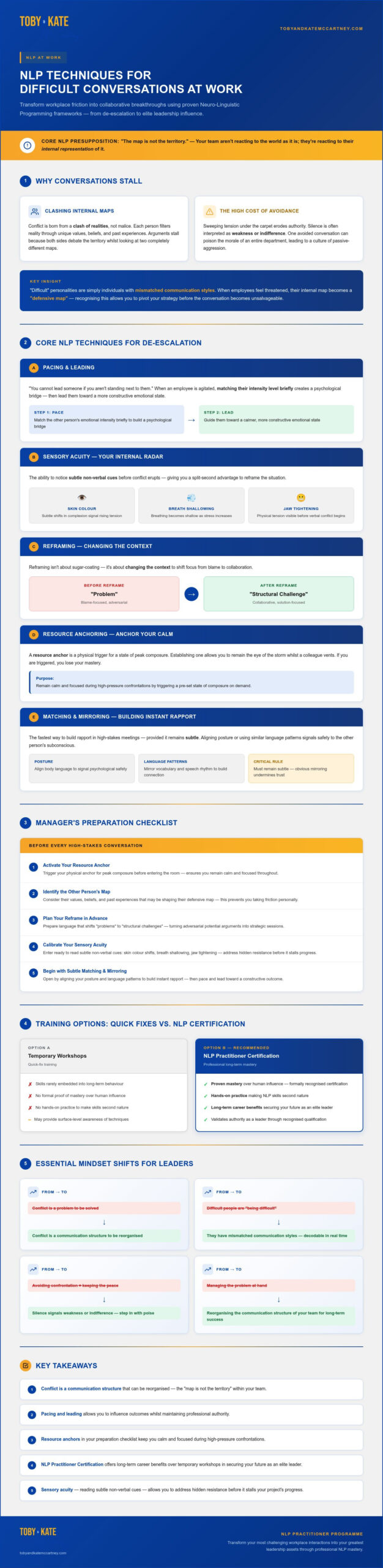
The Manager’s Preparation Checklist: Organising Your Approach for Success
Success in a high-stakes meeting isn’t accidental. It is engineered. To transform a potential confrontation into a breakthrough, you must arrive with a structured psychological plan. Most managers walk into difficult rooms hoping for the best, but elite leaders use specific nlp techniques for difficult conversations at work to pre-determine the outcome before the first word is even spoken. This preparation checklist ensures you remain the most composed person in the room, regardless of the other person’s behaviour.
- Step 1: Define Your Outcomes. Clarity is power. Identify your primary desired outcome and a “Plan B” outcome that still represents progress. If you don’t know where you’re going, you’ll end up where the other person’s emotions lead you.
- Step 2: Resource Anchoring. Cleanse your internal state. Use a resource anchor, a physical trigger you’ve conditioned to evoke a state of total composure. You cannot lead effectively if your own physiology is in “fight or flight” mode.
- Step 3: Pre-frame the Meeting. Set the rules of engagement immediately. A collaborative tone established in the first sixty seconds dictates the trajectory of the next hour.
- Step 4: Identify Meta-Programs. Listen to how your colleague speaks. Are they motivated “Towards” goals or “Away from” problems? Matching your language to their motivational direction bypasses their natural resistance.
- Step 5: Design an Exit Strategy. Ensure every conversation ends with positive forward-motion. Never leave the room without a clear, agreed-upon next step that reinforces the new communication structure.
If you are ready to turn these steps into an instinctive part of your management style, our leadership training provides the immersive environment you need to achieve mastery.
Pre-Framing: Setting the Rules of Engagement
A 30-second pre-frame can prevent a 30-minute argument. By defining the purpose and boundaries of the talk early, you remove the element of surprise that often triggers defensiveness. For a performance review, you might say: “I’ve organised this time so we can align your current output with your long-term career goals here.” This frames the feedback as an investment in their success rather than a critique of their failings. Mastery of pre-framing is also what allows you to command the room during larger presentations, a core skill detailed in our guide on public speaking for leaders.
Maintaining the “Observer” State During the Talk
The “Observer” state allows you to remain detached whilst staying deeply empathetic. It’s the ability to watch the interaction as if you were a neutral third party. This perspective is vital for calibration. You must notice the tiny changes in their breathing or the subtle shift in skin colour that signals a change in their internal state. If you see their jaw tighten, you’ve likely lost rapport. Recognising this instantly allows you to pause, re-establish the bridge, and redirect the conversation before it stalls. This level of sensory acuity is what separates a functional manager from an empowering master of influence.
Mastering Influence: Why Toby and Kate McCartney’s NLP Practitioner Programme is Your Secret Weapon
Toby and Kate McCartney are more than just trainers; they are the catalysts for the significant professional shifts you’ve been seeking. They understand that true leadership isn’t about managing tasks, but about mastering the nuances of human influence. Their curriculum offers a sophisticated blend of corporate leadership strategy and psychological growth, designed specifically for those who want to operate at an elite level. By adopting the “Empowering Master” approach, you don’t just learn nlp techniques for difficult conversations at work; you develop the assertive, grounded voice required to lead your team through any storm. This is your invitation to join a community of like-minded achievers who refuse to settle for average communication and instead demand excellence in every interaction.
The McCartney training environment is one of attainable excellence. It operates from a place of deep conviction, aiming to instill a sense of self-worth and immediate confidence in every manager. You aren’t just gaining a skill set; you’re gaining access to a master-level toolkit that has been refined since the business was founded circa 2003. This is a proactive, results-oriented journey that moves you from a state of curiosity to a state of total readiness for action. You’ll stop reacting to conflict and start designing the collaborative breakthroughs your organisation needs to thrive.
A Personal Journey to Elite Leadership
This is not merely “training” in the traditional sense. It’s a transformative journey for your identity as a leader. Within the McCartney ecosystem, you aren’t just another student; you are a professional on a pathway to mastery. We provide unique opportunities for one-to-one coaching and specialised mentorship, ensuring that the theory is perfectly tailored to your specific corporate challenges. Our certification programmes have a recognised national reach across the UK, providing a professional validation that carries weight in any boardroom. You’ll find that as your internal state shifts, your external influence expands, allowing you to command respect without ever needing to raise your voice.
Your Next Step Towards Communication Mastery
The journey toward becoming an elite communicator is both flexible and methodical. Your next logical step is to explore the Practitioner Certification syllabus to see how these multi-modal learning options fit into your professional development plan. For leaders who require a more bespoke, high-level approach, our executive coaching and mentoring offers the elite pathway to leadership mastery. Don’t let another high-stakes meeting pass you by while you feel stuck in repetitive arguments or fearful of being perceived as weak. The tools to transform your career are within reach. Step into your potential today and claim the authority that comes with true psychological mastery.
Step Into Your Authority as an Empowering Master
You now possess the roadmap to transform workplace friction into your greatest leadership asset. Conflict is no longer a problem to be solved, but a communication structure to be reorganised. By integrating specific nlp techniques for difficult conversations at work into your daily management, you move from a state of reaction to total psychological mastery. You’ve learned that elite preparation and sensory acuity are the secret weapons that allow you to command any room with poise and purpose.
Since 2003, Toby and Kate McCartney have acted as the catalysts for significant professional shifts, providing accredited certification levels from Practitioner to Trainer. This is your moment to move beyond temporary fixes and embrace a journey of attainable excellence. Unleash your potential and master workplace influence with our NLP Practitioner Certification. Under the direct mentorship of leaders in personal transformation, you’ll gain the confidence to lead any conversation with absolute conviction. Your evolution into a world-class leader starts now.
Frequently Asked Questions
Is NLP just a form of workplace manipulation?
NLP is a framework for ethical influence rather than manipulation. It focuses on reorganising communication structures to achieve win-win outcomes. When you use nlp techniques for difficult conversations at work, you’re seeking to understand the other person’s mental map to find common ground. It’s about clarity and connection. True mastery involves using these tools to empower your team and foster a culture of mutual respect whilst maintaining your professional authority as a leader.
How quickly can I see results from using NLP techniques in my meetings?
You can often experience immediate shifts in communication dynamics. Simple techniques like matching and mirroring or pacing and leading can change the energy of a meeting within minutes. However, the deep psychological shifts required for complex disputes take consistent application. Whilst you’ll see quick wins in rapport, achieving the level of an Empowering Master requires the experiential practice found in formal leadership training and professional certification programmes.
Can NLP help me handle a “toxic” boss or just my subordinates?
NLP is exceptionally effective for managing upwards. It allows you to decode your manager’s meta-programs and communication filters, making it easier to present information in a way they can actually hear. By understanding their internal map, you can de-escalate tension and protect your own mental wellbeing. These tools aren’t limited to subordinates; they’re universal strategies for navigating any challenging relationship within the UK corporate landscape.
Do I need a formal certification to use NLP at work?
Whilst you can apply basic principles from reading, a formal NLP Practitioner Certification is essential for real-world mastery. High-stakes meetings require a level of sensory acuity and internal state control that only comes from expert-led, experiential training. Certification provides the “why” behind the “how”, giving you the flexibility to adapt when a conversation takes an unexpected turn. It also validates your elite communication skills to HR and senior leadership.
What is the difference between conflict management training and an NLP Practitioner course?
Traditional conflict management training often focuses on surface-level “tips and tricks” that fail under genuine pressure. An NLP Practitioner course dives into the psychological drivers of behaviour and the internal maps that cause friction. It provides a comprehensive toolkit for personal transformation and leadership. You’re not just learning how to handle a dispute; you’re learning how to reorganise the very structure of communication within your department for long-term success.
Can NLP techniques be used to negotiate a higher salary or promotion?
Absolutely. Using nlp techniques for difficult conversations at work allows you to frame your value in a way that aligns with your employer’s desired outcomes. By using specific language patterns and anchoring a state of confidence, you can navigate salary reviews with poise. It’s about building such strong rapport and clarity that the promotion feels like the logical next step for both parties. You are essentially reorganising their perception of your professional worth.
How does NLP help with the fear of public speaking during difficult presentations?
NLP addresses the root cause of the fear by reorganising your internal representation of the event. Techniques like resource anchoring allow you to trigger a state of calm on demand, even when facing a hostile audience. You learn to reframe the “anxiety” as “readiness” or “excitement”. This psychological shift is a core component of our specialised public speaking programmes, designed to help leaders command the room with unapologetic authority and poise.
Is the McCartney NLP Practitioner Certification recognised by professional bodies in the UK?
Yes, our certification programmes are designed for professionals who require recognised, high-level accreditation. Founded circa 2003, Toby and Kate McCartney provide professional certification levels from Practitioner to Master Practitioner and Trainer. These programmes are widely respected across the UK for their focus on measurable success and elite communication. We offer the professional validation needed to prove your mastery of human influence to any corporate body or training department.