
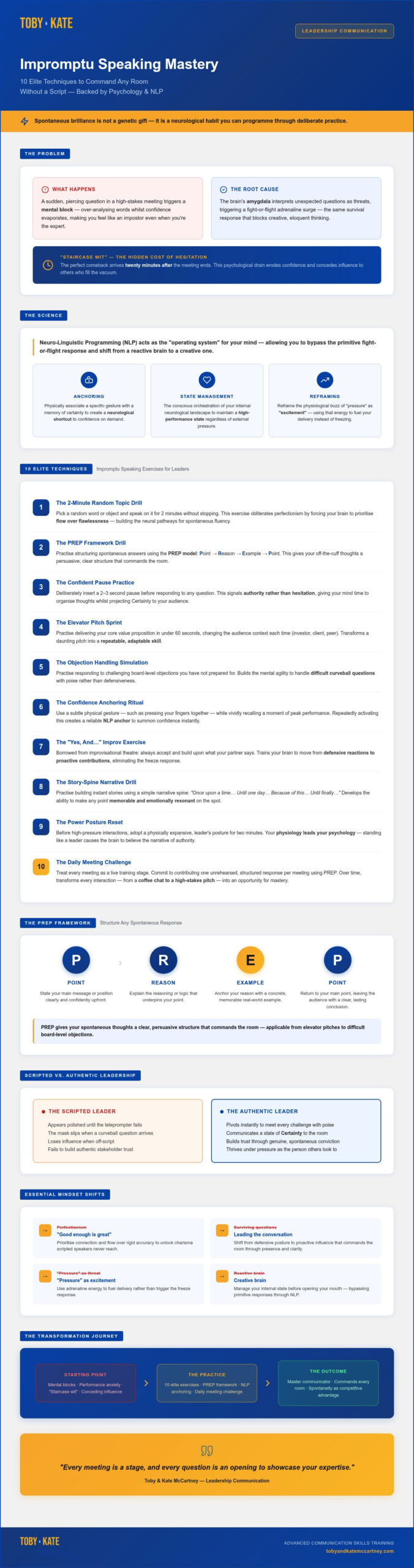
Spontaneous brilliance is not a genetic gift; it is a neurological habit that you can programme through deliberate impromptu speaking exercises. You know the feeling. A sudden, piercing question in a high-stakes meeting triggers a mental block, leaving you over-analysing your words whilst your confidence evaporates. It’s frustrating to feel like an impostor when you’re actually the expert in the room. We agree that your best ideas shouldn’t be trapped behind a wall of performance anxiety.
You deserve to command every interaction with absolute fluidity and poise. By integrating these psychology-backed methods into your leadership routine, you’ll transform those off-the-cuff moments from sources of dread into your greatest competitive advantage. This is your pathway to a commanding presence that feels entirely natural and unshakeable. We’re exploring ten elite-level techniques designed to rewire your response patterns and ensure you always have the right words at the right time, regardless of the pressure.
Key Takeaways
- Discover how to leverage spontaneity as a leadership superpower to build immediate trust and authority with your stakeholders.
- Understand the psychology of the “fight or flight” response and how to use NLP as an operating system to master unplanned communication.
- Implement 10 high-impact impromptu speaking exercises that prepare you for everything from elevator pitches to difficult board-level objections.
- Adopt proven frameworks like PREP to give your spontaneous thoughts a clear, persuasive structure that commands the room.
- Move beyond basic skills to transform your professional identity into that of a master communicator who thrives in “off-the-cuff” situations.
The Art of Thinking on Your Feet: Why Impromptu Speaking Exercises Matter
Leadership in 2026 isn’t about memorising a script; it’s about the raw, visceral ability to command a room when the unexpected strikes. We call this a leadership superpower. In a world moving at breakneck speed, the capacity to deliver structured, persuasive thoughts without preparation is what separates the elite from the average. Engaging in regular impromptu speaking isn’t just a soft skill. It’s a strategic asset. Spontaneity builds a level of trust and authority with stakeholders that a rehearsed speech simply cannot touch. They see the real you. They see your conviction.
Think about the “scripted leader”. They appear polished until the teleprompter fails or a board member asks a curveball question. Then, the mask slips. Contrast this with the authentic leader who pivots instantly, meeting every challenge with poise. By using specific impromptu speaking exercises, you transform every interaction, from a coffee chat to a high-stakes pitch, into an opportunity for mastery. Every meeting is a stage, and every question is an opening to showcase your expertise.
The High Cost of Hesitation in Leadership
Hesitation is expensive. When you fail to speak up because you’re over-analysing your response, you aren’t just staying quiet; you’re conceding your influence. This “freezing” creates a vacuum that others will fill, often to the detriment of your professional reputation. We’ve all experienced “staircase wit”; that frustrating moment when the perfect comeback or solution arrives twenty minutes after the meeting has ended. It’s a psychological drain that erodes your confidence. Consistent impromptu speaking exercises eliminate this lag, ensuring your brilliance is available in real-time, not in hindsight.
Commanding the Room Without a Script
Mastering the unplanned is a core pillar of public speaking for leaders. It requires a shift in your internal state. You aren’t just trying to survive the question; you’re leading the conversation. This comes from a place of “Certainty”, a communicable state of being that tells your audience you’re in control. When you stop fearing the unknown, you unlock a new level of communication identity. You move from a defensive posture to one of proactive influence, commanding the room through the sheer power of your presence and clarity. You become the person everyone looks to when the stakes are highest.
The Psychology of Spontaneity: Using NLP to Master the Unplanned
Your brain’s primary directive is survival, not eloquent public speaking. When a colleague asks for your “immediate thoughts” on a complex project, your amygdala often interprets this as a threat. The resulting adrenaline surge causes the classic mental block. To override this, you must treat your communication like a software system. Neuro-Linguistic Programming (NLP) serves as the “operating system” for your mind, allowing you to bypass the primitive fight-or-flight response. By practising impromptu speaking exercises through an NLP lens, you learn to manage your internal state before you ever open your mouth. It’s about shifting from a reactive brain to a creative one.
Anchoring Confidence for Instant Access
To master the unplanned, you must be able to summon confidence on demand. This isn’t about “faking it”; it’s about anchoring a resourceful state. By physically associating a specific gesture, like a subtle press of your fingers, with a memory of absolute certainty, you create a neurological shortcut. Your physiology must lead your psychology whilst speaking. If you stand with the posture of a leader, your brain begins to believe the narrative of authority. State-management is the conscious orchestration of your internal neurological landscape to ensure you remain in a resourceful, high-performance state regardless of external pressure.
Breaking the Pattern of Perfectionism
Perfectionism is the enemy of spontaneity. The desperate need to find the “perfect” word creates a cognitive bottleneck that leads to stuttering or silence. You must install a new mental programme: “good enough is great”. This isn’t about lowering your standards; it’s about prioritising connection and flow over rigid accuracy. When you use impromptu speaking exercises to break the perfectionism loop, you unlock a level of charisma that scripted speakers can never reach. Reframing the physiological buzz of “pressure” as “excitement” allows you to use that energy to fuel your delivery.
Investing in advanced communication skills training provides the psychological resilience needed to embrace these moments. You start to see every surprise question as a gift rather than a trap. If you’re ready to refine this internal mastery, exploring the programmes offered by Toby and Kate McCartney is your next logical step. You’ll move from managing anxiety to projecting unshakeable certainty.
10 Essential Impromptu Speaking Exercises for Individual and Team Growth
Professional development in the corporate sphere often suffers from a lack of genuine pressure. Most impromptu speaking exercises found online are designed for hobbyists or students; they lack the professional gravitas required for elite leadership. To truly command a room, you need drills that simulate the high-stakes environment of a boardroom or a media briefing. We advocate for a “playful yet professional” atmosphere during these sessions. This approach reduces the psychological friction of practice whilst fostering the creative behaviour necessary for spontaneity. Consistency is your secret weapon here. Five minutes of focused daily practice is infinitely more effective than a monthly two-hour marathon.
Solo Exercises for Daily Mastery
- The Random Object Pitch: Pick up a mundane item on your desk, perhaps a stapler or a coffee coaster. You have thirty seconds to sell this as a revolutionary £10,000 solution to a complex business problem. This forces your brain to bridge the gap between disparate ideas instantly.
- The Dictionary Challenge: Invent a word that sounds professional, such as “Synerflow” or “Quantispeak”. Define it with absolute conviction, providing two specific “use cases” in a corporate setting. This builds the state of Certainty we discussed earlier.
- The One-Minute Rant: Choose a minor annoyance, like slow lifts or lukewarm tea. Speak passionately for sixty seconds. The goal isn’t the content; it’s the vocal variety and emotional range you develop whilst thinking on your feet.
Group Exercises for Team Development
When training as a team, the goal is to build collective resilience and fluidity. These impromptu speaking exercises shift the focus from individual performance to dynamic interaction.
- The Boardroom Pivot: Whilst a team member is speaking on a set topic, someone shouts “Pivot!”. The speaker must immediately change their stance or perspective on the issue without pausing. This simulates sudden shifts in stakeholder sentiment.
- The Question Tag: One person asks a question. You answer it concisely, then immediately ask a related, challenging question to the next person. This builds the “listening-to-respond” rhythm essential for high-level panel discussions.
- The Expert Interview: Your team assigns you a topic you know nothing about, such as “Quantum Logistics in Sub-Saharan Agriculture”. You must act as the world-renowned expert for two minutes. This is the ultimate cure for impostor syndrome; it proves you can lead a conversation through structure and confidence even when the data is thin.
By integrating these drills into your weekly routine, you move beyond the “games” offered by competitors and start building a robust, professional communication toolkit. You aren’t just practising; you’re rewiring your brain for elite performance.
Proven Frameworks to Structure Your Spontaneous Responses
Creativity requires guardrails. Without a skeletal structure, even the most brilliant insights can dissolve into a disorganised stream of consciousness. Frameworks are the secret weapon of the elite communicator; they provide the mental architecture that allows your creativity to flourish without losing its direction. Whilst impromptu speaking exercises build the muscle of spontaneity, these frameworks provide the technique to ensure your message lands with precision. You aren’t just talking; you’re architecting a response that commands respect.
The PREP Model: Your Go-To Structural Tool
The PREP model is the gold standard for persuasive, high-stakes communication. It allows you to deliver a punchy, logical argument in under thirty seconds without needing a single note. The process is simple:
- Point: State your primary position clearly and immediately.
- Reason: Provide the underlying logic or “why” behind your point.
- Example: Offer a specific piece of evidence, a statistic, or a brief anecdote.
- Point: Reiterate your original point to drive the message home.
Imagine being asked, “Why should we invest in this project?” Your response becomes: “We must invest because it addresses our core efficiency gap (Point). Data shows our current system loses 15% in productivity (Reason). For example, a major department saved £50,000 last month using this new workflow (Example). Therefore, full investment is the only logical path forward (Point).” The PREP model functions as a pre-installed cognitive map that eliminates the need for intensive real-time planning.
The Storytelling Pivot: Past, Present, Future
For leadership updates or strategic overviews, the PEP structure (Past, Event, Prospect) is unmatched. It uses chronology to ground your audience, providing a sense of stability and progression that stakeholders crave. You start by acknowledging where the organisation was (Past), describe the current initiative or challenge (Event), and finish with the vision of what lies ahead (Prospect). This framework is particularly effective because it mirrors the way the human brain processes narrative and growth. When you need to make a decision on the fly, the “Pros, Cons, Recommendation” model allows you to demonstrate balanced, authoritative thinking in real-time.
Integrating these structures with the principles found in an NLP practitioner certification UK allows you to pace your audience’s current reality before leading them to a new conclusion. It’s about more than logic; it’s about influence. If you are ready to move beyond basic impromptu speaking exercises and truly master the art of influential communication, you should explore the specialised leadership programmes offered by Toby and Kate McCartney to sharpen your edge and command any room.
Beyond the Exercises: Transforming Your Communication Identity
True leadership communication isn’t a performance you switch on; it’s an identity you inhabit. You’ve already explored the psychological shifts required to override fear and the structural frameworks like PREP that keep your message on track. Now, the challenge is to move from “practising” these impromptu speaking exercises to “embodying” the role of a master communicator. This is where the shift from competence to mastery happens. It’s the difference between someone who can give a speech and someone who commands the room the moment they step into it. You are no longer a leader who occasionally speaks well; you are a master communicator who happens to lead. This transformation requires a conscious decision to step into a more capable version of yourself.
From Competence to Mastery
Mastery requires deep integration. Don’t leave these drills in the training room. Bring them into your weekly team meetings as a standard three-minute warm-up. Encourage your colleagues to engage with these methods to sharpen their own edge. This creates a culture of high-performance communication where spontaneity is celebrated, not feared. Remember, the most significant shifts occur through consistent feedback and rigorous self-reflection. If you want to accelerate this process, seeking executive coaching and mentoring provides a bespoke development journey. It allows you to dismantle specific mental blocks and refine your unique leadership voice under the guidance of world-class experts who have walked the path before you. It is about unlocking potential that has been dormant due to old patterns of behaviour.
Your Next Step to Elite Communication
Your next step is to step into every room with absolute certainty. The approach developed by Toby and Kate McCartney serves as the ultimate secret weapon for leaders who refuse to settle for mediocrity. By leveraging the transformative power of NLP, we help you rewire your internal response patterns for total mastery. This isn’t surface-level tips; it’s a fundamental upgrade to your personal operating system. Whether you choose our intensive Public Speaking programmes or pursue a full certification, you are investing in a version of yourself that is unshakeable under pressure. The room is waiting. The curveball questions are coming. You have the tools, the frameworks, and the mindset. It’s time to lead the conversation with the authority you were born to possess. Embrace the journey toward attainable excellence and let your communication become your greatest asset.
Step Into Your New Communication Identity
You’ve now discovered that spontaneous brilliance isn’t a mysterious gift; it’s a neurological habit you can cultivate with precision. By committing to these psychology-backed impromptu speaking exercises and adopting structural guardrails like the PREP model, you’ve already begun the journey toward total communication mastery. You now understand that managing your internal state is just as vital as the words you choose. This isn’t just about surviving unexpected questions; it’s about leading every interaction with a level of Certainty that commands the room.
Toby and Kate McCartney, world-class NLP masters, have spent decades refining these specialised leadership training techniques to ensure measurable professional shifts for elite performers. You don’t have to navigate this transformative pathway alone. It’s time to stop over-analysing and start embodying the master communicator you are destined to be. Step into your next meeting with the unshakeable confidence that comes from knowing you’re prepared for anything. Your influence is waiting to be unlocked.
Master the art of influence-explore our Public Speaking for Leaders programme today.
The stage is yours. Go and claim it with absolute authority.
Frequently Asked Questions
How can I stop my mind from going blank during impromptu speaking?
Stop your mind from going blank by resetting your physiology and using state management techniques. Mental blocks occur when the amygdala triggers a survival response; you can override this by grounding your feet and taking a deliberate breath. This pause isn’t a sign of weakness; it’s a tool for recalibration. By using impromptu speaking exercises to practice this reset, you train your brain to remain creative rather than reactive under pressure.
Are impromptu speaking exercises effective for introverts?
These exercises are exceptionally effective for introverts because they focus on structure and neurological habit rather than extroverted charisma. Spontaneity is a skill you can learn through deliberate practice, not an inherent personality trait. Introverted leaders often excel at the PREP framework because it allows them to deliver concise, high-impact answers without the need for unnecessary filler. It’s about building a reliable internal system that supports your natural leadership style.
How long does it take to see results from these exercises?
You will feel an immediate shift in your internal state after your first few sessions, but total habituation usually takes around thirty days of consistent effort. We recommend five minutes of daily practice rather than infrequent, longer sessions. This constant reinforcement helps rewire your neural pathways, making fluidity your new default setting. Within a month, you’ll find that you no longer dread unexpected questions; you start to see them as opportunities.
Can I practice impromptu speaking solo, or do I need a group?
You can absolutely practice solo to master the mechanics, but group sessions are vital for simulating real-world pressure. Solo drills like “The Random Object Pitch” help you build speed and creativity in a safe environment. However, group impromptu speaking exercises introduce the element of unpredictability that you’ll face in boardrooms. Combining both approaches ensures you have the technical skill and the psychological resilience to command any room, regardless of the audience.
What is the best framework for answering a tough question on the spot?
The PREP model (Point, Reason, Example, Point) is the most robust framework for answering tough questions on the spot. It provides a clear mental map that prevents rambling and ensures your conclusion is as strong as your opening. By stating your point immediately, you project authority. Following up with a reason and a specific example provides the evidence needed to persuade your stakeholders, before a final point reinforces your core message with absolute clarity.
How does NLP help with the fear of public speaking?
NLP helps by addressing the root cause of public speaking fear: your internal representation of the event. Instead of seeing a presentation as a threat, NLP techniques like reframing and anchoring allow you to view it as an exciting challenge. You learn to install a resourceful state on demand, ensuring your brain stays in a creative “flow” rather than a defensive “freeze”. It’s like upgrading your mind’s operating system for peak performance.
Should I try to be funny during impromptu speeches?
Humour can be a powerful tool for connection, but you should only use it if it feels natural to the moment. Your primary goal is authority and clarity. If a joke doesn’t land, it can create a spike in your anxiety that derails your flow. Focus first on the PREP structure and your internal state. If a witty observation arises naturally from your state of Certainty, use it; otherwise, stick to delivering high-value insights.
What happens if I make a mistake whilst speaking spontaneously?
If you make a mistake, acknowledge it briefly or simply pivot and continue with conviction. Your audience doesn’t have a copy of the script you haven’t written, so they only know you’ve made a “mistake” if your physiology betrays you. Maintain your posture, keep your voice steady, and use your next point to regain momentum. In the world of spontaneity, a “good enough is great” mindset is far more effective than perfectionism.