
What if the invisible ceiling holding you back from your next promotion or a flawless keynote isn’t a lack of talent, but a faulty neurological programme? Most high-achievers treat self-doubt as an inevitable burden, yet the secret to elite performance lies in overcoming limiting beliefs nlp techniques offer. You aren’t “broken” or “not enough”; you’re simply running outdated mental scripts that no longer serve your 2026 ambitions. It is time to stop negotiating with your excuses and start mastering your mindset.
It’s incredibly frustrating when generic affirmations fail to silence that inner critic during high-pressure career transitions. You’ve likely felt like an impostor in high-stakes environments, watching your confidence ebb away just when you need it most. This guide promises a shift from passive hope to proactive mastery. You’ll discover a clear, practical method to identify and dismantle the sensory structures of your doubts using proven Neuro-Linguistic Programming. We will explore how to rewrite your internal dialogue and use submodalities to replace self-sabotage with a sense of absolute mental freedom and leadership clarity.
Key Takeaways
- Recognise that limiting beliefs are merely outdated neurological programmes that you can consciously deconstruct and rewrite for 2026 success.
- Identify the specific linguistic filters that distort your reality and learn how to spot the verbal clues that signal a mental barrier is in place.
- Gain a practical, step-by-step protocol for overcoming limiting beliefs nlp experts use to dismantle self-doubt and reclaim professional certainty.
- Shift from the frustration of generic positive thinking to precise psychological tools that create measurable changes in your leadership performance.
- Understand how to integrate mindset mastery into your daily career habits to eliminate impostor syndrome and project an authentic sense of authority.
What Are Limiting Beliefs? The NLP Approach to Mental Architecture
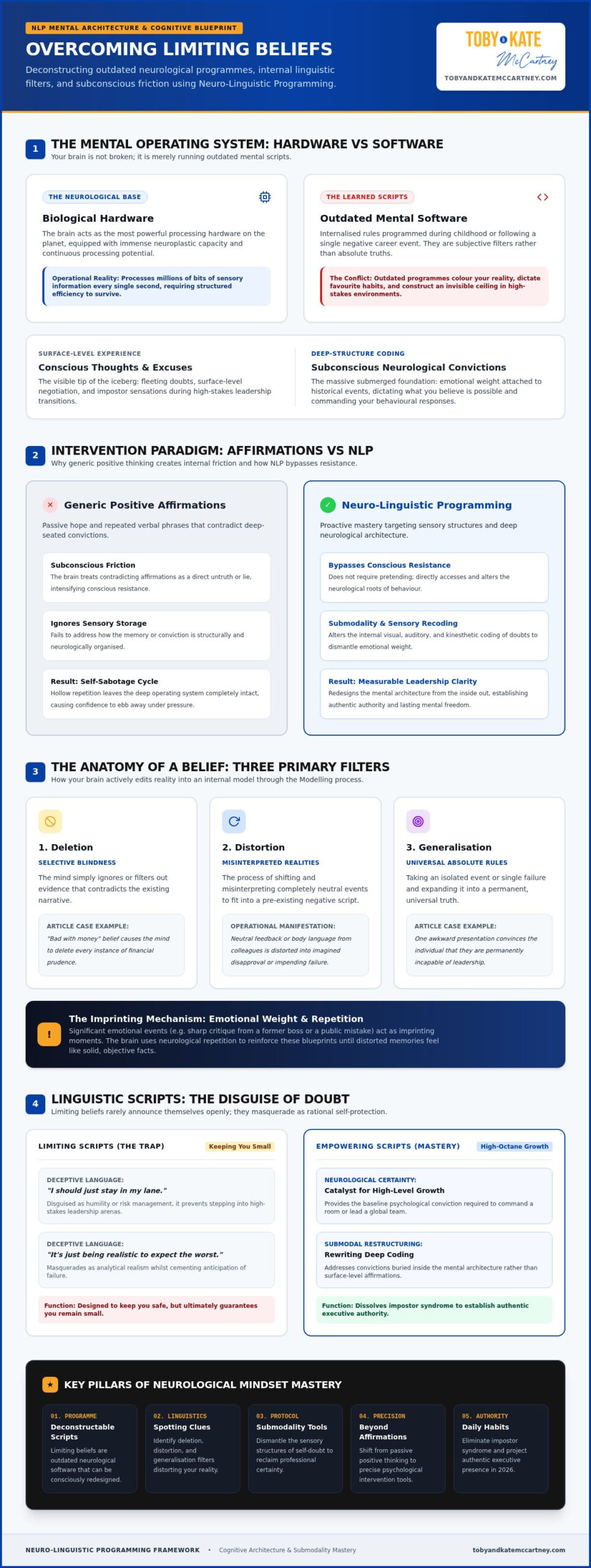
Imagine your brain is the most powerful hardware on the planet. For years, you’ve been running software that was programmed during your childhood or following a single negative career event. These internalised “rules” are what we call limiting beliefs. They aren’t universal truths. They are merely subjective filters that colour your reality and dictate your favourite habits. Whilst these beliefs feel like solid facts, they are actually just mental architecture that can be redesigned. You aren’t stuck with your current mindset; you’re just using an outdated operating system.
By applying foundational neuro-linguistic programming principles, we recognise that overcoming limiting beliefs nlp isn’t about ignoring reality. It’s about changing the deep-structure coding that governs your potential. Your surface-level thoughts are just the tip of the iceberg. True mastery happens when you address the convictions buried in your mental operating system. These deep-seated rules define what you think is possible, how you respond to criticism, and whether you step up or shrink back in high-stakes environments.
The Difference Between Empowering and Limiting Beliefs
Empowering beliefs act as a high-octane catalyst for professional growth. They provide the certainty required to command a room or lead a global team. Conversely, limiting beliefs are masters of disguise. They rarely sound like “I am a failure.” Instead, they sound like “I should stay in my lane” or “It’s just being realistic to expect the worst.” These scripts are designed to keep you safe, but they ultimately keep you small. The difference lies in conviction. A simple thought becomes a rigid belief when you attach enough emotional weight to it, turning a temporary doubt into a permanent barrier.
Why Positive Thinking Alone Often Fails
Generic affirmations often feel hollow because they ignore the conflict between your conscious desires and your subconscious programmes. You can’t simply “affirm” your way out of a deeply held neurological conviction. When you repeat a positive phrase that contradicts a core belief, your brain treats it as a lie. This creates internal friction that leads to self-sabotage. NLP is different. It doesn’t ask you to pretend. It gives you the tools to bypass conscious resistance and reach the root of the behaviour. By shifting the sensory way you store information, you dismantle the barrier from the inside out, allowing for a fresh start that actually sticks.
The Anatomy of a Belief: How Your Brain Organises Your Reality
Your brain is a masterful editor, not a passive recorder. Every second, it processes millions of bits of information, but it only allows a tiny fraction into your conscious awareness. This process, known as “Modelling,” is how you construct your internal map of the world. Whilst this efficiency is necessary for survival, it’s also the mechanism that cements your deepest insecurities. By understanding how your brain organises reality, you gain the power to intervene in the process of overcoming limiting beliefs nlp provides. You are no longer a victim of your history; you become the architect of your future.
Deletion, Distortion, and Generalisation
The brain uses three primary filters to manage the sensory deluge: deletion, distortion, and generalisation. Deletion occurs when your mind simply ignores evidence that contradicts your current narrative. If you believe you’re “bad with money,” you’ll delete every instance where you were financially prudent. Generalisation takes a single failure and turns it into a universal truth, convincing you that one awkward presentation means you are inherently incapable of leadership. Distortion is the process of misinterpreting neutral events to fit a negative narrative. These filters work together to protect your existing beliefs, even when those beliefs are actively sabotaging your career growth.
Significant emotional events often act as the “imprinting” moment for these filters. A sharp critique from a former boss or a public mistake can create a neurological blueprint that lasts for decades. Your brain uses repetition to reinforce these blueprints until they feel like objective facts. However, challenging self-limiting beliefs requires you to recognise that these “facts” are merely distorted memories. You have the capacity to stop the cycle of repetition and start installing new, more effective programmes.
The Role of Internal Representations
In NLP, we look at the “Submodalities” of your thoughts. These are the fine-grained building blocks of your mental images and sounds. Do you picture your failures in vivid, large, high-definition colour? Is the voice of your inner critic booming and close to your ear? These structural qualities dictate the emotional impact of the thought. Memories that feel “heavy” or overwhelming usually have specific submodality settings that you can learn to adjust. By changing the size, brightness, or volume of these internal representations, you strip them of their power.
This mastery over internal imagery is the foundation of elite public speaking for leaders. When you can shrink a daunting memory and brighten a vision of future success, your external confidence shifts instantly. If you’re ready to move beyond theory and start applying these tools at a professional level, embarking on an NLP Practitioner Certification UK is the definitive path to mindset mastery.
Identifying the Invisible Barriers: NLP Linguistic Clues
Beliefs have fingerprints. They aren’t just abstract ideas floating in your mind; they are linguistic structures that you express every time you open your mouth. In the journey of overcoming limiting beliefs nlp provides a precision diagnostic tool known as the Meta Model. This framework allows you to deconstruct the vague language that keeps you trapped in mediocrity. When you learn to listen for specific “clues” in your speech, you start to see the bars of the cage you’ve built for yourself. This linguistic awareness is the secret weapon for overcoming limiting beliefs nlp mastery requires.
One of the most common linguistic traps involves “Modal Operators of Necessity.” These are words like “must,” “should,” and “ought to.” They create a sense of heavy, external pressure and rigid rules that often have no basis in reality. Similarly, “Modal Operators of Impossibility” such as “cannot,” “won’t,” or “it’s impossible” set the boundaries of what you allow yourself to achieve. These words act as mental stop signs. Finally, “Universal Quantifiers” like “always,” “never,” and “everyone” over-generalise a single event into a permanent law. If you say, “I always fail at public speaking,” you’re deleting every time you’ve communicated successfully.
Listening to Your Self-Talk
You must become an elite observer of your internal dialogue. Catch the phrases you use when discussing your career goals. Pay particular attention to the word “but” because it effectively cancels out everything that came before it. “I want to lead the team, but I’m not experienced enough” is a declaration of defeat. Try this exercise: for one entire day, record every “rule” you state as if it were a law of physics. You’ll likely find that most of your “can’ts” are actually “won’ts” in disguise. Recognising this distinction is the first step toward true influence.
The Power of Presuppositions
The questions you ask yourself contain hidden assumptions that your brain accepts as truth. If you ask, “Why am I always failing?” you presuppose that failure is your constant state. Your brain will dutifully search for evidence to prove you right. You can flip this by using NLP for personal empowerment to craft better questions. Instead of presupposing defeat, ask, “How can I use my unique skills to master this challenge?” The language you use with yourself is the most important communication you will ever master. It’s the difference between being a passenger in your life and being the pilot.
How to Overcome Limiting Beliefs: A Step-by-Step NLP Protocol
Transformation isn’t a wish; it’s a precise process. You’ve identified the linguistic markers of your self-doubt. Now, you must execute the protocol to delete them. Overcoming limiting beliefs nlp relies on a structured approach to dismantle the old and install the new. This isn’t about “trying harder” or hoping for a better day. It’s about working with your brain’s natural architecture to achieve professional mastery. Follow this five-step protocol to reclaim your mental freedom.
- Step 1: Identify the specific belief and state it clearly in one sentence. Avoid “vague-speak”; be precise.
- Step 2: Challenge the belief using Meta Model questions. Ask yourself, “According to whom?” or “How specifically does this stop me?”
- Step 3: Identify the “Positive Intent.” Every belief, no matter how limiting, was originally trying to protect you from failure or judgment.
- Step 4: Use Submodality shifting to change the mental “coding” of the belief, stripping it of its emotional power.
- Step 5: Install the new, empowering belief through “Future Pacing,” mentally rehearsing your success in upcoming high-stakes scenarios.
Challenging the Validity of Your “Truth”
Most of your barriers aren’t even yours. They are inherited opinions from parents, teachers, or past managers that you’ve mistaken for laws of nature. By questioning the source, you begin to see the cracks in the foundation. Find counter-examples where the belief was demonstrably false. If you think you “can’t lead a team,” recall a time you successfully coordinated a project or influenced a colleague. A belief is only as strong as the evidence you choose to focus on. When you change your focus, the belief begins to crumble.
The Submodality Shift Technique
Your brain stores “truth” and “doubt” using different visual and auditory settings. Locate the mental image of your limiting belief. Is it large, loud, and in vibrant colour? Use your mind’s eye to shrink it. Drain the colour until it’s a small, silent, grainy black-and-white photograph. Move it far into the distance until it’s just a speck on the horizon. You’ll notice the emotional weight vanishes instantly. Now, replace that void with a compelling, high-definition vision of your future success. If you want to master these high-level skills, you can enrol in an NLP Practitioner Certification UK programme to accelerate your leadership journey.
Beyond the Quick Fix: Integrating NLP Mastery into Your Life and Career
Dismantling a single mental barrier is a victory, but it’s only the beginning of your journey toward elite performance. Real transformation occurs when you stop treating these tools as a “quick fix” and start integrating them into your fundamental identity. Overcoming limiting beliefs nlp protocols address is the gateway to a lifelong practice of mental excellence. It’s about shifting from the occasional application of a technique to living an NLP-informed life where clarity and certainty are your default states. This transition allows you to navigate the complexities of 2026 with an unshakeable sense of purpose.
Mastering your own mindset is the most significant investment you can make in your leadership capacity. When you possess the certainty that comes from internal alignment, you naturally project an authority that others are eager to follow. You stop reacting to external pressures and start creating the outcomes you desire. True leadership begins with overcoming limiting beliefs nlp mastery requires. Professional training is the fastest way to achieve measurable, lasting shifts because it forces you to confront the “blind spots” in your own mental architecture. It is the difference between knowing the path and walking it with absolute conviction.
NLP as a Leadership Tool
Understanding the architecture of beliefs doesn’t just change your life; it transforms how you influence others. By recognising the linguistic filters and submodalities of your team members, you can communicate with surgical precision. You’ll learn to identify the “deletion” and “distortion” in a colleague’s report or the “universal quantifiers” that are stalling a project. This insight is central to executive coaching and mentoring, where the goal is to unlock the latent potential within high-performing individuals and teams. Positioning NLP as your secret weapon allows you to resolve conflicts and motivate your workforce with unprecedented ease.
Your Pathway to Professional Certification
Ambitious achievers recognise that there is always a higher level of excellence to reach. Once you’ve mastered the basics, an NLP Master Practitioner Certification is the logical next step in your development. Learning from seasoned masters like Toby and Kate McCartney ensures that you are acquiring authentic, measurable skills that produce lasting results in the real world. You deserve access to the elite frameworks that separate world-class leaders from the rest of the pack. Ready to command your future? Explore our NLP Practitioner Certification UK today.
Step Into Your Future with Absolute Certainty
You now possess the blueprint for dismantling the invisible barriers that have restricted your professional growth. By mastering the linguistic markers of the Meta Model and applying the precision of submodality shifts, you’ve moved beyond the realm of generic positive thinking. Overcoming limiting beliefs nlp provides is not a one-time event; it’s the foundation of a high-performance lifestyle that demands excellence. You’ve learnt that your beliefs are not laws of physics, but flexible programmes that you can rewrite at will.
Since 2003, Toby and Kate McCartney have delivered elite-level training in NLP, public speaking, and leadership, producing transformative results for thousands of UK professionals. If you’re ready to stop negotiating with your doubts and start commanding your career, the next step is clear. Master your mindset and lead with certainty – discover our NLP Practitioner Certification UK. The version of yourself that is capable of effortless influence is waiting for you to take action. It’s time to claim your mental freedom and step into the leader you were always meant to be.
Frequently Asked Questions
How long does it take to overcome a limiting belief with NLP?
Many people experience a shift in a single session, though deep-seated patterns may require consistent reinforcement. Unlike traditional talk therapies that can span months or years, NLP techniques target the neurological structure of the thought. You can often dismantle the emotional weight of a belief in under an hour. However, the true mastery of overcoming limiting beliefs nlp requires ongoing practice to ensure the new empowering scripts become your permanent default setting.
Can I use NLP to overcome limiting beliefs on my own, or do I need a coach?
You can certainly apply basic techniques like submodality shifts or the Meta Model on your own to manage daily stress. However, deep-rooted beliefs often hide in your “blind spots” where you cannot see them. Working with a professional mentor or attending a certification programme provides the external perspective needed to challenge your own distortions. For significant career shifts, the expert guidance found in formal training is usually the most effective route.
Is NLP the same as hypnosis when it comes to changing beliefs?
NLP and hypnosis share common ground in accessing the subconscious, but they operate through different mechanisms. Hypnosis typically relies on a trance state to suggest new behaviours, whilst NLP focuses on the conscious and subconscious structure of language and internal imagery. NLP gives you the “steering wheel” to consciously recode your own mental programmes. It’s a more active, conversational approach that allows you to remain fully alert whilst making profound neurological changes.
What happens if a limiting belief keeps coming back after I clear it?
If a belief recurs, it usually means there’s an unaddressed “positive intent” or a secondary gain you’re still receiving from that old behaviour. Your brain is trying to protect you from a perceived risk. You need to identify what that protection is and find a more effective way to achieve it. Consistent reinforcement and “future pacing” are essential to ensure the new neurological pathway becomes stronger than the old, outdated script.
Can NLP help with professional impostor syndrome and fear of failure?
NLP is exceptionally effective for dismantling professional impostor syndrome because it targets the specific internal representations that cause you to feel like a fraud. By changing how you store memories of success and failure, you can build an unshakeable sense of authority. Many leaders use these techniques to replace the paralysis of “what if I fail” with a proactive focus on “how I’ll succeed,” leading to increased confidence in high-stakes environments.
How do I know if a belief is truly “limiting” or just a realistic boundary?
A realistic boundary is based on current, verifiable data, whereas a limiting belief is a generalisation that lacks evidence. If you say “I can’t fly a plane because I haven’t been trained,” that’s a realistic boundary. If you say “I can’t lead this company because I’m not a natural leader,” that’s a limiting belief. NLP helps you use the Meta Model to test these “rules” against reality and expose the ones that are simply holding you back.
Is NLP training suitable for business leaders who don’t want to be “coaches”?
Absolutely. Most of our students are ambitious achievers and corporate leaders who want to master their own mindset and influence their teams more effectively. You don’t need to become a professional coach to benefit from these frameworks. Mastery of overcoming limiting beliefs nlp provides you with a sophisticated “secret weapon” for communication, conflict resolution, and strategic decision-making. It’s a leadership skill set that allows you to project certainty in even the most volatile markets.
What is the best way to start learning NLP for personal transformation?
The most effective way to begin is by immersing yourself in a structured learning environment. Whilst books provide a foundation, the real shifts happen through practical application and peer feedback. Enrolling in an NLP Practitioner Certification UK programme allows you to learn directly from experts like Toby and Kate McCartney. This ensures you gain authentic skills and measurable results, moving you quickly from curiosity to the professional mastery of your own internal world.