Most professionals are currently drifting through their careers on autopilot, mistaking frantic activity for genuine progress. You likely feel that familiar weight of “doing enough” whilst sensing your true potential remains locked behind a wall of indecision. It’s exhausting to face endless development options without a clear map to navigate them. Learning how to create a personal development plan isn’t just a corporate tick-box exercise; it’s about reclaiming your trajectory and commanding your future.
You’re here because you refuse to settle for the status quo. You want a psychological blueprint to organise your growth, accelerate your career, and finally unleash your latent potential. This guide delivers exactly that, providing an elite framework designed for high-stakes performance in 2026. We’ll move beyond vague intentions to explore the 70-20-10 learning architecture and the “If-Then” implementation triggers that guarantee follow-through. By the end, you’ll possess a clear, actionable roadmap that transforms your professional aspirations into a measurable reality.
Key Takeaways
- Shift your perspective from seeing a PDP as a bureaucratic exercise to viewing it as a dynamic roadmap for your personal evolution.
- Understand why elite performance requires you to align your mindset and internal dialogue before you attempt to master new technical skills.
- Follow a structured, five-step framework on how to create a personal development plan that turns abstract goals into a concrete Mastery Journal.
- Identify your true starting point by conducting a comprehensive “Holistic Life Audit” across your career, health, and professional influence.
- Leverage Neuro-Linguistic Programming (NLP) and expert mentoring to sustain momentum and ensure your growth becomes an unstoppable habit.
Beyond the Tick-Box: What a Personal Development Plan Really Is
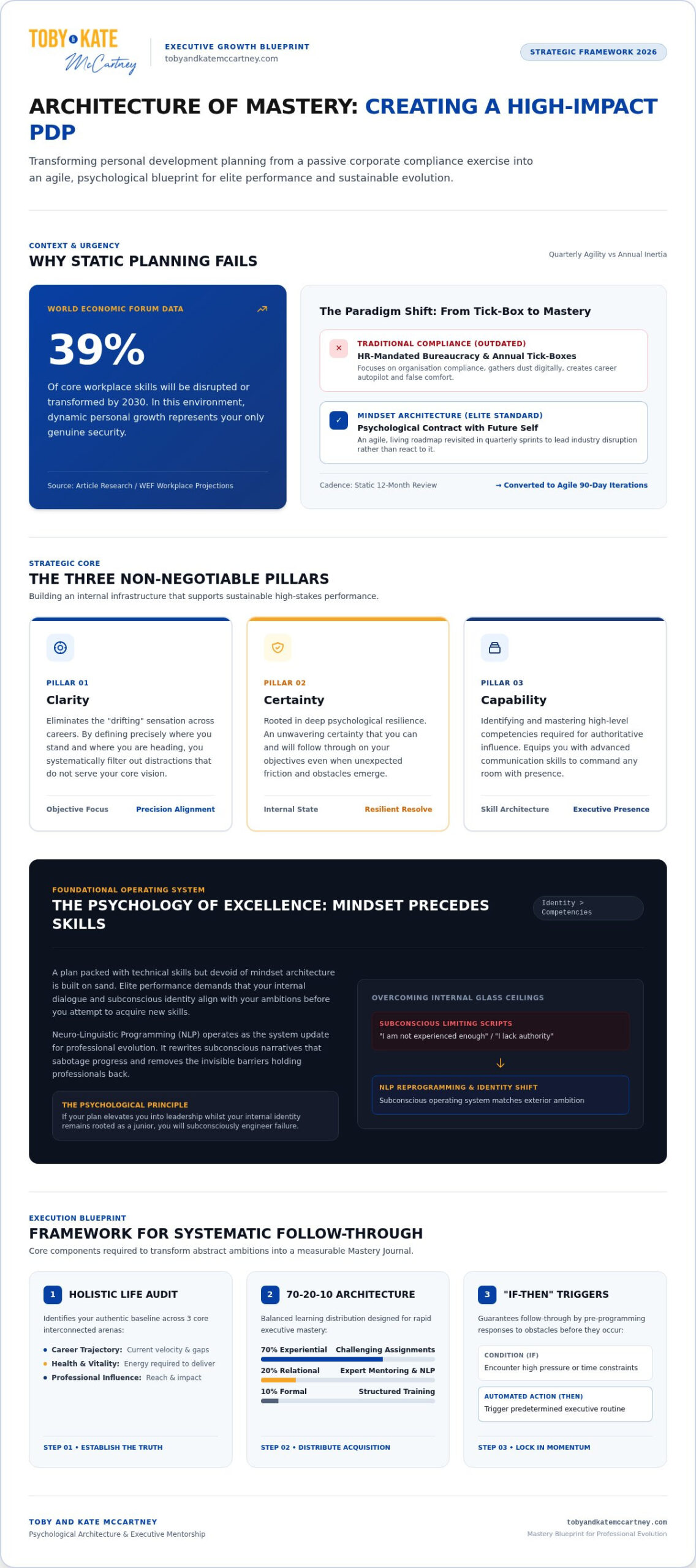
Most professionals treat a Personal Development Plan as a bureaucratic chore. It’s often a dry, HR-mandated document that gathers dust in a digital folder, serving little purpose beyond annual compliance. This traditional approach fails because it focuses on the organisation’s needs whilst ignoring your personal identity and ambitions. True personal development planning is not a record of past training; it’s a psychological contract with your future self. It’s a dynamic roadmap designed to bridge the gap between who you are now and the elite version of yourself you intend to become.
Understanding how to create a personal development plan that actually generates results requires a shift from passive learning to active mastery. You aren’t just “attending courses” or “ticking boxes”. You’re engaging in Mindset Architecture. This means building an internal world of belief and resilience that can support your highest external ambitions. Without this psychological foundation, even the most impressive list of skills will remain untapped potential.
The Three Pillars of a Transformative PDP
To move beyond surface-level growth, your plan must be built on three non-negotiable pillars:
- Clarity: You must know exactly where you’re standing and precisely where you’re heading. Clarity eliminates the “drifting” sensation that plagues most careers by filtering out distractions that don’t serve your ultimate vision.
- Certainty: This is about psychological resilience. It’s the unwavering belief that you can, and will, follow through on your objectives even when the path becomes challenging.
- Capability: You need to identify the high-level skills required for your next level of influence. This might include specialised advanced communication skills training to ensure you can command any room and lead with authority.
Why 2026 Demands a New Approach to Growth
The pace of change has accelerated to a point where static, yearly plans are obsolete. Research from the World Economic Forum indicates that 39% of core workplace skills will be disrupted or transformed by 2030. In this environment, your personal growth is the only true job security you possess. You can’t rely on a fixed set of competencies to carry you through the next decade.
An elite strategy for how to create a personal development plan in 2026 must be agile. It should function as a living document that you revisit and refine in quarterly sprints. This allows you to adapt to emerging technologies and new opportunities whilst maintaining a relentless focus on your long-term mastery. When you treat your development as an iterative process, you stop reacting to the market and start leading it.
The Psychology of Excellence: Why Mindset Must Precede Skills
A Personal Development Plan filled with technical skills but lacking mindset work is destined for the desk drawer. You can’t build a skyscraper on a foundation of sand; similarly, you cannot achieve elite performance if your internal dialogue is whispering doubt. When considering how to create a personal development plan, the most critical variable isn’t your list of objectives. It’s your identity. You must decide who you need to become to inhabit the success you desire. This internal shift is what transforms a static document into a living, breathing transformation. Cultivating an authentic growth mindset is the prerequisite for everything that follows.
Think of Neuro-Linguistic Programming (NLP) as the operating system for your professional evolution. It allows you to reprogram the subconscious patterns that dictate your daily choices. Without this “OS” update, you’ll find yourself reverting to old habits the moment pressure increases. Elite leaders don’t just hope for change; they engineer it by aligning their internal world with their external ambitions. This alignment ensures that every action you take is supported by your subconscious mind, rather than sabotaged by it.
Breaking Through Internal Glass Ceilings
We all have internal glass ceilings. These are the limiting beliefs, the “I’m not enough” or “I don’t have the experience” narratives, that sabotage our progress. If your plan involves stepping into a leadership role whilst you still view yourself as a junior, you’ll subconsciously find ways to fail. Achieving an NLP practitioner certification UK provides the tools to dismantle these barriers at the root. By shifting your identity, you ensure that your behaviours follow naturally. You stop trying to “act” like a leader and simply become one, allowing your growth to feel authentic rather than forced.
The Power of Intentional Behaviour
Busy-ness is the enemy of progress. It’s easy to fill your calendar with tasks that feel productive but lack purpose. Your roadmap must distinguish between noise and needle-moving action. Every entry in your plan should align with your 12-month vision, acting as a deliberate step toward mastery. One of the fastest ways to accelerate this journey is through modelling excellence. Find those who have already reached your desired destination and study their patterns of thought. If you’re serious about mastering how to create a personal development plan that sticks, exploring one-to-one coaching can provide the bespoke clarity needed to refine your trajectory.
Auditing Your Current Reality: The Foundation of Any Plan
You cannot plot a course to a destination if you’re blind to your current coordinates. Most professionals fail in their growth because they focus on the “where” without ever being brutally honest about the “here.” When you’re learning how to create a personal development plan, your first task is a comprehensive audit of your current reality. This isn’t a surface-level review. It’s a deep, analytical dive into your career trajectory, your physical vitality, and your level of professional influence. For active women looking to support their physical strength and wellbeing during this process, GREENDO provides premium natural supplements to complement a high-performance lifestyle. Without this foundation, your plan is merely a list of wishes.
Elite performers use tools like the “Wheel of Life” to visualise their current balance across different domains. You might be excelling in technical delivery whilst your health or leadership influence is stagnant. This imbalance creates a ceiling on your potential. You must be willing to confront the uncomfortable truths about your current performance levels. Are you truly commanding the room, or are you just filling a seat? This level of honesty is the only way to ensure your roadmap is grounded in reality rather than fantasy.
Not all deficiencies are created equal. Skill Gaps are technical. They involve software proficiency, industry regulations, or specific methodologies. Whilst necessary, they rarely provide the highest return on investment for your career. Power Gaps, however, are interpersonal. These are the deficiencies in emotional intelligence, negotiation, and public speaking for leaders. These are the meta-skills that amplify everything else you do. When you prioritise closing Power Gaps, you aren’t just adding a skill; you’re increasing your overall market value and authority.
The Feedback Loop: Seeking External Perspective
We are all prone to “blind spots” in our own performance. You might believe your leadership style is collaborative whilst your team perceives it as indecisive. This is why a solitary audit is rarely enough. To truly understand how to create a personal development plan that works, you need external, objective data. High-level executive coaching and mentoring provides this mirror. A mentor offers the radical candour required to see through your own biases. They help you identify the subtle behaviours that are holding you back, allowing you to refine your plan with surgical precision.
Designing Your Personal Development Plan: A Step-by-Step Framework
Designing your future requires more than a casual list of wishes. It demands a physical manifestation. When you’re mastering how to create a personal development plan, start by ditching the spreadsheets. Invest in a dedicated Mastery Journal. Writing by hand forces a cognitive engagement that digital typing simply cannot replicate. You’re etching your intentions into your subconscious. You must distinguish between Outcome Goals (the “what”) and Process Goals (the “how”). Whilst the outcome provides the direction, the process provides the results. We elevate the traditional SMART acronym to SMART-ER; your goals must be Evaluated and Reviewed constantly to remain relevant.
Step 1 & 2: Vision Casting and Goal Refinement
Start with a “Future Me” statement. Write a vivid description of your professional and personal life exactly 12 months from today. Don’t be modest. Use the present tense to anchor the reality in your mind. From this vision, distil three “Big Rocks”. These are your primary objectives. If a goal doesn’t spark a sense of excitement or even a little healthy fear, it isn’t big enough to pull you through the difficult days. Your goals should be magnets, not chores.
Step 3 & 4: Strategy Selection and Resource Mapping
What specific tools do you need to bridge the gap between your current reality and your vision? Map out the investment required. This might involve high-level training, such as an NLP master practitioner certification, to gain the psychological edge in your industry. Identify your Success Circle. You need mentors who have already walked the path and peers who will challenge your excuses. Growth is a team sport; don’t try to play it solo.
Step 5: The 90-Day Execution Cycle
Annual plans often fail because they lack urgency. Break your year into 90-day sprints. This creates a high-energy rhythm that prevents procrastination. Focus on Lead Measures. These are the specific actions you control daily, like practicing your pitch or completing a study module. Lag Measures, such as a salary increase or a new title, are the results that naturally follow your consistent effort. Establish a weekly review rhythm every Sunday to assess your progress and recalibrate for the week ahead. It’s time to turn your aspirations into an engineered reality.
Ready to refine your roadmap and accelerate your progress? Work with an executive coach to turn your vision into a strategic reality.
From Plan to Mastery: Sustaining Momentum with NLP and Mentoring
Most professionals abandon their growth objectives within three weeks. It’s a phenomenon driven by the friction between a new vision and old habits. When you’ve mastered how to create a personal development plan, you realise that the document is merely the beginning. To achieve elite performance, you must transition from planning to conditioning. This is where Neuro-Linguistic Programming (NLP) becomes your greatest asset. By using techniques such as anchoring, you can link the act of reviewing your plan to a state of high-resourcefulness. You stop fighting your own psychology and start using it as a catalyst for consistency.
Your plan must remain a living document. If it stays in a drawer, it dies. High-performers revisit their trajectory daily, ensuring their actions remain aligned with their 12-month vision. This level of accountability is difficult to maintain in isolation. It requires a structure that challenges your excuses and celebrates your breakthroughs. Without a feedback loop, even the best-designed roadmap eventually succumbs to the gravitational pull of daily “busy-ness.”
The Role of Professional Mentorship
The world’s most influential leaders never work alone. They understand that a mentor provides a “temporal shortcut” to mastery. A mentor has already navigated the pitfalls you’re currently facing; they share their mistakes so you don’t have to repeat them. Whilst a manager is focused on your current output and company KPIs, a mentor is invested in your long-term potential. They see the version of you that hasn’t emerged yet and hold you to that higher standard. This relationship is the difference between incremental progress and a quantum leap in your career trajectory.
Your Next Step: Committing to Excellence
This principle of seeking expert guidance applies to all forms of learning; for students or professionals pursuing academic excellence, you can discover Singapore Home Tuition for personalised one-to-one support.
It’s time to move beyond the theory. You now have the framework for how to create a personal development plan that actually delivers results. The question is whether you have the courage to execute it. Toby and Kate McCartney have spent over two decades helping achievers bridge the gap between ambition and reality. Their approach blends deep psychological expertise with practical leadership strategies, ensuring your growth is both sustainable and measurable.
Don’t just plan your life; master the tools to live it with absolute certainty. Whether you choose one-to-one coaching or a professional NLP Practitioner Certification, the commitment you make today determines your reality in 2026. Step into the version of yourself that is capable of elite performance. Your journey to mastery begins with a single, decisive action.
Your Future is an Engineered Outcome
You now possess the blueprint for elite performance. You’ve moved beyond dry HR templates to embrace a dynamic, psychological approach to growth. True transformation starts with your identity. You must become the person capable of achieving your goals before the results can manifest. By integrating 90-day sprints and seeking external accountability, you ensure that your trajectory remains steep and your momentum stays unbreakable. This is how you outpace the market and lead with authority.
Mastering how to create a personal development plan is the first step toward a career defined by influence and certainty. Toby and Kate McCartney bring decades of experience in high-performance coaching and accredited NLP Trainer Training to support your journey. We are dedicated to fostering national UK leadership excellence through proven, transformative methodologies that work in the real world. It’s time to stop drifting and start designing.
Unleash your potential and master your future with our NLP Certification programmes. Your elite future is waiting; it’s time to claim it.
Frequently Asked Questions
How often should I update my Personal Development Plan?
You should update your plan every 90 days to maintain elite momentum. Static annual reviews are no longer sufficient in a fast-paced professional environment. By breaking your year into quarterly sprints, you can adapt to new opportunities whilst keeping your long-term vision in focus. This iterative process ensures your roadmap remains a living document that reflects your current reality and immediate priorities. Regular reviews prevent drift and keep your energy levels high.
What is the difference between a PDP and a career plan?
A career plan identifies the professional milestones you wish to reach, whilst a Personal Development Plan focuses on the skills and mindset required to inhabit those roles. Think of the career plan as your destination and the PDP as the engine. When learning how to create a personal development plan, you’re mapping out the internal evolution needed to command higher levels of influence. One is about the title; the other is about the person.
Can I create a PDP without my employer’s involvement?
You absolutely can, and should, create a plan independently of your employer. Your personal and professional evolution is your own responsibility; it shouldn’t be limited by corporate budgets or HR templates. Creating an autonomous plan allows you to focus on “Power Gaps” like leadership influence or communication mastery that may not be covered in standard workplace training. This proactive approach ensures you remain the architect of your own career trajectory and ultimate job security.
How many goals should I include in my personal development plan?
Limit your plan to three “Big Rocks” or primary objectives at any one time to ensure maximum focus. Overloading your roadmap with too many goals leads to decision fatigue and diluted effort. By prioritising a small number of high-impact objectives, you can dedicate the necessary time and psychological energy to achieve genuine mastery. Once a goal is reached and the new behaviour is anchored, you can then introduce a fresh challenge to your plan.
What should I do if I fail to meet a deadline in my PDP?
Treat a missed deadline as valuable data rather than a failure. Conduct a brief “post-mortem” to understand whether the timeline was unrealistic or if your daily behaviours were misaligned with your vision. Adjust your strategy and Lead Measures whilst keeping your ultimate Outcome Goal intact. The most successful professionals use these moments to refine their approach and build resilience, ensuring that the journey toward mastery continues without losing momentum or self-belief.
How does NLP help in achieving the goals in my PDP?
NLP provides the psychological tools to align your subconscious mind with your conscious objectives. It helps you identify and reprogram the limiting beliefs that often sabotage long-term growth. When you understand how to create a personal development plan powered by NLP, you can “anchor” peak states of focus and motivation to your daily tasks. This ensures that your plan isn’t just a list of intentions but a series of engineered behaviours that lead to mastery.
Is a personal development plan really necessary for experienced leaders?
A structured plan is essential for experienced leaders who wish to avoid stagnation and lead through disruption. The higher you climb, the more critical your “meta-skills” like emotional intelligence and strategic influence become. Research indicates that 39% of core workplace skills will be disrupted by 2030, meaning even seasoned professionals must commit to continuous evolution. A PDP keeps you sharp, ensuring your leadership style remains relevant and impactful in a changing market.
What are the best resources to include in a 2026 development plan?
The most effective 2026 plans include a mix of formal certifications, such as NLP Practitioner training, and experiential “stretch” assignments. You should also prioritise professional mentorship and one-to-one coaching to gain an objective perspective on your performance. Digital literacy and AI-fluency are important, but the most valuable resources remain those that enhance your human influence and communication. Investing in your “Power Gaps” provides the highest return on your time and financial investment.