
What if your coaching fee reflected the whole journey, not just the hour your client spends with you? If you’re searching for “pricing your coaching services uk”, you may already know that setting a fee can feel personal. You want to value your expertise and preparation without worrying that a higher price will put the right clients off.
Your fee needs to work for both sides. Account for the thinking, planning and business time around each session, then choose a structure that supports the progress your offer is designed to create. A single session, package, programme or retainer can each make sense, depending on the client journey and the support you provide.
This guide will help you calculate a sustainable minimum fee, shape a pricing model around your coaching offer and explain your fees with confidence. You’ll also learn how to set clear boundaries, so clients understand what’s included and you can stand behind the value of your work. Price the journey, not just the hour.
Key Takeaways
- For pricing your coaching services uk, start with the offer, delivery commitments and client fit, rather than choosing a rate at random.
- Work out a sustainable minimum by balancing your income target and business costs against the time you can realistically spend delivering paid work.
- Compare sessions, packages, programmes and retainers to find a structure that suits the client journey and sets clear expectations.
- Test your pricing methodically. Track enquiries, conversions, delivery time and client fit instead of changing your fees after one reaction.
- Build confidence through a clear offer and transparent terms. A strong fee doesn’t have to be the highest possible fee.
Pricing your coaching services in the UK: start with the offer, not a random rate
A coaching fee is more than a figure attached to a conversation. It reflects the service you’re offering, the work involved in delivering it and the client it’s designed to help. Start there, before comparing your rate with someone else’s or choosing a number simply because it feels comfortable.
Sustainable coaching pricing reflects the full delivery commitment, fits the client and supports the ongoing costs of running your UK business. The fee a client pays isn’t the same as your personal income or take-home pay. Business costs, non-billable time and tax obligations all affect what remains. Calculating a fee from session time alone can leave you underestimating what your work requires.
A session may involve reviewing a client’s goals beforehand, preparing questions or resources, writing notes and completing agreed follow-up. You’ll also spend time on administration, marketing and developing your professional skills. Decide which of these commitments are included in each offer before setting its fee. General pricing strategies and models can help you understand different approaches; your coaching offer determines how to apply them.
What exactly is the client paying for?
Describe the scope in everyday language. One offer might include live coaching conversations and a short agreed follow-up; another might include preparation and resources tailored to a development goal. For example, if you coach candidates preparing for formal entrance assessments where they might utilise Reasoning Tests Online for exam practice, be explicit about whether third-party tools are included in the fee or signposted separately. Explain what clients can expect, how they can use any included support and where the engagement ends. This clarity protects your time and helps clients make an informed decision.
Keep the promise realistic. Coaching can create space to explore options, strengthen skills and take purposeful action, but it shouldn’t be presented as a guarantee of a particular promotion, business result or personal transformation. You’re pricing a professional process and your delivery commitments, not a guaranteed outcome.
Who is the coaching offer designed to serve?
Define the client, their goal and the context in which coaching may help. Someone working on a personal professional-development goal—such as a healthcare candidate combining academic mentoring with specialist review tools like pharmedu.com—may need a different structure from a leader developing their influence at work or a business owner seeking support with a specific challenge. A clearly defined client makes it easier to shape relevant preparation, boundaries and follow-up.
That distinction also helps you explain the offer’s value without relying on bold claims. Executive coaching and mentoring focus on leadership development, a more specific context than every form of one-to-one coaching. Name the development context and what your service includes. That’s the starting point for a fee you can explain with confidence.
Calculate a sustainable coaching fee from your capacity and business costs
A fee needs to support the business behind your coaching, not just the time spent with clients. Start with an annual income target and realistic delivery capacity. This gives you a financial floor to assess your offer against, rather than relying on guesswork or a familiar-sounding rate.
A practical calculation for your minimum sustainable fee
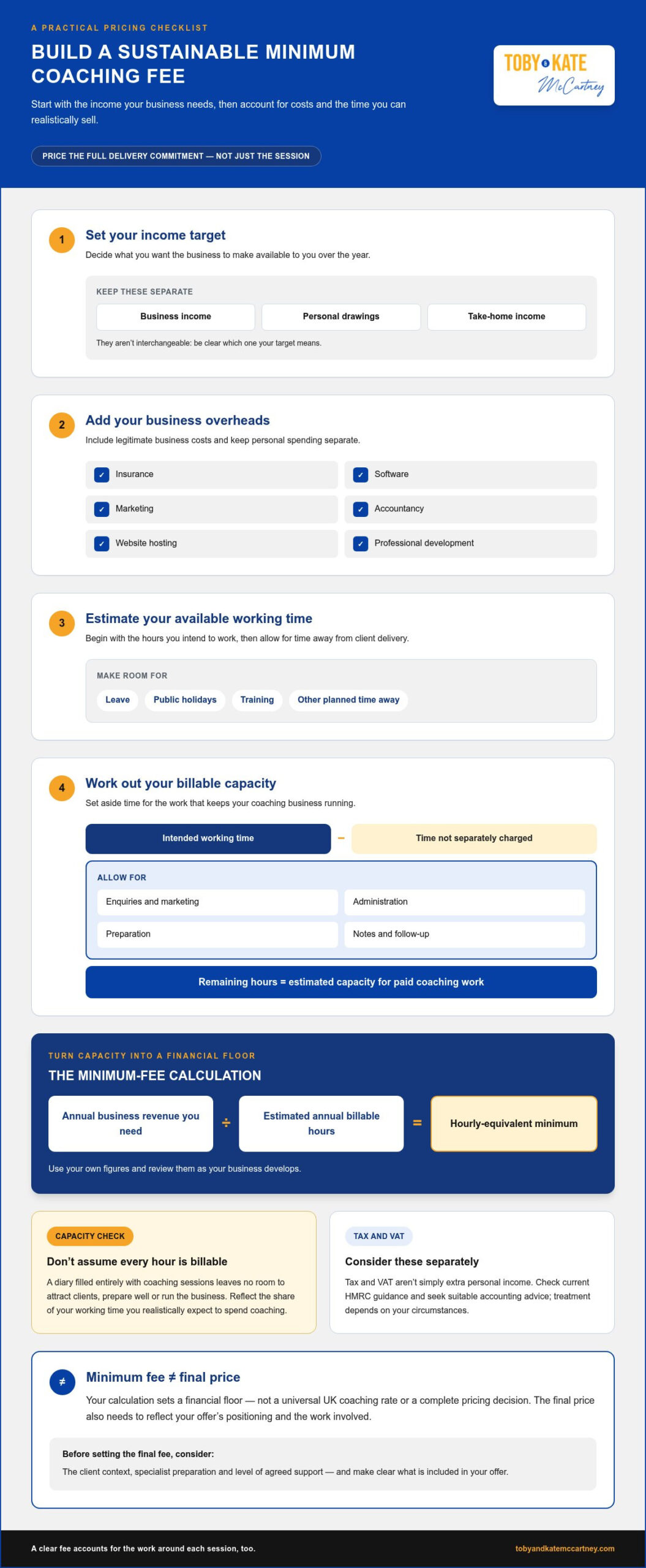
Work through these stages in order, using your own figures and reviewing them as your business develops:
- Set your income target. Decide what you want the business to make available to you over the year. Be clear whether you mean business income, personal drawings or take-home income, as these aren’t interchangeable.
- Add business overheads. Include legitimate costs such as insurance, software, marketing, accountancy, website hosting and professional development. Keep personal spending separate.
- Estimate available working time. Start with the hours you intend to work, then allow for leave, public holidays, training and other planned time away from client delivery.
- Calculate billable capacity. Set aside realistic time for enquiries, marketing, administration, preparation, notes and follow-up. The remaining hours are your estimated capacity for paid coaching work.
Not every working hour can be sold. A diary filled entirely with coaching sessions leaves no room to attract clients, prepare well or run the business. If you expect to coach for only part of your working week, reflect that in your capacity rather than assuming every available hour will be billable.
Worked example using replaceable assumptions: Suppose your plan allows for a chosen number of working weeks and a set number of hours each week. Subtract time for leave, business development, administration and delivery work that isn’t separately charged. The result is your estimated annual billable hours. Divide the annual business revenue you need by those hours to find an hourly-equivalent minimum. Replace every assumption with figures that match your circumstances.
Tax and VAT need separate consideration; they aren’t simply extra personal income. Before publishing a fee or building tax assumptions into your calculation, check current HMRC guidance and seek suitable accounting advice. VAT registration and income-tax treatment depend on your circumstances, so don’t rely on an old calculation.
Why your minimum fee isn’t automatically your final price
Your calculation sets a financial floor, not a universal UK coaching rate or a complete pricing decision. The final price also needs to reflect the offer’s positioning and the work involved. Specialist preparation, a more complex client context or a higher level of agreed support may affect how you structure and present your fee.
Review the scope carefully. If an offer includes extra preparation or follow-up, account for that time in your capacity and pricing assumptions. If the agreed support changes, revisit the calculation rather than quietly absorbing additional work. A professional development pathway, supported by tailored one-to-one coaching and mentoring, starts with understanding what the service requires and what your business needs to sustain it.
Choose a coaching pricing model: sessions, packages, programmes or retainers
The right pricing model makes the shape of your coaching clear before a client commits. It should reflect how you deliver the work, how long the engagement is likely to run and what support you’ve agreed to provide. Don’t use the model to disguise the total commitment: explain the full fee, what’s included and how payment works in plain language.
Use this comparison to identify a structure that fits your offer. The best choice depends on the client’s goal and how you’ll support their progress.
| Model | Best-fit situation | Scope clarity | Flexibility | Administration |
|---|---|---|---|---|
| Single session | A focused topic or flexible starting point | Clear for one meeting | High | Repeat bookings and individual payments to manage |
| Multi-session package | A defined sequence of coaching conversations | Clear if session count and support limits are stated | Moderate | Track sessions, payment and expiry terms |
| Programme | Work with structured stages or a curriculum | Strong when milestones and inclusions are described | Lower within the agreed structure | Coordinate stages, materials and progress reviews |
| Retainer | Ongoing support over an agreed period | Depends on precise availability and deliverables | Can adapt within set boundaries | Manage recurring payments and support expectations |
When does session-based pricing make sense?
A single-session fee can suit narrowly scoped work, such as exploring one defined professional challenge, or a client who values flexibility before committing to a longer journey. Booking is straightforward, but future work isn’t guaranteed, so income may be less predictable. Set out cancellation and rescheduling arrangements, any notice period and whether a booked session expires. Clear terms prevent different assumptions if plans change.
When should you offer a package, programme or retainer?
Choose a package when the work naturally involves a set sequence of sessions and you can state what support is included. A programme is a better fit when coaching follows defined stages, learning themes or a structured curriculum. A retainer needs especially clear boundaries: specify availability, agreed deliverables, response times and what falls outside the arrangement. Don’t imply unlimited access if you’re offering defined support.
Payment design matters too. Upfront payment makes the full commitment clear at the outset; instalments can spread payments over an agreed schedule. In either case, state the total fee and due dates before work begins. For ongoing retainers, explain renewal, notice and any changes to the next period’s scope. In pricing your coaching services uk, transparency is central: clients should be able to see what they’re committing to, regardless of when they pay.
Choose the model that reflects your delivery design. A package isn’t automatically better than sessions, and a retainer shouldn’t blur boundaries. Make the scope, total commitment and terms visible, then select the structure that supports both the client experience and the way you work.
Set, test and communicate your coaching prices with confidence
A considered price is easier to stand behind when you can explain how you arrived at it. Use a simple review sequence: state exactly what the offer includes, check that your calculation supports the delivery time, test your assumptions in real client conversations, then review the evidence. This makes pricing your coaching services uk a business decision you can revisit calmly, rather than a confidence test.
How to test a new fee without undercutting your offer
Pilot one clearly defined offer. Record the time spent preparing, coaching, writing notes and completing agreed follow-up. Also note what prospective clients ask and whether the offer fits their needs. Look for patterns across multiple conversations. One person declining or questioning the fee is useful feedback, but it doesn’t prove that the wider market rejects your price.
If the evidence suggests a change is needed, adjust one element at a time. You might refine the scope, change the format or offer a different payment structure. Changing several things together makes it harder to understand what affected interest or delivery. Track enquiries, conversions, actual delivery time and client fit, not just sales. A high number of enquiries means little if the offer consistently attracts clients it wasn’t designed to serve.
Review your prices with business evidence, not fear. Set a regular point to assess your records, then make a deliberate adjustment if the offer, workload or costs have changed.
How to talk about your fee without apologising
Lead with the purpose and scope of the engagement, then state the fee clearly. For example: “This work focuses on developing your leadership communication through agreed coaching sessions and preparation. The fee is £[amount], payable [payment schedule].” Replace the placeholders with your actual terms. A direct explanation sounds more assured than apologising for the price or listing every task to justify it.
Make the practical details visible before the client commits: what’s included, the total fee, when payment is due, how instalments work if offered, and your cancellation or rescheduling terms. Clear boundaries support trust and prevent expectations about extra contact, resources or availability from quietly expanding beyond the agreed scope.
If a prospective client raises a budget concern, respond with curiosity rather than an immediate discount. Clarify which part of the scope matters most, then consider whether a different format or narrower engagement would still meet the purpose. Don’t promise a particular result to make the fee feel easier to accept. In leadership development, business leadership training in the UK can also help clarify aims and support from the outset.
Confidence grows through practice. Rehearse a short explanation of your offer and fee until it feels clear, not defensive. If you’re strengthening how you communicate professional value, explore leadership training and coaching support as part of your development.
Build a coaching business that supports your value and professional growth
A sustainable coaching business brings four decisions into alignment: a clear offer, a minimum fee that supports your costs and capacity, a pricing model suited to delivery, and transparent terms clients can understand. Together, these provide a repeatable foundation for pricing your coaching services in the UK, without guesswork or copying another coach’s fees.
Confidence doesn’t mean charging the highest possible fee. It means knowing what your offer includes, why it’s priced as it is and who it’s designed to support. An ambitious fee that doesn’t fit the work or client may be just as unhelpful as underpricing. Aim for a price that is sustainable for your business and credible for the value and scope you’re offering.
Review your pricing as your coaching practice evolves
Set a regular review point in your business calendar. Revisit your costs, available capacity, delivery workload and client experience together, rather than changing your fee after one difficult conversation. Ask whether the work still fits the agreed scope and whether your time assumptions match the demands of delivery.
Review the offer sooner if your audience, format or level of support changes. Keep a short record of what prompted each pricing decision, the assumptions behind it and what you’ll monitor next. This helps you make deliberate adjustments, explain them clearly and avoid taking on extra work without reconsidering the offer.
Strengthen the skills behind a confident coaching offer
Your price is only one part of the conversation. Clear communication helps clients understand the scope, boundaries and purpose of your work, so practise describing the offer in plain language. Leadership and public-speaking skills can help you explain professional development confidently to an individual, a team or an organisation.
Professional development is an ongoing pathway. Further learning in coaching, communication or leadership can strengthen your practice and broaden your perspective. NLP training is one option for developing your skills; it isn’t a promise of higher fees or guaranteed business results. Your pricing decisions still need to reflect your offer, delivery and business evidence.
Bring the pieces together: define the work, check that the fee is sustainable, choose a model that fits and state the terms clearly. Then review and refine as your practice develops. You don’t need every decision to be perfect before moving forward. You need a considered approach you can explain and improve.
If you’re ready to explore your next step in coaching or professional development, explore coaching and professional development with Toby and Kate McCartney.
Make your next pricing decision a confident one
Your fee is part of the professional experience you create. It shapes how clients understand your work, the commitment involved and the value of a well-designed development pathway. Confidence doesn’t come from charging the highest possible fee; it comes from making a considered decision you can explain and stand behind.
If you’re refining pricing your coaching services uk, connect the numbers to the people and goals your work is intended to serve. Tailored one-to-one coaching and mentoring, leadership training and public-speaking programmes can each support professional growth in different ways. Choose a next step that fits your development priorities.
Explore coaching and professional development with Toby and Kate to consider a pathway that supports your growth as a coach, leader or communicator. Move forward with purpose. Your expertise deserves a clear, sustainable foundation.
Frequently Asked Questions
How much should I charge for coaching in the UK?
Set a fee that covers your business requirements and reflects the specific coaching offer, rather than choosing a figure from a generic rate list. For pricing your coaching services uk, calculate your financial floor from your income needs, overheads and realistic billable capacity, then consider the scope and specialist demands of the work. Review the result against client interest and delivery experience. The right fee depends on your practice, not a universal UK standard.
Should I charge for a coaching discovery call?
You can charge for a discovery call if it includes substantive coaching, preparation or tailored advice. A brief conversation to understand fit may instead be part of how you introduce the offer. Decide what the call is for and tell prospective clients whether there’s a fee before they book. For example, distinguish an introductory conversation about goals and approach from a paid working session that explores a specific challenge in depth.
Is it better to charge for coaching by the hour or as a package?
Neither format is automatically better. A single-session fee can suit a focused piece of work or someone who wants flexibility, whilst a package may fit a client seeking continuity across an agreed sequence. Consider how much structure the goal needs and whether the client can understand the full commitment. A defined leadership-development objective, for example, may suit a planned series, while a one-off preparation conversation may not need one.
Can I change my coaching prices for existing clients?
Yes, but handle changes transparently and honour the terms already agreed for current work. Check your written agreement, including any review or renewal arrangements, before proposing a new fee. Explain what is changing, when it would take effect and whether the scope is also changing. A client nearing the end of an engagement may find it clearest to discuss the revised fee before agreeing to further sessions or a new phase.
How do I raise my coaching prices without losing clients?
You can’t guarantee every client will stay, but clear communication gives them a fair basis to decide. Give reasonable notice, explain the effective date and state the fee for future work plainly. If your offer has evolved, describe the actual changes in scope or support without overstating outcomes. Where appropriate, discuss a different format that fits the client’s needs and your boundaries, rather than automatically discounting the same service.
Should I offer discounts for coaching packages?
Only offer a discount if the package still makes financial sense and the reason is clear. Check whether the reduced total adequately reflects the time and support involved, and state the full package scope alongside the final fee. A discount isn’t essential to make a package appealing: clients may value a planned sequence, clearer commitment or simpler payment arrangement. Avoid setting a temporary lower fee that you’d feel obliged to maintain indefinitely.
Do UK coaches need to charge VAT?
Not every coach needs to charge VAT. In the UK, a business generally must register when its VAT-taxable turnover exceeds £90,000 over the previous 12 months; the rules can depend on individual circumstances. If you’re VAT-registered, check HMRC guidance on charging and accounting for VAT on your services. Monitor turnover regularly and get qualified tax advice if you’re unsure how the rules apply to your coaching business.