
What if the leadership habit you see as decisive is landing as dismissive? You may intend to move a conversation forward, yet your pace, tone or response to challenge can leave colleagues feeling unheard. Building self-awareness for better leadership starts with noticing the gap between intention and impact, without turning reflection into self-criticism.
If you keep falling into familiar patterns despite good intentions, you’re not alone in finding change difficult. It can be uncomfortable to hear how your behaviour affects others, especially when feedback feels personal. Curiosity gives you a more useful starting point than defensiveness: you can identify what triggers a habitual response and choose what to do next.
This practical guide will help you recognise leadership patterns, understand how they may land with colleagues and turn reflection into deliberate action. You’ll find ways to pause, learn from feedback and make choices that support trust. Self-awareness isn’t about getting everything right. It’s about seeing more clearly, then leading with greater intention.
Key Takeaways
- Build self-awareness by noticing how your values, emotions and habitual responses shape the way you lead.
- Trace a tense moment from trigger to response to see where your intention and its effect on colleagues may differ.
- Practise building self-awareness for better leadership with a short weekly review of one real workplace moment and the behaviour you want to adjust.
- Use neutral reflection to learn from a difficult interaction without turning it into harsh self-criticism or unproductive rumination.
- Consider coaching or leadership development when you’d value structured reflection and another perspective on turning insight into action.
What building self-awareness for better leadership actually means
Leadership self-awareness is the ability to recognise your patterns, values and emotions, and understand how your behaviour affects other people. It helps you see what you bring into a decision or conversation, including assumptions and habits you might otherwise miss. In plain terms: Leadership self-awareness means noticing what shapes your behaviour and how that behaviour is experienced by others.
This is more than knowing whether you prefer a busy office or time to think. Those preferences can be useful, but they don’t reveal how you respond under pressure, what values guide your decisions or whether your communication leaves room for colleagues to contribute. Nor is self-awareness the same as confidence. Confidence can help you act; awareness helps you examine whether your actions fit the situation and the leader you want to be. A broad introduction to the concept of Self-awareness can help place this practice in its psychological context.
What does self-awareness look like in a leader?
In practice, it means spotting an emotional reaction before it takes over. You might notice irritation rising when a colleague challenges a decision, or anxiety pushing you to fill every silence in a meeting. The aim isn’t to suppress the feeling. It’s to recognise it, consider what it may be signalling and decide how to respond.
It also means taking an honest view of your strengths and limits. Perhaps you’re skilled at setting direction but tend to rush through questions. You might value fairness yet assume that a quiet colleague agrees with you. Self-awareness gives you space to test those assumptions rather than treating them as facts.
Hypothetical example: During a project meeting, a manager feels frustrated when a team member raises a risk late in the discussion. Instead of immediately defending the plan, the manager notices the frustration and asks what led to the concern. The conversation may reveal a gap in the process, as well as the manager’s tendency to treat challenge as delay.
Why does self-awareness affect the people you lead?
Colleagues experience leadership through everyday behaviour: your tone when deadlines tighten, whether you listen without interrupting, and whether you follow through on what you’ve agreed. A brief reply may feel efficient to you but dismissive to someone seeking clarity. A quick decision may reflect your confidence, yet leave others unsure whether their input mattered.
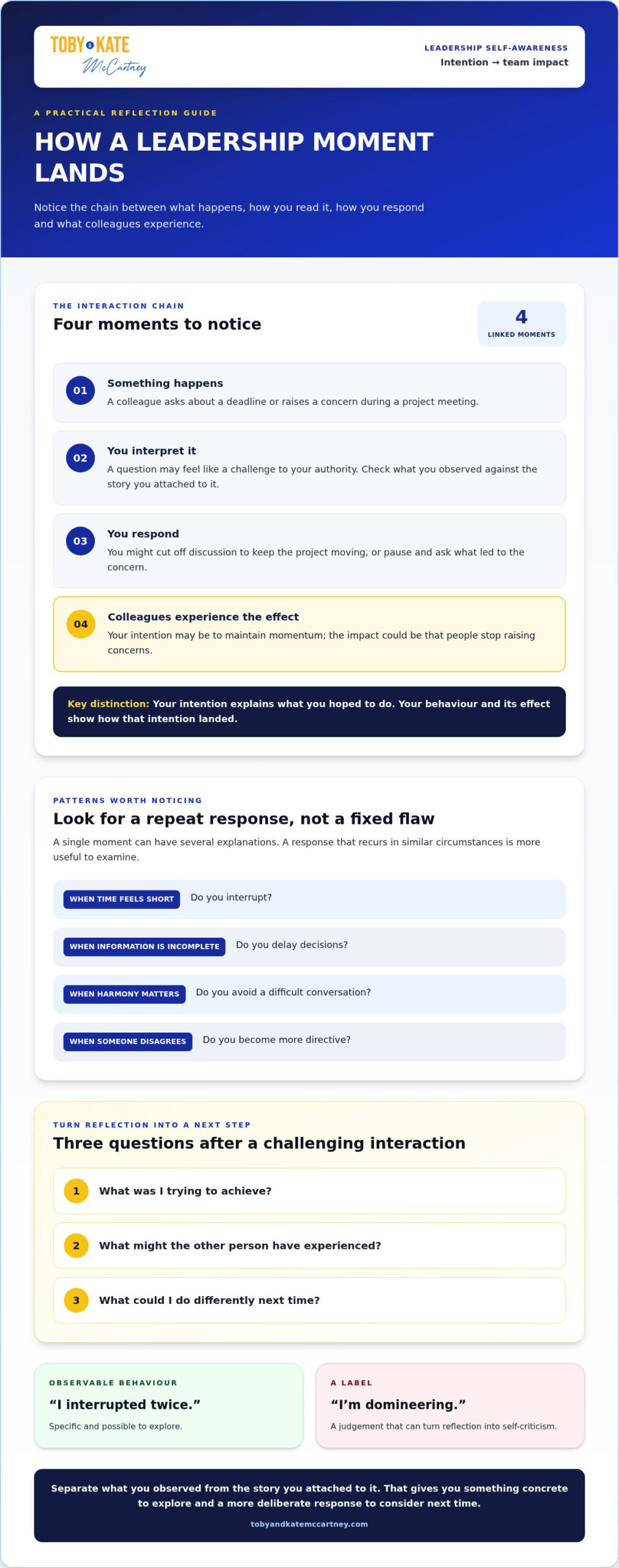
A difference between intention and impact doesn’t mean your intentions are false or that the effect can never change. It means there’s information worth noticing. Ask yourself: What was I trying to achieve? What might the other person have experienced? What could I do differently next time? These questions turn awareness into a practical starting point for more deliberate behaviour. They don’t guarantee a particular response from your team, but they can help you choose your words, listening habits and follow-through with greater care. Building self-awareness for better leadership is not private reflection alone: it’s attention that can shape how you lead at work.
How self-awareness connects leadership intentions with team impact
A leadership moment often follows a quick chain: something happens, you interpret it, you respond, and colleagues experience the effect. A question about a deadline might feel like a challenge to your authority, for example. If you respond by cutting off discussion, your intention may be to keep the project moving, while the impact could be that people stop raising concerns.
Your intention explains what you hoped to do; your behaviour and its effect show how that intention landed. That distinction matters. It lets you examine an interaction without deciding that you’re a bad leader or that a colleague has misunderstood you. As the Harvard Business Review article Cultivating Self-Awareness in Leadership explores, useful self-awareness involves understanding yourself and how others see you.
Your values can guide your choices. If you value fairness, you might invite each person to contribute before making a decision. But assumptions can shape your interpretation: you may read a pause as agreement, or disagreement as resistance, without checking. Separate what you observed from the story you attached to it. “I interrupted twice” is observable; “I’m domineering” is a label. The first gives you something specific to explore and change.
Which leadership patterns are worth noticing?
Look for recurring situations, not proof of a fixed flaw. Do you interrupt when time feels short, delay decisions when information is incomplete, avoid a difficult conversation to preserve harmony, or become more directive when someone disagrees? A single moment may have several explanations. A repeated response in similar circumstances is a more useful pattern to examine.
After a challenging interaction, note the situation, what you did and what happened next. Keep the description behavioural: “I postponed the discussion again” is more helpful than “I’m a conflict-avoider”. This shift turns judgement into an opportunity to choose a different response next time.
How can feedback reveal your blind spots?
Your view of yourself and a colleague’s experience may differ. Neither perspective is the whole picture, but comparing them can reveal something you hadn’t noticed. Ask someone you trust for a specific example: “In that meeting, what did I do when you raised the concern, and how did it affect your willingness to speak?” Listen for observable details before explaining your intention.
The Johari Window is a simple reflection model that maps what’s known or unknown to you and to other people. It highlights a “blind” area: behaviours others notice that you may not. Feedback can make those behaviours visible, while your own reflection may uncover thoughts you haven’t shared. The model isn’t a verdict on your character. Use it as a prompt for a focused conversation.
Building self-awareness for better leadership means testing what you believe about your impact against real interactions, then deciding what behaviour to practise. One-to-one coaching for leadership development can give you a structured space to reflect and plan your next steps. Find out more about one-to-one coaching for leadership development.
Self-awareness or self-criticism: how to tell the difference
Self-awareness isn’t a search for flaws. If every meeting becomes evidence that you’re impatient, ineffective or unfit to lead, reflection has slipped into self-judgement. Useful reflection is more precise: it looks at what happened, what you did and what you might learn. It leaves room for strengths as well as development.
Consider a handover that left a colleague unsure who owned a task. Constructive reflection might identify that you ended the conversation without agreeing responsibilities. Rumination might replay the exchange and conclude, “I always let people down.” The first points towards a practical adjustment; the second turns one moment into a sweeping verdict. Building self-awareness for better leadership means learning from what you can observe, not putting your character on trial.
Useful reflection: Describes a specific action, considers its effect and identifies a possible next step.
Unproductive self-judgement: Uses a difficult moment to condemn your character, replay the past or assume nothing can change.
How can you reflect without turning it into self-criticism?
Keep your review grounded in behaviour. Instead of “I’m a poor communicator”, try “I shared the decision but didn’t explain the reasons behind it.” That description gives you a choice: next time, you could add context or invite questions. Curiosity creates room to act; a character label can make change feel impossible.
Use a few questions to guide your thinking:
- What happened, as someone observing the exchange might describe it?
- What mattered to me in that moment, and what might have mattered to others?
- What would I keep, and what one action could I adjust next time?
Make the final question balanced. Perhaps you explained the decision clearly but moved on before checking whether everyone understood it. Keep the effective behaviour, then choose one thing to practise. Reflection should help you lead with greater intention, not leave you searching for fault in every choice.
What should you do when feedback feels uncomfortable?
When a colleague’s comment stings, pause before defending your intention. Listen to the full point, then ask for a concrete example: “Can you tell me what I said or did, and what happened next?” Specific details are easier to consider than a broad judgement such as “You don’t listen”. You don’t have to agree on the spot.
Afterwards, assess the feedback rather than accepting or rejecting it automatically. Was the behaviour observable? Does the example fit the circumstances? Have you heard a similar concern before, or does it differ from what other colleagues experience? One person’s view is useful information, not a final verdict. A recurring theme may deserve attention; a comment that lacks context may call for a clarifying conversation.
Try writing down the feedback in neutral language, alongside what you were trying to achieve. Then decide whether there’s a small behaviour you want to test, such as leaving more space after asking a question. That keeps the focus on learning and gives you a way to review what changes, without demanding perfection of yourself.
How to build leadership self-awareness with a simple weekly practice
Self-awareness grows through attention and practice, not one dramatic breakthrough. Set aside a few quiet minutes at the end of each week to review a real leadership moment. Keep your notes brief and specific: one situation, your response and what you want to learn. The aim isn’t to analyse every conversation. It’s to spot what repeats and make one deliberate choice about what to try next.
Notice, record, seek perspective, choose one behaviour and review it: this simple cycle turns weekly reflection into more intentional leadership.
- Notice: Recall a moment that prompted a strong reaction, or one that stayed on your mind.
- Record: Describe what happened and what you did, without adding a judgement about your character.
- Seek perspective: Consider what a colleague might have observed, or ask someone you trust for their view.
- Choose one behaviour: Pick a small action to practise in a similar situation.
- Review: After you’ve had a chance to try it, reflect on what happened and what you might adjust.
Which reflection questions help leaders spot patterns?
Use questions that move from the situation to your response, then towards a practical next step. For a few minutes of journalling, you might ask:
- What situation prompted a strong reaction, and what did I do next?
- What assumption, value or concern may have influenced my response?
- What might a colleague have noticed about my words, tone or actions?
- What would I like to try if a similar moment arises?
Write about an actual moment, such as a meeting where you felt pressed for time, rather than a general statement like “I need to communicate better”. Specific notes help you recognise whether the same trigger or response has surfaced before. Include what worked, too. Perhaps you asked a useful question or made space for someone else’s view. That’s behaviour worth keeping.
How can you turn feedback into one practical change?
Choose an action you can notice yourself doing, such as pausing before you respond to a challenge or asking one more question before closing a discussion. Avoid trying to change several habits at once; a small experiment gives you a clearer focus. If you’re inviting a colleague’s perspective, make the question open and specific: “What did you notice when I responded to the concern in that meeting?”
Try the behaviour in relevant situations over the following weeks, then review your notes and invite further perspective if it feels useful. One interaction isn’t proof that the change has worked or failed. Look at what you’re learning across different moments and adjust your approach accordingly. Building self-awareness for better leadership becomes more practical when reflection leads to a behaviour you can test.
One-to-one leadership coaching can help you turn reflection into a focused development plan. Learn more about one-to-one leadership coaching.
How coaching and leadership development can deepen self-awareness
A weekly reflection practice can help you notice what happens in familiar situations. Sometimes, though, it’s hard to see a pattern clearly from inside it, especially when the same communication challenge keeps resurfacing or you’re adjusting to a new leadership responsibility. Structured development offers another perspective, not a shortcut or a requirement for every leader.
Individual reflection is self-directed: you choose the moment to examine and decide what to practise. Guided development adds a conversation, learning structure or outside perspective to help you explore your assumptions, clarify what you want to change and consider possible next steps. The right route depends on your aims, circumstances and preferred way of learning.
When might a leader choose coaching or mentoring?
You might value coaching or mentoring when stepping into a new role, preparing for a difficult conversation or noticing a communication pattern that’s affecting your working relationships. One-to-one coaching can be tailored to individual needs, creating space to examine a specific leadership situation and define what you’d like to handle differently. The conversation doesn’t decide for you; it can help you make your own thinking clearer.
For example, if you tend to delay decisions when colleagues disagree, you could use a coaching conversation to explore what makes those moments difficult, what outcome matters to you and what action you want to test. The executive coaching and mentoring guide offers further context on how guided support can fit into leadership development.
How can structured learning support leadership growth?
Leadership training provides a learning setting in which to explore practical skills and reflect on how you use them at work. It may suit you if you want to develop alongside others or take a more structured approach to leadership. Explore business leadership training in the UK as one possible development route.
NLP training is another optional learning pathway. It can introduce ideas and tools for reflecting on communication and behaviour, but it isn’t a prerequisite for building self-awareness for better leadership, and a course doesn’t guarantee a particular result. The NLP Practitioner Certification guide explains that learning route in more detail.
Whichever approach you choose, connect your development to real situations: a conversation you want to handle differently, a pattern you want to understand or a strength you want to use more deliberately. Reflection remains yours; coaching, mentoring or training can offer additional structure and perspective. Toby and Kate McCartney provide leadership development, one-to-one coaching and mentoring, as well as NLP training and certification.
Make your next leadership choice more intentional
Your next step doesn’t need to be a major overhaul. Choose one moment this week to approach differently: pause before replying, invite a perspective you might usually miss, or make space to explain the thinking behind a decision. Small, deliberate choices give you a way to put building self-awareness for better leadership into practice, one interaction at a time.
If you’d like structured support, Toby and Kate McCartney offer leadership training and business mentorship, alongside one-to-one coaching tailored to individual needs. NLP Practitioner, Master Practitioner and Trainer Training certifications are also available as optional learning pathways. Choose the kind of development that helps you turn reflection into meaningful action at work.
Explore leadership development with Toby and Kate McCartney and take a considered next step towards the leader you want to become.
Frequently Asked Questions
How can I build self-awareness as a leader?
Build it by comparing what you expected to happen with what actually happened in a range of work situations. For example, after delegating a task, note whether the colleague had enough context and authority to proceed, not just whether it was completed. Building self-awareness for better leadership also means looking for useful patterns across decisions, meetings and one-to-one conversations, then deciding what you want to keep or adjust.
What are the signs of a self-aware leader?
A self-aware leader can explain the reasons behind a decision without treating questions as a personal challenge. They’re willing to say when they need more information, notice when their approach isn’t working and repair a conversation if their words have caused confusion. You may also see them adapt how they communicate to the task and people involved, rather than expecting every colleague to respond in the same way.
Can self-awareness improve leadership?
Yes, it can support more considered decisions and working relationships because you’re better placed to notice how your habits affect the way work gets done. If a leader realises that last-minute changes create avoidable pressure, they can give colleagues earlier context or explain what has shifted. Awareness alone won’t resolve every challenge, but it can help you identify where a different leadership choice may be worth testing.
How do leaders identify their blind spots?
Look beyond your own account of events. Compare what you intended with practical signals, such as whether a decision was understood, whether responsibilities were clear and whose contributions shaped a meeting. You could also ask colleagues what would have helped them contribute more effectively. Consider feedback alongside these work outcomes; a single comment may be incomplete, while a recurring theme across situations deserves closer attention.
How often should leaders reflect on their behaviour?
A brief weekly review can help you notice patterns without making reflection another full-time task. Add a short check-in after a particularly consequential conversation or decision, while the details are still clear. Keep the focus narrow: what you did, what the situation required and whether the result matched your aim. If reflection starts to feel repetitive, pause and choose one useful question rather than replaying the whole event.
Does being self-aware mean sharing all your feelings with your team?
No. Self-awareness can help you decide what is useful and appropriate to share. You might tell your team, “I’m concerned about the deadline, so let’s agree what needs to happen first,” without disclosing every private thought behind that concern. Clear, relevant context can help colleagues understand your decisions; thoughtful boundaries help keep the conversation focused on the work and the support the team needs.