What if you didn’t need to eliminate stress to feel more in control of it? Managing stress with nlp techniques is about creating a pause between a trigger and your response, so you can choose what to do next rather than feeling swept along automatically.
If stress seems to switch on before you’ve had time to think, you’re not alone. Advice can also feel too abstract to use when a deadline is looming or a difficult conversation is approaching. This guide offers practical ways to notice early stress signals, identify personal triggers and try a simple technique in a real-life moment.
Here, NLP means Neuro-Linguistic Programming, a set of ideas and skills for exploring how language, attention and behaviour shape your responses. It’s different from Natural Language Processing, the artificial intelligence technology used in some apps. We’ll look at what NLP techniques may offer, where the evidence is still developing, and why they’re not a substitute for mental health care. A calmer response is a skill you can practise, one step at a time.
Key Takeaways
- Managing stress with nlp techniques begins with spotting your personal triggers and the thoughts, feelings and physical cues that appear alongside them.
- Use state awareness to notice what’s happening in the moment before choosing how you want to respond.
- Try a brief, adaptable routine during an everyday stressful situation, without expecting an instant or identical result every time.
- Build your practice through small reflections on the situation, your response and what you noticed, rather than trying to master every technique at once.
- Understand NLP as a personal-development approach, not a diagnosis or treatment, and seek professional mental health support when you need it.
Managing stress with NLP techniques starts with noticing your response
Stress can feel instant. A tense email arrives, a meeting changes direction or a familiar disagreement begins, and your body and thoughts seem to react before you’ve chosen how to respond. That reaction is personal, too: the same situation may feel manageable one day and difficult the next. You don’t have to blame yourself for an automatic response. Start by noticing it.
Managing stress with nlp techniques means using ideas from Neuro-Linguistic Programming to explore how attention, language and learned response patterns may shape your experience. The aim isn’t to erase every source of pressure or promise a cure. It’s to become more aware of what’s happening and create room to make a considered choice.
What stress can look and feel like
Stress can show up physically as a tight jaw, shallow breathing, tense shoulders or restlessness. Emotionally, you might notice irritation, unease or feeling overwhelmed. Your thoughts may race, jump to the worst outcome or become fixed on what could go wrong. These are possible signs to notice, not a diagnosis.
Early awareness gives you a chance to pause before replying, rushing into a decision or avoiding a conversation. Think of one recurring situation that tends to raise your tension. What do you notice first: a bodily cue, a particular thought or a shift in your mood? Naming that first signal can help you recognise the pattern sooner next time.
What NLP can, and cannot, offer
Neuro-Linguistic Programming is a set of communication and personal-development approaches concerned with how people interpret experience and develop patterns of response. For a useful introduction to its background and criticisms, see What is Neuro-linguistic programming (NLP)? In practice, an NLP-inspired exercise might invite you to notice the words you use about a situation, where your attention goes and how you respond.
That makes NLP a framework for reflection and practice, not a guaranteed way to become calm or control everything around you. People respond differently, and an exercise that feels useful to one person may not suit another. Keep your focus modest: observe, try a different perspective or response, and notice what follows without treating one experience as proof of a universal result.
NLP techniques are not a substitute for diagnosis, therapy or other appropriate mental health care. If distress is persistent, severe or interfering with daily life, speak with your GP or a qualified mental health professional. Building self-awareness can be valuable, but you don’t have to manage difficult experiences alone.
How NLP techniques can help you notice and shift a stress response
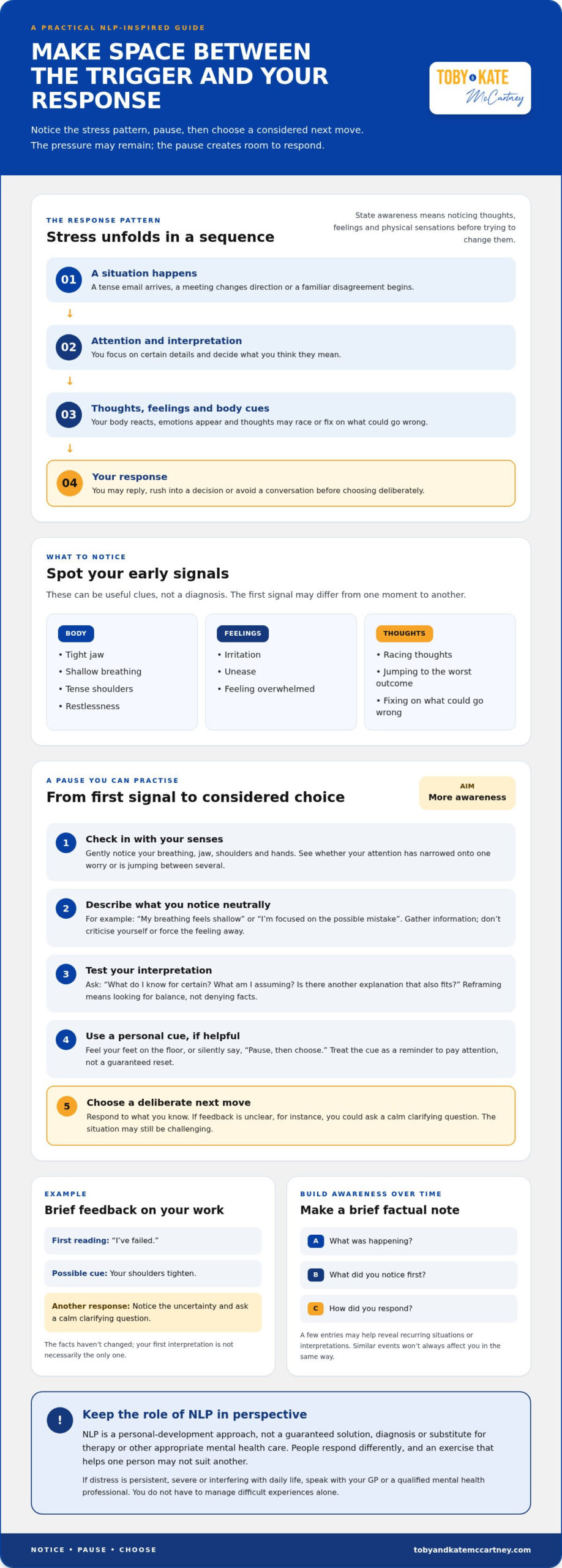
A stress response isn’t shaped by the event alone. Your attention focuses on certain details, you interpret what they mean, your body reacts, and that combination can influence what you do next. State awareness means noticing your present thoughts, feelings and physical sensations without immediately trying to change them. It gives you more information to work with.
For example, imagine receiving brief feedback on a piece of work. You might focus on the lack of praise, interpret the short message as proof that you’ve failed, feel your shoulders tighten and fire off a defensive reply. Another interpretation may become available once you notice that sequence. The facts haven’t changed, but your first reading isn’t the only possible one.
A pause won’t remove the pressure, but it can create space to choose your next move. That space is the practical aim: not forced positivity, but more awareness between what happens and how you respond.
Use sensory awareness to catch rising tension
At a moment of pressure, gently check your breathing, jaw, shoulders and hands. Notice whether your attention has narrowed onto one worry or started jumping between several. Describe what you observe in neutral terms, such as “my breathing feels shallow” or “I’m focused on the possible mistake”. You’re gathering information, not criticising yourself or pushing the feeling away. The physiological effects of stress can involve both body and mind, which makes different kinds of cues useful to notice.
To spot patterns over time, make a brief note after a tense moment: what was happening, what you noticed first and how you responded. Keep it factual. A few entries may help you see whether particular situations or interpretations tend to recur, without assuming every similar event will affect you in the same way.
Use reframing and a chosen cue with care
Reframing means testing a more balanced interpretation, not denying facts or telling yourself that everything is fine. Ask: “What do I know for certain? What am I assuming? Is there another explanation that also fits?” If feedback is unclear, for instance, you can acknowledge the uncertainty and choose to ask a calm clarifying question. The situation may still be challenging; the point is to respond to what you know rather than treating your first thought as the whole story.
You might pair that question with a simple personal cue, such as feeling your feet on the floor or silently saying, “Pause, then choose.” Treat it as a reminder to pay attention, not a guaranteed reset. Practise it in ordinary situations and notice whether it helps you respond more deliberately. If you’d like to explore these ideas in a structured way, NLP learning and development can help you build your understanding and practise the skills over time.
NLP for stress: useful practice, not a magic fix
NLP techniques aren’t instant solutions, and no single exercise works for everyone. They can offer a structured way to examine how you respond to a situation, but they can’t remove external pressures or guarantee that you’ll feel calm. Managing stress with nlp techniques is best approached as a personal-development practice: try an idea, notice your experience and decide whether it’s useful for you.
It also helps to be clear about the boundaries. An exercise for reflecting on your thoughts or preparing a response is not a diagnosis, therapy or treatment for a mental health condition. The source of stress matters, too. A brief pause may help you prepare for a demanding meeting, but it won’t resolve an unsafe situation, an unmanageable workload or another underlying problem on its own.
What a practical NLP exercise may help you practise
Suppose you’re preparing for a challenging conversation with a colleague. Beforehand, you might notice the outcome you’re predicting, the words you’re using to describe the conversation and what happens physically as you imagine it. Then ask what you want to communicate, what facts you know and what response would reflect your intentions. This doesn’t promise an easy discussion. It gives you a chance to prepare with greater awareness.
With practice, an exercise like this may help you recognise familiar response patterns and pause before acting on them. Its value is in the skill you’re practising, not in a claim that it will reliably change your feelings or another person’s behaviour.
Benefits, limitations and sensible cautions
- Potential benefit: A simple reflection can help you notice a trigger, clarify what you’re telling yourself and consider a response that fits the situation.
- Limitation: The exercise may not feel useful, and it won’t control other people, remove practical pressures or guarantee a particular outcome.
- Sensible caution: Context, repetition and the source of stress all matter. Treat your observations as personal experience, not proof that a technique works universally or as a substitute for professional advice.
You can experiment gently. Try the same brief reflection in suitable, everyday situations, then note whether it helped you act in a way you value. If it feels unhelpful or increases your distress, stop and choose another form of support. There’s no requirement to push through an exercise to prove you’re doing it correctly.
When self-guided techniques are not enough
Seek suitable professional support if distress is persistent, worsening or overwhelming, or if it’s making everyday life difficult. An NLP exercise isn’t a replacement for mental health care. If you’re already receiving support or following professional guidance, don’t stop or change that care because of an exercise or an article. Self-reflection can sit alongside appropriate support, but it shouldn’t be asked to do the work of treatment.
A grounded approach is empowering precisely because it respects both possibility and limits. Use NLP ideas to practise noticing and choosing where they’re appropriate, and seek qualified help when your needs call for more.
A simple NLP-inspired routine for a stressful moment
Use this flexible routine when you notice tension rising during an ordinary part of your day, such as before sending a difficult message or starting a demanding task. It isn’t a promise of instant calm. Think of it as a brief way to gather your attention, understand what’s happening and choose a useful next move. You can do it quietly, adapt the wording or skip a step that doesn’t suit you.
Pause, notice and name what is happening
Start by identifying the situation in plain terms: “I’m about to speak in a meeting,” or “I’ve just received an unexpected request.” Then notice your first observable cues. Is your jaw tight? Has your breathing changed? Are your thoughts jumping ahead to what might go wrong? Name the feeling simply, perhaps “nervous”, “frustrated” or “under pressure”. This is a description of your experience, not a diagnosis.
If it feels comfortable, take one unforced breath or allow a brief moment of stillness. You don’t need to make the feeling disappear. The purpose is to acknowledge it before deciding what to do.
Choose a response and review the result
Ask yourself, “What is one useful next step I can take?” Keep the answer realistic and within your control. Before a meeting, that might mean writing down the one point you want to raise. After an unexpected request, it could be asking when it’s needed before agreeing to a deadline. A small, clear action is often more workable than trying to solve the whole situation at once.
Afterwards, take a moment to review what happened. Did you notice a cue earlier than usual? Did the pause affect your next action, even if you still felt tense? If nothing changed, that’s useful information too. Consider whether a different prompt, action or moment to practise might fit better next time. There’s no score to achieve.
Quick summary: a flexible NLP-inspired routine for a stressful moment
- Identify the situation. Describe what is happening in one neutral sentence.
- Notice your cues. Check for a change in breathing, muscle tension, attention or thoughts.
- Name the feeling. Use an everyday word without judging yourself.
- Pause briefly. Take one comfortable breath or allow a moment of stillness, if that feels right.
- Choose one next step. Ask what useful action is within your control.
- Review afterwards. Notice what helped, what didn’t and what you might adjust.
Practising small skills consistently can help you become more familiar with your own responses. If you want to deepen your understanding beyond self-guided exercises, explore NLP Practitioner Certification as a structured way to learn and practise NLP principles. Managing stress with nlp techniques remains an individual process, so use the routine as an experiment, not a guarantee.
Build a lasting stress-management practice with NLP
A useful practice doesn’t depend on mastering every NLP technique. It grows through small, repeatable experiments: notice what happens, try one approach and reflect on what you learn. The aim isn’t to grade yourself or prove that a technique works. It’s to build a clearer picture of your responses and make adjustments that suit your life.
Turn occasional exercises into deliberate practice
Choose one technique you already understand and practise it in a familiar, lower-pressure situation. For instance, if you tend to rush when your diary becomes busy, pause before replying to a routine request and notice what you’re thinking and feeling. Repeating a simple exercise in an ordinary moment can make it easier to remember when a more challenging situation arises. Keep the practice flexible; consistency matters more than getting it “right”.
A brief record can support your reflection. Note the situation, the response you chose and what you observed afterwards. You might write, “I asked for time to check my workload; I felt uncomfortable, but avoided agreeing too quickly.” Avoid drawing sweeping conclusions from one entry. Review your notes from time to time and look for possible patterns, then adjust your approach if it isn’t useful.
Reflection has limits. If a recurring stressor is linked to a practical issue, consider what action could address that issue as well as how you respond. A workload may need a conversation about priorities; an unclear request may call for more information. Changing your perspective doesn’t mean accepting circumstances that need to change.
Explore structured NLP learning when you are ready
Self-guided practice can be a starting point. If you want to develop your understanding further, structured NLP study offers a pathway to explore ideas, practise skills and reflect on how you use them. Learning takes time, and it’s reasonable to approach it with curiosity rather than expecting a qualification or technique to solve every stressful situation.
Toby and Kate McCartney offer NLP Practitioner Certification, NLP Master Practitioner Certification and Trainer Training as structured learning pathways. These are not mental health qualifications and shouldn’t be treated as a substitute for clinical training or care. For development in a professional context, one-to-one coaching and mentoring can also support reflection on communication, leadership and the responses you want to strengthen. The focus is personal or professional development, not diagnosis or treatment.
In the long term, managing stress with nlp techniques means developing a practice that remains realistic: try a skill, note what you observe and make room for practical steps where they’re needed. You don’t have to overhaul your behaviour all at once. Small adjustments can give you useful information about what supports your choices.
If you’re ready to deepen your knowledge, explore the learning pathway that best fits your personal or professional development goals.
Take your next step towards a more considered response
You don’t need to wait for a completely stress-free day to begin changing how you meet pressure. Choose one response you’d like to practise, then give yourself space to learn from each attempt. Progress can start with a single, deliberate choice.
Managing stress with nlp techniques can be one part of a wider personal-development journey, not a promise to remove stress or a replacement for mental health care. If you’re ready to build your understanding beyond individual exercises, NLP Practitioner, Master Practitioner and Trainer Training programmes offer structured ways to learn and practise NLP. Public speaking programmes, professional coaching and mentoring can also support communication and personal or professional development.
Your next step can be simple: explore the learning pathway that feels right for your goals. Explore NLP training and take your next step. With curiosity, practice and the right support, you can keep strengthening your ability to respond with greater intention.
Frequently Asked Questions
Can NLP techniques help with everyday stress?
Some people use NLP approaches to notice familiar patterns and practise responding differently to everyday pressures, such as a packed schedule or a tense household discussion. Managing stress with nlp techniques is a personal-development approach, not a guaranteed result or an established treatment. Try a simple reflection and judge whether it’s useful in your circumstances. If distress persists or significantly affects daily life, speak with an appropriately qualified health professional.
Is NLP a treatment for anxiety or other mental health conditions?
No. This article presents NLP as a personal-development practice, not a way to diagnose or treat anxiety or another mental health condition. If symptoms are ongoing or severe, speak with an appropriately qualified health professional, such as your GP, who can discuss suitable support. Self-guided exercises shouldn’t replace existing care or professional guidance. You deserve help that matches what you’re experiencing, rather than pressure to manage everything alone.
How quickly can NLP techniques reduce stress?
There’s no reliable universal timetable, and an immediate change isn’t guaranteed. A short exercise might help you pause before replying to a demanding message, but your experience will depend on you, the situation and what’s driving the stress. Set realistic expectations: notice what happens over repeated practice rather than judging a technique by one attempt. If the pressure stems from a practical problem, action or professional support may also be needed.
Can I use NLP techniques before a difficult meeting?
Yes, you can try a brief preparation beforehand. Take a moment to notice a physical cue, such as a clenched jaw, then identify one point you want to communicate and one question you may need to ask. This can help you prepare, but it can’t promise to remove nerves or control how the meeting goes. Practise the routine in advance. If stress regularly disrupts work or wellbeing, seek further support.
What should I do if an NLP exercise makes me feel more uncomfortable?
Stop the exercise if you notice that it’s increasing your discomfort. Don’t push through an upsetting response to complete a technique. Instead, turn your attention to something familiar and manageable, such as a routine task or a supportive person or setting. If the distress continues, feels overwhelming or raises concerns about your safety, contact an appropriate health professional or support service for help suited to your situation.
Do I need NLP certification to try an NLP stress-management exercise?
No, you don’t need certification to try a basic reflective exercise for yourself, provided it feels appropriate and comfortable. Formal study is relevant if you want a deeper, structured understanding of NLP ideas and practice. Certification is educational; it doesn’t qualify someone as a clinical mental health professional. Consider your aim: everyday self-reflection calls for curiosity, whilst developing NLP skills more systematically may make structured learning worth exploring.
Can NLP techniques replace professional support for ongoing stress?
No. Self-guided NLP exercises shouldn’t replace appropriate professional support. Persistent, worsening or overwhelming stress deserves attention, particularly if it’s affecting sleep, relationships, work or everyday tasks. Speak with a suitably qualified health professional about what you’re experiencing and the support available. Personal-development tools may be useful alongside professional guidance when appropriate, but they shouldn’t lead you to delay help or change care you’re already receiving.