
What if confidence isn’t something you either have or lack, but something you can build through evidence and action? If self-doubt has made you hesitate over opportunities, or past setbacks shape what you expect to happen next, generic advice to “believe in yourself” may not help in the moment. NLP for building self confidence offers practical ways to notice your inner language, recall times when you handled things well and prepare for a next step.
You don’t need to force yourself to believe an affirmation that feels untrue. Start by recognising what you’ve already managed, then use that evidence to approach a new situation with greater intent. Small actions count. So does learning to pause when a thought tells you that you can’t.
In this guide, you’ll explore everyday NLP exercises for identifying strengths, responding to self-doubt and turning confidence into deliberate action. You’ll also learn how to tell when self-guided practice may not be enough, and how structured NLP training or personalised coaching can support your development.
Key Takeaways
- Explore how nlp for building self confidence can help you respond to hesitation with practical communication and reflection exercises, not guaranteed outcomes.
- Learn to rehearse for situations that trigger worry, reframe harsh self-talk and reconnect with memories of your capability.
- Match an exercise to the kind of self-doubt you’re facing, then choose one small, observable action to take.
- Build a repeatable practice: select a situation, try one technique, take action and reflect on what you learn.
- Discover how NLP Practitioner and Master Practitioner certification, one-to-one coaching and mentoring can provide structured support for developing your skills.
NLP for building self-confidence: what it can help you practise
You have a useful idea in a meeting, but the conversation moves on before you share it. Or a task matters to you, so you keep putting off the first step. That hesitation doesn’t mean you lack ability. It points to a moment where a more deliberate response could help. NLP for building self confidence offers practical ways to examine what’s happening and choose an action, rather than waiting to feel completely sure.
Confidence practice means noticing capabilities you already use and learning to draw on them in situations where you want to act. Neuro-Linguistic Programming, or NLP, is a set of approaches to communication and reflection. Its exercises can prompt you to examine where you direct your attention, how you describe an experience to yourself, what you recall from past events and what you choose to do next. They aren’t a guaranteed cure or a promise that you’ll always feel confident.
Confidence can also depend on the situation. You might feel at ease helping a colleague, yet hesitate to present your own work. Success in one setting can offer useful evidence about your skills, but it won’t automatically remove uncertainty in another. The aim is not to become fearless everywhere. It’s to build a practical bridge between what you can already do and the action you want to take.
What does confidence look like in a real situation?
Feeling confident and acting usefully aren’t the same thing. You may still feel nervous whilst asking a question, contributing an idea or opening a document you’ve been avoiding. Confidence can mean deciding to take that step with uncertainty present, rather than waiting to feel perfectly calm. Afterwards, the action gives you something specific to reflect on.
Make the goal concrete. Instead of “I want to be more confident at work”, identify a moment: “I want to share one suggestion in the project meeting.” Or, “I want to spend ten minutes outlining the difficult task.” Ask yourself what you’d be doing differently if confidence mattered in that situation. A clear example gives you something manageable to practise and review.
How NLP approaches confidence
An NLP exercise might invite you to notice where your attention goes and whether you’re focusing only on what could go wrong. It may help you examine the words you use about yourself or recall a past occasion when you handled a challenge. You can then decide what behaviour would move you towards your goal. These are prompts for reflection and rehearsal, not proof of how a future situation will turn out.
That distinction matters: remembering that you spoke up before doesn’t guarantee a particular response from others next time. It can help you identify skills you used, such as preparing a point or asking for clarification, and decide whether to use them again. The methods of neuro-linguistic programming include approaches such as anchoring and reframing, which later sections put into practical context.
If you want to develop these approaches in a more structured way, the NLP Practitioner Certification guide explains the learning pathway. For now, choose one situation where a small, observable action would make a difference.
How NLP exercises work with self-doubt and remembered success
A memory of handling a challenging moment can remind you of resources you’ve used before. It can’t prove that an upcoming conversation, presentation or task will go exactly as you hope. That distinction keeps confidence practice grounded: you’re drawing on evidence of your own capability, not predicting someone else’s response.
Practice can support confidence, but it can’t guarantee a particular response from you or anyone else. Treat each exercise as a way to prepare, reflect and choose your next action, rather than a promise of instant change. Approaches such as anchoring, reframing and visualisation are discussed in NLP techniques for confidence building. The useful test is whether an exercise helps you take a realistic step.
Anchoring a useful state without promising instant confidence
Choose a genuine memory when you felt capable, even if the situation was ordinary: perhaps you asked for help, solved a practical problem or kept going after a mistake. Recall enough detail to explore what contributed to your response. What was around you? How were you standing or sitting? What were you saying to yourself, and what did you do that helped?
Whilst recalling the moment calmly, pair it with a discreet cue, such as gently pressing a finger and thumb together. This is often called anchoring. Practise bringing the memory to mind with the cue at a quiet moment, without expecting it to switch off nerves or produce a fixed feeling. The purpose is to reconnect with the details of your effective behaviour, then decide whether one of them could be useful now.
Modelling and reframing self-doubt
To learn from someone you admire, notice a specific behaviour rather than trying to copy their personality. Perhaps they pause before answering, prepare a clear opening sentence or ask a direct question. This kind of observation, known in NLP as modelling, turns “I wish I were like them” into a skill you can test in your own style.
When a self-critical thought appears, examine it before accepting it as the whole story. Is it based on one event? What information might it leave out? What would be a more balanced, useful description? Reframing doesn’t mean pretending a setback went well. It means treating it as information: perhaps you need more preparation, a different approach or another attempt, rather than concluding you’re incapable.
Mental rehearsal and the circle of excellence
For a manageable upcoming situation, imagine the setting in specific detail: where you’ll be, what you’ll see and hear, and the moment you want to handle. Picture yourself carrying out one realistic behaviour, such as taking a breath before speaking or asking your prepared question. This is rehearsal, not a guarantee of how the event will unfold.
A circle-of-excellence visualisation is an optional reflection exercise. You might imagine a circle on the floor, recall a time you felt resourceful, and picture stepping into the circle whilst revisiting that memory. Use it to focus your attention, not as a clinical intervention. Then choose one action to try. If you want personalised help applying confidence practices to a meaningful goal, one-to-one coaching and mentoring can provide a structured next step.
Which NLP confidence technique fits your self-doubt?
Start with the pattern you notice, not the technique with the most impressive name. If you’re caught up in what might go wrong, rehearsal can help you plan a response. If your inner commentary turns one setback into a sweeping judgement, try reframing. If you struggle to remember times you’ve coped well, anchoring can help you revisit a relevant example. These are starting points, not diagnoses or a ranking of effectiveness.
Use the guide below to choose one approach for one situation. Then ask whether it helped you take a useful next step. If it didn’t, treat that as information: adjust the exercise, choose a different one or make the action smaller.
| Situation | Exercise to try | First practical action |
|---|---|---|
| You expect to get something wrong | Reframing | Write down the prediction and one step that could test it. |
| You can’t recall what you can already do | Anchoring | Recall a relevant moment and identify one action you took effectively. |
| An important moment is approaching | Mental rehearsal | Picture yourself taking the first useful action, then prepare for it. |
When you expect to get something wrong
Separate a possible outcome from a fixed judgement about your ability. “I might stumble over my words” describes a possibility; “I’m terrible at speaking” turns it into a verdict. Ask yourself: what evidence supports the prediction, and what complicates it? You don’t need to insist everything will go well. Instead, identify a small action that tests the thought, such as preparing one opening sentence or asking one question. Reframing is useful when it gives you a fairer view and a practical way forward.
When you forget what you can already do
Choose a specific time you handled a challenge related to the one ahead. Recall what you did, not just how you felt: perhaps you broke the task into steps, asked for clarification or kept going after an awkward start. An anchoring exercise can pair that memory with a discreet cue, which you practise recalling calmly. The situations won’t be identical, so focus on transferable actions. You can also model a behaviour you admire in someone else, adapting it to your own style rather than copying their whole personality.
When an important moment is approaching
Use brief mental rehearsal to picture the beginning, not a flawless performance. Imagine entering the room, opening your notes or saying your first point. Then pair the image with practical preparation: organise your key points, check what you need or practise the opening aloud. The aim is to make your first action more familiar, not to predict the outcome. Toby and Kate McCartney’s public speaking programmes focus on communication and presentation confidence, making them relevant if your goal is to speak to an audience.
Choose one technique, try it in a real situation and assess what happened: did it help you act, prepare or think more fairly about yourself? That’s a more useful measure of nlp for building self confidence than expecting nerves to disappear.
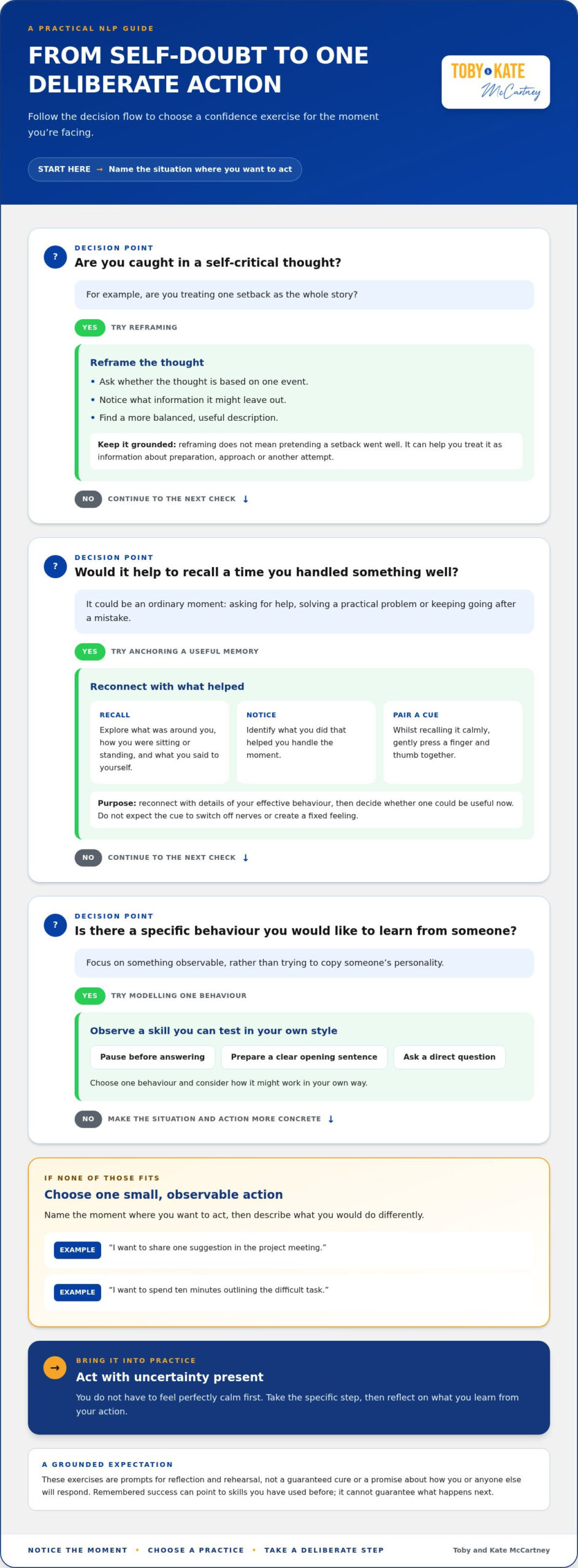
A practical NLP routine for building self-confidence over time
A technique becomes more useful when you connect it to a real moment, take an action and reflect on what happened. Keep the routine simple enough to repeat. You’re not trying to prove your worth or force yourself to feel different; you’re gathering practical evidence about what helps you move forward.
Confidence grows through consistent, meaningful action, not through a promised timeline. One attempt won’t tell you everything, and progress may feel uneven. Focus on what you can practise and observe.
Before the situation: prepare a useful mental cue
Name the situation and the response you want to practise. Make it specific: “I’ll share one idea in the discussion” is easier to act on than “I’ll be confident”. Choose one exercise that fits, such as recalling a relevant success or mentally rehearsing the first step. If a discreet cue helps you reconnect with that memory, practise using it calmly beforehand.
Set an intention around behaviour, not emotion. You might still feel nervous, and that doesn’t mean the preparation has failed. Your goal could be to speak once, begin the first part of a task or ask for clarification. A clear action gives you something achievable to focus on when the moment arrives.
Afterwards: review evidence, not self-worth
Take a moment to record what you did, what helped and what you might adjust next time. For example, perhaps you shared your point even though your voice felt uncertain, or found that writing a prompt beforehand made it easier to begin. Notice the behaviour, not just whether the outcome matched your hopes.
One difficult attempt isn’t a verdict on your ability. Nor does one successful moment mean every future situation will feel easy. Try the same exercise again in a similar context before drawing broad conclusions. This gives you a more grounded picture of which preparation and actions are useful for you.
When to seek more tailored support
Self-guided exercises may not suit every person or challenge. If you’re unsure how to apply a technique to a meaningful goal, one-to-one coaching or mentoring offers personalised support. Structured NLP training can help you develop your understanding and practice. These are personal development pathways, not mental health treatment.
If your difficulties are persistent, seriously distressing or affecting your daily life, consider seeking support from a qualified mental health professional. NLP exercises aren’t a replacement for clinical care. Choosing the right kind of support is a practical step in itself, not a judgement on your capability.
To explore personalised support for applying confidence-building practices to your goals, find out about one-to-one coaching and mentoring.
Take your NLP confidence practice further with structured support
Self-practice can be a useful starting point when you have a specific, everyday goal, such as contributing in a meeting or beginning a task you’ve been putting off. Choose an exercise, try a manageable behaviour and notice what you learn. You may find this is enough to help you make progress independently.
Guided development may suit you if you want to understand recurring patterns, explore NLP approaches more deeply or receive feedback as you practise. The value is in having space to reflect and apply what you’re learning to situations that matter to you. Neither training nor coaching can guarantee a particular confidence outcome.
When self-practice is enough and when guidance can help
Keep practising on your own if the goal is clear and you can review your actions constructively. Consider tailored guidance if you’re unsure how to adapt an exercise, keep encountering the same obstacle or want another perspective on your approach. For instance, working with an experienced manifestation coach UK can assist in shifting limiting mindset patterns, whilst one-to-one coaching and mentoring help you work towards personal goals through reflection and practice. They are personal development support, not treatment for mental health conditions.
Choose a learning pathway that matches your next goal
If you want to develop your understanding of NLP through structured learning, NLP Practitioner Certification offers a pathway to build your knowledge and skills. NLP Master Practitioner Certification is a further development route for those looking to continue their NLP learning. The right direction depends on what you want to learn and how you hope to apply it.
For a goal centred on speaking to an audience, public speaking programmes focus on communication and confidence. They can be a relevant route if you want to practise presenting, rather than exploring NLP as a broader set of approaches. One-to-one coaching or mentoring provides personalised support for applying confidence-building practices to a meaningful goal.
Take the next step with Toby and Kate McCartney
The core practice remains grounded: recall genuine examples of capability, choose a useful behaviour and review what happened. You don’t need to wait until you feel entirely confident before acting. Each deliberate attempt can give you more insight into what helps, what you want to adjust and where further learning may be valuable.
If you’re ready to develop your NLP skills beyond self-guided exercises, structured training can deepen your learning, whilst coaching and mentoring can help you apply it to your own objectives. Choose the pathway that fits what you want to work towards, without expecting any single approach to produce the same result for everyone.
Explore NLP training and coaching and take a considered next step in your confidence practice.
Make your next step a deliberate one
Confidence doesn’t have to arrive before you move. Start with one meaningful action, then decide what you want to practise next. That shift puts you in a stronger position: you’re no longer waiting for certainty, you’re building experience through choices you can make and review.
If you’d like to take nlp for building self confidence further, choose a pathway that fits your goals. NLP Practitioner and Master Practitioner certification programmes offer structured learning, whilst one-to-one coaching and mentoring can support personal application. Public speaking programmes may suit you if you want to develop confidence in front of an audience.
There’s no need to have every step mapped out. Start with the situation that matters most, and build from there with thoughtful practice and support that matches your ambitions.
Explore NLP training and coaching, and take your next step with purpose. You have more capability to draw on than self-doubt may let you see.
Frequently Asked Questions
Can NLP help build self-confidence?
NLP exercises may help you approach confidence as a skill to practise, rather than a fixed trait, but they can’t guarantee a particular change. For example, before asking your manager to clarify priorities, notice the language driving your hesitation and choose a response that reflects what you need. The value of nlp for building self confidence lies in whether the approach helps you act more deliberately in situations that matter to you.
How long does it take for NLP to improve confidence?
There’s no set timescale, and an exercise may feel useful in one situation without changing how you respond in another. Rather than waiting for a particular feeling, track a practical sign of progress: are you beginning a task sooner, putting forward a question or recovering more readily after a difficult exchange? Reviewing those specific behaviours across relevant situations can give you a clearer picture than judging progress by one experience.
Can I practise NLP confidence techniques on my own?
Yes, you can try a straightforward exercise independently, especially when working towards a specific everyday goal. Keep notes on what you tried and what you noticed, so you can make a considered adjustment rather than simply repeating an exercise by habit. Choose a manageable situation and stop if recalling an experience feels overwhelming. If you’re uncertain how to adapt a technique or want feedback, structured learning or one-to-one coaching may help.
What is the difference between NLP anchoring and positive affirmations?
Anchoring involves using a cue to help recall a specific experience or state; an affirmation is a statement you repeat to yourself. For instance, a cue might remind you of a time you stayed focused, whilst a phrase could be, “I can prepare carefully even if I feel nervous.” Choose wording that feels believable. If a sweeping statement feels false, a realistic phrase based on your actions may be a more comfortable starting point.
Can NLP help with confidence at work or in interviews?
NLP exercises can help you prepare how you want to communicate, though they can’t determine how an interviewer or colleague will respond. Before an interview, identify a relevant example from your work, decide what you want the listener to understand and practise expressing it clearly. For a workplace conversation, consider the specific point or request you need to make. Practical preparation keeps the focus on what you can contribute.
Is NLP a treatment for social anxiety or low self-esteem?
No. NLP is used for personal development and coaching, not as a clinical treatment for social anxiety or low self-esteem. If these difficulties are persistent, seriously distressing or interfering with everyday life, consider speaking with a qualified mental health professional about appropriate support. Personal development exercises may help with particular goals, but they shouldn’t replace clinical care when that’s what you need.