
Remote teams don’t need constant supervision; they need clear agreements and leadership that fits the work. Managing remote teams effectively means setting expectations for communication, availability, responsibilities and outcomes, then adapting your approach to the people and tasks involved. The aim is clarity and accountability without treating online activity as a measure of contribution.
You already know that working apart can make it harder to read the room, resolve uncertainty and keep people aligned. Managing remote teams effectively isn’t about adding meetings or checking every message. It’s about setting shared expectations so everyone knows what to do, when to communicate and how their work contributes.
This article explains how to set practical communication norms, adapt your management approach to your team’s needs, and support training and leadership in a remote setting. You’ll learn to focus on outcomes, make room for regular feedback and build trust while respecting the boundary between work and personal time. Put these choices into practice step by step.
Key Takeaways
- Agree which channels suit different conversations, when people are expected to be available, and how quickly messages need a response.
- Shape meeting rhythms around your team’s needs, making space for balanced contributions and purposeful one-to-one conversations.
- Use regular feedback, role-relevant learning and peer support to help remote employees develop and feel connected.
- Assign work with clear ownership and deadlines, then assess progress by results while respecting personal boundaries.
1. Communication norms and response-time expectations
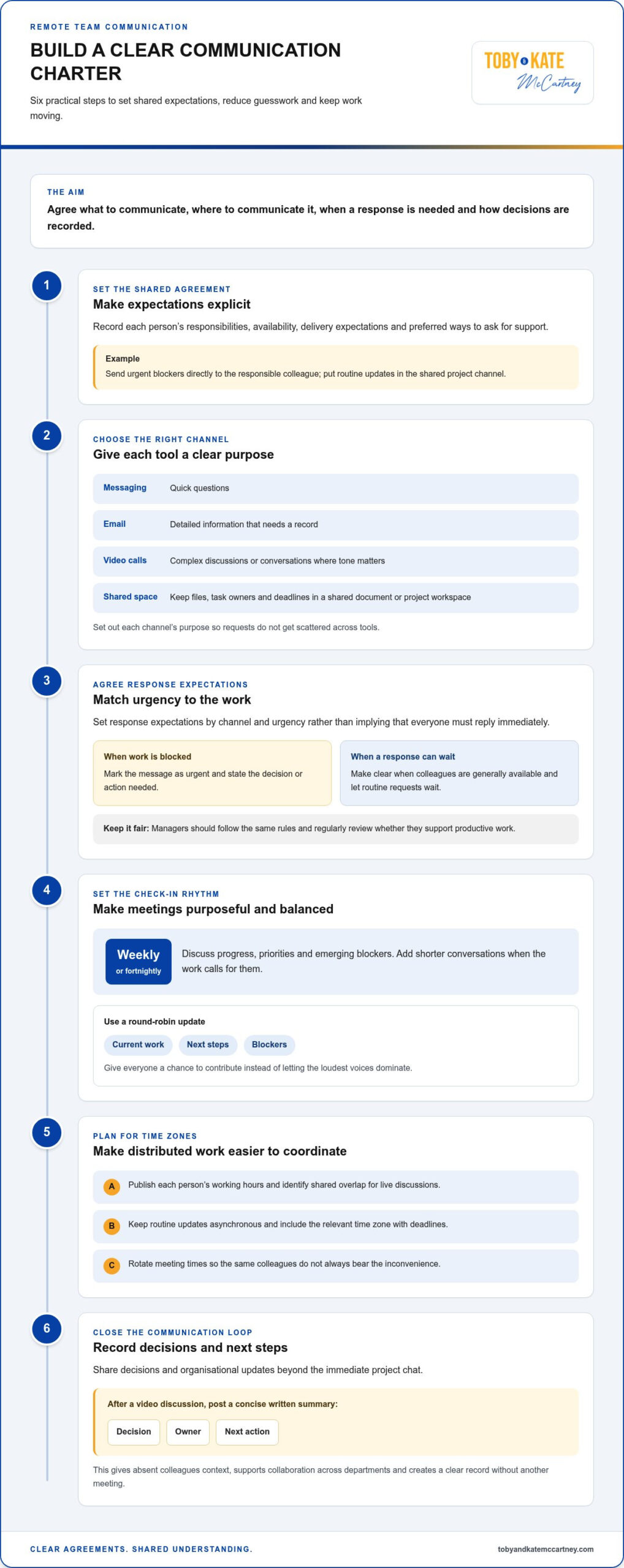
A clear communication charter helps remote teams work with less guesswork. Record each person’s responsibilities, availability, delivery expectations and preferred ways to ask for support. For example, agree that urgent blockers go directly to the responsible colleague, while routine updates go in the shared project channel. This shared agreement helps the team collaborate and resolve disagreements.
Which tools work best for remote team communication and collaboration? Use messaging for quick questions, email for detailed information that needs a record, and video calls for complex discussions or conversations where tone matters. Keep files, task owners and deadlines in a shared document or project workspace. Set out each channel’s purpose so requests don’t get scattered across tools.
Set response-time expectations by channel and urgency instead of implying that everyone must reply immediately. Clarify when colleagues are generally available, how to flag a time-sensitive issue and when a response can wait. For instance, mark a message as urgent only when work is blocked, and state the decision or action needed. Managers should follow the same rules and regularly review whether they support productive work.
How often should remote teams hold meetings and check-ins? Schedule weekly or fortnightly check-ins to discuss progress, priorities and emerging blockers, adding shorter conversations when the work calls for them. A round-robin update gives everyone a chance to share current work and next steps, rather than letting the loudest voices dominate.
How can managers handle time zone differences in distributed teams? Publish each person’s working hours and identify any shared overlap for live discussions. Keep routine updates asynchronous, include the relevant time zone with deadlines, and rotate meeting times so the same colleagues don’t always bear the inconvenience.
Transparent communication means sharing decisions and organisational updates beyond the immediate project chat. After a video discussion, post a concise written summary of the decision, owner and next action. This gives absent colleagues context, supports collaboration across departments and provides a clear record without another meeting.
2. Tailoring management practices to team needs
Remote work calls for clear roles, but the right management rhythm depends on the team’s tasks and experience. Only about half of professionals understand what their work expects of them. Make responsibilities, deadlines and decision-making authority explicit, then invite team members to flag gaps. A new starter may need closer guidance on priorities; an experienced colleague may need more autonomy and regular space to raise obstacles.
Design meetings to encourage participation. Harvard DCE recommends asking open-ended questions and ensuring everyone contributes. Send an agenda in advance, invite each person’s view and let quieter colleagues respond in chat or after the meeting. Balance airtime rather than treating silence as agreement. A camera can help a manager convey presence, but participation shouldn’t depend on being on camera.
Build team belonging through deliberate opportunities to connect, not just task updates. Harvard DCE recommends setting aside time to catch up at the start of meetings and using virtual celebrations, book clubs or game nights to strengthen relationships. Pairing an experienced colleague with a newcomer can also encourage knowledge-sharing. These activities help remote workers find support and foster collaboration.
Turn these habits into a team agreement covering how decisions are made, disagreements are raised and people ask for help. Invite the group to shape it, then revisit it as projects or needs change. For example, agree that concerns can be raised without blame, with discussion focused on the work rather than personal fault. This supports psychological safety and clearer collaboration.
The University of Cambridge recommends regular one-to-one and team meetings to provide structure and continuity. Set the cadence around the work: short daily chats may help a team facing shifting priorities, while a weekly discussion may suit steady projects. Use one-to-ones to ask what support each person needs, and team sessions to surface shared dependencies. Review the routine regularly so it stays responsive to the team.
3. Do remote employees need different training?
Remote employees need training suited to how they learn and work, but not necessarily different subject matter. Begin onboarding with a clear role outline, a guided tour of shared systems and a practical first task. Pair newcomers with experienced colleagues who can explain team routines and answer questions. Then agree learning goals and revisit them through regular feedback.
Inclusive virtual meetings need more than a video link. Share materials beforehand, ask open questions and invite contributions by voice or chat. Make room for each person to speak, and follow up privately if someone hasn’t had a chance to contribute. Employees who regularly meet their managers are three times more engaged than peers who don’t, making consistent interactions valuable for development.
Build trust by clarifying what employees can decide independently and when they should seek input. Give feedback on specific work, invite employees to assess their own progress and recognise useful contributions publicly. Monthly performance check-ins provide a structured opportunity to discuss development and concerns. Pulse surveys can also help managers spot changes in morale and respond.
Training should include wellbeing and connection, not just systems and tasks. Nineteen per cent of remote employees report loneliness as their biggest challenge, while 22 per cent say switching off after work is their biggest challenge. Ask about workload, isolation and boundaries during check-ins. Casual group conversations and peer mentoring can strengthen connection without turning every interaction into a formal review.
What are effective ways to onboard and train remote employees? Combine written guidance, demonstrations, supported practice and follow-up conversations, then tailor the learning to the role. Employees whose managers help set work priorities and performance goals are 69 per cent engaged, so make goals part of the onboarding process.
What UK employment, health and safety, and data protection rules apply to remote workers? Clearly agree working arrangements and responsibilities, discuss home-working conditions to support healthy and safe work, and handle personal and confidential information appropriately. For staff covered by the Equality Act, discuss reasonable adjustments, including alternatives if existing adjustments can’t continue during remote work.
4. Adapting management styles to remote teams
Remote leadership works best when you replace visibility with clarity. Set the outcome, decision boundaries and available support, then let people choose how to complete the work. A manager who relies on green status indicators may mistake online presence for progress. Instead, discuss the agreed result and remove barriers to delivery.
For collaborative work, make ownership clear by naming the task owner and deadline. Harvard DCE recommends clarifying how work is generated, assigned, communicated and prioritised. For example, if two colleagues share a project, identify who makes the final decision and where it will be recorded. This prevents duplicated effort and gives everyone a clear route when priorities conflict.
Assess results, not hours logged or constant online activity. Agree what evidence will show progress, such as a completed milestone, a recorded decision or a submitted client deliverable. Repeatedly requesting updates can interrupt focused work. Planned milestone reviews give you a clearer view of delivery and let employees raise blockers before deadlines slip.
What are common challenges of managing remote teams, and how can you address them? Unclear ownership, isolation and blurred work boundaries can undermine performance. Assign responsibilities clearly, hold regular virtual huddles to discuss workflow and wellbeing, and respect agreed personal time. Schedule one-to-ones with direct reports, and use brief, unplanned check-ins when a meeting suggests someone needs support.
Leadership also means organising the workplace around focused work. Harvard DCE recommends setting aside meeting-free time, such as a daily block from noon to 2 pm. Protecting that shared focus period can reduce interruptions, especially when tasks require concentration. Encourage employees to set boundaries and model the behaviour yourself by avoiding unnecessary messages outside agreed working hours.
When you want to strengthen the leadership skills behind these practices, explore leadership training for remote team management. Apply the learning by reviewing one team routine, clarifying its purpose and agreeing how you’ll assess whether it supports progress.
Toby and Kate McCartney: NLP Practitioner Certification
Toby and Kate McCartney’s NLP Practitioner Certification is a development pathway for strengthening communication and personal effectiveness at work. If you want to build on the practical management approaches in this article, NLP training can help you explore how you communicate, listen and respond to others. These skills are relevant when leading remote conversations, giving feedback or supporting team members with different needs.
Choose a learning path that matches your goals. NLP Practitioner Certification is a starting point, while NLP Master Practitioner Certification offers a further stage of study. Public Speaking programmes can help you build confidence when presenting ideas, and NLP Trainer Training is for those aiming to develop as trainers. Consider which capability you want to strengthen first.
To explore a learning pathway for your professional development, contact Toby and Kate McCartney or visit tobyandkatemccartney.com.
Make your next leadership move deliberate
Turn your intention into a leadership practice your team can feel. Choose one interaction to improve this week, then ask what made it clearer, more inclusive or easier to act on. This gives you a practical starting point for managing remote teams effectively, with the focus on how people work together, not where they log in. Treat each adjustment as a learning cycle: observe, invite input, refine and share what changes.
For a deeper development pathway, Toby and Kate McCartney offer NLP Practitioner Certification and NLP Master Practitioner Certification, alongside Public Speaking programmes. These can support your communication and confidence as you take on greater responsibility. Choose the area that matches the leadership capability you want to strengthen next.
Contact Toby and Kate McCartney to explore a suitable next step. Keep learning, stay curious about your team’s experience and lead with intention.
Frequently Asked Questions
What is remote workforce management?
Remote workforce management is how leaders coordinate, support and evaluate people working away from a shared workplace. It includes setting priorities, enabling collaboration, tracking outcomes and addressing barriers such as isolation or unclear decisions. For example, a manager might give a distributed project team a shared brief and named decision-maker, then review whether employees have the resources to deliver their responsibilities.
Do remote employees need different training?
Remote employees often need training in formats that work well without in-person support, even when the subject matter is the same. Use short demonstrations, recorded reference material and realistic practice with the tools employees use daily. For example, let a new team member rehearse a client handover in a virtual session, then give feedback on the process and communication.
How do I keep remote workers engaged and motivated?
Connect each person’s work to a meaningful purpose and give them appropriate ownership over how they achieve it. Ask what kind of recognition they find useful: some people value public praise, while others prefer private acknowledgement. Watch for signs of overload, such as repeatedly postponed breaks or difficulty switching off, and discuss manageable priorities before frustration becomes disengagement.
How do you build culture in a remote team?
Build culture through consistent behaviour, not slogans. Show team values in everyday decisions, such as how colleagues share credit or respond when a project encounters difficulty. Create a simple ritual to welcome new starters, and record stories that demonstrate the behaviours the team wants to reinforce. Leaders shape culture when their actions match the standards they set.
What are KPIs for remote teams?
Useful KPIs measure the quality and impact of work, not whether someone appears online. Depending on the role, track customer satisfaction, error rates, rework, revenue contribution or the quality of completed deliverables. Choose indicators employees can influence, explain how they’re assessed, and review them alongside context such as workload or shifting priorities. Metrics should guide improvement, not encourage box-ticking.
What are the best practices for managing remote teams effectively?
Effective practices combine clear ownership with trust and regular learning. Give each project a defined outcome, decision-maker and way to raise risks. Review whether team routines help work progress, then address one point of friction at a time. If approvals stall, for instance, clarify who has authority to decide. Keep the process adaptable as responsibilities and team needs evolve.