
A tailored proposal to an event whose audience matches your expertise is a practical route to learning how to get professional speaking engagements. Lead with a useful talk idea, explain what attendees will learn and show why your experience suits the session. Visibility matters too: organisers need clear evidence of what you can bring to the stage.
You may know your subject inside out, but turning that knowledge into a compelling speaking pitch takes a different skill set. A strong proposal is neither a general biography nor a sales pitch. It connects your message to the event’s aims and helps organisers picture you speaking to their audience.
This guide shows you how to build visibility, demonstrate your expertise and find events that fit your goals. You’ll learn to shape a focused talk, prepare useful speaker materials, start with accessible opportunities and tailor each proposal to the event. Then you can pitch with greater clarity and confidence, making every submission a considered step towards the right stage.
Key Takeaways
- Build a visible speaker profile with clear materials that help event organisers understand your expertise and style.
- Use articles, webinars and podcasts to make your ideas accessible and demonstrate the value you bring to an audience.
- Start with panels and smaller speaking opportunities to practise your message and develop stage experience.
- Assess each event’s audience, format and reputation before deciding whether it supports your professional goals.
- Tailor your proposal to the event, with a focused abstract, relevant biography and clear learning points for attendees.
Building visibility through speaking engagements
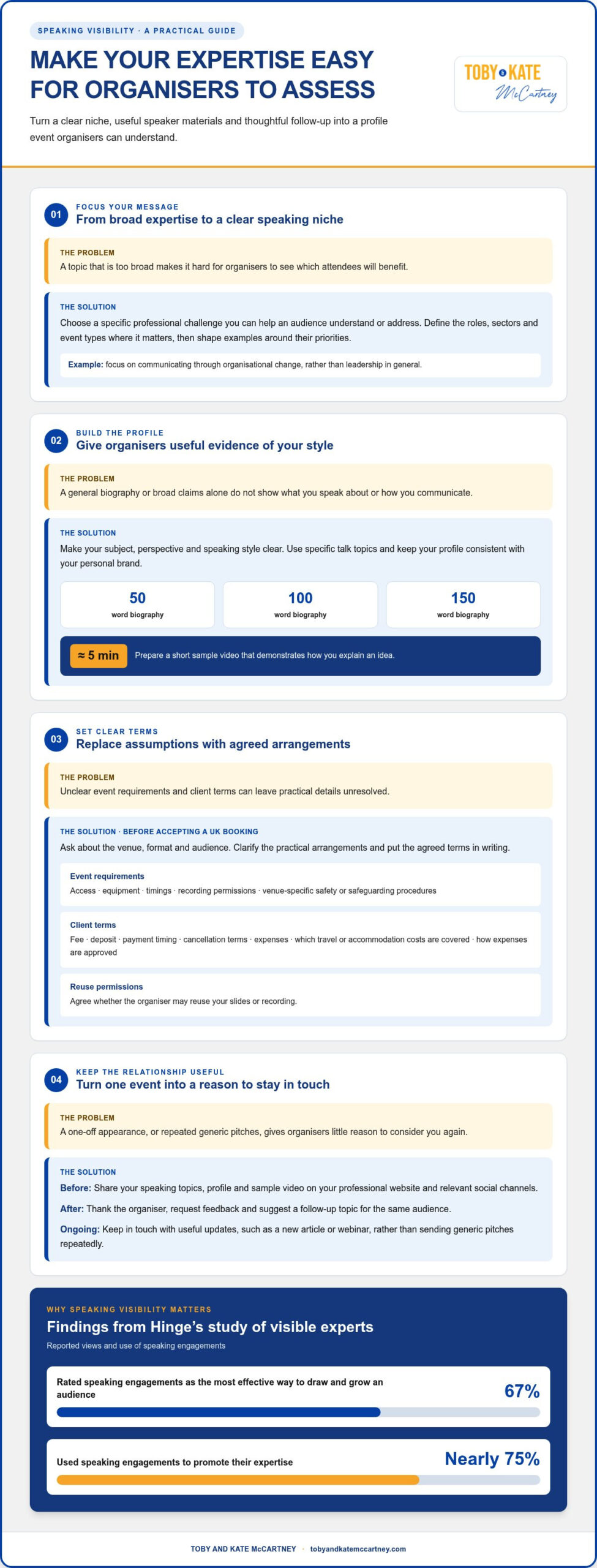
Build visibility by defining the audience you serve and making your expertise easy for organisers to assess. A focused profile and thoughtful follow-up can turn each event into a platform for future opportunities.
-
Define your speaking niche and audience
Choose a specific professional challenge you can help an audience understand or address. For example, a leadership speaker might focus on communicating through organisational change, rather than covering leadership in general. Identify the roles, sectors and event types where that topic matters, then shape your examples around their priorities. Avoid a niche so broad that organisers cannot tell which attendees will benefit.
-
Build a compelling speaker profile
Present your expertise in a concise profile that makes your subject, perspective and speaking style clear. Prepare biographies in 50-, 100- and 150-word versions, so organisers can use the length that suits their event materials. Add a short sample video, about five minutes long, that demonstrates how you explain an idea. Keep the profile consistent with your personal brand, and use specific talk topics rather than broad claims.
-
Agree event requirements and client terms
Before accepting a UK booking, ask the organiser about the venue, format and audience, then agree the practical arrangements. Requirements vary by event, so clarify access, equipment, timings, recording permissions and any venue-specific safety or safeguarding procedures. Put the fee, deposit, payment timing, cancellation terms and expenses in writing. Specify which travel or accommodation costs are covered, how expenses are approved and whether the organiser may reuse your slides or recording.
-
Promote your services and build connections
Share your speaking topics, profile and sample video on your professional website and relevant social channels. After an event, thank the organiser, request feedback and suggest a follow-up topic for the same audience. Keep in touch with useful updates, such as a new article or webinar, rather than sending generic pitches repeatedly. This builds a working relationship and gives organisers a clear reason to consider you again.
Speaking can also strengthen your reach beyond the room: an event agenda may be seen by hundreds or even thousands of people online. In Hinge’s study of visible experts, 67% rated speaking engagements as the most effective way to draw and grow an audience, whilst nearly 75% used them to promote their expertise.
Showcasing expertise through articles, webinars and podcasts
Turn your ideas into useful content that lets event organisers experience your expertise before booking you. Articles, webinars and podcasts also help you refine your message for conferences and other speaking opportunities.
- Publish articles that demonstrate your thinking. Choose a recurring question in your field and answer it with a clear framework or practical example. A leadership article, for instance, could explain how to structure a difficult team conversation. Share it on your professional website or contribute it to a relevant industry publication. Each piece should show how you think, not simply announce that you’re available to speak.
- Use webinars to practise delivering ideas live. Build a focused session around one audience challenge, then invite questions to find out what people find useful or confusing. A webinar on presenting change to colleagues could combine a short teaching segment with a worked example. Record the session and review your pacing, explanations and responses. With permission, use a short excerpt to demonstrate your delivery style.
- Appear on podcasts and relevant online conversations. Pitch podcast hosts a specific discussion angle, such as lessons from a project or a fresh perspective on an industry problem. Prepare concise examples and avoid turning the interview into a sales pitch. Share the published episode with your network and add it to your speaker profile. This gives conference organisers another way to assess your expertise and communication.
- Build proof through practice and feedback. Seek opportunities to speak at internal meetings, professional networks, community events or online panels. After each session, note what resonated, refine one section and request a brief testimonial from the organiser. Hinge’s study of 220 visible experts found 61% ranked authoring a book as the second most effective technique for promoting expertise, while 37% had written one. A book can support your profile, but consistent useful content also makes your ideas discoverable.
Bring these channels together: link an article to a webinar, then use a podcast conversation to explore the same idea from another angle. If you want to strengthen your delivery as you build this portfolio, Public Speaking programmes can support focused practice.
When an opportunity fits, turn your existing material into a focused proposal. A speaker proposal commonly includes a presentation abstract, a biography, details of your speaking expertise and submission by the proposal deadline. Use the abstract to connect your subject to the audience’s challenge, and keep your biography aligned with the expertise demonstrated in your articles, webinars and podcast appearances. Check that your examples and delivery evidence support the same central idea.
Starting with panels, webinars and other smaller opportunities
Build experience through focused sessions before pursuing larger conference slots. A speaking opportunity doesn’t have to be a keynote in front of 500 people.
Professional speakers’ fees vary with the event format, preparation, travel and value delivered. Set your fee by weighing those factors, then agree the amount and expenses with the organiser before accepting.
UK speakers can explore speaker bureaus, speaker directories and professional networks to find bookings. Use these alongside direct approaches to event organisers, rather than relying on one route.
-
Research and identify speaking opportunities
Search for events whose attendees match the industries and customers you want to reach. Review organisers’ event pages, past programmes and social media to understand their themes and preferred formats. For example, a leadership speaker could look for a business network hosting a session on managing organisational change. Record the event, organiser, audience and submission route in a simple tracker.
-
Connect with professional organisations and networks
Approach professional organisations whose members face the challenge your talk addresses. Membership groups, trade associations and business networks may host panels, webinars or events. Introduce your topic to the programme organiser with a concise explanation of its relevance. Speaker bureaus and directories can also make your profile discoverable, but keep your profile current and continue building direct relationships with organisers.
- Offer a practical panel contribution. Panels let you demonstrate expertise through concise answers and interaction with other speakers. Study the theme and prepare a clear viewpoint, one example and a useful takeaway. If the discussion concerns workplace change, explain an approach leaders can apply instead of repeating general advice. After the event, thank the moderator and ask which future themes would serve the audience.
- Pitch a webinar that solves one defined problem. Suggest a focused online session to an organisation with a relevant membership or customer base. Outline the audience challenge, the key idea and how attendees can apply it afterwards. A webinar on giving clearer project updates, for instance, could include a short demonstration and audience questions. Keep the format manageable and confirm the platform, timing and promotional responsibilities with the organiser.
- Turn each appearance into a next step. Before an event, agree how the organiser will introduce you and whether they’ll share your profile. Afterwards, send a concise thank-you and one relevant follow-up idea. Track responses and bookings alongside the event type and audience. This helps you identify which panels, webinars and professional networks create the strongest connections, so you can focus future pitches.
Assessing event relevance, format and reputation
Assess each event against your audience, the session format and the professional value of participating. Reviewing its programme, organiser and practical arrangements can reveal whether your contribution fits.
- Match the event to your intended audience. Read the event description and identify who is likely to attend, what matters to them and what they should take away. A session for senior managers may suit a talk on leading change, while an event for early-career professionals may need practical guidance on building influence. Prioritise opportunities where your expertise answers a clear audience need.
- Check that the format suits your material. Review whether the organiser wants a keynote, workshop, panel contribution or online presentation. A detailed framework may work best in a workshop, where attendees can practise applying it. A panel calls for concise points and responsive discussion. Compare the session brief with your proposed content, and avoid forcing a prepared talk into a format that will not serve attendees.
- Assess the organiser’s track record. Examine past programmes, speaker names, attendee feedback and the consistency of event communications. For example, a regularly updated programme with clear session descriptions gives you useful context about the event’s focus. Look for alignment between the stated audience and the speakers or topics featured previously. This helps you judge whether the event’s reputation supports your professional visibility goals.
- Clarify the practical expectations before committing. Confirm the session length, location, audience size, equipment and preparation required. A typical presentation may last 50-60 minutes, but the organiser’s brief should guide your plan. Ask how the event will handle introductions, questions, recording and promotion. These details affect how you prepare, what materials you provide and whether the opportunity fits your schedule.
- Weigh the value, not just the fee. The vast majority of speaking engagements are unpaid, and organisers often reserve payment for the keynote speaker and possibly one or two featured speakers. Consider audience relevance, exposure, networking potential and preparation before accepting. An unpaid session may support your goals if it reaches the right people, but decline opportunities whose demands outweigh their professional value.
When learning how to get professional speaking engagements, target audiences should always include your desired customers and key industries. To showcase your expertise effectively to organisers, prepare a concise sample video lasting around five minutes. Industry research highlights that event marketing remains a vital channel, with businesses increasingly prioritising structured pre-event programmes to maximise audience engagement and participation.
Crafting tailored speaker proposals
A strong proposal shows an organiser that your session fits the event and serves its audience. Learning how to get professional speaking engagements means adapting each submission to the event’s purpose, rather than sending a generic description of your expertise.
- Study the event brief and submission deadline. Read the organiser’s call for speakers, programme themes and audience description before drafting. Note the required format, submission method and deadline, then plan backwards to allow time for editing. If the event focuses on workplace communication, shape your pitch around a relevant challenge rather than sending an unrelated talk. Follow the requested format precisely, because missing details can make a suitable idea harder to assess.
- Write a focused presentation abstract. Open with the audience’s problem, then explain your central idea and what attendees will gain. For a session on leading through change, describe the practical decisions participants will be better equipped to make. Make the abstract specific enough to distinguish your talk from a broad overview. Tailor the language and examples to the event’s stated aims, and remove claims that do not explain the session’s value.
- Set out three to five learning points. Give organisers clear outcomes they can use to assess the session. Start each point with an action, such as identifying a communication barrier, planning a team conversation or adapting a message for different stakeholders. Keep each outcome connected to the abstract. Avoid promising results outside the session’s control; focus on knowledge, methods or tools attendees can take away and apply.
- Adapt your biography and evidence for the event. Select experience that supports the proposed topic, rather than listing every role or achievement. A leadership conference needs leadership-related evidence, while a communication event calls for examples that demonstrate expertise in that area. Use the requested biography length and make sure the details match your abstract. Include relevant speaking experience or a sample that helps organisers picture your delivery.
- Review, submit and track the proposal. Check that your title, abstract, learning points and biography tell one coherent story. Confirm that you have included all requested information, then submit before the deadline. Record the event, submission date and any response in a simple tracker. This helps you refine future pitches and see what organisers respond to. It’s a practical way to improve how to get professional speaking engagements without sending the same pitch everywhere.
Clear proposals start with confident delivery. Develop your public speaking skills to strengthen how you present your expertise to event organisers and audiences.
Toby and Kate McCartney: NLP Practitioner Certification
Toby and Kate McCartney’s NLP Practitioner Certification offers a development pathway for professionals seeking to strengthen their personal and professional capabilities. If you’re building a speaking profile and want to deepen your approach to communication, NLP training can complement the practical work of preparing talks and engaging audiences.
For a more advanced pathway, the NLP Master Practitioner Certification builds on the Practitioner level. Public Speaking programmes are directly relevant if your priority is developing your speaking skills, while NLP Trainer Training may suit those interested in delivering NLP training. Choose the direction that best matches your goals and the expertise you want to bring to future engagements.
Explore Toby and Kate McCartney’s training options on their website and choose a next step that aligns with your goals.
Make your next speaking move with confidence
Turn your speaking ambition into a deliberate development goal. Decide which capability you want to strengthen, whether shaping your message, speaking with greater confidence or deepening your professional communication skills. A focused goal gives you a clear direction for continued growth.
If you’re considering how to get professional speaking engagements, developing your skills alongside your speaker profile can help you prepare for new opportunities. Toby and Kate McCartney offer Public Speaking programmes, as well as NLP Practitioner Certification and NLP Master Practitioner Certification for those seeking broader personal and professional development.
Choose the pathway that fits what you want to build next. Contact Toby and Kate McCartney to explore your development options and take your next step with purpose.
Frequently Asked Questions
How do you create a speaker bio, topic list, and showreel?
Build each asset around the audience benefit you can deliver. In your bio, connect your professional experience to your speaking subject, then state what attendees can learn. Give each talk a specific title and describe the challenge it addresses. For a showreel, select clear excerpts that demonstrate your delivery, presence and ability to explain ideas. Use accurate captions and get permission before sharing recorded event footage.
Where can you find professional speaking opportunities in the UK?
Look for speaker calls on conference websites, professional-body newsletters, trade-association pages and event organisers’ social media accounts. Search by your subject and the audience you want to reach, such as “leadership conference speaker call”. Check university enterprise events, business networks and industry webinars for smaller sessions. Keep a record of the organiser, event theme and application route so you can respond promptly when a suitable opportunity appears.
How do you pitch yourself to event organisers and conference planners?
Lead with a session idea that meets the event’s stated purpose, then briefly explain why you can deliver it. A concise email might refer to a programme theme and propose a talk that gives attendees a practical tool. Include relevant experience and a link to your speaker materials, then follow the organiser’s submission instructions. Keep the message focused on audience value, rather than asking for a platform to promote your business.
Should you speak for free to build experience, and when is it worthwhile?
Unpaid speaking can be worthwhile when the audience closely matches your goals and the preparation is manageable. The vast majority of speaking engagements are unpaid, and organisers often reserve payment for the keynote and possibly one or two featured speakers. Before agreeing, weigh the expected audience, travel and preparation, as well as any recording or reuse of your material. Clarify expenses and permissions in writing, and decline if the commitment offers little professional value.
How can you build credibility and testimonials when you are a new speaker?
Start with a short session for a team, professional network or community group, then ask the organiser for specific feedback. Request permission to quote their comments, and clearly identify who provided them and which session they describe. You can also publish a short article that develops the talk’s central idea. For example, a new speaker on project communication could share a practical meeting framework and invite readers to discuss it at an event.
How much do professional speakers charge in the UK, and how should you set your fee?
Weigh those factors, then agree the fee and expenses with the organiser before accepting, and put the arrangements in writing.