
Executive presence isn’t reserved for the boardroom. Executive presence training in the UK can help professionals at every level communicate with greater confidence and influence. It develops practical skills for expressing ideas clearly, building trust and contributing with authority in important conversations.
You may know your subject inside out yet still struggle to hold attention in a senior meeting or make a presentation compelling. That’s a skill gap you can address. Confident body language, assertive communication and thoughtful listening can help make your expertise visible without losing your authentic style.
This guide explains who the training suits and how it can build leadership confidence, stakeholder influence and stronger performance in senior meetings. It also explores the often-overlooked practice that turns insight into action: speaking in front of an audience, refining your presentations and responding to challenging questions. You’ll leave with a clearer picture of the skills involved and how to choose a development pathway that fits your goals.
Key Takeaways
- Identify whether your next development step is clearer communication, more confident body language or stronger performance in presentations.
- Build stakeholder trust by adapting your message, listening actively and staying composed when challenged.
- Prepare for senior meetings by clarifying your priorities, anticipating competing agendas and making your contribution concise.
- Choose training that gives you opportunities to practise, reflect and apply leadership skills to real workplace situations.
- Explore public speaking programmes or NLP training when you want a structured pathway to strengthen communication and influence.
Who Should Attend this Executive Leadership Presence Training?
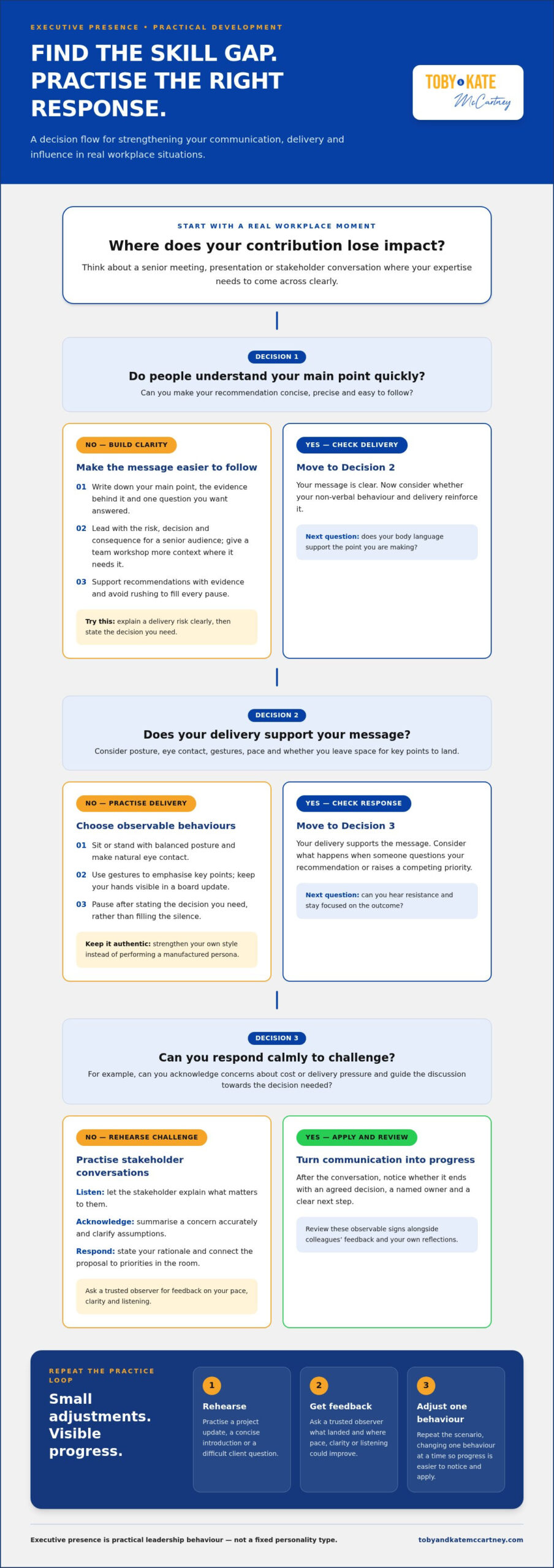
Executive presence training in the UK can suit professionals at different career stages, not just established directors. It’s especially relevant when your expertise is strong but your contributions get lost in meetings, presentations or conversations with senior stakeholders. A project lead, for example, may need to explain a delivery risk clearly, then respond calmly when colleagues challenge the recommendation. The focus is practical leadership behaviour, not adopting a manufactured persona.
Body language shapes how others receive your words. Start with three observable habits: sit or stand with balanced posture, make natural eye contact and use gestures to emphasise key points. In a board update, for instance, keep your hands visible and pause after stating the decision you need. These choices can help you appear authoritative and trustworthy while still feeling comfortable and authentic.
Practise charisma in business situations rather than treating it as an abstract quality. Rehearse a concise introduction for a networking event, a project update for colleagues and a response to a difficult client question. Ask a trusted observer for feedback on your pace, clarity and listening. Then repeat the scenario, changing one behaviour at a time. This practice loop makes progress easier to notice and apply.
Gravitas comes from the connection between what you say and how you say it. Choose precise language, support recommendations with evidence and avoid rushing to fill every pause. Your professional appearance also sends a message, but it should suit the workplace and occasion. Ask whether your clothing, posture and tone support the purpose of the meeting or distract from your contribution.
Executive storytelling helps leaders make strategy meaningful. Use a simple sequence: describe the current challenge, explain why it matters and show the future your proposal supports. For example, a team leader introducing a new process can connect a recurring customer problem to the change and its intended benefit. This structure gives stakeholders a clear reason to engage with the vision.
Mindset influences non-verbal communication. Before a high-stakes discussion, write down your main point, the evidence behind it and one question you want answered. This preparation can reduce the urge to over-explain. Adapt your communication to the room, too: a concise recommendation may suit a senior meeting, while a team workshop may need more context and discussion.
Executive presence training in the UK varies in content and intended outcomes. Some programmes focus on presentation practice; others address communication, stakeholder influence or leadership behaviours. Compare the practical exercises and feedback, then match them to the workplace situations you need to handle.
Employer support depends on the organisation’s development budget and policies. Ask your manager or learning and development team whether executive coaching or training can be funded through an existing professional development scheme.
Common criticisms include pressure to conform to a narrow idea of authority, excessive focus on appearance and treating confidence as performance. A useful course should develop adaptable communication and self-awareness, not ask you to hide your identity or imitate someone else.
Leadership confidence and stakeholder engagement
Leadership confidence grows when you can explain a decision, hear resistance and stay focused on the outcome. Imagine presenting a revised timetable to finance and operations. Finance questions the cost, while operations flags delivery pressure. Executive presence training in the UK can help you prepare a clear rationale, acknowledge both concerns and guide discussion towards the decision needed. Influence comes from making your thinking easy to follow, not simply speaking more forcefully.
Leadership presence is the impression your choices create across everyday interactions. Before a project review, identify the message you want colleagues to remember. During the meeting, listen without interrupting, summarise a concern accurately, then state your recommendation. This sequence shows respect and direction. It also aligns your words and behaviour, helping colleagues see both confidence and authenticity.
To develop influence, adapt your language to the people involved. A technical team may need implementation details, while a board audience may need the risk, decision and consequence first. Ask stakeholders what matters to them, then connect your proposal to those priorities. Active listening can reveal competing agendas early, giving you a chance to clarify assumptions before disagreement hardens into resistance.
Leadership impact is visible in what happens after the conversation. For example, note whether a meeting ends with an agreed decision, a named owner and a clear next step. These are observable signs that communication has moved work forward. They don’t prove that training caused the result, but they give you practical evidence to review alongside colleagues’ feedback and your own reflections.
Look for an executive presence coach with relevant leadership and communication experience, a clear coaching approach and examples of helping professionals practise workplace situations. Ask how sessions identify behaviours, use feedback and turn learning into action. A coach should help you strengthen your own style, rather than prescribe one personality or presentation standard. For instance, rehearse a difficult stakeholder conversation, review what landed, then practise a more concise response.
Measure return on investment by setting a baseline before coaching begins. Choose workplace indicators linked to your goal, such as clearer meeting decisions, stronger stakeholder feedback or greater confidence presenting recommendations. Review them with your manager after applying new behaviours, and consider what else may have influenced the change. This creates a focused cycle: define the behaviour, practise it, gather feedback and adjust.
When you want structured support to translate insight into workplace behaviour, explore leadership development support as one possible next step.
Stakeholder influence and senior meetings
Influence in senior meetings depends on preparation, clear reasoning and awareness of competing agendas. A practical approach helps you contribute with purpose, even without formal authority.
Influence in Senior Meetings
Before a meeting, map each stakeholder’s priorities, likely concerns and decision-making role. For a proposal affecting finance and operations, prepare the financial rationale and delivery implications separately. Open with the decision required, then connect your recommendation to organisational goals. This structure helps senior colleagues see the issue quickly and gives the discussion a clear direction.
Influence without authority comes from making collaboration easier. Share relevant evidence before the meeting, invite concerns and credit colleagues’ contributions. If a senior stakeholder challenges your assumptions, clarify what evidence would change your recommendation. This keeps the conversation focused on the decision, not status. Training can help you practise these responses and navigate complex stakeholder dynamics or competing agendas.
Credibility also depends on how you handle uncertainty. State what is known, what remains unresolved and how you propose managing the risk. For example, if a delivery date depends on supplier approval, explain the dependency and offer a decision point. This is more persuasive than presenting an uncertain forecast as settled fact.
Building Stakeholder Buy-In and Credibility
Stakeholder buy-in grows when people can see their priorities reflected in your proposal. Identify the shared outcome first, then explain how your recommendation addresses different concerns. A service change, for instance, may improve customer response while requiring teams to adjust their processes. Acknowledge both sides openly and invite stakeholders to shape the implementation.
Persuasion is not pressure. Build a case with relevant evidence, a clear benefit and a specific request. Ask questions to uncover objections, then respond directly rather than repeating your pitch. If a stakeholder disagrees, summarise their point accurately before explaining your view. This shows respect and helps establish whether the disagreement is about evidence, priorities or timing.
After the meeting, reinforce agreed actions in a concise follow-up. Record the decision, owner, next step and any unresolved risk. If a stakeholder raises a concern, address it with the information you promised. Consistent follow-through turns a persuasive conversation into a dependable working relationship.
Useful practice includes rehearsing a proposal, responding to pushback and framing risk under scrutiny. Look for training with realistic meeting scenarios and feedback on your reasoning, listening and responses. The goal is not to win every discussion; it’s to help stakeholders reach well-informed decisions and move shared work forward.
Course audience and senior executive aspirations
Executive presence courses can suit professionals at different career stages. Training may be relevant at all levels, so a senior title isn’t the only reason to attend. A new team leader preparing to brief directors may need different practice from an experienced executive facing investor questions. Start with the situations you want to handle more effectively.
Class profiles may bring together managers, specialists and aspiring leaders from different organisations. That mix can make learning more practical: a finance manager may offer a useful perspective on presenting risk, while a technical lead can explain complex decisions clearly. Look for opportunities to practise with varied audiences, rather than relying only on discussion of leadership concepts.
Senior executive aspirations often involve broader influence, not simply promotion. You might want to lead a cross-functional programme, present strategy to a board or represent your organisation at an industry event. Identify the next situation on your pathway, then choose training that develops the communication skills it demands. A future board presenter, for example, needs concise recommendations and confident responses to scrutiny.
Formal prerequisites depend on the individual programme. Before enrolling, compare its stated entry requirements with your experience and development goals. If a course expects participants to bring a current workplace challenge, prepare an example, such as a difficult stakeholder conversation or an upcoming presentation. This gives practice a direct link to your leadership responsibilities.
Reading an audience means noticing what people need before choosing your message. In a team meeting, colleagues may need implementation details; senior sponsors may want the decision, risk and business impact. Watch for questions, interruptions and signs of confusion. Then adjust your explanation, invite clarification and check whether your audience understands the point.
Eligibility and suitability are different questions. You may meet a programme’s entry criteria yet need a different development focus. Compare your current challenges with the course content: does it address senior meetings, stakeholder influence, presentation practice or confidence under pressure? A clear match helps you choose learning you can apply straight away.
To assess a programme, examine its audience, exercises and feedback. A course built around practical scenarios should let you rehearse a real contribution, receive specific observations and refine your approach. For instance, practise explaining a proposal to a sceptical senior colleague, then review whether your reasoning and delivery were clear.
For a more advanced pathway, consider whether your goals call for further study or targeted presentation practice. An NLP Master Practitioner Certification may suit someone seeking deeper personal development, while public speaking programmes can focus more directly on presenting. Match the learning route to the situations you want to master, not simply the seniority you hope to reach.
Which executive presence training providers operate in the UK?
UK options include executive coaches, leadership consultancies, communication trainers and in-house learning teams. Each has a different emphasis. An executive coach may work one-to-one on a leader’s meeting behaviour, while a group programme can offer practice with colleagues facing similar challenges. Public speaking specialists typically focus on structuring and delivering presentations. Begin by identifying the situations you need to handle better.
Compare programmes by their practical content, not just their titles. A programme focused on stakeholder influence should give you opportunities to prepare recommendations, respond to challenges and reflect on feedback. Presentation-focused learning should include rehearsal and delivery guidance. If your goal is stronger performance in senior meetings, check that practice scenarios resemble the decisions and conversations you face at work.
Delivery format also shapes the learning experience. Live online sessions let you join remotely, while in-person classes give you the chance to practise in a room with others. One-to-one coaching can focus on individual goals, while group learning lets participants learn from different perspectives and approaches.
- Executive coaches can focus development on individual leadership situations and behaviour.
- Leadership consultancies may align development activities with an organisation’s broader priorities.
- Presentation trainers concentrate on planning, practising and delivering speeches or briefings.
- Internal learning teams can connect training with workplace goals and existing development plans.
Ask how you’ll apply what you learn after each session. A useful programme might set a practical task, such as presenting a proposal, then invite you to reflect on what worked. Look for specific feedback on clarity, listening and responses to questions. This helps you judge whether the approach builds skills you can use, rather than offering ideas without workplace application.
Clarify the intended audience and level before choosing. A programme may suit professionals at different levels, but its exercises should still match your experience and aims. A newly appointed manager might practise explaining team priorities, while a senior leader could rehearse communicating a strategic change. Strong training makes the relevance of each exercise clear.
For your shortlist, compare the provider’s teaching style, practice opportunities and fit with your goals. If you want a development pathway grounded in communication and leadership, explore tailored leadership development as a next step. Choose the format that supports consistent practice and helps you apply learning in real situations.
Toby and Kate McCartney: NLP Practitioner Certification
Toby and Kate McCartney’s NLP Practitioner Certification can be a next step if you want to develop communication skills alongside your leadership practice. It offers a structured route for personal and professional growth, while the NLP Master Practitioner Certification may suit learners seeking further development. If your priority is presenting with greater confidence, Public Speaking programmes offer a more direct focus. Leadership training and mentoring can also support professionals working towards specific workplace goals.
Consider this pathway when you’re ready to practise new approaches beyond a single meeting or presentation. Choose learning that matches your next challenge, whether that’s communicating ideas, speaking to an audience or developing your leadership approach.
To explore your options, visit tobyandkatemccartney.com.
Turn your next opportunity into a leadership moment
Your next step is to choose one situation where stronger presence could change the conversation. It might be presenting a proposal, speaking to senior stakeholders or shaping a team’s direction. Turn that moment into a practical development goal: decide what you want others to understand, how you want to communicate it and what feedback would help you improve.
Executive presence training in the UK can support your growth when it connects communication practice with real leadership ambitions. Toby and Kate McCartney offer NLP Practitioner Certification and NLP Master Practitioner Certification for those seeking a structured development pathway, alongside Public Speaking programmes for focused presentation practice. The right starting point depends on the skill you want to strengthen and how you plan to use it at work.
Ready to take your next step? Contact Toby and Kate McCartney to explore a development pathway that fits your goals. Your expertise deserves to be heard.
Frequently Asked Questions
Can this course be delivered online?
Yes, executive development can be delivered online, and Toby and Kate McCartney include live online sessions in their learning formats. This suits professionals balancing development with work or joining remotely. Their hybrid learning blend combines online activity with other formats. For a remote session, prepare a quiet space, a reliable connection and a specific workplace situation to explore, such as an upcoming team briefing or stakeholder discussion.
Is this training, coaching, or something else?
Training and coaching can work together, depending on your development goal. Training introduces communication approaches and creates opportunities to practise; coaching focuses on your individual challenges and progress. Toby and Kate McCartney offer leadership training and One-to-One Coaching alongside NLP training. You might develop presentation skills through structured learning, then use coaching to work through a particular speaking challenge before an important work event.
What will the learning experience be like?
Expect an applied experience rather than passive listening alone. A session might ask you to explain a proposal, receive feedback and try a revised approach. Toby and Kate McCartney’s learning formats include live online sessions, in-person classes, group learning and home study. The format depends on the programme you choose, so consider whether individual guidance, shared practice or a blended approach best suits how you learn.
What does executive presence training in the UK cover?
Executive presence training in the UK develops how you communicate, lead and contribute in professional situations. Skills can include presenting ideas clearly, adapting your message for different audiences, listening actively and responding to challenges. For example, you might practise answering a difficult question without losing your main point. Public Speaking programmes support presentation development, while leadership training addresses communication and influence more broadly.
What affects the cost of a UK leadership development course?
Cost depends on the format, programme scope and level of individual support. Group learning, tailored coaching and a longer development pathway have different structures, so compare what each includes against your goals. For training or coaching from Toby and Kate McCartney, the price depends on the case and is given after a quote request. Consider whether the learning format and support match the skills you want to develop.
What formats are available: one-to-one coaching, group courses, or online training?
Available formats include One-to-One Coaching, group learning, live online sessions, in-person classes and a hybrid learning blend. These options let you practise and receive guidance in different ways. One-to-one coaching can focus on your personal objectives, while group learning offers shared perspectives. A hybrid approach combines learning methods, connecting home study with live practice.
Who benefits most, and what level of experience is required?
Professionals who want to communicate more effectively, lead with confidence or strengthen their presentations may benefit. The programmes can suit different levels, so seniority alone needn’t determine suitability. Consider your immediate goal, such as preparing for a leadership role or presenting to colleagues. Bringing a current workplace challenge can help you connect the learning with situations you face day to day.
What should you expect during a programme?
Expect to set a development goal, explore relevant communication skills and apply them through practical activities. You might rehearse a short presentation, review how your message lands and identify one change for your next attempt. The format shapes the experience: group sessions allow shared learning, while One-to-One Coaching can focus on personal objectives. Choose a programme that links practice to the professional situations you want to handle.