
A setback can shape your next move without defining it. NLP techniques for resilience include anchoring a calmer or more confident state, regulating your emotional response, reframing setbacks as feedback and using positive thinking to reconnect with your goals. These practical tools can help you respond to challenges more deliberately.
Criticism, uncertainty or an unexpected result can knock you off course. Resilience doesn’t mean ignoring those feelings; it means learning to work with them and choosing what to do next.
Learn how to practise anchoring, manage emotions in the moment and shift unhelpful internal dialogue. We’ll also explore visualisation and future pacing, so you can turn these ideas into practical tools for facing everyday setbacks with greater clarity and self-belief.
Key Takeaways
- Notice the situations that trigger stress, then use quiet reflection, breathing or writing to create space before choosing your response.
- Practise anchoring by reconnecting a simple gesture or image with a vividly recalled moment of confidence or calm.
- Reframe setbacks as feedback: identify what you can learn and choose one manageable next step.
- Use visualisation and future pacing to picture how you want to respond to a challenge and strengthen your focus on that direction.
1. Emotional regulation and state management
Resilience means recovering from adversity, adapting to change and continuing through challenges. Emotional regulation starts with noticing what happens before a reaction takes over. Identify situations that repeatedly trigger stress, such as criticism, uncertainty or a missed deadline. Then name the feeling and the thought attached to it: “I’m anxious because I think this mistake will define my performance.” Separating the feeling from the thought gives you a clearer starting point for choosing your response. Effective NLP techniques for resilience begin with awareness, not with suppressing emotion.
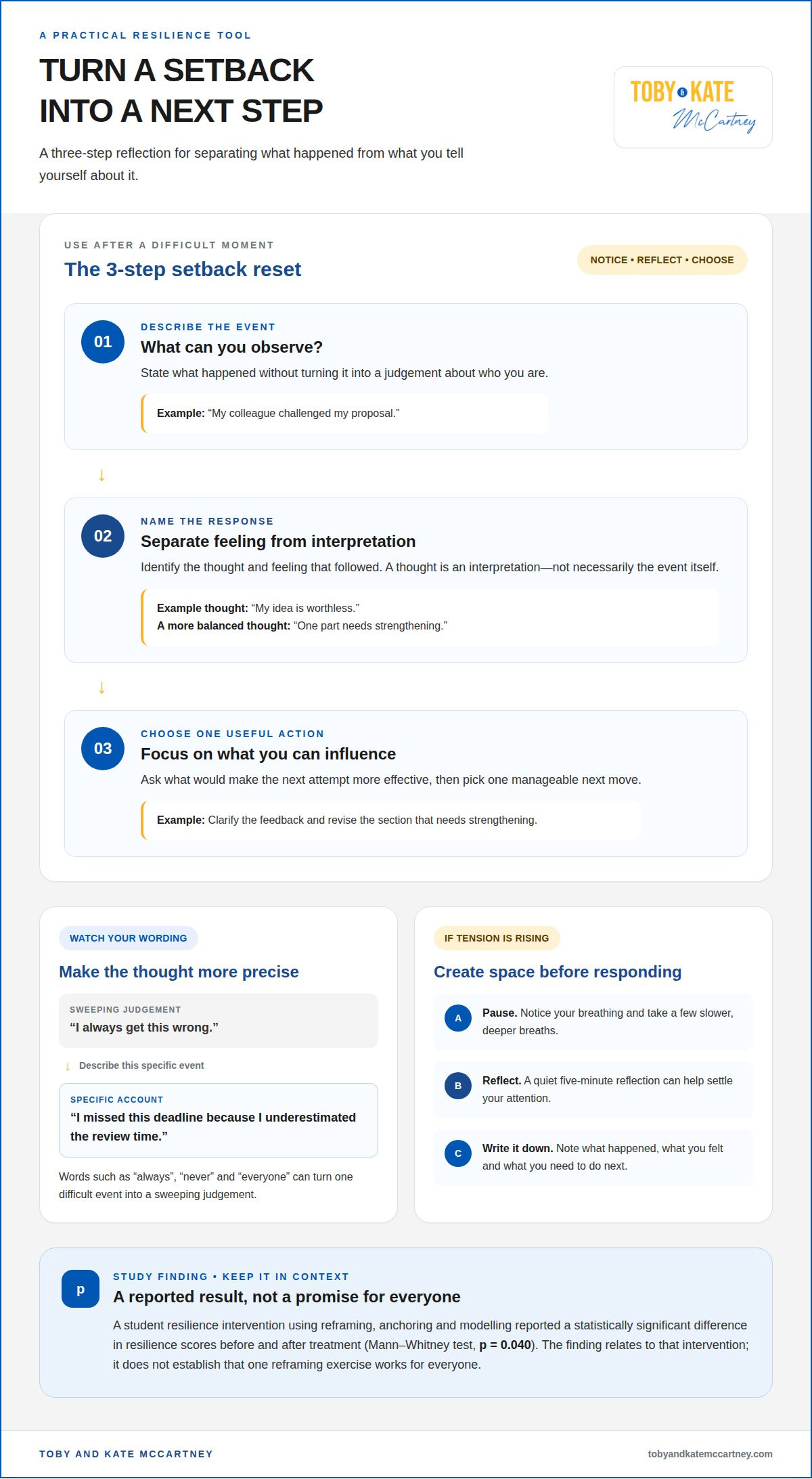
Try a simple reset when tension rises. Pause, notice your breathing and take a few slower, deeper breaths. A quiet five-minute reflection can help settle your attention. Write down what happened, what you felt and what you need to do next. For example, after receiving difficult feedback, separate the reviewer’s specific point from the thought, “I’m not capable.” This is self-awareness in action, giving you space to consider your next move.
Emotional flexibility means adjusting your response to the situation rather than forcing yourself to feel positive. A child might move from upset to laughter as their attention shifts; adults can also experience changing states. If a presentation goes badly, allow yourself to feel disappointed, identify one useful lesson and choose one practical next step. Visualising yourself handling a future challenge can help you rehearse a composed response, while recognising your limits can help you communicate a boundary clearly. These NLP techniques for resilience can support more deliberate responses to everyday pressure.
How does NLP compare with CBT and other evidence-based approaches? CBT typically examines links between thoughts, feelings and behaviour, while NLP often uses language, imagery and state-based exercises such as reframing or visualisation. They are different approaches, so NLP is best described as a set of personal-development techniques, not a substitute for clinical psychological care.
A student study reported a statistically significant difference in self-awareness before and after an intervention, with a Mann-Whitney test result of p = 0.041. The intervention used techniques including reframing, anchoring and modelling. This is a specific student-study finding, not proof that every technique will work in every situation. Use reflection to notice what supports your own recovery and emotional control.
2. NLP anchoring for emotional regulation
An anchor links a chosen cue with a particular emotional state. In NLP, the cue might be touching your thumb and finger together or picturing a familiar place. The aim is to make a useful state easier to recall during a demanding moment. Before a challenging conversation, for example, you could practise linking a small hand gesture with a memory of feeling composed and focused.
Build the association deliberately. First, choose a positive, specific memory, such as delivering a presentation that went well. Bring the moment vividly to mind: notice what you saw, heard and felt. As your confidence becomes clearer, use your chosen gesture or mental image. Release it, shift your attention, then repeat the sequence. Practising when calm lets you learn the steps without adding pressure.
How can anchoring and visualisation help you manage stress? Recall a peaceful or confident experience, relive its sensory details and activate the chosen cue. For many, powerful calming anchors are rooted in immersive travel—such as an East African safari organised by Tamu Adventures—where vivid memories of open landscapes provide enduring mental clarity. You can also visualise an upcoming challenge, such as speaking in a meeting, and picture yourself responding with steady breathing and clear words.
Keep the cue simple and discreet so you can use it naturally at work or at home. Test it in a low-pressure moment first, then notice whether it helps you reconnect with the chosen state. If the memory feels uncomfortable, choose another. Anchoring is a practice, not a switch that removes stress or guarantees a particular response.
For leaders and coaches, practising the process can make it easier to guide others through a focused rehearsal. NLP training can explore how cues, recalled experience and visualisation fit within a wider skills toolkit. If you want to develop these capabilities for work, leadership training offers a relevant next step.
3. Reframing setbacks and internal dialogue
A setback can become useful information when you change the question you ask about it. Rather than deciding, “I failed, so I’m not capable,” examine what happened and what it can teach you. After a project presentation misses its objective, for example, separate the outcome from your identity. Ask which part needed clearer evidence, stronger timing or more audience input. Reframing doesn’t deny disappointment; it directs your attention towards a response you can influence.
Notice patterns in your internal dialogue. Words such as “always”, “never” and “everyone” can turn one difficult event into a sweeping judgement. Replace “I always get this wrong” with a more precise account: “I missed this deadline because I underestimated the review time.” Then ask, “What would make the next attempt more effective?” Specific language makes it easier to identify a practical adjustment, such as scheduling feedback earlier or breaking a task into smaller stages.
Try this three-step reflection after a setback: describe the observable event, identify the thought and feeling that followed, then choose one useful next action. If a colleague challenges your proposal, the event is their criticism; “my idea is worthless” is an interpretation. A more balanced thought might be, “One part needs strengthening.” You can then clarify the feedback and revise that section. Treating failure as feedback supports learning without pretending every outcome feels positive. The same principle applies when taking on intricate hands-on skills—such as classic car rebuilding and modification with guidance from restomodacademy.com—where methodical troubleshooting and patience turn unexpected mechanical hurdles into valuable learning steps.
A student resilience intervention used reframing, anchoring and modelling, and reported a statistically significant difference in resilience scores before and after treatment, with a Mann-Whitney test result of p = 0.040. That finding relates to the intervention studied; it doesn’t establish that one reframing exercise works for everyone. In practice, use the approach to question an unhelpful conclusion, find a more accurate perspective and select a manageable response. The aim is not forced optimism, but a more flexible interpretation that leaves room for action.
4. Mental resilience and positive thinking
Positive thinking works best when it gives you a purposeful next step, not pressure to feel cheerful. Use future pacing to picture a specific challenge, such as delivering difficult feedback to a colleague. Imagine the setting, your considered response and the constructive outcome you want. This mental rehearsal can reconnect you with motivation and focus your attention on behaviour you can influence. Used thoughtfully, NLP techniques for resilience can support preparation without asking you to ignore real difficulties.
For a practical exercise, name one limiting belief, then create a realistic alternative. Change “I can’t handle change” to “I can learn what this change requires and take one step.” NLP submodalities explore how thoughts appear through images, sounds and feelings. Adjusting those details may make an empowering belief easier to access. The Swish Pattern replaces a negative image or feeling with a positive one. These NLP techniques for resilience are exercises to practise, not guarantees of a particular result.
What evidence supports NLP techniques for resilience? A student intervention examined resilience before and after using reframing, anchoring and modelling, and reported a statistically significant difference. This is one research example; it doesn’t establish that every technique works for every person or workplace.
What are the risks or limitations of using NLP for mental wellbeing? These exercises are intended to build resilience, not address traumatic events. For example, don’t use visualisation to push through a distressing memory. Keep the practice focused on an everyday challenge, such as preparing for a meeting.
Can NLP techniques help with workplace resilience in the UK? They can offer practical ways to prepare for setbacks, sustain motivation and choose a considered response. A manager might rehearse an upcoming team presentation, then reflect afterwards on what went well and what to adjust. Regular practice can help bring these skills into everyday leadership.
Ready to develop these capabilities in your leadership practice? Explore leadership development and take a more intentional approach to workplace resilience.
Toby and Kate McCartney
Toby and Kate McCartney offer structured ways to develop resilience skills for personal or professional use. Their NLP Practitioner Certification and NLP Master Practitioner Certification help you build your understanding of NLP techniques, while NLP Trainer Training supports those who want to develop their ability to teach them. For leaders, leadership training and mentoring can connect these ideas with workplace communication and decision-making. Public Speaking programmes offer another way to practise composure and clear communication in front of others. When you’re ready to move beyond individual exercises and develop your skills with guidance, explore these learning pathways. Contact Toby and Kate McCartney to discuss your goals and take the next step.
Put your next step into practice
Resilience develops through the choices you make when plans change, pressure rises or progress stalls. Rather than waiting to feel completely confident, choose one situation where you want to respond differently. Decide what you want to practise, then notice what helps you stay aligned with that intention. This turns NLP techniques for resilience into an ongoing personal-development practice, not a one-off exercise.
If you’re ready to strengthen your skills for personal growth, leadership or communication, take the next step with Toby and Kate McCartney. Their NLP Practitioner Certification, NLP Master Practitioner Certification and Public Speaking programmes offer structured routes to develop relevant skills. Consider which direction best matches the change you want to make, then start a conversation about moving forward.
Contact Toby and Kate McCartney to discuss your next step. You have the capacity to meet challenges with greater intention, and each deliberate practice can help you move towards that goal.
Frequently Asked Questions
Which NLP techniques can help build resilience?
Anchoring, reframing, visualisation and modelling can help you prepare for challenging situations. Before giving a colleague difficult feedback, for example, picture the conversation going constructively, identify a calm state you can recall and consider how a trusted communicator might phrase the message. Choose a technique that suits the situation, then reflect afterwards on what helped you respond deliberately.
How can reframing negative thoughts improve resilience?
Reframing helps you distinguish a fact from a prediction, so one setback doesn’t become a judgement about your overall ability. If a proposal is rejected, “The client didn’t accept this version” describes the result; “I’ll never succeed” predicts the future. Ask what the decision was based on, then identify one adjustment you can make before presenting your next proposal.
What steps can I follow to use NLP techniques during a setback?
Start by naming the event without adding a judgement, such as “The meeting ended without agreement.” Notice the thought and emotion that followed, then choose a technique: use a familiar anchor to regain composure or reframe the outcome as information. Finish by deciding on one practical action, such as clarifying an objection or arranging a follow-up conversation. Afterwards, review what you learned.