
There isn’t one standard fee for business coaching in the UK. If you’re asking how much a business coach costs in the UK, the answer depends on the format, meeting frequency and the coach’s experience.
It’s sensible to understand the commitment before investing. Group coaching and one-to-one support are priced differently, as are packages and session-by-session arrangements. Compare not only the fee, but also what the coaching includes and how well it fits your goals.
This guide explains the main factors behind UK business coaching costs, from format and session structure to relevant experience. You’ll get a clearer way to assess what shapes the fee and which support may suit your next stage of growth.
Key Takeaways
- Assess coaching value against the business priorities and outcomes you want to influence, not just the session fee.
- Group coaching can offer shared learning, while one-to-one support focuses on your specific challenges and goals.
- A coach’s relevant experience and the complexity of your needs can shape the structure and cost of coaching.
- Compare what a coaching arrangement includes, such as session frequency and package format, to understand the commitment behind the price.
How Much Does Business Coaching Cost in the UK?
UK business coaching fees vary according to format, the coach’s experience and the scope of support. To assess value, compare the agreed work with the business outcome you want to influence.
What a coaching fee includes
A UK business coaching fee covers an agreed coaching arrangement, not just the time spent talking. Depending on the agreement, it may include sessions, preparation, progress reviews or support between meetings. The scope determines what you can fairly compare.
Ask what happens before, during and after each session, and how progress towards leadership goals will be reviewed. This helps clarify whether a higher fee reflects broader involvement or mainly meeting time. To assess return on investment, identify a business priority first, then decide how you’ll measure progress.
Packages, retainers and pay-as-you-go sessions
A package groups sessions into a planned engagement, while a retainer provides ongoing support over an agreed period. Pay-as-you-go means paying for sessions individually. Packages may lower the average cost per session, but they aren’t necessarily cheaper overall if you don’t use the support or need a different structure.
Are packages or retainers cheaper than pay-as-you-go sessions? They can cost less per session, particularly when several meetings are included, but consider the total commitment and support provided. Compare session frequency, preparation and progress reviews to find the structure that suits your needs.
Location and coaching costs
Business coaching prices can vary across the UK, particularly for in-person delivery. In-person coaching in major UK cities may cost more than virtual sessions; travel and meeting arrangements can also affect the overall commitment.
To assess return on investment, set out the expected coaching cost and the business outcome it is meant to support. For example, link a leadership objective to a practical measure, such as better decision-making or progress on a growth initiative. Review that measure throughout the engagement, rather than judging value by one session alone.
Choosing between group and one-to-one coaching
Group and one-to-one coaching differ in how closely sessions focus on your business. The right format depends on whether you value shared perspectives or tailored attention.
Group and one-to-one formats
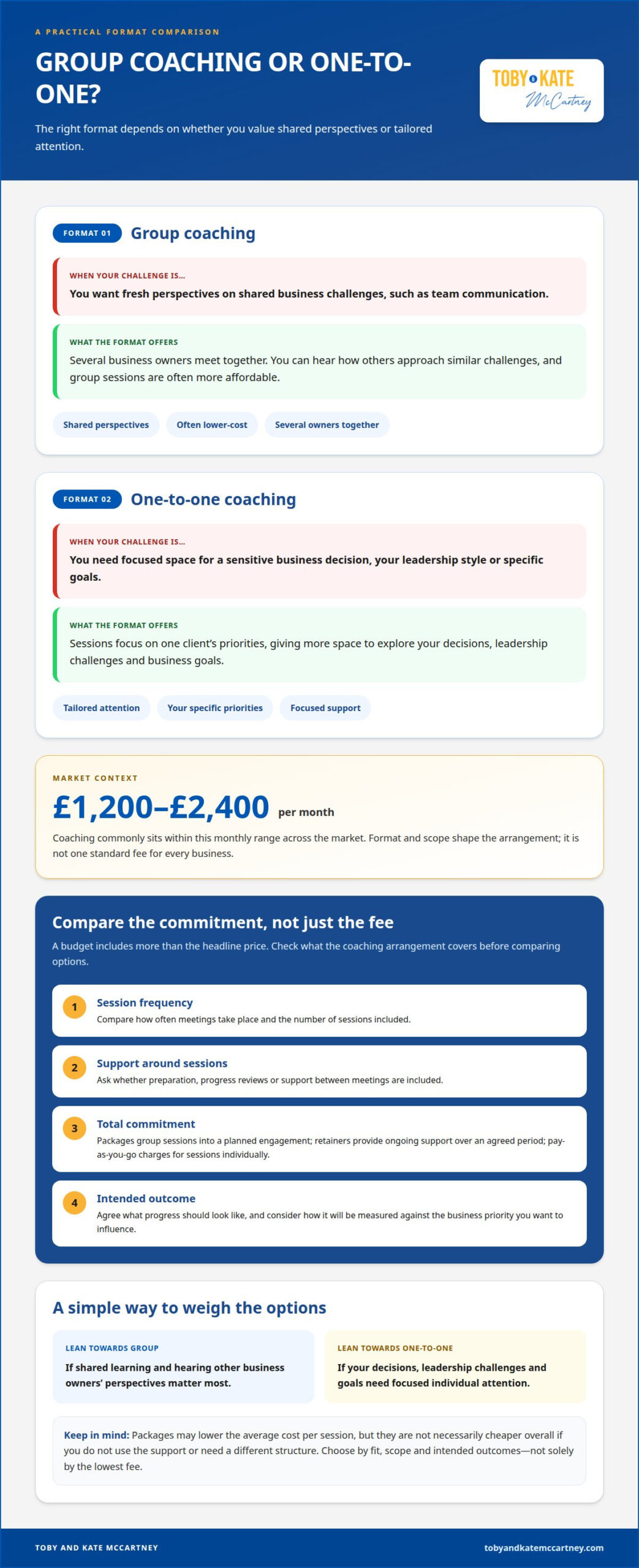
Group coaching brings several business owners together, while one-to-one coaching focuses on a single client’s priorities. Group sessions are often more affordable and let you hear how others approach similar challenges. Individual sessions offer more space to explore your decisions, leadership style and specific goals.
Choose the format according to the support you need. A founder seeking fresh perspectives on team communication, for example, may benefit from group discussion. A leader considering a sensitive business decision may prefer focused individual support. In either format, agree on what progress should look like before coaching begins.
Matching a format to your budget
Budget means more than the fee: it includes the number of sessions, their frequency and the support included. Across the market, coaching commonly sits between £1,200 and £2,400 per month, with format and scope shaping the arrangement. Group coaching is often the lower-cost route, whilst individual coaching concentrates resources on your own objectives.
Set a budget, then compare the structure and intended outcomes of each option. A package may lower the average cost per session, but a larger commitment makes sense only if its schedule and focus suit your needs. Don’t choose solely by the lowest fee; consider whether the format provides enough access and accountability to help you act.
How can you compare UK business coaches and judge whether their fees offer value? Compare the agreed goals, session frequency, format and included support, then consider how progress will be measured. This makes it easier to assess the fee against the work involved, rather than comparing headline charges alone.
If individual attention fits your priorities, explore one-to-one coaching as a way to focus sessions on your leadership challenges and business goals.
Coach experience
Experience can influence a coach’s fees, but relevant expertise matters as much as time spent coaching. These ranges offer context, not a measure of fit for every business.
How do UK business coaching prices vary according to experience and qualifications? Newer coaches may charge less, while senior specialists may charge more for relevant expertise and a strong track record. Qualifications can inform your assessment, but don’t show on their own whether a coach understands your challenges or can support your goals.
There is no legal requirement for accreditation in the UK coaching market. Look beyond credentials by considering a coach’s training, professional focus and experience with businesses facing challenges like yours. For instance, a founder working to improve team leadership may value experience with leadership teams over expertise unrelated to that goal.
A coach’s track record is most useful when it relates to your intended outcome. Experience supporting businesses through revenue growth may be relevant if growth is your priority; leadership transition experience may matter more when roles or responsibilities are changing. Ask how the coaching approach would address your goal and what progress might look like over the engagement.
Before committing to a monthly arrangement, compare the coach’s expertise with the scope of support. A higher fee may reflect specialist knowledge, a focused engagement or senior experience, but price alone cannot demonstrate value. Match the coach’s background to your business stage, upcoming decisions and desired outcomes. This gives you a clearer basis for judging whether the fee fits the work.
Average UK business coaching costs
There isn’t one average fee that suits every UK business. Costs depend on whether support is individual or group-based, the coach’s experience, session frequency and what the engagement includes. To decide whether an offer fits, compare its full scope with the business priority you want to address.
Executive and specialist coaching can cost more when it involves senior-level challenges, focused expertise or a broader ongoing commitment. A specialist supporting an owner through growth decisions may offer a different scope from coaching focused on a career transition. Compare the purpose, format and included support, not just the headline fee.
Can UK businesses claim business coaching costs as a tax-deductible expense? Coaching fees are generally an allowable business expense when incurred wholly and exclusively for business purposes. The purpose matters: coaching focused on a business leadership objective differs from support centred on personal career development.
For a practical comparison, note the outcome, session format and frequency included in each proposal. If your aim is to strengthen leadership, for example, consider whether the coaching addresses that objective and how progress will be reviewed. Packages may lower the average cost per session, but their overall value depends on the support you’ll use.
Then weigh the commitment against the decision ahead. A business owner addressing a specific growth challenge may need a different coaching structure from someone seeking ongoing leadership development. Focus on the fee for the agreed scope, what it covers and how it supports your business priorities.
If one-to-one support aligns with your goals, explore coaching options to consider a focused pathway for your leadership and business development.
Toby and Kate McCartney: One-to-One Coaching
Toby and Kate McCartney’s One-to-One Coaching provides focused support for working through business priorities with individual attention. It may suit you if group discussion feels too broad or you’re facing a leadership challenge that calls for careful reflection and clear decisions.
Bring a specific goal, such as strengthening communication, developing your leadership approach or working through a business decision. One-to-one coaching gives you dedicated space to explore that goal and consider practical next steps. The focus is on your needs and direction, rather than a general group programme.
If you’re ready to discuss whether this kind of support fits your goals, contact Toby and Kate McCartney.
Turn your next decision into a development plan
Knowing how much a business coach costs in the UK is a starting point. Next, define the capability you want to strengthen. Choose a goal that matters to your work, whether that’s clearer communication, stronger leadership or greater confidence presenting ideas. A specific direction makes coaching purposeful from the outset.
Toby and Kate McCartney also offer NLP Practitioner Certification, NLP Master Practitioner Certification and Public Speaking programmes. Each provides a different development pathway: one-to-one coaching centres on your individual goals, while certification and public speaking programmes focus on building specific skills. Consider which route best fits the progress you want to make.
Ready to explore your next step? Contact Toby and Kate McCartney to discuss your goals. Your development can begin with one clear decision, and you can shape the pathway from there.
Frequently Asked Questions
Affordable vs Premium: What’s the Real Difference?
Affordable and premium coaching often differ in depth, specialisation and access, not simply quality. A focused session about one decision has a different scope from ongoing support for leadership challenges across a business. A founder preparing a presentation, for example, may need a narrower engagement than a director managing organisational change. Compare the work included with your needs.
What Drives the Price Difference?
Fees reflect factors such as the coach’s experience, coaching format, session frequency and scope of support. In-person delivery in major UK cities may cost more than virtual coaching. A package that includes preparation and progress reviews also differs from a session-only arrangement. For a fair comparison, check what each offer covers and whether it addresses the same business objective.
What are the main factors that determine this cost?
The main factors include whether coaching is group-based or one-to-one, the coach’s relevant expertise, session length and meeting frequency. The challenge matters too: support for a specific leadership decision differs from an ongoing growth engagement. Compare proposals by their schedules and included work, then consider which scope suits your priorities and budget.
What is the average hourly rate for a business coach in the UK?
If you’re weighing how much a business coach costs in the UK, remember that the broad range reflects differences in experience, specialism and arrangements. An hourly figure alone doesn’t show the full commitment. Check whether the rate covers only the meeting or also preparation and follow-up.
How much does a UK business coach charge per session?
These figures describe different payment structures, so compare the session count and total package scope. Don’t assume every session has the same rate or includes the same support.