
A learner’s response to a lesson depends on more than the information on the board. NLP for educators and teachers explores how communication, memory, beliefs and emotional states can shape pupils’ engagement with learning. It offers practical ideas to consider alongside evidence about their use.
You already know that how a concept is explained, and how a pupil feels about getting it wrong, can affect participation. The practical question is how to turn that awareness into thoughtful classroom practice without treating NLP as a guaranteed shortcut to better results.
This article explores how techniques such as chunking, reframing and positive-state anchoring relate to memory, mindset and goal-setting. You’ll also see where evidence supports careful consideration, where claims need perspective, and how these ideas might inform your development as an educator.
Key Takeaways
- Explore how chunking and modelling can make complex information easier for pupils to process and retain.
- Use thoughtful reframing to help learners approach difficulty as part of developing their skills.
- Separate practical classroom ideas from claims about NLP, and consider what the education evidence does and doesn’t show.
- Discover how communication and rapport techniques can support your teaching practice, and where further NLP training could fit your development.
Chunking, modelling and information retention
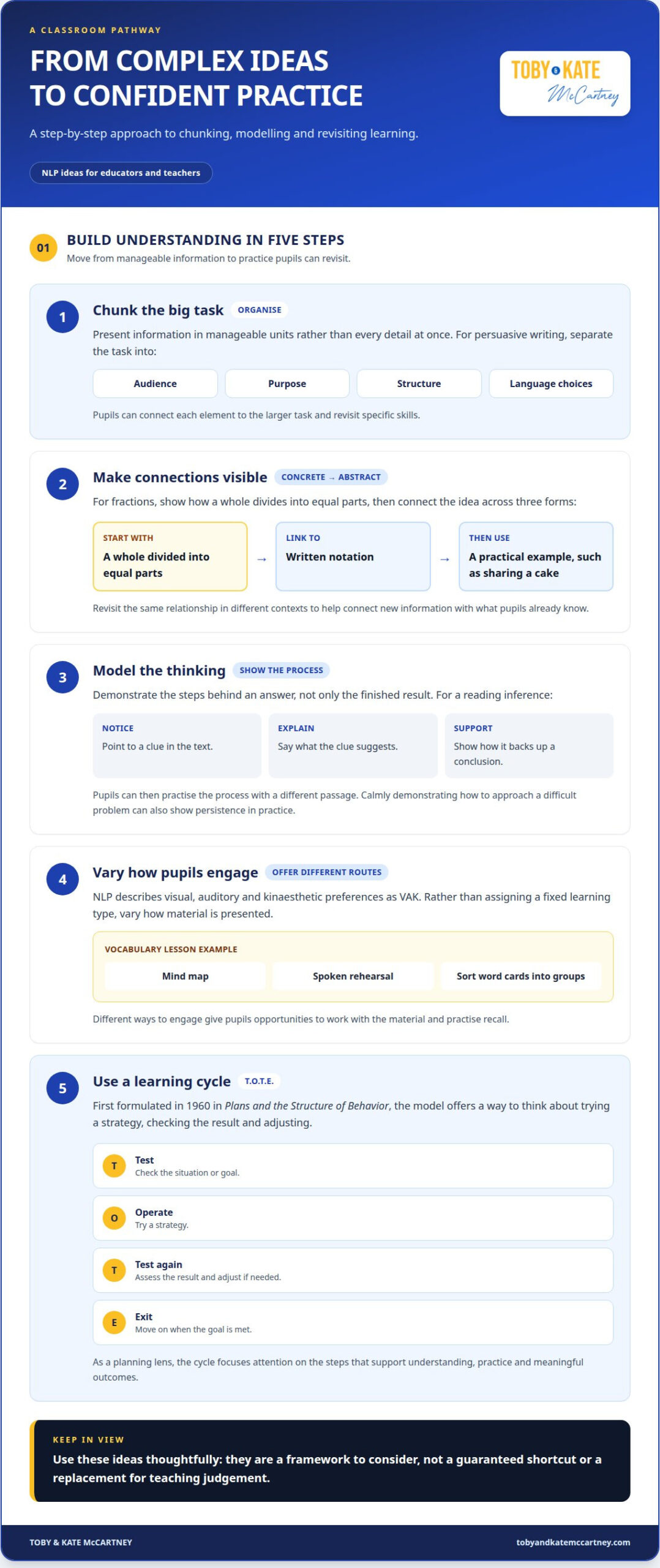
In NLP, chunking means organising information into manageable units instead of presenting every detail at once. For example, a lesson on persuasive writing might separate audience, purpose, structure and language choices. Pupils can then connect each element to the larger task, giving them a clearer route through complex material and making specific skills easier to revisit.
A teacher can make those connections visible. When introducing fractions, show how a whole divides into equal parts, then link the diagram to written notation and a practical example, such as sharing a cake. This sequence moves from a concrete image towards abstract symbols. Revisiting the same relationship in different contexts helps pupils connect new information with what they already know.
Modelling adds another layer: demonstrate the thinking, not just the finished answer. For a reading inference, a teacher might point to a clue in the text, explain what it suggests, then show how it supports a conclusion. Pupils see the steps behind the outcome rather than an example to copy, and can practise the process with a different passage.
Modelling also draws attention to a teacher’s behaviour. Calmly demonstrating how to approach a difficult problem can show pupils what persistence looks like in practice. This may support a growth mindset: effort and strategy matter, and mistakes can inform the next attempt. A teacher’s language and actions shape the learning relationship.
The T.O.T.E. model was first formulated in 1960 in Plans and the Structure of Behavior. Its test, operate, test, exit sequence offers a way to think about learning as a cycle: try a strategy, assess the result, adjust, then move on when the goal is met. Used as a planning lens, these NLP techniques focus attention on the steps that support understanding, practice and meaningful outcomes.
Cognitive reframing and growth mindset
A pupil who says, “I can’t do fractions,” may treat difficulty as proof of fixed ability. Reframing shifts attention to a specific next step: “Which part of this fraction question can you work through first?” The wording recognises the challenge without defining the learner by it. That distinction can affect how a pupil approaches practice, feedback and another attempt.
In the NLP model, beliefs, values, decisions and memories act as filters for incoming information. A pupil who remembers struggling with spelling may interpret a new task through that experience. A teacher can acknowledge the memory, then invite a fresh attempt: choose an unfamiliar word, identify its sound pattern and try a spelling strategy. This shifts focus from a general belief to an observable action.
Growth-mindset language works best when it names a strategy, rather than offering empty praise. Instead of saying, “You’re brilliant at science,” identify the choice that helped: “You compared both results before deciding.” This makes success more specific and gives the learner something to develop. It also helps teachers distinguish effort from effective approaches and guide pupils towards a more useful method.
An evaluation of growth-mindset reframings found students rated the model’s language 24% to 85% better than teachers’ language, depending on the task. Reported evaluation samples included 174 students and 1,006 students. These figures describe ratings of language, not proof that a particular phrase guarantees learning gains. They do, however, make the wording of feedback worth examining across classroom settings.
Use a simple framework: notice the pupil’s interpretation, acknowledge the difficulty, then offer a next action. After a disappointing result, for example, a teacher might ask which question caused the most difficulty, identify a skill to practise and agree how to review progress. This keeps the conversation grounded in evidence from the task, rather than assumptions about ability.
Neuro-linguistic programming gives educators another lens on how language shapes meaning, but it shouldn’t replace sound teaching judgement. If you want to strengthen how you communicate ideas aloud, explore ways to practise confident spoken communication alongside your classroom approach.
Research and evidence for NLP in education
Evidence for NLP in education includes classroom examples, training projects and reported practitioner experience. One author describes using an NLP spelling strategy with hundreds of children. That account illustrates a practice, but it is not the same as a controlled evaluation. For anyone exploring NLP for educators and teachers, the distinction matters: positive feedback can prompt further enquiry, but it does not establish that NLP caused a particular outcome.
Are there UK education policies or safeguarding considerations for using NLP with pupils? Yes. Any use should fit the school’s safeguarding procedures, pupils’ ages and educational context, and the educator’s professional boundaries. Before choosing an approach, educators need to understand these factors.
What are the risks, limitations and criticisms of NLP in education? The central risk is presenting a technique or model as proven to improve learning when evidence for that claim is limited. Treat NLP as a framework to consider, not a replacement for teaching judgement, and do not assume one method suits every pupil or cultural setting.
The NLP for Education Project exists to explore and promote responsible use in education. A separate international training project involved five local universities and a local NLP consulting and training company. Its initial training had 50 attendees, and more than 500 participants completed the associated course. Those figures show reach, not measured changes in students’ learning or school outcomes. They don’t establish effectiveness in UK classrooms.
To appraise NLP for educators and teachers, separate the method from the result. If a teacher uses a repeated cue before a spelling task, record whether the pupil starts, uses the strategy and completes the work. Compare these observations with ordinary teaching practice, while considering other influences such as task difficulty or familiarity. Specific feedback helps educators examine whether rapport or a positive state appears relevant.
Keep the fundamental question practical: does the approach support learning in this context and within professional boundaries? An example that helps one class may not transfer unchanged to another. Clear aims, culturally responsive communication and careful observation give educators a stronger basis for deciding what to retain, adapt or set aside.
How can teachers use NLP to improve communication and build rapport with pupils?
Start with the interaction in front of you. If a pupil stops contributing during a class discussion, notice both their words and non-verbal cues, such as posture or eye contact. Use a calm tone, an open question and an attentive pause. Combining verbal and non-verbal communication can make classroom exchanges feel more natural and give pupils room to respond.
Rapport grows through everyday routines, not a single technique. A getting-to-know-you activity can help pupils share interests, while group work gives them a reason to listen and respond to classmates. A teacher can acknowledge an emotion without endorsing disruptive behaviour: “You seem frustrated by this task. Which part feels difficult?” This recognises the pupil and opens a route back into learning.
NLP anchoring uses a repeated gesture, expression or body movement as a cue for recalling a desired positive mental state. For example, a class might practise a chosen gesture during a calm rehearsal before a presentation, then use it as a familiar prompt beforehand. Treat the gesture as a prompt, not a guarantee. Teachers can also manage their own emotional responses, helping them respond to a pupil’s distress thoughtfully.
Perceptual positions offer another lens for communication: invite a pupil to describe a disagreement from their perspective, then consider what the other person might have experienced. During a playground conflict, this can help pupils identify different interpretations before discussing a way forward. It does not replace school procedures for serious concerns; it supports perspective-taking within an appropriate conversation.
For difficult feedback, stay physically and emotionally approachable. Instead of labelling a piece of work “careless”, point to a specific example, explain its effect and agree a next step. “This paragraph needs evidence for its claim. Which detail from the text could support it?” keeps the focus on the work and preserves the pupil’s dignity. Practise the spoken communication skills that support clear, confident classroom interactions through a public speaking programme.
Toby and Kate McCartney
Toby and Kate McCartney offer a pathway for educators who want to explore NLP concepts and strengthen communication skills in their professional practice. The NLP Practitioner Certification and NLP Master Practitioner Certification provide routes for deeper study of NLP principles. Public Speaking programmes can support clear, confident communication, while NLP Trainer Training is suited to those who want to develop their ability to teach NLP.
These options suit educators seeking structured development beyond reading about classroom techniques, with skills to reflect on in their own context. Consider which area best matches your goals: understanding NLP, advancing your practice, communicating with confidence or training others.
To discuss your learning goals, contact Toby and Kate McCartney.
Put your next learning step into motion
Make reflection part of your teaching practice. Choose one communication habit to develop, such as giving feedback that identifies a pupil’s next action, then observe how learners respond over time. This keeps your approach purposeful and grounded in your classroom’s needs.
A thoughtful approach to NLP for educators and teachers also means continuing your own development. You might explore NLP Practitioner Certification or NLP Master Practitioner Certification to deepen your understanding, or consider Public Speaking programmes to strengthen how you communicate ideas. Choose a direction based on the skills you want to build and how you intend to use them professionally.
If you’re ready to explore a learning pathway that fits your goals, contact Toby and Kate McCartney. Keep asking, keep learning, and take your next step with confidence.
Frequently Asked Questions
What does NLP mean in education and how is it used by teachers?
In education, NLP means neuro-linguistic programming, a model concerned with communication and patterns of experience. Teachers may use its ideas to reflect on how instructions, expectations and pupils’ interpretations affect classroom interactions. If a pupil hesitates to ask for help, for example, a teacher could invite them to explain what feels unclear, adjust the explanation and check whether it makes sense.
What evidence supports the effectiveness of NLP techniques in teaching and learning?
Evidence does not establish that NLP as a whole reliably improves educational outcomes. To assess a claim, consider what was measured, how learning was assessed and whether results were compared with another approach. A positive response during a lesson may be useful feedback, but it does not show that pupils retained knowledge or transferred a skill to a new task.
What are practical NLP techniques teachers can use in the classroom?
Ask precise, neutral questions to understand a pupil’s interpretation before responding. For instance, replace “You understand, don’t you?” with “Which part would you explain in your own words?” The answer reveals what needs clarifying without putting the pupil on the spot. You can then adapt your explanation and agree on an observable goal, such as completing one example independently.
What NLP training and qualifications are available for educators in the UK?
Educators can explore private NLP training, including NLP Practitioner Certification, NLP Master Practitioner Certification and NLP Trainer Training. These offer routes to develop knowledge and skills in NLP, with further study suited to those who want to advance their practice or train others. Consider your purpose first: applying ideas to professional development differs from preparing to teach NLP as a subject.
How does NLP compare with evidence-based approaches such as cognitive behavioural strategies and growth mindset?
NLP, cognitive behavioural strategies and growth mindset are not interchangeable. Cognitive behavioural approaches examine links between thoughts, feelings and behaviour; growth mindset focuses on beliefs about developing ability. NLP offers a separate, communication-oriented lens. In a school, match the approach to the learning aim, stay within appropriate professional boundaries and assess it against relevant classroom evidence rather than assuming equal research support.