
Employees who feel listened to are five times more likely to perform at their highest potential, according to KPMG research. That makes learning how to improve listening skills in the workplace more than a communication exercise: it’s a practical way to strengthen understanding, trust and day-to-day collaboration. And while hearing happens automatically, listening well takes attention and practice.
You’ll learn what active listening looks like at work, explore empathetic, critical, appreciative and discriminative listening, and see how learning and development can make better listening a lasting workplace skill. We’ll also cover practical behaviours for everyday conversations, from asking thoughtful questions to summarising what you’ve heard. Start with clear steps towards more focused, constructive communication.
Key Takeaways
- Build trust in conversations by giving colleagues your attention and checking you’ve understood their meaning before responding.
- Choose your listening approach to fit the moment, whether a colleague needs empathy, careful evaluation or attention to what their tone conveys.
- Use open body language, thoughtful questions and well-timed pauses to help conversations become clearer and more constructive.
- Make listening part of workplace learning and development through practice, reflection and training shaped around real communication needs.
1. What Is Active Listening & Why Is It Important?
Active listening means focusing on a colleague’s message, understanding its meaning and responding thoughtfully. It can surface details a quick reply might miss, such as pressure caused by a deadline or the concern behind a customer’s request. That understanding supports better decisions, smoother teamwork and fewer misunderstandings that require correction. It also shows respect for a colleague’s perspective, helping build trust and making it easier to raise concerns or share ideas.
To improve listening skills at work, put distractions aside, let the speaker finish, then summarise their main point in your own words. Ask an open question, such as “What would help you move this forward?”, before agreeing on next steps. This gives you a chance to check your understanding rather than act on an assumption, especially when a task or responsibility is unclear.
Use pauses as well as words. The Center for Creative Leadership advises aiming to spend 80% of a conversation listening and 20% talking, and recommends getting comfortable with silence. After a colleague finishes explaining a challenge, wait before replying; then ask, “What happened next?” A short summary, such as “So the handover was late, and that affected the client deadline,” lets them correct any misunderstanding before you propose a solution.
Active listening has limits: it doesn’t mean agreeing with every point, taking responsibility for every problem or replacing clear decisions. In a virtual meeting, show attention by facing the camera, nodding, using interested expressions and recapping key points afterwards. A quiet setting helps you focus, but video cues can be harder to interpret than in-person signals. If a colleague’s tone or expression seems different from their words, ask a considerate follow-up rather than assuming what they mean. Listening well is not passive; it helps you respond to the actual message.
2. Empathetic, critical, appreciative and discriminative listening
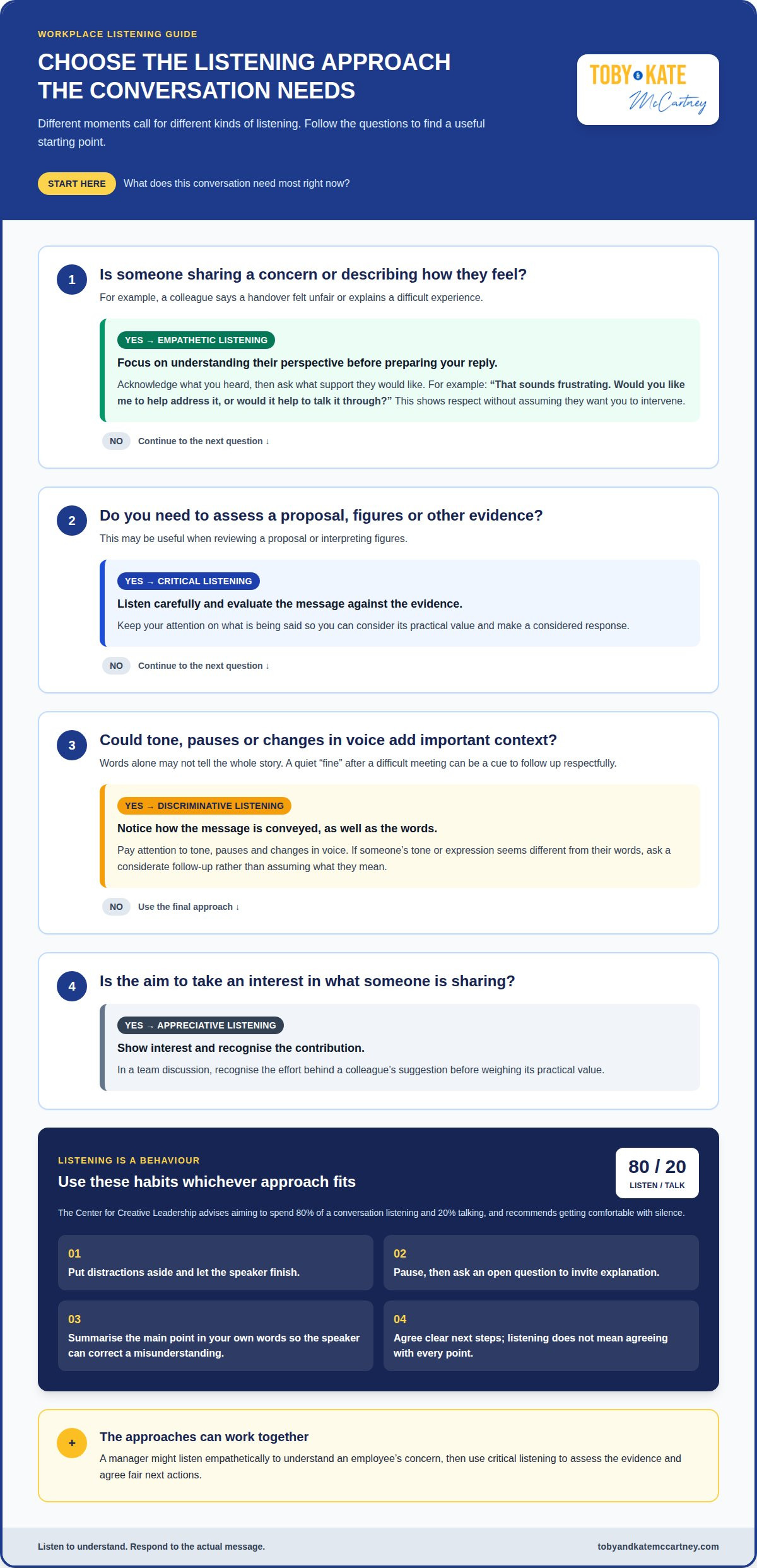
Different conversations call for different listening approaches. Passive listening means hearing words with little deliberate response, such as listening to a colleague while preparing another task. Attentive listening focuses on the speaker, while empathetic listening aims to understand their feelings and point of view. Critical listening assesses a message against evidence, which is useful when reviewing a proposal or interpreting figures.
Appreciative listening can involve taking an interest in what the speaker shares. In a team discussion, that could mean recognising the effort behind a colleague’s suggestion before weighing its practical value. Discriminative listening involves noticing tone, pauses and changes in voice, not just words. If a team member quietly says “fine” after a difficult meeting, their tone may be a cue to follow up respectfully.
Empathy helps you listen better by shifting your attention from preparing a reply to understanding another person’s experience. Imagine a colleague explaining that a handover felt unfair. Instead of comparing it with your own experience or immediately suggesting action, pause and consider the situation from their perspective. A calm expression and an open question can show respect without implying agreement.
To respond empathetically, acknowledge what you heard, then ask what support your colleague would like. For example: “That sounds frustrating. Would you like me to help address it, or would it help to talk it through?” This avoids assuming that every concern needs intervention. In a workplace conflict, listening to both people’s accounts can help identify the underlying issue before you discuss solutions.
These approaches work together, rather than competing. A manager might listen empathetically to understand an employee’s concern, then use critical listening to assess the evidence and agree fair next actions. For leaders developing how they communicate ideas as well as receive them, Public Speaking programmes offer a related development pathway.
3. What are Listening Skills at Work?
Listening skills show in how you behave while a colleague speaks, not just in what you say afterwards. Face the speaker, keep an open posture and use natural eye contact. A nod or brief verbal cue, such as “I see”, signals attention without taking over. Leaders can model these behaviours during a project update, then invite a quieter team member to contribute before moving on.
Let the speaker finish their thought before asking a question. If a colleague pauses after describing a problem, try asking, “What do you think is causing the delay?” rather than jumping straight to a solution. Open questions invite explanation; a closed question, such as “Is the report ready?”, is useful when you need a specific fact. Choose the approach that suits the moment and purpose of the conversation.
Distractions make attentive listening harder in everyday conversations. Before a one-to-one, silence phone alerts, close unrelated tabs and turn your screen away from incoming messages. In a meeting, avoid typing while someone explains a decision; note only the details needed for follow-up. During a video call, look towards the camera when speaking and show interest while listening. These actions make your attention easier to read, even through a screen.
A practical way to improve listening skills in the workplace is to identify one behaviour, such as interrupting, and notice when it happens. To assess your progress, ask colleagues for specific feedback after a meeting: did you make room for their views, clarify the point and agree clear next actions? Teams can also review whether people understand their responsibilities after discussions and whether follow-up messages need correcting. Use feedback to practise one change, then ask for observations again in a later conversation. This gives you concrete evidence of progress, rather than relying on intention alone.
4. Developing workplace listening skills through L&D
Learning and development can turn listening from a personal intention into a shared workplace practice. Start with a needs analysis: speak with people at different organisational levels about communication strengths, everyday obstacles and useful resources. For example, frontline staff may need clearer handovers, while managers may need practice hearing concerns without rushing to solutions. In frontline and safety-critical roles, programmes such as Insight Security Training similarly emphasise active listening to defuse tension and maintain operational safety. These conversations help shape training around real work instead of generic advice.
Build learning around behaviours people can observe. A session might introduce listening styles, then use paired exercises to practise noticing tone, asking open questions and checking understanding. In a delayed-project scenario, one person explains the issue while the other listens, summarises the message and agrees next steps. Feedback can focus on specific actions, such as interrupting, missing a key detail or overlooking a colleague’s expressions.
Practice needs to continue beyond the training room. Managers can model attentive listening in team meetings, make space for concerns and follow up on suggestions. If a colleague raises a problem, the manager can acknowledge it, clarify what support is needed and explain any agreed action. Consistent responses help make listening part of the workplace culture, rather than a technique used only during a course.
To assess progress, connect learning goals to workplace conversations. A team could review whether handovers make responsibilities clear or gather feedback on whether people feel understood in one-to-ones. Use these observations to refine exercises and identify where further coaching could help. A DISC-based approach can also help participants recognise differences in communication styles and adapt how they listen, without treating any one style as the right one.
For a practical development pathway, explore communication skills training to strengthen how you listen, respond and share ideas at work.
Toby and Kate McCartney
Toby and Kate McCartney help people develop communication and leadership capabilities that support more effective listening at work. If you want to improve your own approach or strengthen how you guide conversations with colleagues, their training and mentoring offer a practical next step for continued professional development.
Options include NLP Practitioner Certification, NLP Master Practitioner Certification, public speaking programmes, leadership training and mentoring. These offerings support broader communication development and complement workplace-specific learning and practice. The right pathway depends on which skills you want to develop and how you plan to use them in your role.
If you’re ready to explore a development pathway, contact Toby and Kate McCartney.
Make listening part of your professional growth
Stronger listening comes from deliberate practice, not good intentions alone. Choose a communication habit you want to strengthen, apply it in real conversations and notice what changes. If you’re looking for ways to improve listening skills in the workplace, make that development part of your ongoing learning rather than a one-off exercise.
Toby and Kate McCartney’s NLP Practitioner Certification, NLP Master Practitioner Certification and public speaking programmes support broader personal and professional communication development. They may suit you if you’re ready to deepen your skills and apply them in your working relationships. Take the next step by building your ability to listen with purpose, respond thoughtfully and contribute with confidence.
Contact Toby and Kate McCartney to explore your next step.
Frequently Asked Questions
What Is Active Listening & Why Is It Important?
Active listening means working to understand a speaker’s meaning, not simply waiting for your turn to talk. If a teammate says a deadline feels unrealistic, for example, find out which task is causing pressure before changing the plan. This helps separate the immediate request from the underlying issue, so colleagues can agree on a response based on what’s actually happening.
What are Listening Skills at Work?
Workplace listening skills include noticing key information, interpreting tone and checking details that affect decisions. During a project handover, listen for who owns the next action, what remains outstanding and whether another team depends on it. Asking a colleague to clarify an unclear responsibility can stop assumptions from turning into missed tasks.
What Are Barriers to Effective Listening?
Common barriers include competing notifications, tight schedules, emotional tension and fear of negative consequences. A team member may hold back a concern if they expect blame, while a rushed meeting can leave little room to explain a complex issue. Managers can address these obstacles by setting aside focused time and responding to concerns without dismissing them.
What Causes Poor Listening?
Poor listening can stem from divided attention, jumping to conclusions or focusing on a speaker’s delivery instead of their message. For example, disagreeing with a colleague’s tone may distract you from the evidence they’re presenting. Strong emotions can also narrow your attention. Notice when you’re preparing a rebuttal, then bring your focus back to the point being made.
What are active listening techniques for workplace conversations?
Choose techniques that suit the purpose of the conversation. Ask “What’s the main risk?” to explore a concern, or “Which date is confirmed?” when you need a precise fact. Paraphrase a complicated instruction before acting, and pause after asking a question to give the speaker time to respond. In a phone conversation, summarising the agreed action is particularly useful because visual cues aren’t available.
How can managers encourage better listening in teams?
Managers can make listening visible by inviting different views, acknowledging contributions and explaining what happens after feedback. For example, if a team member flags a recurring handover problem, report back on the decision and the reasoning, even if the suggestion can’t be adopted. Training exercises based on real team scenarios can help people practise listening, responding and resolving misunderstandings together.