
Avoiding failure can become one of the biggest risks to your business. Fear is a normal response to uncertainty, but when it stops you making decisions, testing ideas or pursuing growth, playing safe can cost you valuable opportunities. Learning how to overcome fear of failure in business starts with understanding what that fear is telling you, without letting it define what you can do.
You may feel pressure to get every decision right, especially when your work, reputation and livelihood are involved. That pressure is real, but a setback isn’t proof that you lack ability or that your business is doomed. It can show you what needs to change.
This article explains how fear of failure can show up, then explores practical ways to reframe it and take considered action. You’ll also see how fear can restrict risk-taking and business growth, with steps to help you move forward more clearly, even when you don’t feel completely ready.
Key Takeaways
- Notice how fear shows up in your decisions, wellbeing and relationships, then separate your identity from your business’s results.
- Use setbacks as information: examine what happened and identify what you can learn for your next decision.
- Spot when perfectionism or fear of uncertainty is keeping you from taking considered risks and pursuing growth.
- Build momentum with a small next step, a practical contingency plan and support from people you trust.
1. What is fear of failure?
Fear of failure is anxiety about falling short, making a costly mistake or disappointing others. For entrepreneurs, it can show up as delaying a launch, avoiding feedback or repeatedly revising a plan instead of testing it. Nearly half of entrepreneurs fear failure, with the cited figure at 42.6%. Physical symptoms can include dizziness, excessive sweating, nausea and panic attacks.
When fear becomes constant, stress and anxiety can cloud business decisions and strain personal relationships. A founder may stay absorbed in work, become irritable at home or struggle to accept constructive criticism. Atychiphobia is associated with persistent fear; the symptoms must have lasted at least six months to meet the stated criteria. That threshold alone does not establish a diagnosis.
Manage everyday stress by naming the specific worry, then choosing one practical next step. If losing a key customer feels overwhelming, for example, review your sales pipeline and set a time to speak with them. Protect time away from work, too. Regular boundaries and activities outside the business can help stop work worries from taking over every conversation.
Market research and a business plan can replace some uncertainty with evidence. Speak to potential customers, test whether the problem matters to them, and record assumptions, likely costs, risks and possible responses in your plan. To test an idea on a small budget, try a simple prototype or limited pilot before committing to larger purchases, premises or staffing.
Limit exposure by keeping business and personal finances separate and understanding which commitments could put personal assets at risk. Plan for disruption by identifying alternative premises and documenting essential tasks, so another team member can cover if key personnel leave. These steps cannot remove every risk, but they make potential losses and possible responses easier to assess.
Finally, separate your identity from business outcomes. A venture that struggles is not a verdict on your ability or worth; it is an outcome to examine. If fear repeatedly causes panic or disrupts sleep, work or relationships, speak with your GP or a mental health professional. Cognitive behavioural therapy involves working with a mental health professional on negative thought patterns.
2. Reframing failure as a learning experience
A setback can be useful when you treat it as information, not a final verdict. Separate what happened from what you assumed it meant. If a launch attracts few customers, the result may reveal a mismatch between the offer, audience or timing. It doesn’t prove the whole venture is doomed. Start learning with a specific question: what did this outcome show that you can use?
Analyse mistakes without turning the review into self-criticism. Write down the decision, the evidence available at the time, what happened and what you’d change next. If customers don’t complete an online order, for example, check where they leave and whether the instructions are clear. Distinguish between a decision made with incomplete information and a process you can improve. This turns discomfort into a focused next step.
Creative work shows how progress can include unsuccessful attempts. Thomas Edison held 1,093 patents, most of which went nowhere. Picasso produced over 20,000 pieces of art to make a few masterpieces. These examples don’t mean every attempt will succeed. They show why one disappointing result cannot tell you the full value of someone’s work or potential.
Fear can become linked to a particular action, such as pitching to a client or sharing an early idea. Avoiding that action may bring short-term relief, but it leaves the fear untested. Instead, choose a manageable experiment: rehearse a pitch with a trusted colleague, then present it to a potential customer. Notice what you feel, what actually happens and what you learn. Repeating the process can make the action feel more familiar.
Failure can also come through inaction. Delaying a decision may mean missing useful feedback or a chance to adapt. After each experiment, record one lesson and one next move. A positive review isn’t pretending mistakes don’t matter; it’s using them to improve the next decision. A structured approach to personal development can help you practise reframing and communicating with confidence through personal development training.
3. How fear of failure can restrict risk-taking and business growth
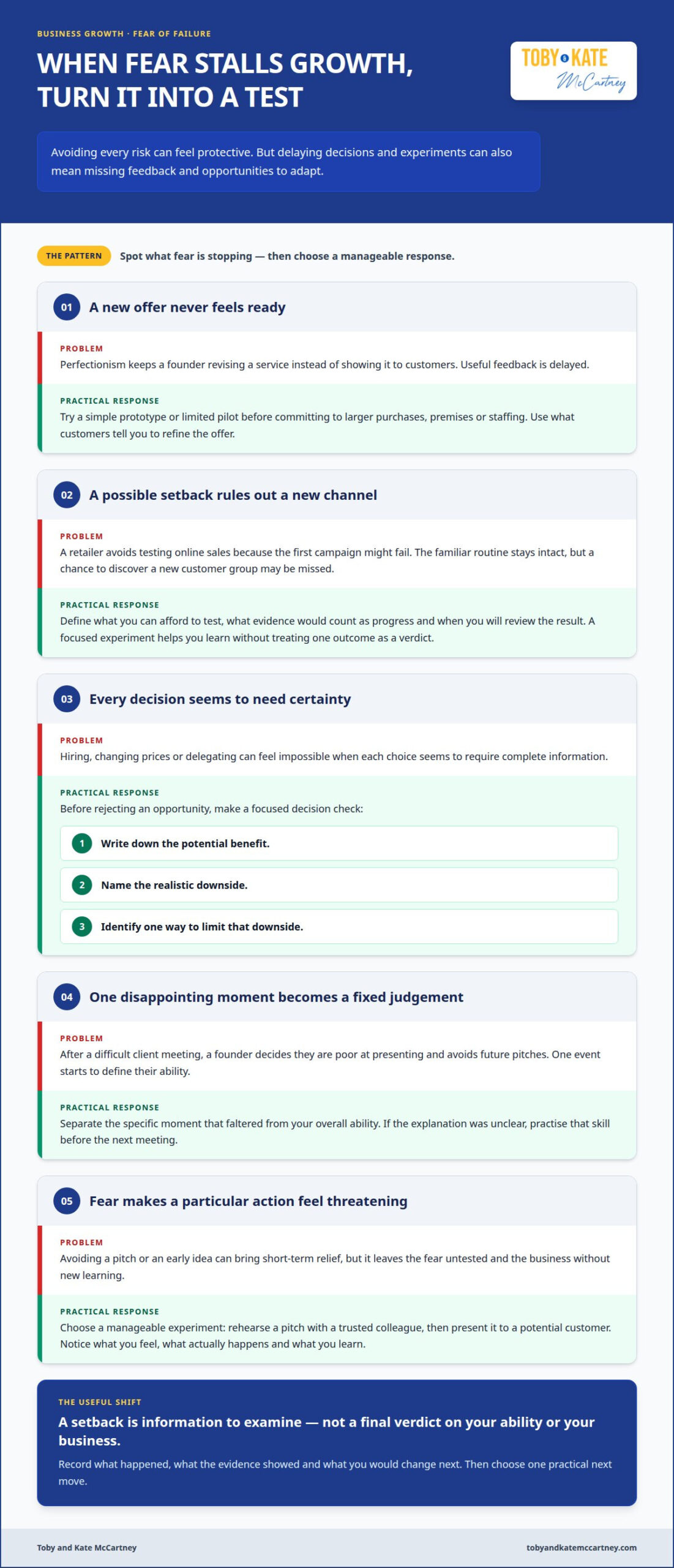
Fear of failure can make a sensible business risk feel like a threat to your identity. A perfectionist founder may keep revising a new service instead of showing it to customers. Holding back delays useful feedback and leaves the business focused on avoiding criticism rather than learning what people value.
Anxiety can also narrow the choices you consider. Imagine a retailer who avoids testing online sales because the first campaign might fail. They may preserve their current routine but miss the chance to discover a new customer group. The risk is not only making the wrong move. Refusing to test anything can also limit how the business develops.
Perfectionism raises the bar until taking action feels impossible. A founder might postpone hiring, changing prices or delegating because each decision seems to require certainty. Yet business decisions rarely come with complete information. Reduce exposure by defining what you can afford to test, what evidence would count as progress and when you’ll review the result.
Fear can also undermine your confidence in your ability. After a disappointing client meeting, you might decide you’re poor at presenting and avoid future pitches. That turns one event into a fixed judgement about yourself. Instead, identify the specific moment that faltered, such as an unclear explanation, then practise that skill before your next meeting.
Before rejecting an opportunity, try a focused decision check: write down the potential benefit, the realistic downside and one way to limit that downside. For example, pilot a product with a small customer group before committing to a wider launch. You cannot control the market’s response, but you can shape the test. Considered risks give you evidence to develop your strategy; avoiding every uncertain move leaves assumptions unchallenged.
4. What practical steps help entrepreneurs overcome fear of failure?
Start by making the fear specific. Write down the outcome you dread, such as losing a key client, then list what you could do if it happened. A contingency plan turns a vague threat into decisions you can prepare for. Visualise a positive outcome, too, while keeping practical steps ready for setbacks.
Break a large goal into smaller actions. If you’re avoiding a new service launch, define one manageable task, such as drafting a customer survey. Take a small step towards your business goals today. Progress builds confidence through evidence: you acted, learned something and can choose what comes next.
Try an admiration diary to challenge the belief that capable people never struggle. Spend 10-15 minutes quietly writing in a notebook, and list 3-5 people you deeply admire. Note a difficulty each person has faced, then consider what their response tells you about resilience. The exercise shifts attention from flawless performance to growth.
Practise self-compassion after a mistake. Forgive yourself for past decisions, use deep breathing when tension rises, and record small wins alongside lessons. A hobby can also give you a low-stakes way to practise being a beginner. Learning a new skill means accepting early mistakes without treating them as proof you can’t improve.
Stay connected rather than carrying every concern alone. Talk with a trusted friend, family member, fellow entrepreneur or mentor who has experienced setbacks. Write down why you started the business and what you want it to achieve; revisit those reasons when fear pulls you off course. If guided practice would help you communicate with greater confidence, explore a development pathway.
Toby and Kate McCartney
Toby and Kate McCartney help you develop the communication and personal skills that support confident business decisions. If fear is affecting how you lead, present your ideas or respond to setbacks, their leadership training and mentoring offer a practical pathway for development.
For a deeper exploration of how thought and behaviour patterns influence action, NLP Practitioner Certification and NLP Master Practitioner Certification provide structured learning. Public Speaking programmes can help you build confidence presenting ideas, while NLP Trainer Training is for those who want to develop their ability to teach NLP. Choose the pathway that aligns with the skills you want to strengthen, whether that means communicating clearly, leading others or acting with greater confidence.
If you’d like to explore your next step, contact Toby and Kate McCartney.
Make your next move with greater intention
Confidence doesn’t require certainty. It grows as you practise making decisions, responding to new information and adjusting your approach. Choose how you want to show up when uncertainty returns: as someone who pauses to learn, or someone who lets the possibility of criticism decide for them.
That shift takes practice, especially when your decisions affect colleagues, customers or your ambitions. If you want to strengthen the communication and personal skills that support your leadership, Toby and Kate McCartney can help you explore a development pathway. Building those capabilities gives you more ways to approach challenging conversations and business decisions.
For support in taking that next step towards how to overcome fear of failure in business, speak with Toby and Kate McCartney.
You don’t need to feel fearless to move forward. Choose your next step with purpose, and let each experience sharpen your judgement.
Frequently Asked Questions
What is fear of failure?
Fear of failure is the expectation that a mistake or disappointing result will bring serious consequences. It can range from concern before a difficult decision to an intense, persistent fear. Atychiphobia is a term associated with this more persistent fear; the criteria referenced for it require symptoms lasting at least six months. For example, a founder might avoid routine decisions because they anticipate humiliation or loss.
What causes fear of failure in business, and how can you identify it?
Uncertainty, pressure to meet others’ expectations and concern about financial or reputational consequences can all contribute. If you’re working out how to overcome fear of failure in business, keep a brief decision log: record what you were about to do, what you feared, and whether you delayed, overprepared or sought repeated reassurance. Look for recurring triggers, such as client conversations or spending decisions, instead of labelling yourself incapable.
How can business owners reframe failure as learning without ignoring risks?
A practical part of how to overcome fear of failure in business is setting safeguards before acting, then judging the outcome against evidence rather than hope. For a proposed service, define the resources you’ll commit, what customer response would justify continuing and what result would prompt a pause. This makes experimentation deliberate, not reckless. If the evidence falls short, document why and revise your plan. Learning doesn’t require repeating a costly test.
How do successful entrepreneurs handle setbacks and recover from business failure?
They respond to the practical consequences first, then decide what the experience calls for. A founder facing a cancelled contract might review immediate obligations, communicate clearly with affected people and assess which parts of the business remain viable. Next, they can separate factors within their control from external events, record lessons while details are fresh, and decide whether to adapt, pause or close. Recovery may mean choosing a different direction, not simply restarting.