
Recognition isn’t the same as government regulation. Whether NLP is a recognised qualification depends on what you mean by recognition: NLP qualifications are not formally regulated by the UK government, but professional organisations set standards and accredit training. That distinction matters if you plan to use your learning professionally or internationally.
It’s understandable to want a clear answer before committing to training. Look beyond the certificate title: consider the course level, the trainer’s authority to certify learners and the professional body involved. Recognition varies between organisations and countries, so an NLP qualification doesn’t automatically carry the same standing everywhere.
This guide explains the progression from introductory learning to Practitioner, Master Practitioner and Trainer training, and how professional self-regulation and accreditation work. It also explains what international recognition can mean in practice, helping you assess how a qualification fits your goals.
Key Takeaways
- Use the training pathway to identify what each stage prepares you to do, and which earlier certification it builds on.
- Distinguish professional self-regulation from government regulation when judging what a certificate represents.
- Assess accreditation by looking at the organisation behind it, the trainer’s authority and the course’s practical assessment.
- For international plans, consider how recognition may depend on the country, professional body and purpose for which you’ll use your training.
NLP qualification and training stages
NLP training usually progresses from introductory learning to Practitioner, Master Practitioner and, for trainers, Trainer certification. The stages matter because some qualifications build on earlier training.
Training stages and prerequisites
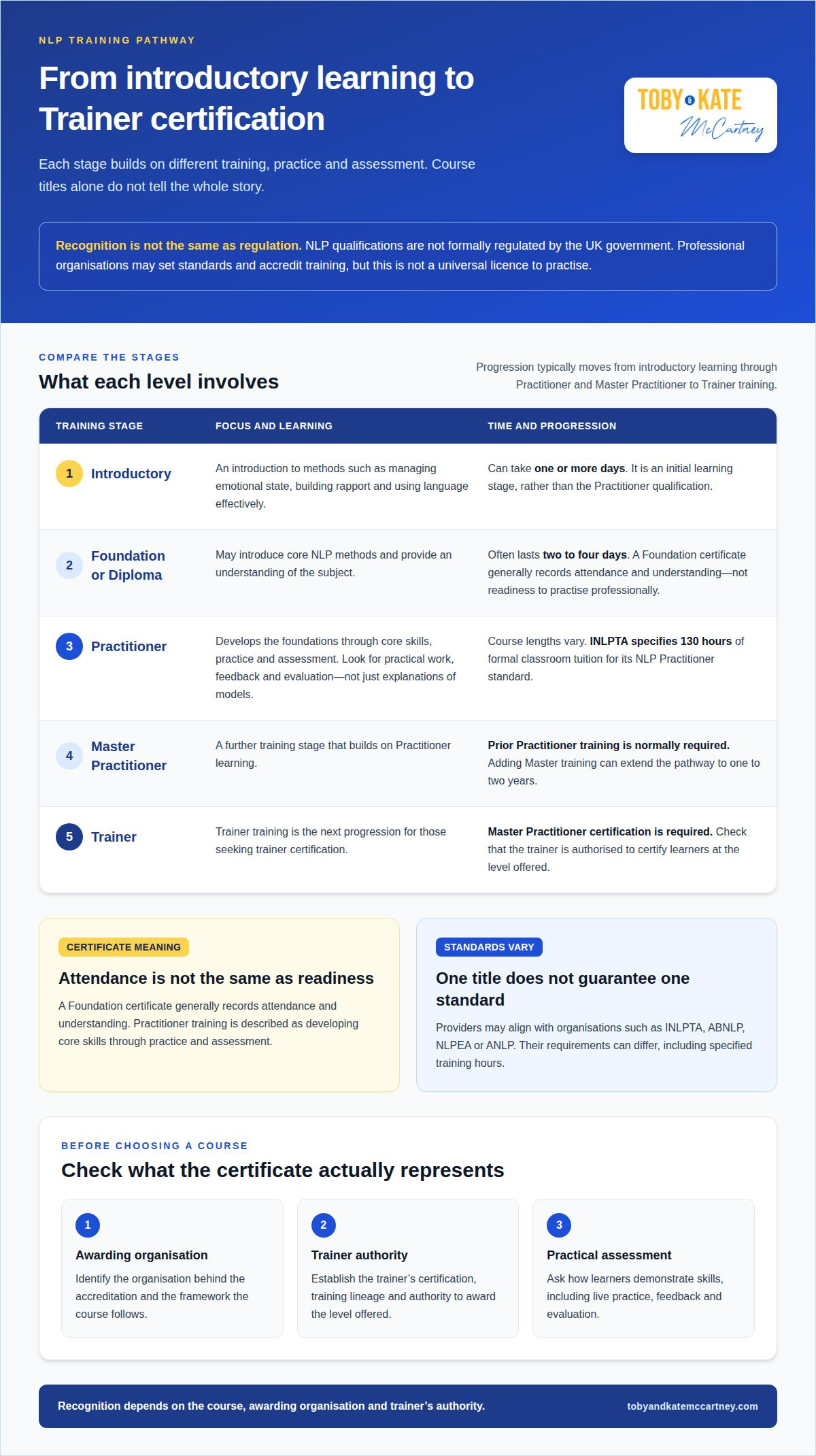
An introductory course can take one or more days, while Foundation or Diploma training often lasts two to four days. These stages may introduce methods for managing emotional state, building rapport and using language effectively. Practitioner training develops those foundations through core skills, practice and assessment. Master Practitioner training normally requires prior Practitioner training, and Trainer training requires Master Practitioner certification.
Practitioner course lengths vary. INLPTA’s NLP Practitioner standard specifies 130 hours of formal classroom tuition. Adding Master training can extend the pathway to one to two years. A Foundation certificate generally records attendance and understanding, rather than readiness to practise professionally.
UK course prices depend on factors such as training level, duration, delivery format and assessment. The cost varies, so request a quote.
Common pitfalls include confusing a course attendance certificate with a professional qualification, or assuming every certified NLP course follows the same standard. Training quality and certification authority can differ between providers.
International training standards and providers
No single central authority sets standards for every NLP provider internationally. Independent training providers may align courses with professional organisations, including INLPTA, ABNLP, NLPEA or ANLP. Standards can differ: for example, one organisation’s specified training hours may not match another body’s requirements. The certificate’s meaning therefore depends partly on its awarding organisation.
Before enrolling, establish the trainer’s certification, training lineage and authority to certify learners at the level offered. Ask what assessment involves, including live practice, feedback and evaluation. A certified NLP Practitioner course should build practical behaviour and communication skills, not just explain models. If your goal is an NLP Master qualification, confirm that the route recognises prior Practitioner training and explains progression clearly.
Professional organisations and self-regulation
In the UK, NLP qualifications are not formally regulated by government. Professional organisations provide a form of self-regulation through standards, ethics guidance and membership. Recognition by an organisation can indicate that training follows its framework, but it is not government regulation or a universal licence to practise.
Organisations in the NLP field include INLPTA, ABNLP and NLPEA. Their frameworks can support professional development by setting expectations for training and practitioner conduct. For example, the Professional Guild standard required NLP Practitioner training to include a minimum of 120 contact hours, according to its standard as recorded in December 2021. Such standards help learners understand what a qualification covers.
The Professional Guild of NLP was formed in May 2003 and formally closed in 2017. It had around 20 member organisations, including training providers in England, Wales and Scotland, according to figures reported in December 2021. Its closure means the Guild is a historical example of collective standards, not a current route to membership. It also shows that self-regulation can change as professional organisations evolve.
No. An NLP qualification alone does not qualify you to practise as a therapist or counsellor in the UK. NLP training can develop communication and coaching techniques, but it should not be presented as clinical mental health training or a substitute for a separate professional qualification.
For coaching, distinguish an NLP Practitioner certificate from a coaching qualification or membership. For example, graduates of an NLP Practitioner and Coaching Certification receive Student Membership of the Association for Coaching. That membership relates to that specific certification; it doesn’t mean every NLP diploma or practitioner course grants the same recognition. A professional coach should describe their credentials accurately and work within their scope of practice.
If your aim is to use NLP in coaching or professional development, focus on practical assessment, ethics and professional standards. Explore NLP Practitioner Certification as a pathway for developing practitioner skills and applying techniques responsibly.
Accreditation and recognition of NLP qualifications
Accreditation can indicate that a course or trainer follows a professional body’s framework. It doesn’t create one universal NLP qualification: the Society of NLP and INLPTA are among the bodies affiliated with some training programmes. Qualified trainers authorised by professional bodies award NLP qualifications and certifications. The awarding body and trainer’s authority help define what a certificate represents.
Professional bodies can set expectations for course content, training time and assessment. Those expectations may differ, so the same course title doesn’t necessarily mean identical training across providers. Compare the course level, delivery hours and how learners demonstrate their skills. A certificate that names its awarding body and assessment gives a clearer account of what the learner completed.
Accreditation can apply to a trainer rather than a learner’s qualification. Trainer recognition may involve evidence of teaching experience and learner feedback. This differs from the standards applied to a Practitioner or Master Practitioner course. When assessing a course, establish whether the trainer is authorised to award its certificate and whether the accreditation applies to that programme.
A Level 3 Certificate of Achievement issued by QAUK is not an Ofqual-regulated qualification. Its learning outcomes are benchmarked at Level 3 against descriptors published by Ofqual. That distinction matters: a level benchmark describes learning outcomes, while regulation concerns the qualification’s formal status. Don’t treat the words “Level 3” or “accredited” as proof of government regulation.
To judge whether recognition fits your purpose, establish who awards the certificate, which body’s standards apply and how assessment works. Observed practice and clear feedback can show how learners demonstrate skills, beyond simply completing course content. Consider whether the certificate supports your intended professional use. These details help you describe your training accurately to employers, clients or professional organisations.
Whether the qualification is internationally recognised
An NLP Practitioner certificate can be relevant to professional work, but recognition may vary by context. But “recognised” can mean different things: a certificate may be accepted within NLP networks without being treated as a regulated qualification by every employer, association or country. Your purpose matters. Applying NLP skills in a business role differs from seeking formal professional status abroad.
Recognition can depend on the organisation that awarded the certificate, the trainer’s authority and the course level. An NLP Practitioner certificate and an NLP Master Practitioner certificate represent different stages and are not interchangeable. A foundation course may introduce linguistic methods, while advanced training represents further study. The certificate should clearly identify its level and awarding body.
Before using a qualification internationally, take three practical steps. First, establish which organisation issued it and what its accreditation covers. Next, consider the role you intend to pursue, such as coaching, leadership development or another professional setting. Then identify whether the relevant association or employer recognises that training for your purpose. This clarifies the difference between skill development and formal recognition.
For example, an NLP Practitioner may use communication techniques in a business context, while an overseas professional association may apply its own membership criteria. An NLP Master Practitioner qualification can show advanced NLP training, but the title alone doesn’t establish acceptance by every organisation. The course assessment, trainer credentials and documented training pathway help explain the qualification’s substance across borders.
So, is NLP a recognised qualification internationally? It can be recognised within professional NLP contexts, but recognition isn’t uniform across countries or purposes. Treat the certificate as evidence of completed training, then assess its relevance to the role or association you’re pursuing. That’s a stronger basis for planning international work than relying on the word “recognised” alone.
Build a clear foundation for your next step by exploring NLP Practitioner training aligned with your professional goals.
Toby and Kate McCartney
Toby and Kate McCartney offer a clear next step if you want to turn your interest in NLP into structured learning. Their NLP Practitioner Certification, NLP Master Practitioner Certification and NLP Trainer Training support progression through different stages of study.
Choose a pathway that matches your intended use. Practitioner training can build a foundation in NLP skills, while Master Practitioner and Trainer Training provide routes for further development. Understanding the course level and certificate awarded helps you decide whether the training fits your professional goals. Recognition can still vary between organisations and countries, so consider the qualification alongside the role you plan to pursue.
If you’d like to discuss which learning pathway fits your goals, contact Toby and Kate McCartney.
Choose the next step that fits your goals
You’ve asked whether NLP is a recognised qualification. The useful next step is to define what you want that recognition to support: professional development, applying NLP at work or progressing to further training. A clear goal helps you choose a learning pathway and explain your training accurately to employers, clients or professional associations.
Toby and Kate McCartney offer NLP Practitioner Certification, NLP Master Practitioner Certification and Public Speaking programmes. These options support different development aims, from building NLP skills to improving communication and presentation capability. Focus on the learning that fits your direction, rather than choosing by certificate title alone.
If you’re ready to explore a pathway that aligns with your goals, contact Toby and Kate McCartney to discuss your next step. Your professional growth begins with a clear decision, and you can make it with purpose.
Frequently Asked Questions
What are NLP qualifications?
NLP qualifications are certificates awarded after completing training in Neuro-Linguistic Programming. They can document learning in communication methods and NLP models; their value is shaped by course content, assessment and the awarding organisation. For example, a learner may use NLP skills in a leadership role without presenting the certificate as a university degree or clinical credential. The qualification should accurately describe what was studied.
What is an NLP Practitioner?
An NLP Practitioner is someone who has completed Practitioner-level NLP training and applies its methods in appropriate settings. For example, a practitioner might use rapport-building or language techniques in business communication, management or education. The title describes NLP training, not a licence to provide therapy. A certificate can show completed study, while the practitioner remains responsible for using their skills within their competence.
Who regulates NLP, and what do affiliation bodies stand for?
NLP isn’t formally regulated by the UK government. Professional bodies such as INLPTA, ABNLP, NLPEA and the Society of NLP offer frameworks covering standards, ethics and professional membership. Affiliation can show that a course or practitioner is connected with an organisation’s criteria. It isn’t government approval, and each organisation’s membership or accreditation has its own scope and meaning.
What does NLP mean in the context of qualifications?
NLP means Neuro-Linguistic Programming. In a qualification title, it identifies the subject area of the training rather than a single nationally standardised award. Course providers may teach methods involving communication, language and behaviour. For instance, an NLP certificate can describe training in these areas, but its title alone doesn’t establish the course level, assessment or recognition by a particular employer.
Is Neuro-Linguistic Programming (NLP) recognised as a qualification in the UK?
NLP training is available as professional certification, but NLP qualifications aren’t formally regulated by the UK government. Recognition can come through a professional body’s standards or an employer’s view of the training. Whether NLP is a recognised qualification therefore depends on what kind of recognition you mean and how you plan to use it. A certificate doesn’t automatically equal a regulated academic award.