
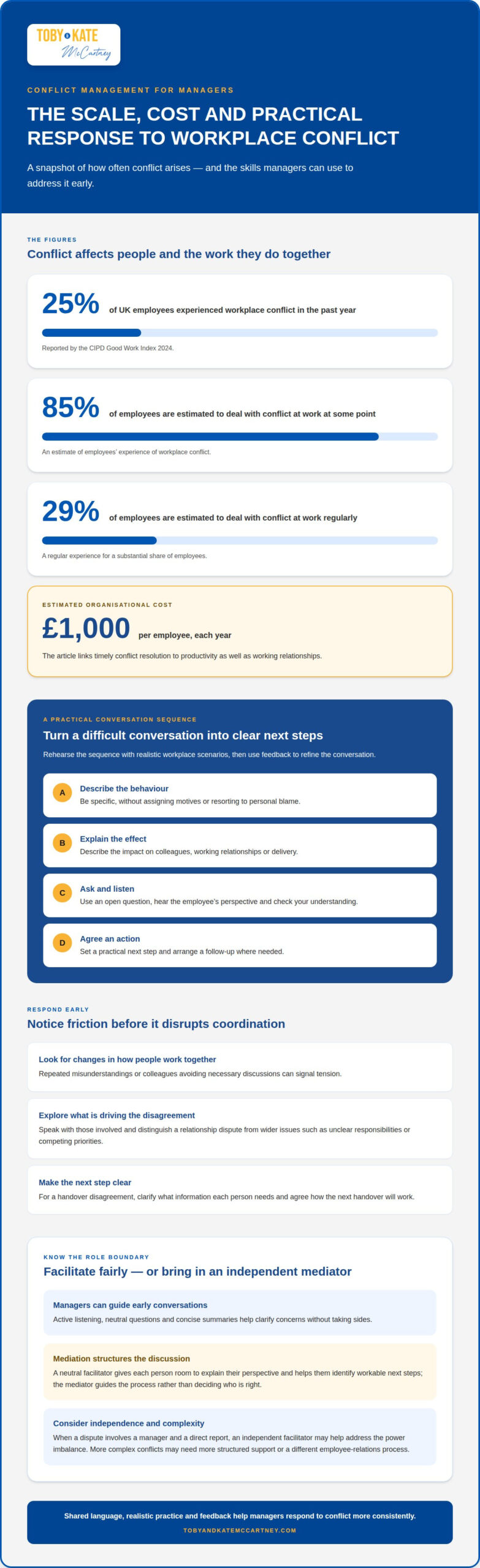
In the UK, 25% of employees experienced workplace conflict in the past year, according to the CIPD Good Work Index 2024. Conflict management training for managers helps build the skills to address disagreements early, hold difficult conversations and protect working relationships. It matters because unresolved tension can affect both people and the work they need to do together.
Managers must balance results with trust, accountability and team relationships. The challenge is responding when priorities clash or a conversation becomes difficult. Conflict management training for managers builds practical skills to address issues clearly, rather than avoiding them or allowing them to escalate.
This article explains why conflict-resolution training matters, what effective training can cover and how leadership development can give teams shared ways to handle conflict. It also explores what to consider when choosing an approach, from live practice to support for more complex situations.
Key Takeaways
- Look beyond individual disagreements to spot workplace conditions that may be fuelling team conflict.
- Recognise when a manager can facilitate a resolution and when a complex situation calls for more advanced mediation skills.
- Use realistic practice and feedback to build confidence in difficult conversations and clear, fair accountability.
- Develop shared leadership expectations so managers address conflict consistently, with NLP training as one possible development pathway.
Why is Conflict Resolution Training Important?
Workplace conflict affects employees and the relationships teams rely on to deliver work. The CIPD Good Work Index 2024 reports that 25% of UK employees experienced workplace conflict in the past year.
Workplace mediation and team resolution
Mediation gives colleagues a structured conversation with a neutral facilitator, helping them explain concerns, identify common ground and agree practical next steps. In a team, this can bring different accounts into the open before disagreements disrupt coordination. Training should help managers distinguish a relationship dispute from a wider team problem, such as unclear responsibilities or competing priorities.
Communication during workplace disagreements
Clear communication helps employees discuss specific behaviour and its impact without resorting to personal blame. A manager can listen carefully, summarise each person’s concerns and ask what would help them work together. If two colleagues disagree about handovers, for example, focus on the information each needs and agree how the next handover will work.
Proactive responses to workplace conflict
Responding early gives managers a chance to address friction before it becomes harder to resolve. Start by recognising changes such as repeated misunderstandings or colleagues avoiding necessary discussions. Then speak with those involved, establish what happened and agree a follow-up step. Conflict at work costs organisations £1,000 per employee each year, making timely resolution relevant to productivity as well as working relationships.
Conflict and employee relations
Workplace conflict can affect trust between employees and managers, especially when people see concerns being handled inconsistently. Internal workplace mediation accreditation can form part of a structured approach: clarify who may mediate, define the limits of that role and set expectations for impartial conversations. Training should also show managers when a dispute needs a different employee-relations process, rather than treating every disagreement as a mediation issue.
Mediation and advanced conflict skills
Mediation can help people work towards resolution when direct conversations have stalled. Managers need to recognise when facilitation is appropriate and when their leadership role makes it difficult to remain impartial.
Third-party intervention
A third-party mediator structures the discussion, gives each person room to explain their perspective and helps them identify workable next steps. The mediator guides the process rather than deciding who is right. If a dispute involves a manager and a direct report, an independent facilitator may help address the power imbalance. CIPD describes mediation as an approach that can resolve workplace conflict.
Mediating between coworkers
For conflict between coworkers, mediation can shift the discussion from competing accounts towards practical agreements. The facilitator might ask each person to describe the behaviour affecting their work, explain its impact and say what needs to change. If colleagues disagree about task allocation, the discussion can clarify responsibilities and establish a process for raising concerns. Record agreed actions and arrange a follow-up.
Manager mediation skills
Managers can use mediation skills to guide early conversations, while considering their relationship to the people involved. Active listening, neutral questions and concise summaries help clarify concerns without taking sides. Effective training lets managers practise these techniques with realistic workplace scenarios and reflect on how their words shape the discussion. Further leadership development can help selected leaders facilitate complex conflicts that need more structured support.
Choose training that builds confidence through practice and helps managers recognise the limits of their role. For broader development of leadership capability, explore leadership development as one pathway for strengthening how leaders handle challenging conversations.
An estimated 85% of employees deal with conflict at work at some point, while an estimated 29% deal with conflict at work on a regular basis. This makes a shared approach useful beyond the leaders selected to facilitate complex disputes: managers need a common foundation for recognising and responding to tension.
Organisations can use microlearning to establish shared language, expectations and core conflict-management skills for managers. Live, interactive training gives managers the chance to rehearse difficult conversations, receive feedback and learn from peers. Combining these approaches can build consistent habits and prepare managers for conversations that require careful judgement.
Live practice for difficult conversations
Live, interactive training gives managers space to rehearse difficult conversations before they arise at work. A facilitator can present a realistic scenario, such as repeated missed deadlines affecting a shared project. Managers practise opening the discussion, explaining the impact and inviting the employee’s perspective. This turns learning into deliberate communication practice, not just advice to “be clearer”.
Effective practice follows a clear sequence. First, describe the specific behaviour without assigning motives. Next, explain its effect on colleagues or delivery. Then ask an open question and listen before agreeing a practical action. When addressing incomplete handovers, for example, a manager can ask what is getting in the way and agree what information the next handover should include.
Feedback makes each rehearsal more useful. A facilitator or peer can point out when a manager interrupted, used blame-focused language or missed a chance to check understanding. The manager can then try the conversation again and apply the feedback immediately. Repeating and reflecting builds confidence as participants see how small changes in tone and phrasing affect the discussion.
Practice should also show managers how to set accountability without making it punitive. They might agree a clear deadline, explain why it matters and arrange a follow-up conversation. If the commitment is missed, they can return to the facts, ask what happened and decide what comes next. Clear expectations keep the focus on resolving conflict and improving work, rather than labelling an employee.
To apply learning at work, training can include peer observation and a brief reflection after each role-play. Managers note which question opened the conversation, where tension rose and what helped the other person engage. They can then use the same structure in a real discussion, adapting it to the employee and situation. Rehearsal builds a practical foundation for more purposeful conflict-resolution conversations.
Conflict management and leadership training
Choose a course with realistic practice, feedback and clear links to managers’ workplace situations. The price depends on the case and is given after a quote request; format, tailoring, duration and participant numbers shape the cost.
Course content
For managers, useful content includes recognising conflict patterns, holding difficult conversations, agreeing actions and knowing when mediation is appropriate. Strong programmes connect these skills to leadership responsibilities, rather than treating disputes as isolated incidents. Options can include live interactive workshops, microlearning, immersive leadership learning or advanced mediation skills. Choose an approach that fits the issues managers face and gives them practical knowledge to apply at work.
Organisations can make conflict competence part of their leadership approach instead of waiting for a complaint or team breakdown. A layered programme can establish shared language and expectations through microlearning, then build capability through deeper practice. Look for practical signs of progress: managers address issues earlier and more consistently, feel more confident in difficult conversations, and identify systemic causes such as unclear responsibilities.
Course duration and online availability
Training duration depends on its format, depth and the skills participants need to practise. A short session may introduce shared concepts, while an immersive programme can give leadership teams more time to examine patterns and align expectations. Online delivery can include live discussion, guided scenarios and follow-up learning; the design should still give managers a chance to practise responses and receive feedback. Similarly, for professionals seeking structured online modules to maintain compliance and professional standards, Education Pathways, LLC demonstrates how dedicated digital hubs make state-approved continuing education accessible.
Choose a course by matching its learning method to the outcome you want. If managers need a shared foundation, microlearning can create consistent expectations across teams. If leaders need to address complex conflict, prioritise facilitated practice and advanced skills. Assess progress through practical signs: issues are raised sooner, resolved at the lowest appropriate level and recurring organisational causes are addressed.
To strengthen leadership capability alongside conflict skills, explore leadership training as a development pathway for managers.
Toby and Kate McCartney
Toby and Kate McCartney offer leadership training and NLP programmes for personal and professional development. If you want to strengthen your communication, influence and leadership alongside your organisation’s approach to workplace conflict, their programmes provide a relevant development pathway. NLP Practitioner Certification, NLP Master Practitioner Certification, public speaking programmes and NLP Trainer Training support different goals, from developing personal skills to building the capability to train others.
This pathway is a good next step when you want to develop your own leadership practice, rather than seeking mediation for a specific workplace dispute. Choose the direction that best matches the skills you want to build. To discuss your development goals, contact Toby and Kate McCartney.
Make your next leadership step count
Conflict management training for managers can be a starting point for a wider shift in how you lead. Connect the skills you want to develop with the conversations and relationships your role depends on. Consider where you want greater clarity, confidence or influence, then choose a learning pathway that supports that goal. Strong leadership grows through deliberate practice, reflection and a willingness to keep learning.
If you’re ready to explore how personal and professional development could support your leadership goals, contact Toby and Kate McCartney. A conversation can help you consider which direction fits your ambitions. Take that step with purpose, and keep building the leader you want to become.
Frequently Asked Questions
What skills should managers learn to handle workplace conflict?
Managers need emotional self-management, impartial judgement and the ability to ask focused questions. If a team member reacts angrily to a rota change, for example, the manager should stay composed, clarify the concern and separate the practical issue from personal assumptions. Managers also need to recognise when their involvement could affect trust and when someone else should lead the discussion.
How effective is conflict management training for managers?
Training is effective when managers can apply its methods to workplace situations and receive feedback on their approach. One practical measure is whether a manager can handle a scenario they previously avoided, such as addressing dismissive behaviour in a team meeting. Organisations can review examples from supervision discussions to see whether managers take appropriate action and learn from how conversations unfold.
What are the steps for managers to resolve workplace conflict?
Start by gathering relevant accounts separately, then identify the specific issue and its impact on work. Bring the people involved together only when a joint discussion is appropriate. Agree clear, practical actions within each person’s control, such as confirming who owns a shared task. Set a follow-up point and review whether the agreement has changed the situation.
What are the risks of managers handling workplace conflict poorly?
Poorly handled conflict can deepen mistrust, discourage employees from raising concerns and allow damaging behaviour to continue. Dismissing a complaint as a personality clash, for example, may leave the actual issue, such as repeated exclusion from project decisions, unresolved. Taking sides before understanding what happened can also undermine confidence in a manager’s fairness and make future team discussions harder.