People Insight’s benchmark data finds that 63% of employees feel valued and recognised for their work. That points to a practical starting place for how to improve employee engagement: help people feel their contribution matters, understand what they’re working towards and see room to grow. Engagement reflects how invested employees feel in their work and the effort they bring to it.
You’re right to look beyond perks or a one-off thank you. Recognition works best as part of a consistent approach, supported by useful feedback, clear goals and meaningful development. When people feel appreciated and connected to their work, they have a stronger foundation for contributing with purpose.
This article explains what employee engagement means and how recognition and rewards can support it. You’ll also find practical ways to set clear goals, create development pathways and build a workplace where people feel heard, motivated and ready to do their best work.
Key Takeaways
- Use employee surveys and two-way conversations to uncover what helps people feel engaged, then follow through with visible action.
- Make recognition timely and specific, and choose rewards that reflect employees’ contributions rather than relying on one-size-fits-all gestures.
- Set shared goals with clear expectations, and connect regular feedback to practical opportunities for learning and career progression.
- Explore how engagement can support stronger day-to-day performance, team wellbeing and staff retention.
1. What Is Employee Engagement?
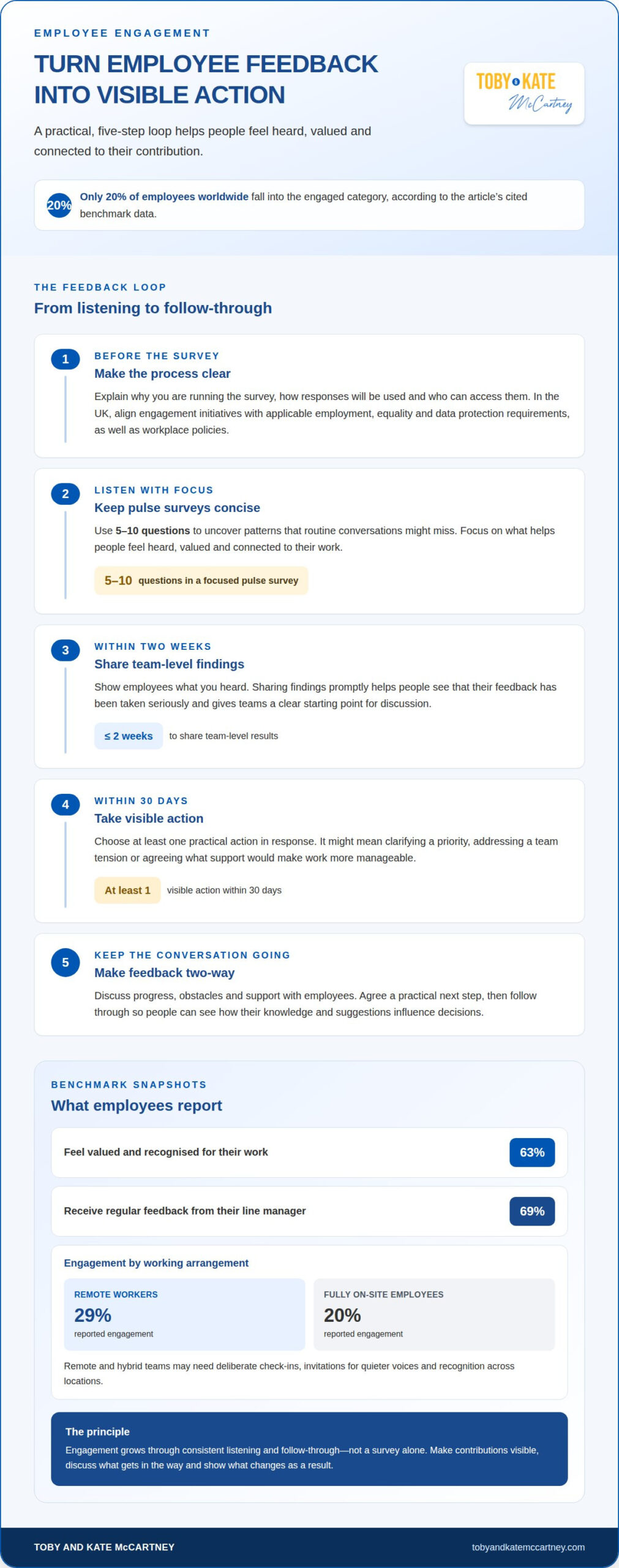
Employee engagement describes how invested people feel in their work and the effort they bring to it. Only 20% of employees worldwide fall into the engaged category. For managers, improving engagement starts with understanding what helps people feel heard, valued and connected to their contribution.
A survey can reveal patterns that routine conversations might miss. Keep pulse surveys focused, with 5-10 questions, then share team-level findings within two weeks and take at least one visible action within 30 days. That follow-through closes the feedback loop: employees see their knowledge and suggestions influencing decisions.
Make ongoing feedback a two-way conversation, not a performance verdict. People Insight’s benchmark data says 69% of employees receive regular feedback from their line manager. Managers can discuss progress, obstacles and support, then agree a practical next step, such as clarifying a priority or arranging coaching.
In the UK, engagement initiatives should align with applicable employment, equality and data protection requirements, as well as workplace policies. Explain why you’re running a survey, how responses will be used and who can access them. Clear communication helps employees understand the process and share feedback with confidence.
Flexible working and work-life balance can support engagement by giving people more autonomy over how they manage work. In People Insight’s benchmark data, 74% say they can strike the right balance between work and home, while 80% feel they have the freedom needed to do their job.
Remote and hybrid teams need deliberate contact, because informal conversations happen less often. Remote workers reported 29% engagement, compared with 20% for fully on-site employees. Managers can schedule regular check-ins, invite quieter voices into meetings and recognise contributions across locations.
Low engagement can stem from unclear priorities, limited recognition, poor communication, unresolved conflict or unmanageable workloads. Address the specific cause: clarify expectations, listen without defensiveness, resolve team tensions and agree what support would make work more manageable.
Leadership development can strengthen these habits. A 360-feedback process gathers perspectives from colleagues and direct reports, helping managers identify how their behaviour affects trust and communication. Pairing that feedback with coaching gives leaders a clear opportunity to practise listening, recognition and constructive conversations.
2. Recognising achievements and offering rewards
Recognition makes effort visible, especially when it names the contribution and its impact. People Insight’s benchmark data finds that 63% of employees feel valued and recognised for their work. A specific thank you can reinforce the behaviour behind a result: “Your clear handover helped the team meet the client deadline” shows exactly what mattered.
Timing gives praise its force. People Insight’s benchmark data says 61% of employees received thanks or praise for good work in the past week. Managers can recognise a helpful action soon after it happens, in a team meeting or a private conversation, depending on the employee’s preference. Frequent, sincere acknowledgement is more meaningful than saving every compliment for an annual review.
Recognition can strengthen connection, morale and collaboration when it acknowledges shared effort. For example, thank a project group for resolving a delivery problem, then recognise individuals who coordinated work or shared knowledge. This avoids rewarding only visible, individual wins and shows how different roles contribute to the same outcome.
Rewards can complement praise, but choose them to suit the achievement and workplace culture. A team might mark a completed project with a shared celebration, while an individual reward could acknowledge a specific contribution. Set transparent criteria, explain eligibility and review whether the initiative encourages the intended behaviour rather than competition or favouritism.
Recognition, rewards and career development support engagement in different ways: appreciation affirms current contributions, rewards mark achievement, and development offers a future pathway. Link praise to a conversation about skills the employee wants to build, then identify a suitable stretch task or learning opportunity. Recognition can then become a practical step towards growth, not just a moment of appreciation.
For managers building these habits, develop recognition into everyday leadership through deliberate communication, consistent acknowledgement and follow-through. Track which contributions are recognised across the team, then adjust your approach if some people or forms of work receive less visibility.
3. Setting clear goals and career progression paths
Clear goals turn broad priorities into meaningful contributions. Agree objectives with each employee, define the deliverable and explain how success supports the team. For example, a customer service goal might focus on resolving recurring enquiries, with progress reviewed through examples and regular feedback. Employees can see what matters and where to focus their effort.
Career development matters too. People Insight’s benchmark data finds that 63% of employees say they have the right opportunities to learn and grow at work, while 59% say their career development aspirations are being met. Ask about an employee’s interests, identify skills needed for their next step, then agree relevant training or stretch assignments.
A visible progression framework can clarify routes beyond promotion. Map the skills and responsibilities associated with different roles, and show how someone might move into a specialist, project or leadership pathway. Track internal mobility and promotion velocity on a rolling 12-month basis to understand whether employees can advance within the workplace.
Mentoring and coaching can help turn those pathways into action. A mentor can share knowledge and perspective; coaching can help an employee practise a skill, reflect on feedback and choose their next step. In one study, 87% of mentors and mentees felt empowered by their relationship and developed more confidence. Match support to the person’s goals, rather than treating every development need alike.
Leaders can strengthen motivation by revisiting objectives in one-to-one conversations. Discuss what has progressed, what is blocked and whether priorities still fit the role. If an employee wants to develop presentation skills, for instance, agree that they can lead a team briefing and review what they learn afterwards.
Regularly review whether opportunities are accessible across the team. Employees stay 41% longer at organisations that regularly hire from within. Internal appointments are not the only measure of satisfaction, but transparent criteria and practical development options show employees how they can contribute and grow.
4. Employee engagement and its benefits
Engagement matters because it connects workplace culture with outcomes leaders can measure. Gallup’s database associates highly engaged employees with 23% higher profitability across companies. That relationship is not a promise of automatic gains; it shows why committed employees’ experiences deserve attention alongside financial results.
Productivity offers another useful lens. Gallup associates highly engaged employees with 14% higher productivity, measured through production records and evaluations, across companies in its database. Its figures are not a UK-specific estimate. For a UK business, compare engagement trends with relevant internal measures, such as completed work, quality checks and customer feedback.
There is no single figure for what disengagement costs every UK business. The impact depends on factors such as staff turnover, absence, output and mistakes, as well as the roles affected. Track these indicators together over time, then assess where low engagement coincides with operational problems.
Gallup also associates highly engaged employees with 21% less turnover in high-turnover organisations, defined as those with more than 40% annualised turnover. In low-turnover organisations, defined as those with 40% or lower annualised turnover, the association is 51% less turnover. These comparisons show why retention should be considered in context, not treated as a standalone result.
Engagement strategies can strengthen more than output. Gallup’s database links high engagement with 10% higher customer loyalty or engagement, 63% fewer safety incidents and 70% higher wellbeing, measured as net thriving employees. Each measure highlights a different part of organisational performance, from customer experience to people’s working lives.
Build a practical feedback loop: measure engagement, identify a team-level issue, agree an action and review the change. If survey results point to unclear priorities, leaders could reset responsibilities, then track progress and employee feedback. This turns culture into everyday behaviour rather than a statement on a wall.
To strengthen the leadership skills behind these conversations, develop your leadership communication with focused training and coaching.
Higher employee engagement can be associated with stronger productivity, though the relationship may vary across organisations. UK businesses can compare engagement trends with internal measures such as completed work, quality checks and customer feedback.
Toby and Kate McCartney
Toby and Kate McCartney help leaders strengthen the communication and leadership skills that support a more engaged workplace. If managers need to listen more effectively, give constructive feedback or build trust, leadership training and mentoring can help turn those priorities into practical behaviours.
For individuals looking to develop their influence and communication, NLP Practitioner Certification and NLP Master Practitioner Certification offer structured learning pathways. Public Speaking programmes can help people communicate ideas with greater confidence, while NLP Trainer Training supports those building their training skills.
Choose a development pathway that matches the challenge: improving everyday manager conversations, growing leadership capability or communicating with clarity. These skills can complement recognition, clear goals and career development, helping leaders put engagement principles into practice. Contact Toby and Kate McCartney to discuss your development goals.
Build engagement into the way you lead
A stronger employee experience grows through consistent leadership, not a single initiative. Choose one change to carry forward, make it part of everyday practice, and pay attention to how your team responds. A practical answer to how to improve employee engagement is to make that commitment visible in the way you lead.
Developing your communication and leadership skills can help you put that commitment into action. Toby and Kate McCartney offer NLP Practitioner Certification, NLP Master Practitioner Certification and Public Speaking programmes. These learning pathways help strengthen personal and professional communication, whether you want to develop your own capabilities or bring new skills into your leadership approach.
If you’re considering how to improve employee engagement, choose a development pathway that fits your goals. Contact Toby and Kate McCartney to explore your next steps. Every thoughtful improvement in how you lead can help create a workplace where people feel able to do their best.
Frequently Asked Questions
What Is Employee Engagement?
Employee engagement describes the connection people feel with their work and their willingness to contribute beyond completing assigned tasks. It differs from job satisfaction: someone may value their working conditions but feel little involvement in team goals. For example, an engaged employee might flag a recurring problem and help colleagues improve the process instead of waiting for instructions.
What are the best team engagement strategies in 2027?
Strong strategies for 2027 should make contribution, communication and development part of everyday team routines. Agree how decisions are shared, invite input before changes affect workloads, and make team responsibilities visible. For example, after a project, ask what slowed collaboration and choose one improvement to test next time. Review the result with the team, rather than assuming an initiative worked.
What are the most effective ways to improve employee engagement?
The most effective approach starts by identifying what is weakening engagement in a particular team. Use employee comments and workplace indicators to pinpoint a barrier, such as conflicting priorities or limited input into decisions. Then agree a focused action with employees, assign responsibility and review its effect. This makes deciding how to improve employee engagement a practical process, not a generic campaign.
How can employers measure employee engagement using surveys and other metrics?
Combine survey responses with measures that show how work is experienced and delivered. Ask focused questions about trust, clarity and whether employees can raise concerns, then compare responses with relevant indicators such as staff turnover, absence, quality or customer feedback. Look for patterns by team and over time. Discuss results with employees before drawing conclusions, since one metric rarely explains the full picture.
How often should companies conduct employee engagement surveys?
Choose a survey rhythm that gives employees time to experience changes and leaders time to act on feedback. A full survey can establish broader themes, while shorter pulse checks can explore a specific change or concern. Avoid repeatedly asking questions without explaining what happened next. The right cadence depends on how quickly the organisation changes and whether it can respond meaningfully between surveys.
How can managers improve employee engagement through regular one-to-ones and feedback?
Make one-to-ones useful by inviting the employee to set the first agenda item. Ask what is helping or hindering their work, then offer feedback tied to a specific behaviour and its effect. For instance, discuss how raising a risk early in a project meeting helped the team respond. End by agreeing on one action, who owns it and when to review progress.