
Coaching for performance improvement turns a work goal into focused conversations, practical actions and regular reflection. Leaders can use the GROW model: clarify the Goal, explore the current Reality, consider Options and agree what the person Will do next. Coaching is an ongoing process, not a one-off review.
Strong performers need development too. You may recognise their contribution and trust them to deliver, while still seeing room to strengthen their judgement, influence or impact. Effective coaching builds on existing strengths rather than treating every conversation as a response to poor performance.
This guide explains how leadership coaching works, from setting shared goals and listening actively to creating psychological safety and reviewing progress. You’ll learn how to make feedback specific and useful, support people through barriers and give high performers a clear path to keep growing. The aim is practical: help people take ownership of their development while keeping performance conversations grounded in work, behaviour and outcomes.
Key Takeaways
- Set shared development goals, agree practical actions and revisit progress regularly to keep coaching connected to workplace performance.
- Make feedback specific and focused on behaviours and results, so people can see what to build on and where to adjust.
- Use thoughtful questions and active listening to uncover barriers, strengthen trust and help employees find their own solutions.
- Support high performers by identifying new challenges that develop their strengths, influence and leadership capability.
- Measure progress against agreed goals and relevant work outcomes, then use what you learn to shape the next conversation.
What are the steps in employee performance coaching?
Employee performance coaching turns a work goal into agreed development actions and regular reviews. For example, a manager could help an employee strengthen presentation skills, then assess progress by observing meetings and discussing feedback.
In the UK, align coaching with your organisation’s documented performance procedures, apply them consistently and keep records relevant to each discussion. Coaching supports development; it doesn’t replace a formal process where one applies.
There’s no single standard UK price for hiring a performance coach. Costs depend on factors such as the coach’s experience, session format, preparation and engagement length. For a defined price, ask for a quote.
The GROW model is commonly used in workplace coaching: Goal, Reality, Options and Will. It helps an employee clarify an outcome, examine their current position, explore possible actions and commit to a next step.
Set session frequency and length around the employee’s goal, work demands and progress. Coaching is ongoing rather than a one-off review; a leadership engagement typically lasts several months.
Avoid vague criticism, judgements about personality and imposing solutions before hearing the employee’s perspective. For example, describe missed handovers, explore the cause together and agree a practical change, rather than labelling someone careless.
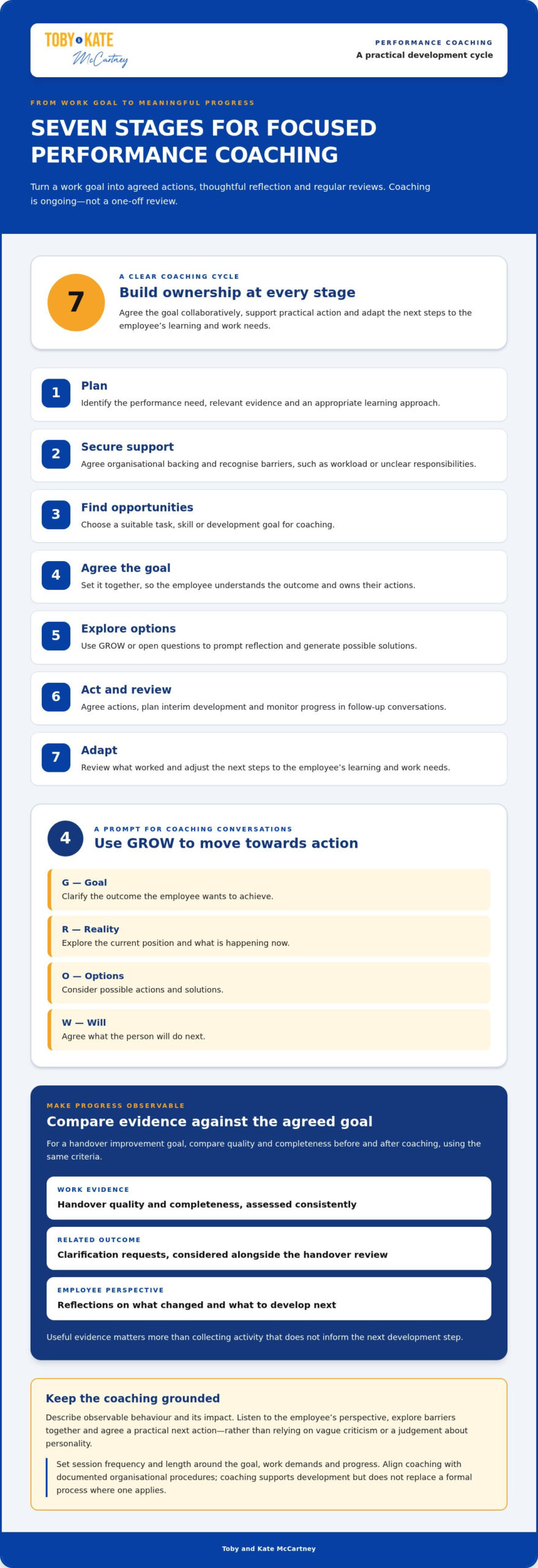
A clear coaching cycle gives employees ownership and helps managers connect strengths, engagement and performance. These seven stages keep development focused:
- Plan: Identify the performance need, relevant evidence and appropriate learning approach.
- Secure support: Agree organisational backing and recognise barriers, such as workload or unclear responsibilities.
- Find opportunities: Choose a suitable task, skill or development goal for coaching.
- Agree the goal: Set it collaboratively, so the employee understands the outcome and owns their actions.
- Explore options: Use GROW or open questions to prompt reflection and generate possible solutions.
- Act and review: Agree actions, plan interim development and monitor progress in follow-up conversations.
- Adapt: Review what worked and adjust the next steps to the employee’s learning and work needs.
Measure impact against the goal agreed at the outset. For a handover improvement goal, compare the quality and completeness of handovers before and after coaching, using the same criteria. Review related outcomes, such as fewer clarification requests, alongside the employee’s reflections. This combination shows whether coaching is changing observable behaviour, supporting productivity and strengthening engagement. Keep the review proportionate: useful evidence matters more than collecting activity that doesn’t inform the next development step.
Performance coaching can support employee development and career growth. It helps managers and employees plan, carry out and review actions, with the aim of supporting productivity and job satisfaction. Coaching is also seen as an important part of improving employee engagement. Developing existing employees’ skills through coaching may reduce the need to recruit new employees.
In a leadership coaching engagement, the coach and participant define goals, agree how to measure success, and set expectations for confidentiality and communication. Setting development goals collaboratively can build accountability, commitment and ownership.
How Does Leadership Coaching for Performance Work?
Performance improvement coaching helps leaders strengthen work behaviours and results through focused conversations, feedback and agreed actions. It links a capability to a practical outcome, such as handling disagreement constructively or making team expectations clearer.
Leadership Capabilities and Feedback
Leadership capability includes giving useful feedback and managing conflict while keeping people focused on shared work. A leader’s response can clarify expectations or intensify tension. In a session, examine a specific example, such as a disagreement over responsibilities, and identify communication choices that could support a better outcome.
Separate the issue from the person. A leader can describe what happened, explain its effect on the work and invite the employee’s perspective. This creates space to understand different views before agreeing an action. Coaching can also help leaders recognise their strengths and blind spots, so they can adapt their approach instead of relying on habit.
Constructive Feedback and Recognition
Constructive feedback describes observable behaviour, its impact and a clear next action. This helps employees understand what to change without interpreting criticism as a judgement of their personality. Instead of saying, “you’re disorganised”, for example, a leader could identify a missed handover, explain the resulting delay and agree how future updates will be shared.
Recognition is most useful when it names the behaviour worth repeating. A leader might acknowledge how an employee summarised concerns before a meeting decision, then explain how that helped the group move forward. Specific recognition makes strengths visible and gives the employee a practical signal about which contribution to continue.
Assessments and Feedback Conversations
Assessments provide structured insight into leadership strengths, tendencies and possible blind spots. A 360-degree assessment can bring together perspectives that help a participant explore how their behaviour is experienced by others. It should inform a conversation, not become a verdict; the coaching value comes from connecting the insight to a development goal and workplace action.
In feedback conversations, leaders and employees discuss evidence, explore what influenced the result and agree what happens next. Ask open questions, listen without rushing to defend the feedback, and check that the next action is clear to both people. Follow-up sessions can review what changed and whether the action supported the intended outcome.
If you’re ready to strengthen these capabilities in practice, explore leadership development support as a next step.
How leadership coaching supports performance improvement
Leadership coaching helps managers turn development needs into stronger skills, clearer decisions and better team outcomes. It supports team leaders who set objectives and help employees deliver them.
Performance coaching develops skills through reflection, feedback and agreed actions. A formal performance improvement plan (PIP), by contrast, sets out specific concerns, required changes and review arrangements within an employer’s performance process.
Coaching Skills for Leaders
Using coaching as a leadership skill means drawing on listening, questions and reflection to help employees find practical ways forward. A manager who asks before advising may uncover barriers that aren’t obvious from a performance measure alone. For example, missed deadlines may reflect unclear priorities, not a lack of ability.
Leaders can build coaching skills through targeted learning and practice. A manager might assess how they respond to challenge, then practise asking open questions and summarising an employee’s perspective. Awareness of personal strengths and blind spots helps leaders choose a useful response instead of relying on a fixed management style.
Managers don’t need to treat coaching as a substitute for every other leadership responsibility. They need to recognise when a coaching conversation can develop talent and when clear direction or a formal process is required. Coaching skills are especially useful when an employee can improve but needs support identifying the next action.
Coaching, Improvement Plans and Accreditation
Coaching supports performance improvement by helping people assess their current approach, uncover assumptions and choose development actions. A PIP is more formal: it records the performance gap, expected standard and review process. Keeping these purposes distinct helps managers offer development support without disguising a formal performance process as an informal conversation.
For instance, a team leader could coach an employee to improve client handovers by exploring what causes information gaps and agreeing a new routine. If the employer has initiated a PIP, keep the coaching conversation aligned with its documented expectations and review arrangements.
When choosing an accredited performance coach in the UK, look for a credential relevant to workplace coaching, then assess the awarding organisation, training and experience. Ask how the coach sets goals, measures progress and handles confidentiality. These details help you judge whether their approach fits the leadership capability or employee development need.
Coaching can benefit leaders responsible for team objectives and employees developing role-specific skills. A leader might use it to strengthen delegation, while a team member develops confidence in handling customer concerns. In both cases, agreed actions connect individual strengths to a practical workplace outcome.
Active listening and psychological safety
In a coaching session, active listening means giving an employee your full attention before shaping a response. Notice pauses, tone and body language, then check what you’ve understood. If someone says a project feels unmanageable, ask which part is creating the greatest pressure. Don’t jump straight to advice. A clear account of the problem gives both people a better starting point.
Psychological safety means creating a workplace conversation where individuals can raise concerns, admit uncertainty and discuss mistakes without humiliation. It doesn’t mean removing accountability. A manager can set clear performance expectations while responding respectfully when an employee explains a barrier. That balance can help people share information early, giving the team a chance to address problems before they further affect delivery.
Use a simple listening sequence during coaching sessions:
- Give attention: Put aside distractions and let the employee finish explaining.
- Notice cues: Pay attention to changes in tone, facial expression and posture.
- Reflect back: Summarise the key point and ask whether you’ve understood it correctly.
- Ask openly: Use a question such as, “What would help you move this forward?”
Consider an employee who has missed a handover deadline. Instead of assuming poor commitment, ask what happened and listen to the full answer. They may describe changing priorities, unclear ownership or missing information. The manager can then explore which factor they can influence and agree one practical action. This keeps the discussion focused on work, not a personal label.
Trust grows through consistent behaviour across conversations. If a manager invites honest feedback in one session but reacts defensively in the next, employees may stop speaking openly. Explain the purpose of the discussion, listen without interruption and respond to concerns with care and patience. If information needs to be shared, explain how it will be used. Don’t imply that every conversation is confidential without limits.
Active listening also makes recognition more precise. When an employee describes how they resolved a customer issue, reflect the specific judgement or communication skill they used. Then ask how they could apply that strength in another situation. This draws learning from real workplace experience and encourages individuals to identify their own next steps.
Respectful coaching doesn’t mean agreeing with every explanation. It means hearing the employee’s perspective, checking relevant facts and discussing expectations directly. When people feel able to raise obstacles, managers can distinguish a skills gap from unclear processes or competing demands. That understanding makes follow-up actions more relevant and helps employees and leaders work towards achievable performance goals.
Coaching high performers to improve further
High performance isn’t a finish line. A dependable employee may already deliver strong results, yet still want greater influence, broader responsibility or sharper decision-making. Coaching helps leaders explore that next challenge without framing development as a response to failure. The focus shifts from fixing a weakness to extending strengths and preparing for what comes next.
Start by asking the employee what they want to achieve, rather than assuming promotion is their main goal. One person may want to lead a complex project; another may want to mentor colleagues or improve collaboration across teams. Clarifying the individual’s ambition helps the manager connect learning to meaningful work and avoid offering training that doesn’t fit.
Then examine what already drives their success. For example, a high-performing project lead may be strong at planning but less confident influencing senior stakeholders. Coaching can explore how they prepare, communicate and respond to challenge. The employee can identify which strengths transfer to the new situation and where practice or feedback would make progress visible.
Useful development opportunities stretch capability without simply adding more work. A manager might invite an experienced analyst to present recommendations to another team, then reflect together on the audience’s questions and the analyst’s response. The task creates a real opportunity to practise influence, while a follow-up conversation turns experience into learning.
Agree how you’ll recognise progress before the stretch assignment begins. Consider evidence such as:
- How clearly the employee explains a recommendation and its rationale.
- Whether colleagues understand the decision and their next actions.
- How effectively the employee invites challenge and adapts their approach.
- What the employee learns from feedback and applies in a later task.
These indicators assess the capability being developed, not just whether a project succeeded. Outcomes can depend on circumstances beyond one person’s control. Reviewing specific behaviours gives a fairer picture of learning and helps distinguish development from a favourable result.
High performers also need room to discuss workload and motivation honestly. If an employee takes on a mentoring role alongside a demanding project, ask which responsibilities should change. This helps leaders support sustainable progress instead of treating extra duties as the only sign of growth. It can also show where collaboration would make a new opportunity more achievable.
Make coaching part of a continuing development pathway. After a stretch task, recognise the specific behaviour that worked, explore what the employee would change, then agree a fresh challenge. If you’re ready to strengthen your own leadership approach, explore one-to-one coaching as a practical next step.
Toby and Kate McCartney: NLP Practitioner Certification
Toby and Kate McCartney’s NLP Practitioner Certification is a practical next step if you want to strengthen communication and self-awareness in your leadership practice. NLP training supports personal and professional development, helping you explore how people communicate, interpret experiences and respond to change. These insights can complement the coaching skills discussed in this guide.
If you’re ready to build on that foundation, the NLP Master Practitioner Certification offers a further development pathway. The SpeakUp programme supports aspiring speakers and keynote presenters, while NLP Trainer Training is for those interested in delivering NLP training. Choose the direction that best matches the capability you want to develop.
Contact Toby and Kate McCartney or visit tobyandkatemccartney.com to explore your next step.
Turn development into your next leadership move
The next step in coaching for performance improvement is to choose one capability you want to strengthen and put it into practice. Focus on a real leadership challenge, such as influencing a decision, developing a colleague or communicating a new direction. Then make time to reflect on what you learn and how you’ll apply it.
Your own development can shape the conditions in which others grow. If you want to build your communication and coaching approach, Toby and Kate McCartney offer NLP Practitioner Certification and NLP Master Practitioner Certification. Their public speaking programmes can also support leaders who want to communicate with greater confidence.
Choose the pathway that fits the capability you’re ready to develop. A clear intention gives your learning direction, and consistent practice helps turn insight into action.
Contact Toby and Kate McCartney to explore your next step. Your growth as a leader can create new possibilities for you and your team.
Frequently Asked Questions
Who should attend?
Employees, managers and team leaders can all benefit from a clear development objective. An employee might want to handle customer conversations more confidently, while a manager may need to delegate more effectively. High performers can also use coaching to prepare for wider responsibilities. The right participants are those willing to reflect, try new approaches and connect their learning to a practical workplace challenge.
What are the steps to create a performance improvement coaching plan?
Start by defining the work outcome that needs attention, then involve the employee in shaping the plan. A coaching for performance improvement plan might address client updates that regularly omit key information. Agree what a complete update should include, identify a suitable task for practice and record the support needed. Finish by deciding how both parties will review progress and what evidence they’ll bring to the discussion.
How can managers set measurable goals and track progress during coaching?
Choose evidence that reflects the goal rather than relying on general impressions. For a goal about clearer team briefings, a manager could review whether each briefing covers its purpose, decisions and responsibilities. Note the starting point, then use the same criteria in later observations. Ask the employee to record examples of what changed and what remains difficult. This makes progress easier to discuss and informs the next development action.
What evidence shows that coaching improves employee performance?
Useful evidence combines workplace outcomes with observed changes in behaviour. Managers can compare relevant work samples over time, such as customer responses, project updates or completed handovers, and discuss the employee’s experience of applying new skills. Coaching for performance improvement can support motivation and performance; reviewing local evidence helps assess its value for a particular team. Consider workload and changing priorities when interpreting results.
How often should performance coaching sessions take place, and how long should they last?
Set session frequency and length around the employee’s goal, work demands and progress. Coaching is ongoing rather than a one-off review, and a leadership engagement typically lasts several months.