
Your coaching expertise is not a finished achievement; it is a capability you keep strengthening. Continuing professional development for coaches in the UK means ongoing learning that helps maintain and enhance your skills and competence. It is a practical way to keep your coaching purposeful as your clients, responsibilities and professional goals evolve.
Development can happen beyond formal training. The key is knowing which activities count, how to record what you have learned and what your accreditation requires. Get those details clear, and CPD becomes a focused part of your coaching practice rather than a last-minute scramble.
This guide explains CPD options for UK coaches, from courses and workshops to reflective and self-directed learning. It also outlines how evidence, points and expiry dates work for the Association for Coaching (AC) CPD Hours Scheme, so you can plan your next steps with confidence.
Key Takeaways
- Explore formal and self-directed ways to develop your coaching practice, then choose activities that match your learning goals.
- Understand how ongoing learning helps you maintain and strengthen your skills and professional competence.
- See how programme hours help determine the relevant track when applying for AC CPD approval.
- Find out how evidence, points and expiry dates differ between schemes, so you can plan and record your development effectively.
Courses, workshops, certifications, webinars and events
CPD can take place in structured or online learning environments, with formats to suit different goals and working patterns. Start with the skill you want to develop, then consider the course content, delivery format and evidence of completion.
Training formats and events
Options include training courses, practical workshops, webinars, conferences and certification programmes. UK Coaching courses cover topics such as safeguarding, mental health awareness and performance development; many also attract CIMSPA points. Some courses funded by Sport England are free to access through UK Coaching Club Membership. A named example, the Group Coaching Mastery Design workshop, is scheduled for 21st November at 9:00am.
For colleges and institutions, begin by identifying participants’ roles and desired learning outcomes. Then coordinate bookings around the cohort, delivery environment and any completion records required. Online courses can help coaching businesses fit learning around client work, while in-person conferences offer a setting for focused development. A certificate of completion records a finished course, but does not automatically equal professional accreditation.
Costs of courses and events
What do CPD courses and events for coaches in the UK cost? There is no single fee: costs depend on the course, provider, format, duration and whether funding applies. Compare the learning included and the evidence of completion, not just the booking price. Sport England-funded courses available through UK Coaching Club Membership offer eligible members a free-access route; other events may charge a fee.
For an institutional booking, assess the overall arrangement against your learning outcomes and delivery needs. Online access, an in-person workshop and a conference can have different cost structures, so compare equivalent formats and content.
Choosing relevant CPD
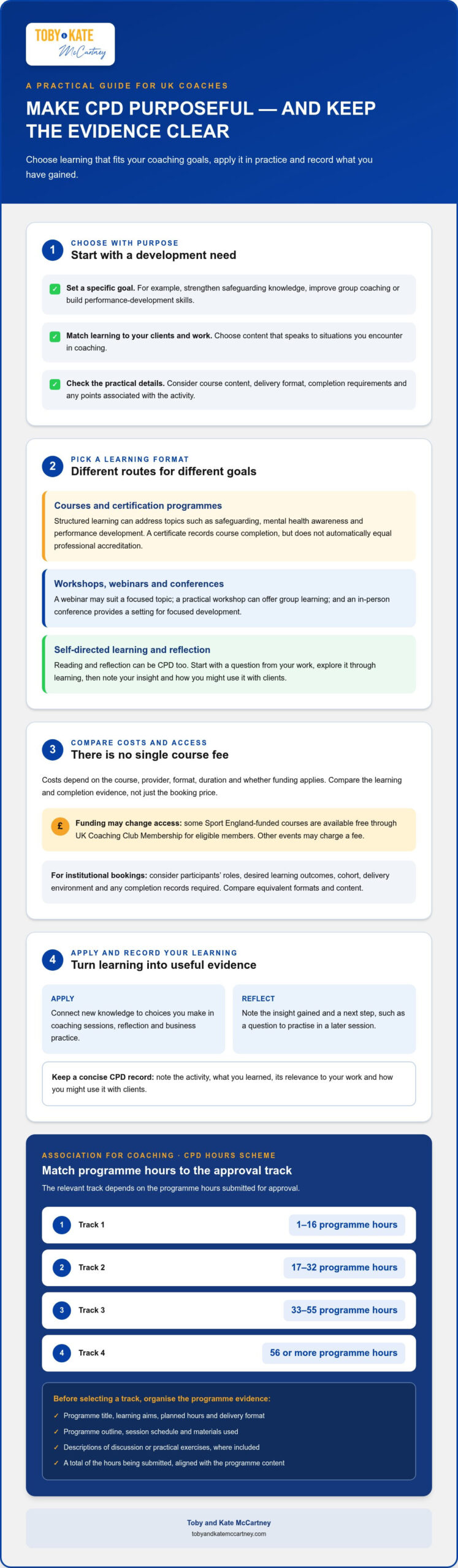
How can coaches choose CPD that suits their specialism and their clients’ needs? Start with a specific development goal, such as strengthening safeguarding knowledge, improving group coaching or building performance-development skills. Match the course content to that goal and to the situations you encounter with clients. This keeps learning purposeful instead of turning into a collection of unrelated certificates.
Next, check the format, completion requirements and any points associated with the activity. A webinar may suit a focused topic, while a workshop can offer practical group learning. For online learning, plan when you will complete the modules and how you will apply them in your coaching business. Record the learning and its relevance as part of your CPD evidence.
Definition and purpose of continuing professional development
Continuing professional development for coaches in the UK is ongoing learning to maintain and enhance professional skills and competence. It connects new knowledge with the choices you make in coaching sessions, reflection and business practice. Identify a development need, select learning that addresses it, then apply what you learn. For example, a coach supporting leadership teams might develop their approach to goal-setting and challenging conversations.
Learning may be structured, such as a course, or self-directed, such as reading and reflection. Give each activity a clear purpose: identify a question from your work, choose learning that explores it, then record your insight and how you might use it with clients. This creates a practical development cycle and helps distinguish meaningful learning from collecting certificates with no clear connection to your coaching practice.
Are there UK legal or safeguarding requirements for coach professional development? Requirements depend on your role, organisation and working environment. Safeguarding learning is relevant when your responsibilities involve safeguarding. Make it a development priority when it relates to the people you work with, and follow the procedures that apply to your role.
Within an organisation, CPD can help teams address shared development needs. Leaders might, for example, identify a need for clearer feedback, choose a structured programme, then discuss how to apply the learning at work. For independent coaches, a recurring client challenge can point to a useful learning goal. Link each activity to a specific change you intend to make.
Keep a concise record of each activity, the insight gained and your next step. After a webinar on coaching conversations, for instance, note a question you want to practise and review its effect in a later session. This turns reflection into a practical tool for choosing future development and helps you see how learning informs your work over time.
CPD evidence for AC accreditation
For the Association for Coaching (AC) CPD Hours Scheme, the relevant track depends on the programme hours submitted for approval. The Association for Coaching says Track 1 covers 1-16 programme hours, Track 2 covers 17-32 programme hours, Track 3 covers 33-55 programme hours, and Track 4 covers 56 or more programme hours. These bands help organise an application around programme duration.
Keep a clear record of the programme you are submitting. Note its title, learning aims, planned hours and delivery format. An interactive workshop and a series of webinars, for example, may have different schedules and evidence of participation. An organised record helps show how the programme is designed to engage learners and develop coaching practice.
Make the learning pathway easy to understand by gathering the programme outline, session schedule and materials used. If an event includes discussion or practical exercises, describe them in the programme information. This gives reviewers a clearer picture than a title alone. Keep records consistent so the hours and content align throughout the application.
Before choosing a track, total the programme hours you intend to submit, then compare that total with the AC bands. For instance, a programme lasting 20 hours falls within Track 2, while one lasting 40 hours falls within Track 3, according to the Association for Coaching. Use the actual programme duration, rather than adding unrelated activities to reach a higher band.
Finally, make the connection between the content and coaching development clear. A programme on listening skills could show how exercises, guided reflection and feedback help participants practise. Strong evidence is specific: explain what learners do, how sessions deliver the intended learning and how the programme can build confidence. This makes the application easier to review and keeps claims grounded in the programme itself.
CPD points and expiry dates
Points and expiry rules depend on the scheme, so record the scheme name alongside each activity. The Association for Coaching states that approval under its CPD Hours Scheme is valid for one year from the approval date. Record that date and plan a review before approval expires, especially if you deliver an approved programme.
British Canoeing Awarding Body uses a separate points system for instructors, coaches and leaders. It requires 20 CPD points before the expiry date to update CPD. Examples include reading and reviewing publications for 10 points, coaching and mentoring as provider or recipient for 10 points, and leadership training in any discipline for 20 points. Enquiry-based research and peer review activities each count for 10 points.
Build a simple tracker for each activity, date, points and evidence. Save publication details after a reading session, for example, or note the purpose and outcome of a peer review. Add the expiry date to your calendar and review your progress regularly. This gives you time to find suitable learning opportunities instead of trying to record everything at the last minute.
What happens if a UK coach does not meet their professional body’s CPD requirements? The consequences depend on the scheme. Under British Canoeing Awarding Body’s Update Scheme, national association membership, first aid, safeguarding, CPD and adherence to the Code of Conduct must all be up to date for an update. Missing CPD points can therefore leave that requirement unmet.
Keep scheme requirements distinct. The Association for Coaching’s one-year approval period applies to approved programmes, while British Canoeing Awarding Body’s 20-point requirement applies to its instructors, coaches and leaders. Don’t assume points from one system automatically transfer to another. Check each activity against the relevant scheme, retain supporting evidence and plan completion before the applicable expiry date.
If leadership development is part of your learning plan, explore leadership training as a way to strengthen your practice.
Toby and Kate McCartney: NLP Practitioner Certification
Toby and Kate McCartney’s NLP Practitioner Certification provides a focused pathway for developing communication and coaching skills. If you want to strengthen how you work with clients, this training can complement your ongoing professional development, but it does not replace the specific requirements of an accreditation scheme.
As your goals evolve, consider NLP Master Practitioner Certification, Public Speaking programmes or NLP Trainer Training. Choose the pathway that fits the capabilities you want to build, whether you are developing your coaching approach, communicating with greater impact or preparing to deliver training.
For a practical next step in your learning journey, contact Toby and Kate McCartney or visit tobyandkatemccartney.com.
Make your next development move count
A continuing professional development plan for coaches in the UK can be more than a record of completed learning. Use it to guide the skills you want to strengthen and the way you want to work with clients. Choose a next step that fits your professional direction, then put the learning into practice.
If you want to develop your coaching approach, Toby and Kate McCartney offer NLP Practitioner Certification and NLP Master Practitioner Certification. Their Public Speaking programmes may also suit coaches who want to build confidence and communicate with greater impact. These are learning pathways, not substitutes for your professional body’s or accreditation scheme’s requirements.
Your development is personal. Start with the capability you want to build, and choose learning that supports it. Contact Toby and Kate McCartney to explore a programme that aligns with your goals. Take the next step with purpose, and keep growing into the coach you want to become.
Frequently Asked Questions
What is ongoing professional development?
CPD is the ongoing process of building your capability as your coaching work evolves. If clients regularly struggle to turn broad ambitions into practical goals, for example, you could focus your next learning activity on goal-setting, then reflect on how you apply it. Connect a development need to learning and then to your coaching practice, rather than treating training as an isolated event.
Why is it important to keep your CPD up to date?
Keeping CPD current helps your skills stay relevant to your clients, role and professional commitments. It also makes it easier to explain how you are developing your practice, whether you work independently or within an organisation. If you belong to a professional body or hold an accreditation, up-to-date records can help demonstrate that you have met its ongoing requirements and planned development around your responsibilities.
How do I get CPD points?
Start by identifying the scheme that applies to your professional membership or accreditation. Choose learning activities that meet its criteria, then record the date, activity, learning gained and supporting evidence. For example, keep an event confirmation alongside a brief reflection on what you will apply in client sessions. Maintain or submit those records in the required format rather than assuming every activity earns points.
How is CPD calculated?
CPD is calculated according to the rules of the relevant scheme, not through a universal conversion. Some systems count programme hours, while others assign points to specific activities. The Association for Coaching CPD Hours Scheme uses programme-hour bands for approval, whereas activity-based schemes assess qualifying learning differently. Keep hours and points in separate records, and use the scheme’s stated method to calculate your total.
What counts as CPD?
CPD can include learning that develops your capability in your professional role, provided it meets the relevant scheme’s criteria. A coach might learn through a relevant publication, structured training, reflective practice or discussion with peers. Make the connection clear: record what the activity involved, what insight you gained and how it relates to your work. Attendance alone may not demonstrate what you learned or its relevance.
What is CPD?
CPD means continuing professional development. It describes the learning and reflection professionals undertake to maintain and enhance their competence over time. It is not a single qualification or a particular course, but an ongoing part of professional practice. For a coach, a useful CPD record captures more than completed activities: it shows the development focus and how learning informs the way you work with clients.