
Most speakers lose their audience before they have even finished their first sentence. What if the first sixty seconds of your talk weren’t just an introduction, but a psychological pattern interrupt that forced every person in the room to lean in? You likely know that sinking feeling when you stand at the front of a boardroom and see eyes drifting toward smartphones. It is the common anxiety of being perceived as just another boring presenter in a world of constant digital distractions.
You are about to discover the psychological secrets and engaging presentation opening examples that will help you command the room and transform that initial nervous energy into a magnetic presence. This is about more than just “breaking the ice”; it is about mastering the art of human influence. We will walk through proven strategies to reset your audience’s focus and provide you with the confidence to lead high-stakes meetings with absolute authority. By the end of this guide, you will have a toolkit of master-level openings that ensure your message lands with impact from your very first word.
Key Takeaways
- Leverage the Primacy Effect to ensure your audience weights your opening message more heavily, setting the tone for a successful presentation.
- Master the psychological art of state management to project an authoritative presence that commands attention before you even speak.
- Access a curated list of engaging presentation opening examples that use pattern interrupts to reset your audience’s focus and eliminate distractions.
- Follow a step-by-step framework to align your opening hook with your core emotional objectives and final call to action.
- Discover how specialised Public Speaking programmes and NLP techniques act as a secret weapon for leaders aiming to achieve communication mastery.
Why Your Presentation Opening Dictates Your Entire Success
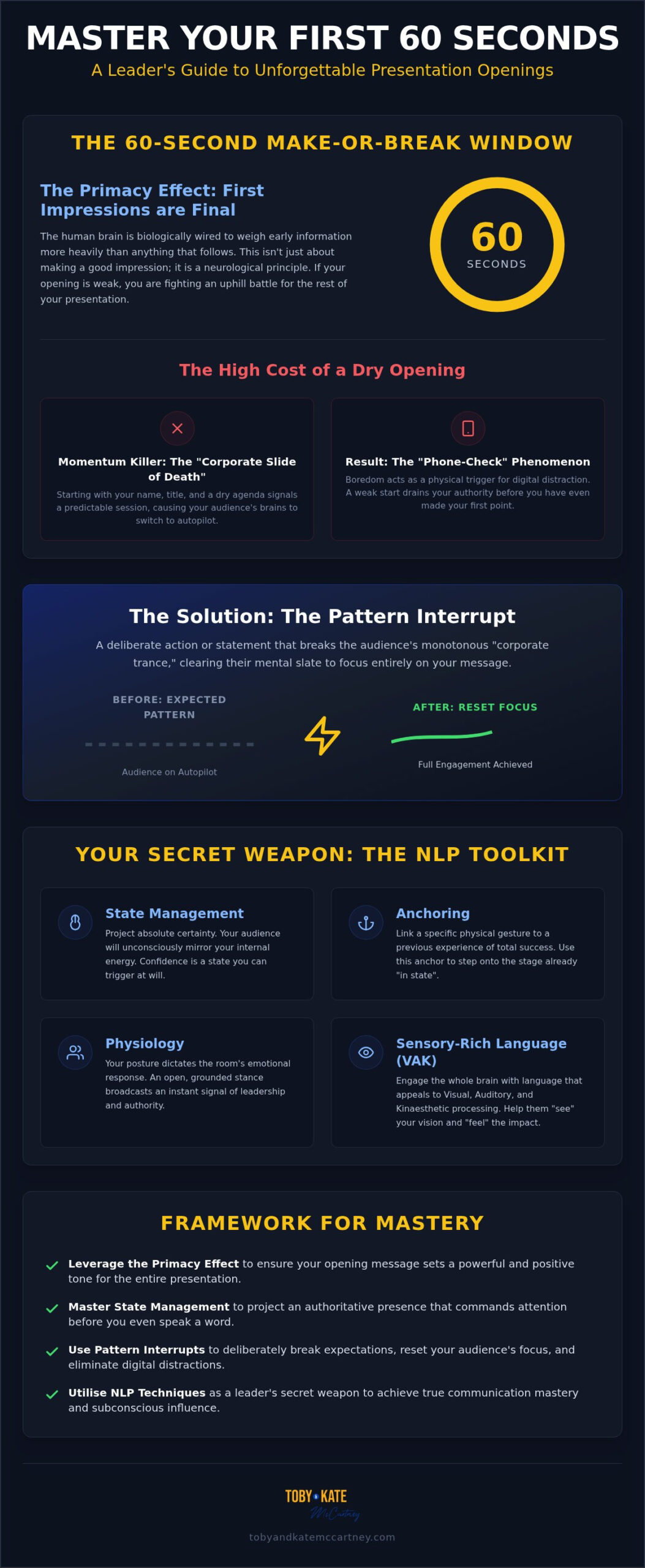
The first sixty seconds of your talk are the most expensive piece of real estate in your professional life. This isn’t just about making a good impression; it’s about the “Primacy Effect.” Your audience’s brain is biologically wired to weight early information more heavily than anything you say in the middle. If you start with a whimper, you’re fighting an uphill battle for the rest of the hour. Most people confuse attention with interest. Just because someone has stopped talking and is looking at you doesn’t mean they are engaged. True engagement requires a psychological hook that pulls them out of their own internal monologue and into your world.
The 60-second window is your make-or-break moment. Within this tiny timeframe, your audience decides your value, your authority, and whether you’re worth their time. They are scanning for reasons to listen or reasons to check their email. One of the most common mistakes in public speaking is starting with the “corporate slide of death”: your name, your job title, and a dry agenda. This is a momentum killer. It signals to the room that this will be a standard, predictable session, and their brains immediately switch to autopilot. Studying engaging presentation opening examples reveals that the best leaders never waste these precious seconds on pleasantries.
The High Cost of a Dry Opening
When you fail to land a punchy start, you trigger the “Phone-Check” phenomenon. Boredom acts as a physical trigger; the moment your audience feels a dip in energy, they reach for digital distraction. This isn’t just a loss of focus; it’s a direct blow to your authority. If you can’t lead the first minute, why should they trust your data in the fortieth? You miss the chance to establish a leadership presence, turning what could have been a transformative moment into a forgotten meeting. A weak opening drains the power from your subsequent arguments before you’ve even made them.
The Psychology of the Pattern Interrupt
To truly command the room, you must use a pattern interrupt. In a communication context, this is a deliberate action or statement that breaks a person’s expected routine or thought process. Most corporate meetings follow a predictable, monotonous pattern that puts the audience into a “corporate trance.” You break that trance by doing something unexpected. A well-crafted hook serves as a cognitive reset for the audience, clearing their mental slate so they can focus entirely on your message. This is the master-level skill that separates world-class speakers from the rest of the pack. Using engaging presentation opening examples isn’t about being theatrical; it’s about being effective.
The Psychology of Influence: How NLP Shapes Engaging Openings
Mastering the first sixty seconds requires more than a polished script. It demands a deep understanding of how the human brain processes influence and authority. Neuro-Linguistic Programming (NLP) provides the “secret weapon” for this, moving beyond basic body language into the mechanics of subconscious connection. Whilst many engaging presentation opening examples focus solely on the words you choose, NLP prioritises how you are being whilst you speak. This starts with State Management. Your audience will naturally mirror your internal energy; if you are anxious, they will feel uneasy. If you project absolute certainty, they will feel secure in your leadership. Establishing this unconscious rapport builds trust in seconds, creating a bridge between your message and their focus.
Managing Your Internal State
Confidence is not a fixed personality trait; it’s a state you can trigger at will. Using the NLP technique of “anchoring,” you can link a specific physical gesture to a previous experience of total success. This allows you to step onto the stage already “in state,” bypassing the first-minute jitters. Your physiology dictates the room’s emotional response. When you stand with an open, grounded posture, you aren’t just looking confident. You are broadcasting a signal of authority that the audience’s brain recognises instantly. This transition from nervous energy to a commanding presence is the hallmark of elite communication.
Engaging the Subconscious Mind
To truly hook an audience, you must speak to their whole brain. This means using sensory-rich language that appeals to Visual, Auditory, and Kinaesthetic (VAK) processing. By weaving these predicates into your opening, you ensure that every person in the room can “see” your vision, “hear” your message, and “feel” the impact. You can also use “Embedded Commands,” which are subtle phrases that bypass the critical mind to plant suggestions of curiosity or agreement. Metaphors are equally powerful; they act as a bridge, taking the audience from the known to the unknown without triggering resistance.
Pacing and leading is another vital tool for the opening minute. You start by acknowledging the audience’s current reality, perhaps their scepticism or the high stakes they face. This “paces” their experience, proving you understand them. Once you have met them where they are, you can “lead” them toward the new perspective you are offering. When you frame your topic around their favourite subject, which is themselves, you create instant engagement. If you want to dive deeper into these psychological triggers, exploring an NLP Practitioner Certification can provide the master-level toolkit you need to influence any room with ease.
7 Engaging Presentation Opening Examples for Maximum Impact
You have mastered your internal state and understood the neurological triggers behind influence. Now, it is time to apply the specific engaging presentation opening examples that turn theoretical authority into real-world results. These hooks are designed to shatter the “corporate trance” and force your audience to pay attention. By using these proven structures, you ensure that your message isn’t just heard; it is felt. Here are five core examples to integrate into your next high-stakes talk:
- The Provocative Question: Force an immediate internal dialogue. Instead of a rhetorical question, ask something that challenges their identity. “If your department was closed tomorrow, would your customers actually notice?”
- The Shocking Statistic: Use data to create a sense of urgency. Ensure the number is verified and directly impacts their world. For instance, citing a specific percentage of market share lost to a new technology can jar a room into focus.
- The Future-Pace Opening: This is a powerful NLP tool. Ask your audience to imagine a specific successful outcome. “Imagine it is twelve months from today and you have achieved every KPI on your list with half the effort.”
- The Counter-Intuitive Claim: Challenge a deeply held industry belief. “The most effective way to lead your team is to stop giving them answers.” This creates a curiosity gap that only you can fill.
- The Personal Vulnerability Hook: Build rapid trust through authenticity. Share a brief, relevant moment of failure or a lesson learned the hard way. It proves you are a practitioner, not just a theorist.
Narrative Openers: The Power of Story
Stories act as a delivery system for complex ideas. Starting “In Media Res” means jumping straight into the heat of the action. Don’t start with “I’d like to tell you a story about a client.” Start with “The board was silent, and I knew I had thirty seconds to save the merger.” This creates instant tension and hooks the listener’s imagination. Your “Origin Story” is equally vital; people buy into your “why” long before they care about your “what.” Much like how Tails From Me To You Productions Ltd captures the unique personality and spirit of their subjects through photography, your story should provide a clear, authentic window into your character. Just ensure your story has a clear moral that links back to your primary presentation goal.
Interactive Openers: Engaging the Room
Physical engagement changes the chemistry of the room. A “Show of Hands” is a classic for a reason; it forces a physical response whilst providing you with instant data about your audience’s mindset. You might also try a “Micro-Challenge,” giving the group a thirty-second task to solve a problem related to your topic. By identifying a “Shared Experience” or a common pain point amongst the group, you establish yourself as a mentor who understands their journey. These engaging presentation opening examples ensure you are not just a speaker, but a leader who commands the room from your very first word.
Crafting Your Hook: A Step-by-Step Framework for Leaders
Creating a powerful hook is not a creative accident; it is a strategic decision. To move beyond simply reciting engaging presentation opening examples, you must understand the architecture of influence. This requires a methodical approach that aligns your internal state with your external message. As a leader, your opening is the pathway you create for others to follow. If the path is unclear or uninspiring, your audience will simply stay where they are. By following a structured framework, you ensure that every second of your first minute is engineered for maximum impact and authority.
The first step is to identify the core emotion. What do you want your audience to feel within those first sixty seconds? Whether it is a sense of urgent curiosity or a sudden burst of confidence, your choice of emotion dictates your vocabulary and tone. Once the emotion is set, you must align the hook with your desired outcome. An opening that doesn’t serve your final call to action is merely a distraction. Every word must be a deliberate step toward the goal of your talk. If you want to master this level of strategic communication, our Public Speaking programmes offer the elite training required to lead any room with certainty.
Refining your vocabulary is equally vital. High-stakes communication requires lean, muscular language. This means removing “filler” words like “basically,” “actually,” or “just,” which act as verbal leeches on your authority. Finally, you must enter the “Rehearsal Loop.” Test your opening for flow and timing until it feels like a natural extension of your presence. It shouldn’t sound like a script; it should sound like a conviction.
The McCartney “Impact” Checklist
Before you step onto the platform, run your opening through this brief checklist to ensure it meets the standard of master-level communication:
- Does this opening challenge the status quo and force a “pattern interrupt”?
- Is the language sensory-rich and evocative, appealing to the visual, auditory, and kinaesthetic mind?
- Am I fully present and “in state” as I deliver these first crucial words?
Common Mistakes to Avoid Whilst Opening
Even the most experienced professionals can fall into traps that kill momentum. Never use the “Apology Start.” Phrases like “I’m not really prepared” or “I’ll try to keep this brief” are immediate signals of low status. If a “Technical Glitch” occurs, ignore the screen and manage the room. Your ability to remain unshakeable whilst tech fails is a powerful demonstration of leadership. Avoid over-scripting at all costs. Reading your opening word-for-word creates a barrier between you and the audience, destroying the rapport you have worked so hard to build. When you use engaging presentation opening examples, they must be delivered with the freedom of a master practitioner, not the rigidity of a novice.
Elevate Your Influence with Professional Public Speaking Training
Possessing deep knowledge of your topic is only half the battle. In a high-stakes environment, the ability to present that knowledge with absolute authority is what separates the experts from the leaders. Many professionals rely on functional scripts, yet they find themselves ignored whilst their audience drifts toward digital distractions. To avoid this, you must bridge the gap between being a speaker who conveys information and an influencer who changes minds. Mastery of engaging presentation opening examples is a brilliant start, but true command of the room requires a deeper psychological foundation.
This is where Neuro-Linguistic Programming (NLP) becomes your secret weapon. By understanding the mechanics of human influence, you can tailor your communication to bypass the audience’s critical resistance. Professional mentorship accelerates this journey, helping you identify blind spots in your delivery that might be undermining your authority. Instead of spending years in trial and error, you can gain access to a master-level skill set that has been refined over decades of leadership experience. The trajectory of your career often hinges on these moments of high-level communication.
Mastering the Room with Toby and Kate McCartney
We provide the transformative training required for leaders to step into a more capable version of themselves. Our public speaking for leaders programmes focus on the pragmatic strategies needed to own any stage. We don’t just teach you what to say; we teach you how to be whilst you say it. For those looking for a comprehensive development process, our NLP Practitioner Certification UK offers the psychological tools to build an unshakeable foundation for elite communication. If you face unique or bespoke challenges, our one-to-one mentorship services provide a personal consultation to refine your presence and impact.
Your Next Step to Excellence
The long-term ROI of becoming a masterful communicator is immense. It influences every board meeting, every client pitch, and every team interaction you lead. We invite you to explore our upcoming workshop dates and discover the flexible learning options available to you. By integrating the engaging presentation opening examples you have learned with professional training, you ensure that your message lands with impact every single time. Don’t wait for the next high-stakes meeting to wish you were better prepared. Step into your potential today and become the authoritative leader you were meant to be.
Step Into Your Command Presence
You now possess the psychological blueprint to own any room. By moving beyond dry agendas and embracing the power of the pattern interrupt, you ensure your message carries the weight it deserves. Remember that your internal state is the foundation upon which every word is built. When you apply the engaging presentation opening examples discussed, you aren’t just starting a talk; you are initiating a transformation in your audience’s focus. Mastering these first sixty seconds is the vital key to unlocking your full potential as a world-class communicator.
This journey toward elite influence doesn’t end with a single article. You can achieve measurable shifts in your confidence and impact through our tailored training designed for executive-level leadership. Master the art of high-impact presenting with our Public Speaking programmes and discover how NLP-based communication mastery can accelerate your career trajectory. The room is waiting for a leader who can truly connect. It is time to step forward and lead with absolute certainty.
Frequently Asked Questions
How do I start a presentation without being nervous?
You start without being nervous by mastering your internal state through NLP anchoring techniques before you even step on stage. This involves linking a physical trigger to a memory of total confidence, allowing you to bypass the “fight or flight” response. When you are “in state,” your physiology projects authority, which naturally settles your nerves and commands the room whilst you speak.
What are some funny opening examples for a corporate setting?
Use self-deprecating humour or highlight a shared, absurd industry pain point to build instant rapport. For example, referencing the “thirteenth version of the same spreadsheet” can get a knowing laugh in a corporate boardroom. Avoid generic jokes; instead, use observational humour that proves you understand the audience’s daily reality and the specific challenges they face.
How long should a presentation opening actually be?
Your presentation opening should ideally last between 60 and 90 seconds. This is the critical window where the Primacy Effect is strongest and the audience decides your value. Whilst you have their initial attention, you must use engaging presentation opening examples to transition that attention into genuine interest before moving into your main content.
Can I use a quote to start my presentation?
You can use a quote, provided it acts as a genuine pattern interrupt rather than a tired cliché. Avoid overused lines from famous historical figures that the audience has heard a dozen times. Instead, choose a provocative statement from a contemporary industry disruptor that directly challenges the status quo of your specific topic to spark immediate curiosity.
What if the audience doesn’t react to my opening hook?
Maintain your internal state and continue with absolute certainty if the audience doesn’t react immediately. Sometimes a “shocking statistic” or “provocative question” requires a few seconds of silence to sink in. Use this silence as a tool of authority whilst you move into pacing and leading to bring the room back into the dialogue on your terms.
How do I introduce myself after a high-impact opening?
Introduce yourself only after you have landed your hook and established your value. A simple bridge like, “My name is [Name], and I’ve spent the last decade obsessed with solving this specific problem,” works best. This ensures your credentials support the high-impact message you’ve already delivered rather than acting as a boring, momentum-killing preamble.
Is it better to memorise my opening word-for-word?
It is better to internalise the structure and key emotional beats rather than memorising word-for-word. Rigid memorisation often kills the natural rapport and makes you sound like a script-reader. Focus on the psychological anchors of your engaging presentation opening examples so you can remain flexible and present whilst delivering a start that feels authentic and unshakeable.
How do I choose which opening example is right for my specific audience?
Choose your opening based on the core emotion you want to trigger and the primary sensory preference of your audience. If you are speaking to data-driven executives, a “shocking statistic” is often more effective than a “narrative opener.” Always align the hook with the specific pain point you know is currently amongst the top priorities of your listeners.