
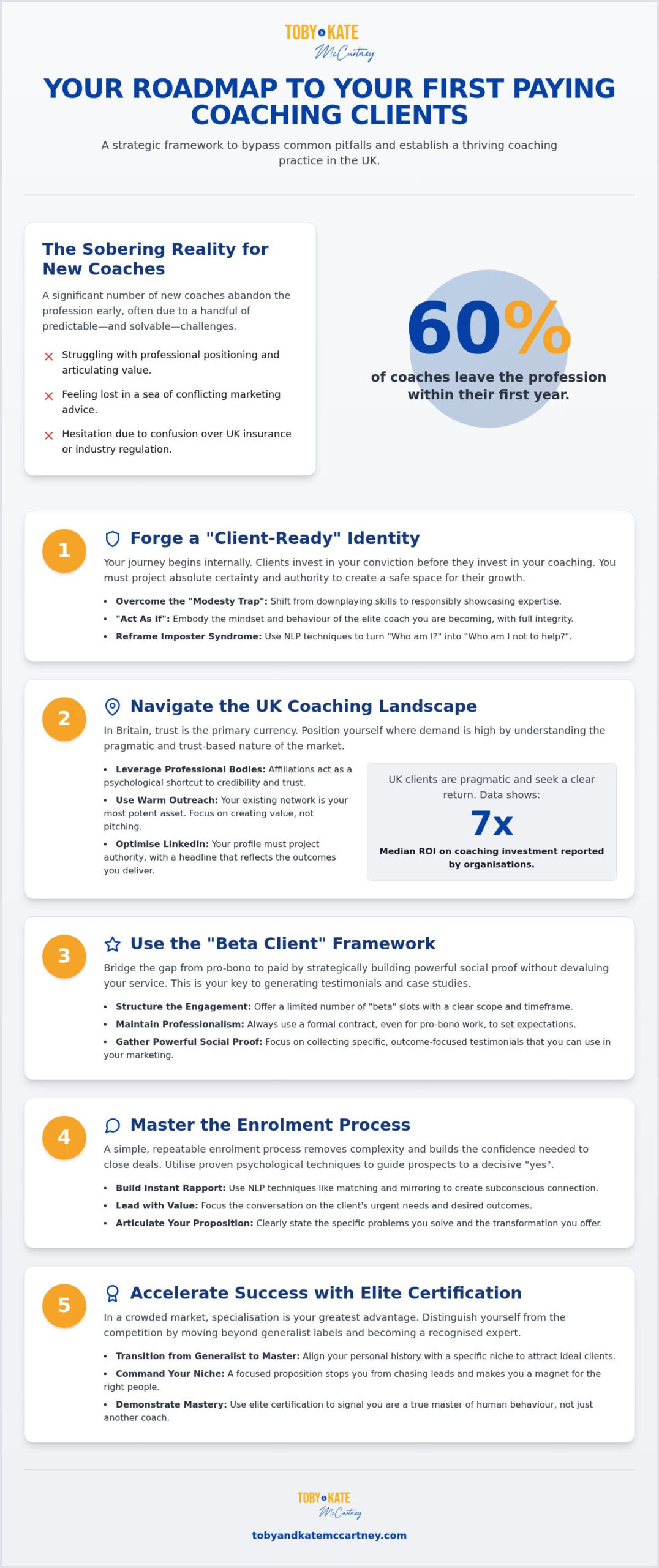
Did you know that approximately 60% of coaches leave the profession within their first year? It’s a sobering reality that often stems from a struggle with positioning and the daunting task of finding your first coaching clients uk. You might feel the weight of rejection or find yourself lost in the noise of conflicting marketing advice. Perhaps you’re even hesitating because of confusion over UK insurance or the lack of formal regulation in the industry. It’s time to stop the hesitation and step into the professional authority you already possess.
I know you’re ready to make an impact, yet the bridge between your skill and a paying client can feel like a chasm. This masterclass provides the psychological and strategic framework to secure your first three paying clients with confidence. We’ll strip away the complexity to focus on a simple, repeatable enrolment process. You’ll learn to articulate your value clearly and navigate the UK market with a roadmap designed for immediate action. By the end of this guide, your professional identity will be unshakable and your path to growth will be clear.
Key Takeaways
- Adopt a “Client-Ready Identity” to project the professional certainty and authority that prospects must feel before they commit to an investment.
- Navigate the strategic landscape of the British market to identify high-value congregation points, streamlining the journey of finding your first coaching clients uk.
- Utilise a structured “Beta Client” framework to gather powerful social proof whilst ensuring every session maintains a high perceived value and professional contract.
- Refine your enrolment process using NLP influence techniques like matching and mirroring to build instant rapport and lead prospects to a decisive “yes.”
- Distinguish yourself from the competition by leveraging elite certification to transition from a generalist coach to a true master of human behaviour.
The Identity Shift: Becoming the Coach Clients Want to Hire
The journey to finding your first coaching clients uk doesn’t begin with a LinkedIn post or a shiny new website; it starts in the mirror. You must cultivate a “Client-Ready Identity” before you ever open your mouth to sell. This is a state of absolute certainty and authority. Potential clients aren’t just looking for your methodology; they’re buying your conviction. If you don’t believe in the transformation you offer, why should they? In Britain, we often fall into the “modesty trap,” where we downplay our skills to avoid sounding arrogant. This cultural quirk is a business killer. You aren’t being boastful; you’re being responsible by showing up as the expert they need.
Professional Coaching is about partnership and potential, but that partnership requires a leader. You must “Act As If” you’re already the successful coach you intend to be, whilst maintaining total professional integrity. This isn’t about lying or fabrication. It’s about stepping into the behaviour and mindset of an elite practitioner. When you project certainty, you create a safe space for your client to be vulnerable and grow. They need to see that you’re comfortable in your expertise before they’ll trust you with their future.
Overcoming Imposter Syndrome with NLP
Imposter syndrome is simply a collection of limiting beliefs that haven’t been reframed yet. Many new UK coaches tell themselves they need “one more qualification” before they’re truly ready. NLP allows you to refactor this internal dialogue, turning a “who am I to do this?” into “who am I not to help?”. It’s about shifting your perspective from your own anxiety to the client’s urgent need. An NLP-trained coach views every challenge as a feedback loop rather than a failure, allowing them to remain resilient whilst others retreat.
Defining Your Unique Coaching Proposition
Trying to be a “general life coach” is a recipe for invisibility in a crowded market. You must align your personal history with a specific niche to stand out. Your professional bio shouldn’t be a dry list of facts; it should be a declaration of the specific problems you solve. Think about the specific transitions you’ve mastered in your own life. When you command the room with a focused proposition, you stop chasing leads and start attracting the right people. Your bio is your first opportunity to demonstrate that you’re a master of human behaviour, not just another person with a certificate.
Navigating the UK Coaching Landscape for Quick Wins
Finding your first coaching clients uk isn’t about shouting into a digital void; it’s about positioning yourself precisely where the demand is already white-hot. In Britain, trust is the primary currency of any professional transaction. Whilst the coaching industry remains unregulated, savvy UK consumers look for the “hallmark” of professional bodies to verify your credibility. These affiliations act as a psychological shortcut to trust. Before you start your outreach, ensure your foundation is solid. The GOV.UK guide on how to set up a business provides the essential logistical framework every professional practitioner must follow.
Warm outreach is your most potent secret weapon. Your existing network already understands your character and work ethic. Reach out to former colleagues or industry peers, but avoid the “desperate pitch.” Instead, focus on the transition you’re making and the specific problems you now solve. In British professional circles, “networking” often carries a transactional, almost negative connotation. You must shift your focus to “creating value.” If you can solve a specific challenge during a simple coffee chat, you’ve done more for your brand than a thousand cold emails ever could.
Leveraging Professional Circles and LinkedIn
Your LinkedIn profile is your digital shop front. For the UK executive market, it must project professional authority rather than “aspiring” status. Optimise your headline to reflect the specific outcome you deliver. When sending connection requests, use a curiosity-led approach. Ask a question about their specific industry challenges or a recent insight they’ve shared. Build rapport amongst your peers first. Referrals in the UK are built on the bedrock of personal recommendation; people only refer those they genuinely respect.
Understanding the UK Market Sentiment
British clients are notoriously pragmatic. They have little patience for “woo-woo” promises or vague claims of “transformation.” They want to see the bottom line. Industry data shows that 86% of organisations report a positive return on their coaching investment, with a median ROI of seven times the cost. Use these facts. Tailor your language to emphasise measurable success and leadership growth. This is particularly vital if you’re moving into executive coaching and mentoring, where the expectations for clarity and results are significantly higher.
Ready to master the psychological tools that make this level of influence possible? Our NLP Practitioner Certification provides the elite skillset required to command these professional rooms with absolute certainty.
The “Pro-Bono to Paid” Framework: Building Social Proof
The most dangerous trap in finding your first coaching clients uk is the “infinite freebie” loop. Many new practitioners spend months coaching for free without a strategy for transition; this is how that 60% failure rate becomes a personal reality. You must shift from “doing a favour” to implementing a “Beta Client” strategy. This is a deliberate, time-bound exchange of your expertise for their evidence. You aren’t giving your services away. You’re investing your time to gather the social proof that will eventually fund your entire career. Every beta session must be treated with the same gravity as a high-ticket engagement.
High perceived value starts with a formal contract. Even if no money changes hands, a written agreement ensures both parties are committed to the process. This contract should outline the goals, the duration, and the specific requirement for a detailed testimonial upon completion. Set a clear expiry date for all pro-bono work from the outset. This creates a psychological “scarcity” that encourages the client to take the work seriously whilst protecting your future income. If they don’t pay in cash, they must pay in social capital through referrals or documented results.
Structuring Your First Five Beta Sessions
Don’t just coach anyone who says yes. Select your first five beta clients based on their potential to either convert to paid status or refer you to your target market. Look for individuals who are vocal in their professional circles and are facing the specific challenges your niche addresses. At the very start of the programme, be explicit: “I am providing this elite coaching at no cost in exchange for your honest feedback and a referral if you find value.” This sets a professional tone immediately. Ensure you have your professional indemnity insurance and basic UK legal compliance in place before the first call; your professional identity depends on this foundation.
Capturing Transformative Testimonials
A “nice guy” review is worthless in the competitive UK coaching market. You need result-oriented data. Ask specific questions that force the client to articulate the shift: “What was the specific cost of your problem before we started?” and “How has your decision-making changed since our sessions?” Use these answers to build a “wall of certainty” on your website that addresses every potential objection a future lead might have. A testimonial that documents a tangible shift in behavioural patterns or professional performance carries far more weight than a polite comment about your personality. You’re building a portfolio of mastery, not a collection of compliments.
Masterful Enrolment: Using NLP to Close the Deal
Enrolment isn’t about persuasion; it’s about leading a prospect to the decision they’ve already realised they need to make. When finding your first coaching clients uk, your ability to facilitate this decision-making process is what separates the elite from the struggling. NLP provides the ultimate toolkit for this. By using matching and mirroring, you build a level of rapport that transcends words. You’re aligning your physiology and tonality with theirs, creating a safe psychological space. Once rapport is established, you can listen for their “meta-programmes.” Are they motivated by moving “towards” a goal or “away from” a pain? Understanding this allows you to speak their internal language, making your coaching proposal feel like the only logical next step.
When objections arise, don’t resist them. Use the “Agreement Frame” to maintain flow. Instead of saying “but,” use “and” to acknowledge their perspective whilst gently redirecting the conversation. This keeps the energy positive and collaborative. You aren’t fighting their resistance; you’re dancing with it.
Language Patterns for Influence
Mastering “Sleight of Mouth” patterns allows you to elegantly reframe a prospect’s excuses into opportunities for growth. If they say they don’t have time, you can reframe time as a matter of priority and leadership. Combine this with future-pacing, where you guide the client to mentally rehearse the success they’ll achieve after your programme. They need to feel the result before they invest. To truly excel in these high-stakes conversations, consider our advanced communication skills training to unlock the master key to influence.
Structuring the Discovery Call
The “Certainty Close” is where most new coaches falter. State your price with absolute conviction. Your fee isn’t a number to be negotiated; it’s a reflection of the transformation’s value. You never justify the cost, only the outcome. If they say, “I need to think about it,” handle it with poise. Ask them what specific information they need to process to reach a decision. This keeps you in the driver’s seat. Remember, 72% of coaching clients now prefer remote or hybrid sessions, so your digital presence and vocal certainty are more critical than ever. Your certainty is the bridge they cross to reach their own transformation.
Ready to step into your power and command the room? Explore our NLP Practitioner Certification to gain the elite skills needed to dominate the UK market.
Accelerating Your Success with Elite Certification
You’ve built the foundation. You’ve reframed your identity and mastered the delicate dance of enrolment. Now, you must ensure that the transformation you promise is backed by world-class technical mastery. In a crowded market, the right NLP practitioner certification UK is more than just a piece of paper; it’s your ultimate competitive edge. Finding your first coaching clients uk is a far smoother journey when you can demonstrate a level of psychological depth that generalist coaches simply cannot match. You stop being just another coach and instead become a master of human behaviour, capable of identifying and shifting the deep-seated patterns that hold your clients back.
Toby and Kate’s methodology is designed to organise your business for elite performance from day one. It’s about more than just tools; it’s about a framework for professional excellence. By joining this high-achieving community, you aren’t just learning a skill set. You’re gaining access to a network of mentors and peers who are equally committed to significant professional shifts. This environment acts as a catalyst, pushing you to step into a more capable version of yourself whilst providing the practical, results-oriented strategies needed to dominate the UK market.
Why NLP is the “Secret Weapon” of the UK’s Top Coaches
The top 1% of practitioners in Britain understand that influence is a science. Whilst a basic qualification might get you started, an NLP master practitioner certification provides the profound psychological tools required for lasting change. This level of training allows you to work with the unconscious mind, solving problems that traditional coaching barely touches. Your certification serves as a primary trust signal in all your marketing. It tells potential clients that you’ve invested in the highest level of expertise, making the decision to hire you a safe and logical choice.
Your Pathway to Mastery
Your journey doesn’t end with your first three clients. It’s a continuous pathway from Practitioner to Master Practitioner, and eventually, to becoming a Trainer of NLP yourself. This progression ensures that your business grows alongside your skill set. You can access Toby and Kate’s direct mentorship to refine your business strategy and accelerate your growth. Don’t wait for permission to succeed. Step into your power today. The elite version of your coaching practice is waiting. Book a consultation now to start your journey toward professional mastery and secure your place amongst the UK’s most influential leaders.
Step Into Your Future as an Elite Coach
The transition from an aspiring practitioner to a high-achieving professional is a journey of both strategy and psychology. You’ve learnt that certainty is the primary currency in the British market and that finding your first coaching clients uk is about leading with value rather than desperation. By shifting your identity, leveraging the “Beta Client” framework, and mastering the nuances of NLP influence, you’ve equipped yourself with a toolkit that most generalist coaches simply don’t possess. You have the roadmap; now you need the momentum to move forward.
With over 20 years of expertise in NLP and leadership, Toby and Kate McCartney provide the accredited programmes you need for measurable professional success. You aren’t just gaining a certificate; you’re joining an empowering community of UK-based achievers dedicated to excellence. The time for hesitation has passed. It’s time to claim your value and transform your potential into a thriving practice. Begin your journey to professional mastery with our NLP Practitioner Certification and step into the leader you were meant to be. Your future clients are waiting for the certainty only you can provide.
Frequently Asked Questions
How much should I charge for my first coaching sessions in the UK?
Entry-level rates in the UK generally start between £40 and £90 per session, whilst specialist career coaches often command between £120 and £150 per hour. Your fee should reflect the value of the transformation you provide rather than just the time spent. When finding your first coaching clients uk, focus on establishing a rate that builds your confidence whilst remaining accessible enough to gather those crucial initial testimonials.
Do I need a website before I can find my first coaching clients?
You don’t need a complex website to secure your first three clients. Most successful practitioners begin by leveraging their existing professional networks and a polished LinkedIn profile. Your digital presence should act as a trust signal, but it shouldn’t become a barrier to action. Focus on articulating your unique proposition and engaging in direct, value-driven conversations. A website can be built later as your business begins to scale.
Is coaching regulated in the UK, and do I need insurance?
The coaching industry in the UK is currently unregulated, meaning there are no legal requirements for specific qualifications. However, professional bodies like the ICF or Association for Coaching uphold high ethical standards that build instant consumer trust. Whilst not a legal mandate, professional indemnity insurance is absolutely essential. It protects your practice and reinforces your identity as a serious professional who operates with integrity within the British market.
What is the fastest way to get a coaching client if I have no experience?
The most efficient route is the “Beta Client” strategy combined with warm outreach. Look at your existing professional circles and identify individuals facing the specific challenges you solve. Offer a time-bound, results-oriented programme in exchange for a high-quality testimonial and referrals. This approach bypasses the noise of cold marketing and builds the social proof you need to transition into a fully paid practice with absolute certainty.
How can NLP help me find clients more effectively than traditional marketing?
Traditional marketing often focuses on volume, whilst NLP focuses on precision and rapport. By understanding a prospect’s meta-programmes and using matching and mirroring, you create an immediate psychological bond. This allows you to lead them to a decision with far less resistance. Finding your first coaching clients uk becomes a process of ethical influence rather than pushy sales, ensuring your communication resonates deeply with their specific desires.
Should I offer free coaching sessions when starting out?
You should only offer free sessions if they’re part of a structured “Pro-Bono to Paid” framework. Every session must include a professional contract and a clear expiry date to avoid the “freebie trap.” This ensures the client remains committed to the process and understands the high perceived value of your expertise. Use these sessions as a strategic investment to gather the transformative testimonials that will fund your future growth.
How do I explain the value of coaching to someone who has never had it?
Avoid vague promises of “life change” and focus on pragmatic, measurable results. Research shows that 86% of organisations report a positive return on their coaching investment, often seeing a median ROI of seven times the cost. Use future-pacing to help them visualise the specific professional or personal shifts they’ll achieve. When you speak the language of results, the value of the investment becomes obvious and the decision to start becomes easy.
Can I find coaching clients on social media without a large following?
A large following is unnecessary if you focus on high-value, curiosity-led engagement. LinkedIn is particularly effective for the UK executive market, where one meaningful connection can lead to multiple referrals. Share insights that demonstrate your mastery of human behaviour and engage directly with the challenges your target audience is facing. It’s about being a visible authority in a specific niche rather than a generalist shouting to a crowd.