
What if the biggest barrier to your next career leap isn’t your current skill set, but your hesitation to ask for the tools to sharpen it? It’s natural to feel a flicker of anxiety when considering how to ask your boss for a training budget, especially when you’re worried about rejection or struggling to quantify the ROI of leadership mastery. You likely feel the weight of an already packed schedule and wonder how you’ll manage a certification whilst keeping your daily tasks under control.
You’re about to transform that hesitation into a masterclass in professional influence. This strategic guide moves beyond simple requests; it’s about positioning your growth as a non-negotiable asset for your company. We’ll show you how to secure full funding for high-level development, ensure you’re recognised as a high-potential talent, and gain the exact skills that make your daily job easier. From psychological framing to impact calculations, you’re about to learn how to turn a ‘maybe’ into a definitive ‘yes’.
Key Takeaways
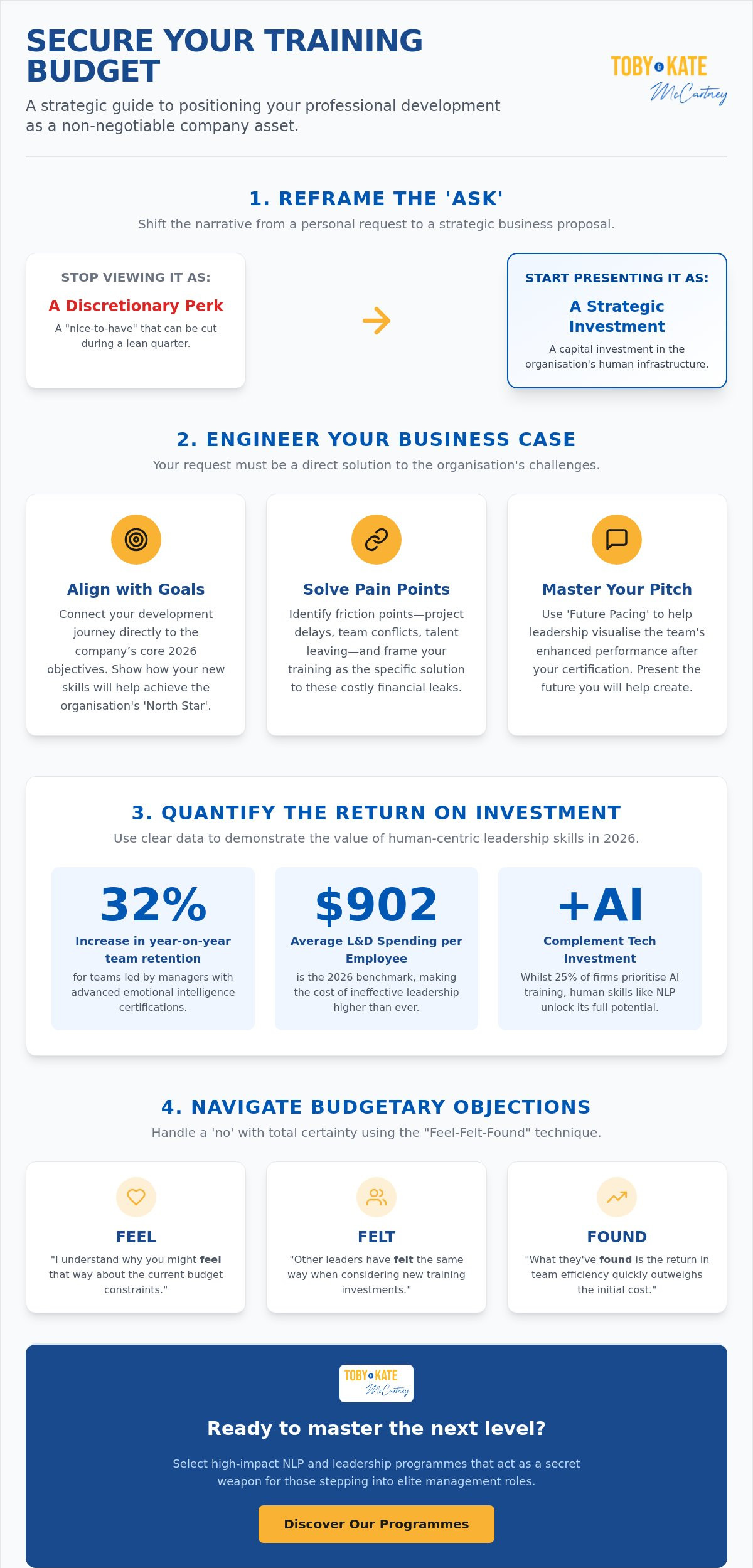
- Shift the narrative from requesting a discretionary perk to presenting a strategic investment in your organisation’s human infrastructure.
- Master exactly how to ask your boss for a training budget by aligning your development journey with the company’s core 2026 objectives.
- Utilise the psychology of influence and “Future Pacing” to help leadership visualise the team’s enhanced performance after your certification.
- Learn to handle budgetary objections with total certainty using the “Feel-Felt-Found” technique and flexible funding proposals.
- Identify the high-impact NLP and leadership programmes that act as a secret weapon for those stepping into elite management roles.
Reframing the ‘Ask’: Why Professional Development is a Strategic Asset
Stop viewing a training budget as a discretionary perk that gets slashed during a lean quarter. In 2026, your training budget is a capital investment in human infrastructure. It’s the fuel that powers the engine of your organisation. When you approach the conversation regarding how to ask your boss for a training budget, you must stop acting like a supplicant asking for a favour. You’re a strategic partner offering a higher version of yourself to the business. You’re proposing an increase in your own output and a sharpening of the company’s competitive edge. You aren’t asking for a gift; you’re presenting a business case for growth.
The 2026 business climate is volatile. Static technical skills now have a shelf life shorter than a seasonal marketing campaign. What the market demands today is psychological agility; the ability to pivot, influence, and lead through uncertainty. By understanding what professional development is in a modern context, you recognise that you aren’t just learning. You’re upgrading the company’s most valuable asset. Consider the cost of stagnation. If you aren’t upskilling, you’re effectively depreciating. Companies that fail to invest in their best talent don’t just lose efficiency; they lose the talent itself to competitors who realise that growth is the ultimate retention tool.
The Identity of a High-Potential Leader
Becoming a leader doesn’t start when you receive a certificate. It starts the moment you decide to embody that excellence. High-potential leaders don’t just “do the job”; they lead the journey. They demonstrate a hunger for mastery that makes it impossible for a boss to say no. When you show up with the mindset of someone already operating at the next level, a request for funding becomes a logical next step in an inevitable progression. Bosses invest in certainty. Give them that certainty by behaving like the leader you intend to become whilst you’re still in your current role. Transition from managing tasks to inspiring people.
The ROI of Human-Centric Skills in 2026
In an AI-disrupted workplace, your technical expertise is no longer your primary differentiator. NLP and advanced communication are the master keys that unlock human potential where machines cannot. We must reframe “soft skills” as high-impact power skills that directly drive revenue and operational clarity. In 2026, teams led by managers with advanced emotional intelligence certifications show a 32% increase in year-on-year retention compared to those relying on technical management alone. These skills allow you to navigate complex office dynamics and turn potential conflict into collaborative momentum. They’re your secret weapon for the next stage of your career.
Engineering Your Business Case: Aligning Training with 2026 Corporate Goals
Your request shouldn’t exist in a vacuum. To succeed in your mission of how to ask your boss for a training budget, you must first decipher the organisation’s ‘North Star’ goals for 2026. Is the company pivoting towards AI integration, or is the focus on radical efficiency? If the board is obsessed with retention, your case for an NLP Practitioner Certification becomes a solution to a burning problem, not just a line item on a spreadsheet. In an environment where 25% of organisations are prioritising AI training budgets, you must show how your human-centric mastery complements these technological shifts.
Gather internal evidence where friction has stalled progress. Perhaps a botched project launch was actually a failure of communication, or a talented team member left because of a culture clash. These aren’t just ‘office issues’; they’re financial leaks. You can quantify the unquantifiable by demonstrating how improved conflict resolution protects the company’s investment. With the average L&D spending per employee reaching $902 in 2026, the cost of ineffective leadership is higher than ever. Before you step into the meeting, review these email templates for asking for a training budget to frame your opening gambit with professional precision.
Mapping Skills to Organisational Pain Points
Knowing how to ask your boss for a training budget requires more than just a list of course modules; it requires a deep understanding of the ‘Gap Analysis’ method. Scour the latest annual report for keywords like ‘synergy’, ‘agility’, or ‘strategic expansion’. If you can mirror the language of the C-suite, your request feels like their idea. Align your growth with the department’s succession plan, perhaps by identifying accredited pathways through the Apeiro Institute that match the company’s future needs. When you identify the bridge between current performance and future targets, you make it easy for your boss to say yes. You are simply preparing to fill a future leadership vacancy that the company already knows it will have.
The Knowledge Transfer Promise
Your training budget isn’t just for you; it’s a seed for the whole team. Propose a ‘Lunch and Learn’ series or an internal workshop where you share the core insights of your programme. Create a ‘Knowledge Legacy’ document that stays with the company long after the course finishes. This transforms you from a student into a multiplier of value. When your boss sees that one investment elevates the entire team’s standard, the ROI becomes undeniable. It’s a proactive way to show you’re thinking about the company’s future, not just your own CV.
The Psychology of Influence: How to Pitch Your Training Request
Mastering the psychology of influence is the difference between receiving a polite “we’ll see” and an immediate “approved.” When you’re learning how to ask your boss for a training budget, you aren’t just presenting data; you’re orchestrating an emotional shift. The first 60 seconds of your meeting are the most critical. This is where you establish rapport and set the frame for the entire conversation. If you walk in looking like a student asking for permission, you’ll be treated as one. If you walk in with the quiet certainty of a leader, the budget becomes a mere logistical detail. You’re there to discuss a solution, not to beg for a favour.
Use the ‘Yes Set’ to build psychological momentum. Ask questions where the answer is an obvious, undeniable ‘yes’, such as, “Do we agree that team efficiency is our top priority this quarter?” or “Is it fair to say we need more robust communication to hit our expansion targets?” Once you’ve gained three or four small agreements, the big ‘ask’ feels like a natural extension of that logic. Follow this with ‘Future Pacing’. Help your boss visualise the specific successes the team will celebrate six months from now because of your new skills. Describe the smoother workflows and the resolved conflicts in vivid detail. You aren’t selling a course; you’re selling the future version of their team.
This level of strategic foresight is applicable beyond the office; just as savvy travellers learn more to make better decisions and reduce stress during their international trips, you are applying that same efficiency to your professional growth.
Structure your pitch with surgical precision to ensure no detail is left to chance:
- The Hook: A high-impact statement about a current organisational challenge that keeps your boss awake at night.
- The Proof: Concrete evidence showing how this specific training solves that challenge.
- The Benefit: The tangible outcome for the boss, the team, and the company’s bottom line.
- The Call to Action: A clear, specific request for the budget approval to secure your place on the programme.
Mastering the Verbal Delivery
Your voice and posture must project the mastery you’re seeking. Use ‘Power Vocabulary’ that denotes action; talk about “optimising”, “architecting”, and “mastering” rather than “trying” or “learning.” To build instant trust, subtly mirror your boss’s posture, speech tempo, and key vocabulary to create a subconscious sense of alignment and mutual understanding. Stand or sit with an open, grounded posture. If you sound like you’ve already mastered the material, the investment feels significantly safer for the business. You’re demonstrating the very skills you’re asking to refine.
Timing and Environment for Maximum Impact
Timing is everything in a high-stakes negotiation. Conduct an ‘Energy Audit’ of your boss. Are they a morning person who is sharpest at 9 AM, or do they need a post-lunch coffee to become receptive? Never attempt this conversation during a crisis or on a Friday afternoon when their mind is already on the weekend. Instead, strike immediately after a team win when the mood is buoyant. Send a ‘Pre-Pitch’ email 24 hours before to set the agenda. This removes the element of surprise and allows them to enter the room with a mindset of growth rather than defence. This is the ultimate secret of how to ask your boss for a training budget with total confidence.
Negotiating the ‘No’: Handling Budgetary Objections with Certainty
A “no” is rarely the end of the conversation; it’s simply the opening of a more sophisticated negotiation. If your initial pitch meets resistance, don’t retreat. This is where you deploy the ‘Feel-Felt-Found’ technique to neutralise financial anxiety. You might say: “I understand you feel that the current department budget is under pressure. Other managers I’ve spoken with felt exactly the same way about external training. However, what they found was that the immediate boost in team productivity and the reduction in conflict-related downtime actually saved them more than the cost of the programme.” By acknowledging their concern, you lower their defences and move back into a partnership mindset.
If the objection is purely about cash flow, offer a logistical solution. Propose a phased payment or a split-budget approach that spans two financial quarters. This minimises the impact on a single monthly P&L whilst still securing your spot. Remind them of the cost of inaction. With 78% of business leaders viewing the growing skills gap as a major risk to their organisation’s future, ask the hard question: “If we don’t bridge this leadership gap now, what will it cost our department in six months when the market moves even faster?” Mastering how to ask your boss for a training budget involves being prepared for the pushback before it even happens.
The ‘No Budget’ Rebuttal
When the “no budget” objection arises, it’s time to look for alternative ‘pots’ of money. Often, recruitment budgets are far more substantial than L&D funds. Position your training as a retention tool that saves the company the significant cost of replacing a high-level manager. You can also propose a performance-based trial. Suggest that if you hit a specific efficiency target within the next three months, the company will then fund your Leadership training. This removes the risk for your boss and makes the investment a reward for proven results. It’s not about whether the company can afford it; it’s about whether they can afford to wait.
Managing the Workload Anxiety
The fear that your work will stall whilst you’re training is a common hurdle. Silence this anxiety by presenting a robust ‘Succession Plan’ for your tasks. Detail exactly who will handle your responsibilities and how this temporary absence actually serves as a ‘growth opportunity’ for your subordinates to step up. Emphasise that modern, hybrid learning models are designed for the high-pressure 2026 environment. These flexible programmes allow you to integrate your learning into the flow of work, ensuring that your absence is minimal whilst your impact becomes maximal. This isn’t time away from the job; it’s time spent mastering the job.
Mastering the Next Level: Selecting High-Impact NLP and Leadership Programmes
Selecting the right partner for your development is the final, most critical step in your journey. You’ve mastered the psychology of influence and built a bulletproof business case. Now, you must provide your boss with the certainty that the programme you’ve chosen is the gold standard. In the UK leadership landscape, Toby and Kate McCartney’s certifications represent the elite tier of professional growth. This isn’t just about attending a seminar; it’s about entering an ‘Elite Pathway’ that fuses deep psychological mastery with pragmatic business mentorship. When you explain how to ask your boss for a training budget, your choice of provider must reflect the high-potential leader you are becoming.
The McCartney method goes beyond the classroom. It moves you from theoretical knowledge to embodied leadership, where your new skills become a natural extension of your professional behaviour. Our NLP Practitioner Certification UK is designed to deliver immediate, measurable ROI. It equips you with a secret weapon: the ability to read people, reframe challenges, and drive results with a level of clarity that was previously out of reach. This is how you prove to your organisation that their investment was the smartest move they made all year. You aren’t just gaining a certificate; you’re gaining a permanent competitive advantage.
Choosing the Right Programme for Your Journey
Your career stage dictates your entry point. The NLP Practitioner certification is for those ready to master the fundamentals of influence and communication. If you’re already leading at a high level, the Master Practitioner programme offers a deeper dive into the architectural patterns of human excellence. For those whose roles demand high-stakes presence, our Public Speaking programmes transform how you command a room. If you require a bespoke route to elite performance, our one-to-one coaching and mentoring services provide the tailored focus needed to shatter your current glass ceiling. Every pathway is designed to be flexible, ensuring your growth never comes at the expense of your daily impact.
Taking the First Step Toward Mastery
Don’t leave your breakthrough to chance. Request a brochure or a consultation today to give your business case the authoritative backing it needs. Presenting a formal prospectus shows your boss that you’ve done the due diligence required of a senior leader. It provides the logistical details that turn a conceptual conversation into a signed approval. Waiting for the ‘perfect time’ is a trap; it is the greatest enemy of progress. The most successful leaders in 2026 are those who act with speed and conviction. Book a discovery call with Toby and Kate McCartney to plan your professional breakthrough.
Step into Your Future as an Elite Leader
You now possess the strategic blueprint for professional transformation. Mastering how to ask your boss for a training budget is more than a simple request for funding; it’s a powerful demonstration of the foresight and influence required at the highest levels of management. By reframing your development as a critical business asset and using psychological influence to align with 2026 corporate goals, you’ve already begun to behave like the leader you intend to become.
Since 2003, we’ve spent over two decades helping achievers unlock their potential through accredited NLP Trainer Training and Practitioner levels. Our specialised public speaking programmes are designed to ensure your voice carries the weight of authority in any boardroom. You don’t have to wait for the perfect moment to sharpen your edge. The path to mastery is ready when you are, and the tools to secure your spot are now in your hands.
Explore our NLP and Leadership Certifications to build your business case and take the first step toward your professional breakthrough today. Your evolution is the company’s greatest asset; it’s time to claim your value and lead the journey.
Frequently Asked Questions Regarding Professional Development
Can I ask for a training budget during my annual performance review?
Yes, the annual performance review is a prime opportunity to secure your funding. It’s the one time of year when the focus is entirely on your professional trajectory and organisational value. Frame the request as the necessary fuel to hit your next set of targets. By linking your growth to the company’s future success, you turn a simple request into a logical strategic step.
How much should I realistically ask for in my training budget request?
Base your request on the specific value of the programme rather than an arbitrary figure. Whilst research indicates the average L&D spending per employee reached $902 in 2026, high-impact leadership certifications often require a more significant investment. Focus on the ROI you’ll deliver. If the training solves a £50,000 communication problem, a £3,000 budget is an absolute bargain for the business.
What if my company doesn’t have a formal professional development policy?
View the lack of a formal policy as an opportunity to set a new standard. You don’t need a handbook to justify your growth; you need a business case. Present a structured proposal that outlines exactly how to ask your boss for a training budget in a way that benefits the wider team. Your initiative demonstrates the very leadership qualities that deserve investment.
How do I prove the ROI of an NLP course to a sceptical boss?
Focus on measurable behavioural shifts and operational efficiency. Explain how NLP Practitioner tools reduce project downtime by resolving team conflicts and sharpening stakeholder communication. Cite the fact that advanced emotional intelligence is a key driver for team retention in the 2026 AI-driven market. You’re not just learning theory; you’re acquiring a toolkit to protect the company’s bottom line.
What should I do if my training request is flatly rejected?
Don’t take a rejection as a permanent “no.” Ask for specific feedback on what needs to change for the request to be approved in the next quarter. Perhaps the timing is wrong or the budget is temporarily frozen. Propose a performance-based agreement where hitting a certain KPI triggers the release of the training funds. This shows you’re committed to earning the investment.
Is it better to ask for training in person or via email?
Use a hybrid approach for maximum impact. Send a structured email to set the agenda and share the programme brochure, then conduct the actual pitch in person or via a video call. This allows you to use your voice and posture to project certainty whilst giving your boss time to review the logistical details beforehand. It ensures the conversation remains focused on your value.
How do I handle the ‘you might leave once you’re trained’ objection?
Reframe the objection by highlighting that employees who feel invested in are far more likely to remain loyal. You should say, “The risk isn’t that I’ll leave with these skills; the risk is that I’ll stay without them and our team will stagnate.” Emphasise your commitment to applying these new masteries within the company to elevate the entire department’s performance.
Can I use my training budget for one-to-one executive coaching?
Yes, executive coaching is often the most effective route for leaders seeking rapid, bespoke growth. When explaining how to ask your boss for a training budget for coaching, highlight the personalised nature of the journey. It ensures every minute of the budget is spent solving your specific organisational challenges, providing a much faster return than a generic group seminar.