Free lunches, casual dress codes, and novelty office perks do not build resilient teams; they merely buy brief compliance. When you are carrying the exhausting weight of missed deadlines, quiet quitting, and widespread apathy, understanding how to improve team morale and motivation demands something far deeper than superficial incentives. You already recognise the frustration: relying on perks fails to address the root psychological causes of disengagement, and shouldering the emotional burden of everyone’s daily output alone is completely unsustainable.
Genuine dedication requires linguistic clarity, emotional precision, and authentic alignment. In this guide, you will discover practical, psychologically grounded strategies to transform your workplace culture and inspire sustained team commitment. We will explore advanced behavioural techniques and predictable communication rhythms that eliminate friction, rebuild trust, and make inspirational leadership an effortless, natural standard.
Key Takeaways
- Differentiate Compliance from Commitment: Uncover why superficial perks yield only short-term compliance, and learn how to activate genuine intrinsic drive across your workforce.
- Implement Proven Cultural Shifts: Discover practical frameworks on how to improve team morale and motivation by embedding psychological safety and aligning individual contribution with wider purpose.
- Apply Advanced Communication Techniques: Master subtle neuro-linguistic reframing methods that subconsciously prime team confidence, dissolve operational friction, and enhance clarity.
- Diagnose and Neutralise Friction: Identify hidden morale killers early and replace counterproductive habits with high-impact, constructive leadership behaviours.
- Scale Sustained High Performance: Recognise that team energy reflects leadership capability, making continuous behavioural development the foundation for long-term cultural resilience.
Understanding the Core Drivers of Team Morale and Motivation
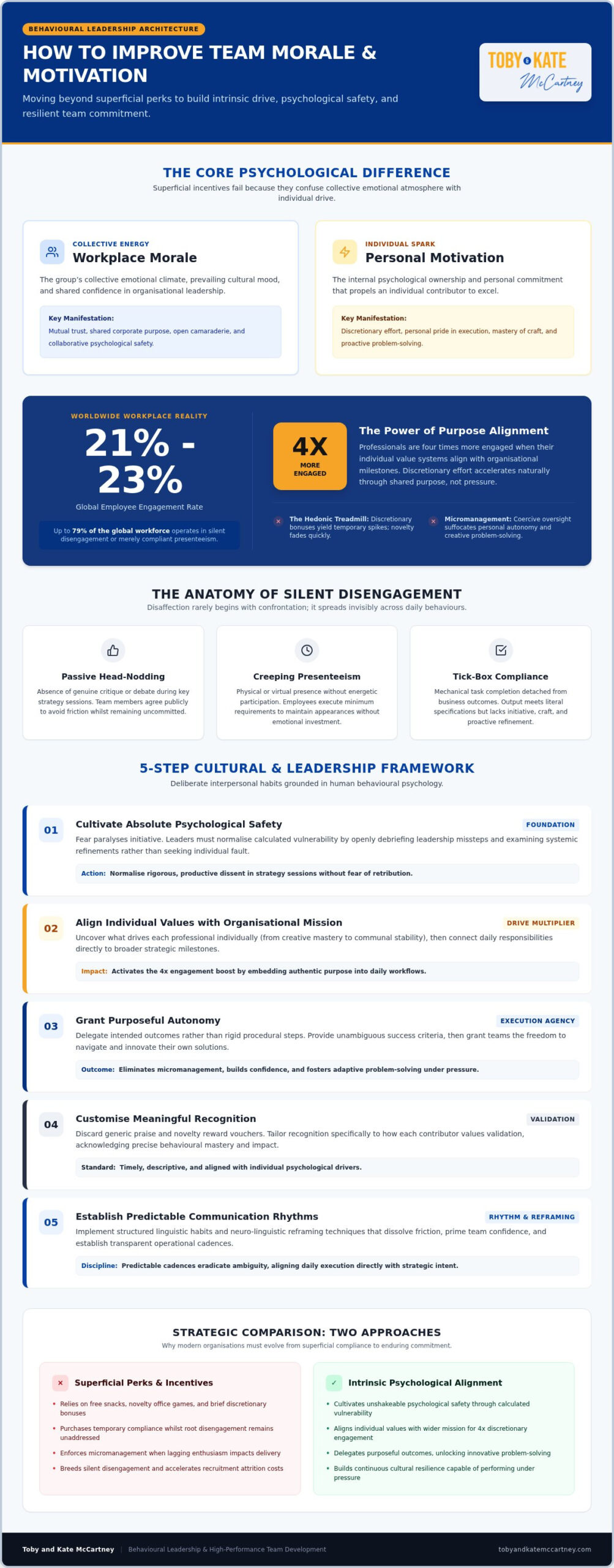
Workplace morale is the collective emotional energy and shared corporate purpose within your organisation. Motivation, by contrast, is the personal spark that propels an individual to excel. When leaders evaluate how to improve team morale and motivation, they often conflate temporary compliance with authentic intrinsic commitment. Putting free pizza in the breakout room or offering superficial perks produces fleeting compliance, not enduring cultural alignment. True engagement takes root only when an employee’s personal value system actively aligns with the wider mission of the organisation.
The Crucial Difference Between Morale and Motivation
Morale reflects the group’s emotional climate and their underlying trust in leadership. Motivation represents individual psychological ownership over meaningful outcomes. A team can easily sit together laughing in the kitchen while remaining completely unproductive and uninspired at their desks. Cultivating the established characteristics of high-performance teams requires uniting these two forces, creating an atmosphere of shared trust where every contributor feels personally driven to execute their responsibilities with pride.
The Hidden Costs of Silent Disengagement
Apathy rarely announces itself with dramatic confrontation. Instead, it surfaces silently through passive head-nodding in meetings, creeping presenteeism, and uninspired tick-box compliance. Left unaddressed, silent disengagement spreads amongst colleagues like a contagion, eroding standards and accelerating staff turnover. Globally, employee engagement sits at a critically low 21% to 23%. This chronic friction drains operational momentum and inflates recruitment costs, making a leader’s ability to master how to improve team morale and motivation a decisive commercial imperative rather than a soft luxury.
Why Traditional External Incentives Eventually Backfire
Relying exclusively on financial incentives traps organisations on an exhausting psychological hedonic treadmill. Discretionary bonuses briefly elevate output, but the novelty fades swiftly, leaving underlying cultural deficits untouched. When managers counter lagging enthusiasm with micromanagement, they suffocate individual autonomy and kill creative problem-solving. Lasting drive cannot be commanded through pressure tactics. It requires you to replace coercive oversight with shared purpose, giving individuals the agency, behavioural clarity, and psychological space to take genuine pride in their work.
5 Proven Steps to Elevate Team Morale and Performance
Sustained performance never emerges from automated workflow tools or outsourced programmes. It demands deliberate interpersonal leadership habits that honour human psychology. When deciding how to improve team morale and motivation across your operations, you must shift from managing mechanics to cultivating human capability. Leaders who master this transition build cultures capable of navigating pressure with exceptional resilience.
Step 1: Cultivate Absolute Psychological Safety
Fear paralyses initiative. To foster true psychological safety, practice calculated vulnerability by openly discussing your own leadership missteps and lessons learned. When debriefing operational setbacks, focus on systemic refinements rather than individual fault. Normalise rigorous, productive dissent in strategic meetings so colleagues can challenge assumptions without fear of retribution, laying the groundwork for unshakeable workplace trust.
Step 2: Align Individual Values with the Organisational Mission
Every professional is guided by distinct internal values, from creative mastery to communal stability. Take time to uncover what drives each person individually, then connect their daily duties directly to key business milestones. Purpose-driven individuals are four times more engaged, and industry research confirms that purpose directly accelerates discretionary effort.
Steps 3 to 5: Autonomy, Customised Recognition, and Rhythms
To implement the remaining framework for lasting cultural change, apply these core operational disciplines:
- Step 3: Grant Purposeful Autonomy: Delegate intended outcomes rather than rigid procedural steps. Clearly outline success criteria, then give your staff the freedom to navigate the path forward. Autonomy builds confidence and sparks innovative problem-solving.
- Step 4: Customise Meaningful Recognition: A staggering 79% of employees who quit their roles cite lack of appreciation as a key factor. Tailor your praise carefully. Introverted contributors often value thoughtful written acknowledgement, whilst extraverted achievers thrive on public team celebrations.
- Step 5: Institute Predictable Communication Rhythms: Maintain structured, weekly one-to-one check-ins focused squarely on professional development and roadblock removal. Consistent feedback loops eliminate unspoken friction before it festers.
Executing these disciplines consistently transforms daily interactions into catalysts for growth. If you want to accelerate this transformation across your management bench, exploring targeted leadership training by Toby and Kate McCartney provides the psychological frameworks needed to turn these five steps into intuitive leadership habits.
Linguistic Reframing and Advanced Communication in Leadership
Every word you speak as a leader subconsciously primes your team’s nervous system. Language does not merely report reality; it constructs it. When exploring how to improve team morale and motivation, many executives focus solely on the message, completely overlooking the linguistic architecture holding it together. Through neuro-linguistic programming (NLP) principles, you discover how individuals delete, distort, and generalise operational information. Mastering these mental filters transforms standard management directives into compelling, psychologically resonant catalysts for action.
Shifting from Problem Frames to Outcome Frames
Problem-focused leadership traps teams in defensive paralysis. Asking “Why did this project fail?” triggers justification, deflection, and emotional fatigue. Reframe the moment using an outcome-focused inquiry: “What is our ideal result here, and what resources do we need to secure it?” This linguistic shift directs cognitive energy away from past errors and anchors your people squarely on generative, forward-looking solutions. Language that points toward the future creates immediate psychological momentum.
Calibrating Your Communication to Diverse Thinking Styles
High-calibre communication requires acute sensory awareness. Your colleagues process reality through distinct representational systems. By listening carefully, you can calibrate your vocabulary to match their internal maps:
- Visual Thinkers: Respond to terms like “clarity”, “perspective”, and “envisioning the road ahead”.
- Auditory Thinkers: Resonate with words like “harmony”, “pacing”, and “striking the right tone”.
- Kinaesthetic Thinkers: Connect with phrases like “solid grounding”, “handling friction”, and “taking tangible steps”.
When you subtly mirror their linguistic patterns and match their speaking tempo, interpersonal resistance melts away. Developing this level of sensory acuity is central to comprehensive advanced communication skills training, giving you the practical tools to unite diverse personalities into a cohesive, high-performing unit.
Delivering Constructive Feedback Without Diminishing Morale
Poorly framed feedback attacks identity, crushing morale in seconds. The secret to delivering rigorous critique whilst preserving inspiration is simple: separate the individual’s inherent identity from their specific behavioural output. Never declare, “You are undisciplined with client deadlines.” Instead, state, “You possess exceptional analytical skills, yet this report missed Tuesday’s deadline. How will we adjust your workflow to ensure the next delivery reflects your true standard?” Concluding performance conversations with an empowering vision of future mastery ensures your staff walk away motivated to improve rather than nursing wounded pride.
Diagnosing Common Morale Killers and Applying Targeted Fixes
Morale does not collapse overnight. It erodes through unchecked micro-frustrations, unspoken resentment, and inconsistent leadership behaviours. If you are examining how to improve team morale and motivation after noticing sudden drops in output, pinpointing the precise operational root cause is vital. Destructive habits such as shifting goalposts or tolerating perceived favouritism breed cynicism rapidly. Restoring high performance requires contrasting these management pitfalls with decisive, constructive interventions.
Eradicating Ambiguity and Shifting Goalposts
Vague instructions create anxiety and defensiveness. When success criteria fluctuate mid-stream, team members retreat into protective self-preservation. Eliminate this friction by establishing crystal-clear definitions of success for every project and individual responsibility:
- Centralise Key Decisions: Document project parameters and scope changes in shared repositories to avoid revisionist debates later.
- Define Explicit Completion Criteria: State clearly what finished looks like before tasks commence.
- Model Absolute Accountability: Demonstrate the same standard of ownership you demand from your staff.
Overcoming Exhaustion and Meeting Saturation
Burnout affects 42% of employees globally, turning enthusiastic contributors into exhausted spectators. Packed calendars strip away the mental bandwidth required for deep, meaningful work. Conduct a ruthless meeting audit: cancel low-value update calls, transition standard reporting to concise asynchronous notes, and fiercely guard dedicated deep-work blocks. Encourage your staff to fully switch off outside working hours. High-energy output is impossible without intentional cognitive rest.
Healing Fractured Workplace Relationships and Broken Trust
Passive-aggressive friction and subtle factionalism stall execution faster than technical obstacles. Left unattended, perceived favouritism or broken managerial promises fracture psychological safety. Address interpersonal disputes immediately through mediated, calm dialogues rather than hoping tensions dissipate on their own. Rebuild fractured rapport by making small, highly visible commitments and keeping them without fail. When you openly acknowledge past leadership errors, you clear the emotional air and restore collective faith.
Resolving deeply rooted cultural misalignment calls for sharp diagnostic capabilities and behavioural mastery. For founders seeking to replace operational resistance with decisive teamwork, investing in structured leadership training for small business owners UK provides the exact roadmap needed. To assess your current leadership blind spots and re-energise your operations, explore executive mentoring options today.
Scaling Leadership Influence to Sustain High Team Performance
Sustained team drive is never an accident; it is a direct reflection of leadership capability. Research reveals that managers account for up to 70% of the variance in team engagement. If you are determined to master how to improve team morale and motivation over the long haul, the transformation begins with your own growth. Elevating your communication mastery and emotional command shifts you from an administrator of tasks into a genuine catalyst for collective achievement.
The Leader as a Cultural Catalyst
Your emotional state sets the psychological temperature for the entire room. When operational pressure mounts, leaders who project grounded composure shield their teams from collective panic. Embody the unwavering integrity, energetic focus, and resilience you expect from those around you. Cultural tone is rarely built through corporate declarations; it is transmitted through your daily micro-behaviours, physical posture, and verbal discipline.
Mastering Advanced Behavioural Methodologies
Inspirational leadership is an art supported by rigorous behavioural science. Immersing yourself in formal neuro-linguistic programming equips you with elite tools to decode unspoken resistance, dissolve interpersonal gridlock, and align diverse personality types toward a singular mission. Honing your public speaking and presentation skills allows you to articulate vision with absolute conviction, galvanising your team when challenging market conditions demand their highest contribution.
Your Blueprint for Lasting Cultural Transformation
Sustainable change thrives on deliberate, compounding action rather than sudden overhauls. Formulate a 30-day implementation plan that anchors one core habit each week:
- Week 1: Audit your operational dialogue, replacing defensive problem-focused phrasing with expansive outcome frames.
- Week 2: Eliminate meeting bloat and protect dedicated deep-work blocks across all diaries.
- Week 3: Conduct one-to-one value discovery discussions to connect personal aspirations with wider commercial targets.
- Week 4: Formalise predictable feedback loops that celebrate tailored recognition and normalise productive dissent.
Gauge your evolution through candid, qualitative check-ins alongside standard quantitative KPIs. Partnering with seasoned practitioners through bespoke executive coaching and mentoring provides the outside perspective and strategic challenge needed to sharpen your personal leadership presence. Step boldly into the role of cultural architect; when you unlock the psychology of human potential, high morale and exceptional performance become your team’s natural standard.
Step Forward as the Leader Your Team Deserves
Lasting cultural transformation is never an accidental stroke of good fortune. When you truly master how to improve team morale and motivation, you replace operational anxiety with genuine psychological safety, clear outcome frames, and purposeful autonomy. Your people don’t need superficial perks. They need a communicative leader who understands human behaviour and models absolute clarity under pressure.
With over two decades of proven experience training leaders and executives across the United Kingdom, our bespoke mentorship models unite practical behavioural science with tangible commercial results. Whether progressing through comprehensive certified pathways spanning NLP Practitioner to Master Trainer levels or engaging in tailored one-to-one mentoring, you gain elite tools to dissolve friction and inspire extraordinary commitment.
The energy of your team is a direct reflection of your leadership capability. It’s time to step into your full authority. Unlock your leadership potential with professional NLP certification and executive coaching, and begin building a resilient, high-performing culture today.
Frequently Asked Questions
What is the fastest way to improve team morale when motivation is at an all-time low?
The fastest way to restore rock-bottom morale is to immediately remove operational roadblocks and actively listen without defensive pushback. Host an informal listening session where you acknowledge current pressures and invite candid input on operational bottlenecks. Follow up by swiftly resolving one or two visible frustrations within 48 hours. Demonstrating rapid, tangible responsiveness proves to your staff that their voices carry genuine influence, creating an immediate emotional reset.
How do you motivate team members who seem completely resistant to change?
You motivate change-resistant individuals by identifying the positive intention behind their hesitation and linking new initiatives to their personal security. Resistance doesn’t usually stem from laziness; it signals anxiety over competence or loss of autonomy. When guiding your workforce through how to improve team morale and motivation during major transitions, frame operational shifts around individual strengths and grant resistant team members direct ownership over key rollout stages.
Can team morale be high if staff are unhappy with their current remuneration?
No, team morale cannot be sustained if baseline compensation is perceived as unfair or uncompetitive. Fair remuneration acts as a vital hygiene factor; if pay fails to meet market standards, resentment quietly poisons the culture. Once salaries are fair, higher pay won’t compensate for poor management. Long-term drive relies instead on psychological safety, meaningful autonomy, authentic appreciation, and clear pathways for individual career advancement.
What are the most reliable early warning signs of declining employee motivation?
The earliest warning signs of fading motivation are uncharacteristic silence during meetings and a sudden drop in spontaneous creative contributions. Watch for staff who transition from energetic problem-solvers into passive observers who simply agree with every suggestion. Other subtle indicators include delayed responses, rigid clock-watching, avoidance of peer collaboration, and increasing cynicism. Spotting these behavioural shifts early allows you to intervene before apathy hardens into disengagement.
How does neuro-linguistic programming help leaders improve team motivation?
Neuro-linguistic programming provides leaders with practical behavioural models to decode how individuals process reality and filter communication. By understanding cognitive filters and sensory language preferences, you can tailor your messaging to connect directly with an individual’s subconscious values. Mastering how to improve team morale and motivation through accredited NLP frameworks equips you to transform defensive dialogues into resourceful solution frames, dissolving operational resistance effortlessly.
What role does public speaking and verbal delivery play in team leadership?
Confident verbal delivery determines whether your strategic vision inspires emotional commitment or merely polite compliance. The vocal tone, tempo, and physical authority you project communicate certainty long before people analyse your data. Completing specialised public speaking programmes helps leaders eliminate hesitant phrasing, project genuine presence, and articulate ideas with absolute clarity. When you speak with grounded conviction, you naturally instil confidence across the entire room.
How frequently should a manager conduct one-to-one meetings to maintain morale?
Managers should conduct one-to-one meetings weekly or bi-weekly for thirty to forty-five minutes to maintain consistent morale. Monthly intervals are simply too infrequent to catch subtle frustrations before they escalate into deep-seated resentment. Treat these check-ins as protected conversations focused on personal development, strategic alignment, and roadblock removal rather than routine status updates. Consistent developmental contact reassures team members that their wellbeing remains a priority.