
What if the right coach isn’t the one with the most impressive C-suite credentials, but the one who understands the leadership challenge in front of you? High-stakes decisions leave little room for reflection, yet your choices can shape teams, stakeholders and organisational priorities. That’s why leadership coaching for c-suite executives should start with what needs to change, not simply your job title.
You may already know that senior leadership calls for more than sharper management skills. It demands clear judgement, influential communication and the ability to bring people with you, especially when priorities compete. Choosing support means looking beyond a polished promise to how the process relates to your work.
This guide will help you connect a coaching process to a real-world challenge, assess the approach that may suit you and set practical goals for stronger leadership behaviour. You’ll also learn how to agree progress measures that make sense for your role, without relying on guarantees. A focused pathway can create space for reflection, sharpen your impact and fit the demands of executive life.
Key Takeaways
- Start with the leadership challenge you need to address, not your job title, to make coaching relevant to your role.
- Leadership coaching for c-suite executives can involve goal-setting, reflection, practical development and regular review, with the process agreed around your needs.
- Compare coaching options by challenge fit, relevant experience, approach, confidentiality and how progress will be reviewed.
- Turn broad ambitions into a useful change you can recognise in real workplace situations, such as clearer communication or stronger influence.
- Prepare your current challenge, desired change, constraints and questions before discussing coaching fit.
Why leadership coaching for C-suite executives must match the challenge
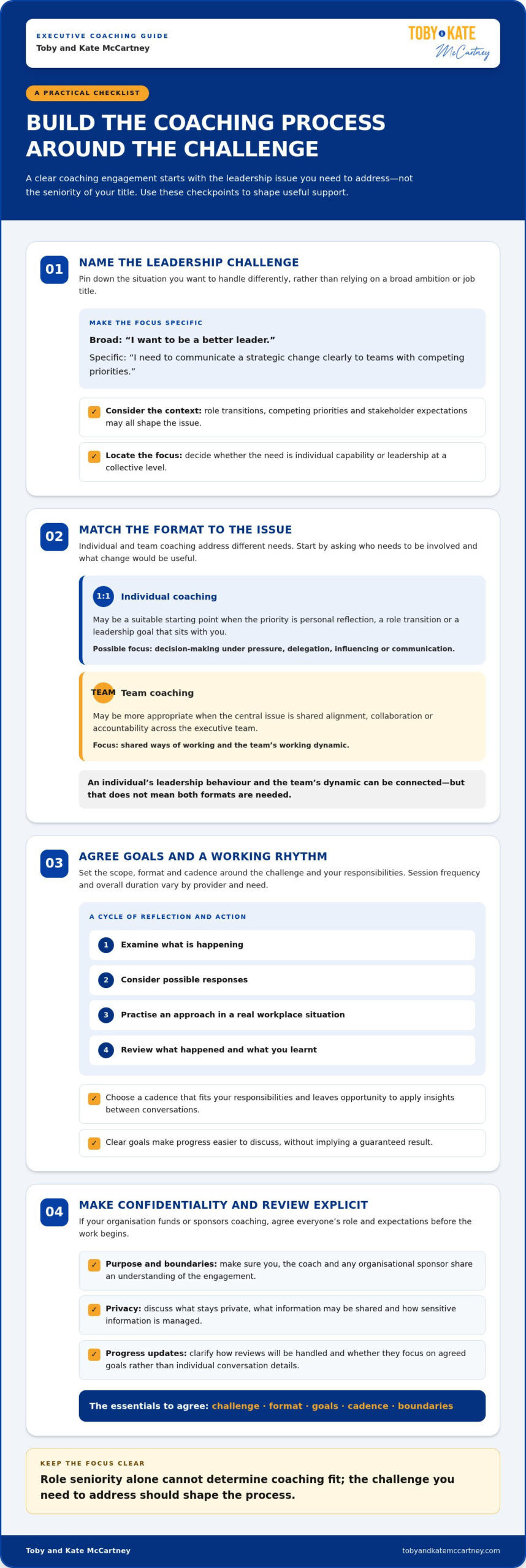
At C-suite level, a decision rarely affects only one department. Organisational change, competing priorities and stakeholder expectations can leave little room to step back and examine how you’re leading. Coaching makes that reflection purposeful: it gives you structured, goal-led support to clarify a development need, consider your options and take deliberate action.
Two leaders with the same title may face very different challenges. A newly appointed CEO may want to explore how to set direction and build trust across the organisation. A CFO may be working on how to communicate difficult financial decisions, whilst a COO may be considering delegation and accountability across operational teams. Leadership development can focus on individual capability as well as leadership at a collective level, so identify which is most relevant to your situation.
Role seniority alone can’t determine coaching fit; the challenge you need to address should shape the process.
Which C-suite challenges can coaching help you explore?
A transition into a CEO, CFO, COO or another senior role can bring new relationships, expectations and decisions to navigate. Coaching can give you structured space to examine how you want to lead in that context. You might explore decision-making under pressure, communication with the board or wider organisation, influencing without relying on authority, delegation, or relationships with colleagues across the executive team.
Make the topic specific. “I want to be a better leader” is a starting point. “I need to communicate a strategic change clearly to teams with competing priorities” gives a coaching conversation something practical to work with. Toby and Kate McCartney provide personalised one-to-one coaching, leadership training and business mentoring, with the focus shaped around individual development needs.
When might individual or team coaching be more appropriate?
Choose the format by locating the challenge. If your priority is personal reflection, a role transition or a leadership goal that sits with you, individual coaching may be a suitable starting point. If the central issue is shared alignment, collaboration or accountability, the need may sit with the executive team rather than one person.
An individual’s leadership behaviour and the team’s working dynamic can be connected, but that doesn’t mean both formats are needed. First clarify what’s happening, who needs to be involved and what change would be useful. This distinction helps you define the right support and keeps the focus on the issue, not the prestige of the role.
What leadership coaching for C-suite executives can involve
A useful coaching engagement has a clear purpose, but the details shouldn’t be assumed from your title. Agree the scope, format and working rhythm around the leadership challenge you want to address. The process may move from clarifying goals to reflection, trying new approaches in real workplace situations and reviewing what you’ve learnt. The executive coaching services overview from the Center for Creative Leadership also describes coaching in relation to challenges such as role transitions and team effectiveness.
Individual coaching and team coaching serve different needs. One-to-one work gives an executive space to focus on personal goals; team coaching centres on shared ways of working. If you’re weighing up individual support, explore executive coaching and mentoring as part of your comparison.
How goals and coaching sessions can be structured
Begin with a specific situation you’d like to handle differently. Perhaps you want to prepare for a challenging conversation, delegate a key responsibility more clearly or communicate a change so that your priorities are understood. From there, agree practical goals that you can return to during the engagement.
Sessions can create a cycle of reflection and action: examine what’s happening, consider possible responses, practise an approach and review what happened afterwards. Session frequency and overall duration vary according to the provider and the need. Choose a cadence that fits your responsibilities and gives you enough opportunity to apply insights between conversations. Clear goals make progress easier to discuss, without implying a guaranteed result.
What confidentiality and organisational involvement mean
If your organisation is funding or sponsoring coaching, establish everyone’s role before the work begins. You, the coach and any organisational sponsor should share an understanding of the purpose, boundaries and reporting expectations. This helps prevent mismatched assumptions about what the organisation will hear.
Discuss what stays private, what information, if any, may be shared, and how progress updates will be handled. Clarify how sensitive information is managed and whether reviews focus on agreed goals rather than the detail of individual conversations. You need enough trust to reflect honestly, while the organisation may need an agreed way to understand whether the engagement remains aligned with its purpose.
Leadership coaching for c-suite executives works best when its goals, format and boundaries are explicit. Toby and Kate McCartney provide personalised one-to-one coaching and mentoring. To explore this support, read about one-to-one coaching and mentoring.
How to compare leadership coaching options before you commit
A compelling profile or impressive credential is only part of the picture. Compare coaching options by looking for a clear connection between your challenge, the approach and how progress will be reviewed. Credentials can help you understand a coach’s training, but they don’t replace rapport, clear boundaries or practical relevance to your role.
| Area to compare | What to look for |
|---|---|
| Challenge fit | The coach explores your specific leadership situation before proposing a process. |
| Relevant experience | Examples show relevant work, with context about the coach’s role and no unsupported claims about results. |
| Approach | You understand how conversations, reflection and practical development may work together. |
| Confidentiality | Boundaries, sponsor involvement and any organisational feedback are explained clearly. |
| Review process | Goals and review points are agreed, so you can discuss progress against what matters to you. |
Relevant examples might include supporting a senior leader through a transition or developing communication in a complex organisation. Treat examples as a way to understand experience, not as a promise that your engagement will produce the same result. Rapport matters too: you should feel able to speak openly and work constructively together.
Questions to ask a prospective executive coach
Keep your evaluation specific. Consider how the coach will understand your challenge before suggesting an approach, what the early sessions might cover and how goals will be agreed. Also establish how progress is reviewed, what remains confidential and whether feedback is shared with an organisational sponsor. Clear answers help you understand the process and decide whether it suits your needs.
Coaching, mentoring or leadership training: how to decide
Choose the format that matches the development need. Coaching supports structured reflection and personal goals; mentoring can offer perspective drawn from relevant experience; leadership training can suit a defined skill or shared learning need. These forms of support may complement one another, but they serve different purposes. For a broader look at structured learning, see business leadership training in the UK.
Strong fit depends on a transparent process and goals agreed by both parties. For leadership coaching for c-suite executives, choose an approach you understand, boundaries you’re comfortable with and a focus that connects directly to the work you need to do.
How to test coaching fit and address common C-suite concerns
A first conversation should help you judge whether coaching is relevant to the leadership challenge you’ve identified. Use a simple sequence to keep the discussion focused:
- Name the challenge: describe the situation or pattern you want to work on.
- Define a useful change: say what you’d like to handle, communicate or decide differently.
- Assess the fit: consider whether the coach’s questions, approach and relevant experience fit your needs.
- Agree review points: decide how and when you’ll revisit your goals.
If communication or high-stakes presentations are central to your goals, public speaking programmes can be a relevant form of development alongside coaching.
How to make progress visible without promising results
Review progress through observable indicators in situations that matter to you. For example, notice whether you’re setting clearer expectations when delegating, making decisions with greater structure or adapting your communication to different stakeholders. These are useful prompts for reflection, not guaranteed performance or organisational outcomes.
Agree when you’ll review the indicators and whether the original goals still reflect your priorities. Executive roles shift, so a useful process makes room to refine the focus rather than treating an initial goal as fixed.
What to do if the first conversation does not feel right
Consider whether the proposed approach, expectations, boundaries and goals are clear. If the coach’s experience or communication style doesn’t feel relevant, pause before committing and reflect on what would make the support a better fit. Trust matters, as does clarity about the work itself.
Your own readiness counts, too. Coaching asks you to reflect honestly, consider alternative perspectives and test new ways of responding. You don’t need every answer before you begin, but a willingness to examine your choices helps make the process purposeful. Leadership coaching for c-suite executives should fit both the challenge and the time you can realistically give it, so agree a workable format and cadence upfront.
Toby and Kate McCartney offer personalised one-to-one coaching. Explore one-to-one coaching as a way to support your leadership goals.
Choose your next step towards C-suite leadership coaching
The strongest starting point isn’t a package or a promise. It’s a clear view of the leadership challenge you want to address, the kind of support that could help and how you’ll review whether the work remains useful. Leadership coaching for c-suite executives should fit the reality of your role, including your priorities, constraints and readiness to reflect.
Prepare for a useful coaching enquiry
Before a conversation, take a few minutes to organise your thoughts. You don’t need a perfect brief. A practical outline can help you explore the need with focus:
- Current challenge: What situation, transition or leadership pattern prompted your search?
- Desired change: What would you like to handle, communicate or decide differently?
- Constraints: What demands on your time or responsibilities should shape the format and cadence?
- Questions: What do you need to understand about fit, confidentiality, expectations and progress reviews?
Specificity helps. Instead of “I need to be more effective”, describe wanting to make clearer decisions when priorities conflict or communicate a strategic shift with greater consistency. You can then assess whether the proposed approach connects to that real work.
Decide whether the available support fits your goals
Different forms of support serve different purposes. Personalised one-to-one coaching may suit individual reflection and leadership goals. Mentoring can offer perspective through relevant experience, whilst leadership training may be appropriate for a defined skill or shared learning need. Toby and Kate McCartney provide one-to-one coaching, leadership training and mentoring, with the support shaped around individual needs.
Consider the proposed support, working format, boundaries and review points, then assess whether they align with your needs and constraints. The aim is an informed choice, not a rushed commitment.
Bring your challenge, desired change and questions into the conversation. Explore coaching and leadership support to consider which pathway best fits the work ahead.
Make your next leadership move with clarity
The right coaching choice starts with the challenge, not the title. Define the change you want to make, decide whether individual coaching, mentoring or leadership training best fits, then agree how you’ll review progress. For leadership coaching for c-suite executives, a transparent process and goals shaped around your real responsibilities matter more than broad promises.
Toby and Kate McCartney offer personalised one-to-one coaching, leadership training and mentoring, alongside NLP certification and public speaking programmes. These forms of support can be considered in light of your leadership goals and practical constraints, rather than assuming one approach suits every executive.
Explore coaching and leadership support with Toby and Kate to discuss a pathway that fits your goals. Focused support can help you bring greater intention to the decisions and relationships that shape what comes next.
Frequently Asked Questions
What is leadership coaching for C-suite executives?
Leadership coaching for C-suite executives is structured support that helps senior leaders examine challenges, clarify goals and practise leadership approaches. You and the coach agree the focus, which might include decision-making, communication, a transition into a new role or relationships across the executive team. The scope and format depend on your needs. Coaching supports professional reflection and development; it isn’t therapy and can’t promise a particular business result.
Is executive coaching worth it for a CEO or C-suite leader?
Executive coaching may be worthwhile if it addresses a meaningful leadership priority and you’re ready to engage with it. Consider whether the approach fits your needs, confidentiality arrangements are clear and progress measures are agreed before you commit. Coaching can create focused time for reflection and action amid competing demands. Its value depends on the relevance of the work and how you apply it; outcomes vary, so avoid treating return on investment as guaranteed.
How do I choose a leadership coach for a C-suite role?
Start by defining the leadership challenge, then assess the coach’s relevant experience, approach, confidentiality arrangements and process for agreeing and reviewing goals. An initial conversation can help you judge rapport and whether the proposed process feels clear and practical. Compare options using the same criteria, rather than relying on broad promises. Where qualifications or client examples matter to your decision, consider what the evidence actually demonstrates.
What is the difference between executive coaching and mentoring?
Executive coaching typically uses questions and structured reflection to help you clarify your own goals and actions. Mentoring often includes perspective or guidance informed by the mentor’s experience. In practice, approaches can overlap, so the label alone may not explain what you’ll receive. Consider how conversations are conducted and what role advice plays. Choose according to your need: personal reflection, experienced perspective or a clearly agreed combination.
Can leadership coaching help an executive team work better together?
Team coaching may help an executive group examine shared goals, communication and accountability when the challenge is collective. Individual coaching may be a better fit for personal development or a role transition. The format should follow the issue, with expectations agreed around participation, confidentiality and review. Coaching can provide a structured setting for discussion, but it doesn’t automatically resolve conflict or guarantee stronger team performance.
How long does C-suite leadership coaching take?
There’s no single standard duration: session frequency and overall length depend on the challenge, goals and approach. Support might focus on a defined role transition or continue as part of broader development. Before starting, agree an initial scope, review points and how you’ll decide whether to continue, adjust or conclude the work. More sessions alone don’t guarantee better outcomes; the focus and usefulness of the process matter.
Is leadership coaching confidential when an employer pays for it?
Confidentiality arrangements should be discussed before coaching begins, particularly if your employer is sponsoring the work. You, the coach and organisation should clarify what information may be shared, with whom and for what purpose. Reporting practices and terms can differ. Agree the boundaries in writing where appropriate, including how progress updates will be handled, so you understand the expectations and feel able to engage openly.