
In an era where AI can draft your emails and manage your schedule, your ability to connect, persuade, and lead remains the only unhackable asset you own. You’ve likely felt the sting of having the sharpest idea in the boardroom whilst watching a louder, less-qualified peer capture the room’s attention. It’s exhausting to navigate complex workplace politics or feel a surge of anxiety when communicating with high-level stakeholders. You deserve to be heard, and more importantly, you deserve to lead.
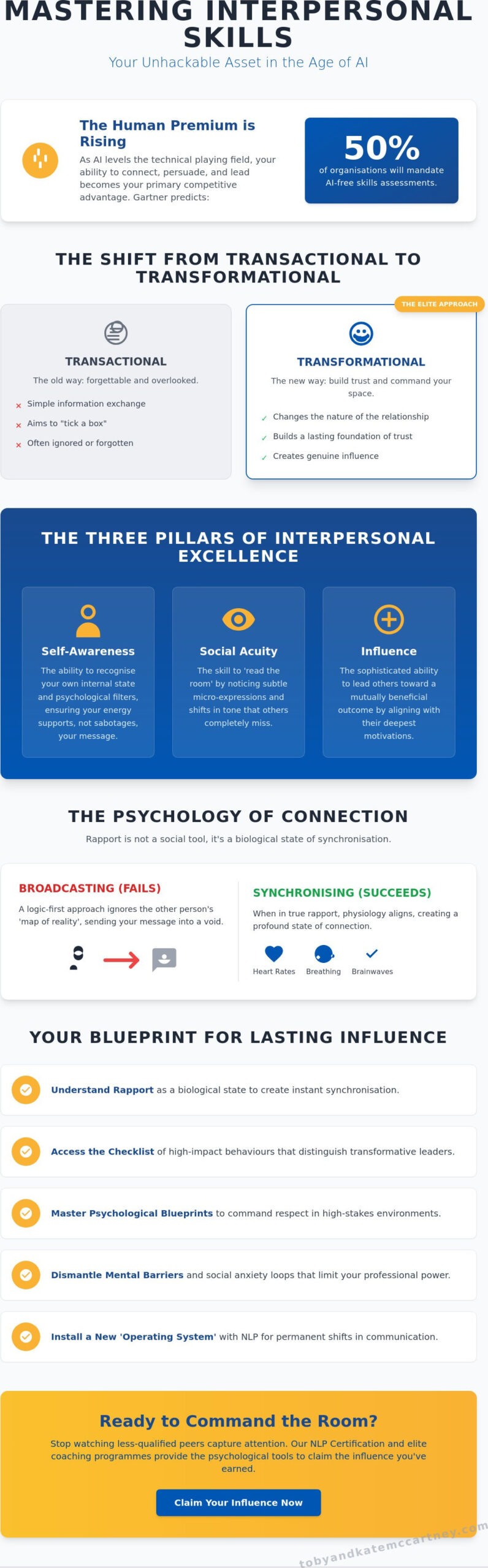
Mastering interpersonal skills is no longer a “soft” luxury; it’s a revenue-critical differentiator in a market where Gartner predicts 50% of organisations will soon mandate AI-free skills assessments. This article reveals the psychological blueprints you need to command respect effortlessly and build instant rapport with anyone. We’ll explore the actionable strategies required to navigate difficult conversations with total certainty, drawing on the same transformative principles found in our NLP Practitioner Certification and elite coaching programmes. Prepare to step into a more capable version of yourself and claim the influence you’ve earned.
Key Takeaways
- Understand why Rapport is a biological state rather than just a social tool, allowing you to create instant synchronisation with anyone you meet.
- Access the elite checklist of high-impact behaviours that distinguish transformative leaders from average managers in the 2026 economy.
- Discover the psychological blueprints essential for mastering interpersonal skills and commanding respect in even the most high-stakes environments.
- Learn to dismantle the mental barriers and social anxiety loops that prevent you from stepping into your full professional power.
- Identify how a structured NLP certification provides the psychological “operating system” for permanent shifts in your influence and communication.
What is Mastering Interpersonal Skills in the Age of AI?
In a professional environment increasingly saturated with generative AI and automated decision-making, the “human premium” has never been higher. Whilst machines can process millions of data points in seconds, they cannot replicate the nuanced dance of human connection or the weight of a trusted handshake. Mastering interpersonal skills in 2026 isn’t about learning to be “polite” or following a generic script for small talk. It is the conscious, strategic application of psychological influence and empathy to drive tangible results. You are essentially upgrading your internal operating system to handle high-stakes human interactions with precision.
Elite influence differs from basic communication because it is transformational rather than transactional. A transactional interaction is a simple exchange of information to tick a box; it’s forgettable and often overlooked. A transformational interaction changes the very nature of the relationship, building a foundation of trust that survives long after the meeting ends. For a comprehensive overview of social skills and their evolution, one can look at the foundational theories of human interaction, but the elite level requires a deeper, more psychological approach. You must move beyond just “talking” to actually commanding the space you occupy.
The Three Pillars of Interpersonal Excellence
To reach this level of mastery, you must focus on three core areas that define how you are perceived by others:
- Self-Awareness: This is the ability to recognise your own internal state and psychological filters whilst you communicate. If you’re stressed or defensive, that energy leaks into your interactions and sabotages your message.
- Social Acuity: This involves developing the “eyes and ears” to notice the subtle micro-expressions and shifts in tone that others completely miss. It’s about reading the room before you ever open your mouth.
- Influence: This isn’t manipulation. It is the sophisticated ability to lead others toward a mutually beneficial outcome by aligning your goals with their deepest motivations and values.
Why Technical Brilliance is No Longer Enough
Many high-achievers fall into the “Expert Trap.” They believe that their technical skills or industry knowledge will carry them to the top. However, as AI levels the playing field for technical output, your relational ability becomes your primary competitive advantage. The ROI of mastering interpersonal skills is visible in faster promotions, smoother project delivery, and higher-value client acquisitions. You can have the best ideas in the world, but if you cannot persuade others to follow them, those ideas will die on the vine.
In the world of Neuro-Linguistic Programming, we often say that “the meaning of your communication is the response you get.” If you aren’t getting the result you want from a colleague or stakeholder, it’s your responsibility to change your approach. You have the power to shift the dynamic of any conversation. You just need the right psychological tools to do it. This is why our Leadership training and One-to-One Coaching focus so heavily on the mechanics of human influence rather than just management theory.
The Psychology of Connection: Why Traditional Communication Fails
Most professionals approach communication as a purely logical exchange of information. They assume that if their argument is sound, their audience will naturally agree. This logic-first approach is exactly why so many interactions fall flat. From a Neuro-Linguistic Programming (NLP) perspective, human connection isn’t about the words you choose; it’s about the subconscious alignment you create before you even start speaking. Every person you meet operates from a unique “map of reality,” a complex internal filter of past experiences, values, and beliefs. If you don’t acknowledge that their map is different from yours, you aren’t communicating; you’re just broadcasting into the void.
True success in mastering interpersonal skills requires moving beyond the static lists of essential interpersonal skills often found in business journals. You must understand Rapport as a biological state of synchronisation. When two people are truly in rapport, their heart rates, breathing patterns, and even brainwave activity begin to mirror one another. This isn’t just “getting along”; it is a profound state of physiological trust that allows for genuine influence. Without this foundation, even the most polished speech will be met with subconscious resistance.
The Power of Sensory Acuity and Calibration
To build this level of connection, you need to develop sensory acuity. This is the ability to notice the tiny, often invisible shifts in another person’s physiology. Are their pupils dilating? Has their breathing shifted from their chest to their stomach? Has the muscle tension around their jaw changed? By noticing these micro-expressions and tonal shifts, you can calibrate your message in real-time. Calibration allows you to read a person’s “baseline” state so you can detect their true, unfiltered reactions to what you’re saying. Sensory acuity is the secret weapon of elite communicators.
Building Instant Rapport through Matching and Mirroring
The science behind this connection lies in mirror neurons, specialised cells in the brain that fire both when we perform an action and when we observe someone else doing the same. You can leverage this biology through matching and mirroring. This isn’t about mimicry, which feels clunky and insincere. Instead, subtly match the other person’s physiology or voice tone. If they speak slowly and softly, adjust your tempo to meet theirs. If they lean back, wait a few seconds and then adopt a similar relaxed posture. This sends a subconscious signal that says, “I am like you; you can trust me.”
Once you’ve established this bond, you can move from matching to “pacing and leading.” This is the ultimate expression of mastering interpersonal skills. You pace their behaviour until the connection is so strong that when you shift your state, they naturally follow you. If you’re ready to command this level of psychological influence, our NLP Practitioner Certification provides the exact blueprints to turn these theories into instinctive habits. You stop being a passive participant in your conversations and start becoming the architect of the outcome.
The Essential Interpersonal Skills Checklist for Leaders
Generic checklists for “soft skills” are everywhere, yet they rarely move the needle for high-level achievers. In the high-stakes professional environment of 2026, the gap between a manager who coordinates tasks and a leader who commands a room is psychological. True leadership requires a bridge between your internal intention and the external impact you make on others. Mastering interpersonal skills at this elite level means moving beyond “getting along” to a state of total influence and certainty. It’s about ensuring that every interaction you have is a deliberate step toward a shared, successful outcome.
To evaluate your current standing, you must look at two distinct dimensions of your performance: how you manage your internal world and how you execute your message in the external one. If these two are out of alignment, your influence will always feel brittle. Use the following criteria to audit your effectiveness and identify where your next breakthrough lies.
The Communication Mastery Checklist
External execution is where your internal mastery becomes visible to the world. It is the tactical application of your influence. Audit yourself against these high-impact behaviours:
- Active Listening: Are you merely waiting for your turn to speak, or are you listening to understand the intent and the underlying emotion? Leaders listen for what is not being said.
- Precision Language: Do you use specific, sensory-based words to reduce ambiguity? Elite communicators avoid “mind-reading” and ensure their instructions leave no room for guesswork.
- Non-Verbal Congruence: Does your body language match the certainty of your words? If you speak of confidence whilst your shoulders are slumped, your audience will subconsciously trust the physiology over the pitch.
If you find gaps in these tactical areas, you can explore the NLP Practitioner Certification UK for a deep-dive into the mechanics of professional mastery. These are not just skills; they are the tools of your trade.
The Emotional Intelligence and Resilience Checklist
Your internal state is the foundation of your authority. Without managing your own psychological “loops,” you cannot hope to lead others through theirs. Consider these pillars of internal excellence:
- State Management: Can you remain calm and resourceful whilst under extreme pressure? A leader’s primary job is to be the most “certain” person in the room, regardless of the chaos outside.
- Empathy and Perspective-Taking: Can you “step into the shoes” of a disgruntled stakeholder or a struggling team member? This isn’t about agreeing; it’s about understanding their map of reality to find a way forward. Developing emotional intelligence for leaders is the cornerstone of this perspective-taking ability, allowing you to navigate complex human dynamics with precision and authority.
- Conflict Reframing: Do you see challenges as threats or as opportunities? Reframing allows you to take a difficult conversation and turn it into a catalyst for a better outcome. Discover how NLP for conflict resolution can transform your most challenging workplace disputes into powerful opportunities for influence and growth.
This checklist is your blueprint for growth. By focusing on these specific, actionable behaviours, you move away from the “Expert Trap” and into the realm of elite influence. You stop reacting to the world and start shaping it through the power of your presence.
How to Organise Your Growth: Overcoming Mental Barriers
Many professionals hide behind the claim that they are “just not a people person.” This is a convenient fiction. It’s a shield designed to protect you from the perceived risk of rejection or the discomfort of growth. In reality, mastering interpersonal skills is a programmable capability, not a fixed genetic trait. To move forward, you must first identify and dismantle the mental loops that trigger social anxiety or defensive communication. These habits are often just outdated survival mechanisms that no longer serve your professional goals in a high-stakes environment.
One of the fastest ways to accelerate your development is through the process of “modelling.” Find an elite communicator in your industry and study them with the precision of a scientist. Don’t just listen to their words. Notice how they stand, where they pause for emphasis, and how they use their eyes to anchor the attention of the room. By deconstructing their behaviour, you can begin to integrate those successful patterns into your own style. Start small. Practise these new micro-behaviours in low-stakes environments like a coffee shop or a brief team check-in before bringing them into the boardroom.
Breaking the “Identity Trap”
Your identity isn’t a solid block of granite; it’s a collection of “parts” that often have conflicting agendas. There is likely a part of you that is hungry for influence and a part that is terrified of being judged by high-level stakeholders. When these parts clash, you experience hesitation and a lack of presence. By acknowledging these internal voices and negotiating a new dialogue, you can align your internal state with your external goals. Changing your internal dialogue is the prerequisite for changing your external behaviour.
The Power of Public Speaking and Presentation
True interpersonal mastery eventually leads to the stage or the head of the boardroom table. This is where you leverage “anchoring,” a technique to trigger a state of total confidence and certainty on demand. Whether you are addressing five people or five hundred, your ability to command attention is a direct reflection of your internal state management. This level of psychological command is a core component of our Leadership Training for Small Business Owners UK, where we help you turn technical expertise into authoritative presence.
If you’re ready to stop playing small and start commanding the respect your ideas deserve, our One-to-One Coaching sessions provide the personalised breakthrough you need to shatter your mental barriers for good. You have the potential to be a master of influence. It’s time to start acting like it.
The Path to Mastery: Elevating Your Influence with NLP
You have the checklist. You understand the psychology. Now, you need the engine that drives it all. Neuro-Linguistic Programming (NLP) is far more than a set of communication tools; it is the definitive operating system for mastering interpersonal skills at an elite level. Whilst traditional management training often focuses on surface-level scripts and generic advice, NLP targets the subconscious drivers of your behaviour. It allows you to rewire your internal responses so that influence becomes your default setting rather than a forced effort. You stop trying to “act” like a leader and simply start being one.
The transition from “learning about” influence to actually “becoming” an influential leader requires a shift in your fundamental identity. You cannot lead others until you have mastered the art of leading yourself. A structured certification programme provides the immersive environment necessary to make these changes permanent. It is the difference between reading a map and actually walking the terrain with world-class guides who have already charted the path to success. You are joining a community of high-achievers who refuse to settle for the status quo.
Why NLP is the Gold Standard for Communication
Traditional coaching can often take months to produce incremental shifts. In contrast, NLP techniques allow for rapid behavioural change by working directly with the way your brain processes information. When you study with world-class trainers like Toby and Kate, you gain access to master-level skills in persuasion and ethical leadership that are simply not taught in standard corporate seminars. You learn to navigate the most complex human dynamics with a level of precision that others will find almost supernatural. This is how you move from being a participant in your career to being the architect of your future.
Your Next Steps to Interpersonal Dominance
The “human premium” in 2026 demands that you step up. You already possess inherent value and unique insights; we simply provide the psychological secret weapons to ensure the world recognises them. Don’t let another meeting pass where your ideas are sidelined or your voice is unheard. You are ready for a significant professional shift, and the journey begins with a single, decisive action. It is time to claim the respect and authority you’ve worked so hard to earn.
Explore our full range of NLP and leadership programmes to find the pathway that matches your ambition. Whether you choose a comprehensive NLP Practitioner Certification or high-impact One-to-One Coaching, you are investing in a version of yourself that commands any room effortlessly. Mastering interpersonal skills is the ultimate investment in your future. We are ready to help you unleash your potential and navigate your professional journey with total certainty.
Claim Your Seat at the Table of Influence
The transition from feeling overlooked to effortlessly commanding any room is within your reach. You’ve discovered that mastering interpersonal skills isn’t about luck; it’s about applying a sophisticated psychological framework to every interaction you have. By bridging the gap between your internal state and your external execution, you transform from a passive participant into a visionary leader. You now have the checklist to audit your performance and the psychological blueprints to dismantle the mental barriers that once held you back.
Since 2003, we’ve provided the transformative NLP techniques required for measurable success in high-stakes environments. Our methods are trusted by CEOs, founders, and ambitious leaders nationwide who demand excellence. It’s time to stop settling for the “Expert Trap” and start leveraging the human premium that machines can never replicate. Master Your Influence: Explore Our NLP Practitioner Certification and join a community of achievers dedicated to professional mastery. Your potential is ready to be unleashed. Step forward with certainty and claim the influence you deserve.
Frequently Asked Questions
How long does it take to master interpersonal skills?
Initial breakthroughs in your communication can occur within days of applying psychological frameworks, but true mastery requires consistent, deliberate practice. A recognised standard from bodies like the ABNLP requires a minimum of 120 hours of training for a practitioner to be certified. This depth of immersion allows the techniques to move from conscious effort to unconscious competence, ensuring your influence remains consistent even under intense professional pressure.
Can an introvert truly become an expert at interpersonal communication?
Introverts often become the most effective masters of interpersonal communication because of their natural aptitude for observation and deep listening. Mastering interpersonal skills isn’t about being the loudest person in the room; it’s about sensory acuity and precise calibration. Introverts can leverage their reflective nature to match and mirror physiology with high precision, creating profound rapport without the need for constant, exhausting verbal output.
What are the most important interpersonal skills for a 2026 leader?
The most critical skills for a 2026 leader include high-level sensory acuity, state management, and the ability to lead human-AI hybrid teams. As AI automates routine tasks, leaders must provide the contextual judgment and emotional intelligence that machines lack. You must be able to read micro-expressions and manage your own internal state to remain a grounded, certain presence for your organisation during times of rapid change.
How do interpersonal skills differ from soft skills?
Interpersonal skills are a specific, high-impact subset of soft skills focused entirely on the mechanics of human interaction and psychological influence. Whilst “soft skills” is a broad umbrella term, interpersonal mastery is the conscious application of tools like rapport, pacing, and leading. It is the revenue-critical “power skill” that allows you to turn your technical knowledge into measurable relational value and authority.
Is it possible to learn interpersonal mastery online, or do I need in-person training?
Foundational theories are easily accessible online, but elite mastery is best achieved through blended learning models that include high-impact coaching. Blended learning is the fastest-growing delivery model for these skills, with a projected 10.11% CAGR through 2031. Real-time feedback during Public Speaking programmes or NLP training ensures you calibrate your behaviour correctly before you apply it in a high-stakes boardroom environment.
What is the best way to handle a conflict with a difficult colleague using NLP?
The most effective approach is to first “step into the shoes” of the other person to understand their unique map of reality. Use matching and mirroring to re-establish subconscious rapport, then use precision language to identify the specific root of the disagreement. By reframing the conflict as a shared challenge rather than a personal battle, you lead the colleague toward a mutually beneficial outcome whilst maintaining your authority. For a deeper exploration of these techniques, our NLP for conflict resolution masterclass provides the complete framework for navigating even the most entrenched workplace disputes.
How do I include interpersonal skills on my professional CV or LinkedIn profile?
List your verifiable certifications, such as an NLP Practitioner Certification, and use action-oriented language to describe your measurable results. Instead of claiming you have “good communication,” state that you “applied psychological influence strategies to lead cross-functional teams and resolve high-stakes stakeholder conflicts.” Verifiable skills from established bodies carry significant weight with recruiters who are increasingly looking for elite, human-centric talent.
Can mastering these skills actually lead to a higher salary or promotion?
Mastering interpersonal skills is directly linked to higher earnings and faster career progression in the modern economy. Workers with advanced, uniquely human skills often command a significant wage premium, particularly as organisations begin to mandate AI-free skills assessments to evaluate leadership potential. When you can command respect effortlessly and build instant rapport with anyone, you become an indispensable asset that businesses invest in heavily.