
Your pounding heart and trembling hands aren’t signs of weakness. They are actually mismanaged energy waiting to be harnessed. Most professionals in the UK recognise the frustration of career stagnation because they avoid the boardroom spotlight, haunted by the memory of a past presentation that didn’t go to plan. You likely believe that public speaking is an innate talent you simply weren’t born with, or a terrifying ordeal to be survived rather than enjoyed.
It is time to challenge that narrative. You can transform stage fright into a commanding, magnetic presence by mastering specific nlp techniques for public speaking. This 2026 guide reveals the psychological secrets used by elite communicators to shift their state from panic to poise in seconds. You will discover how to reframe your identity at a neurological level, ensuring you no longer just “get through” a talk, but actually thrive in the centre of the room. We will explore how to anchor confidence, influence your audience with precision, and finally claim the professional authority you deserve.
Key Takeaways
- Discover why your brain perceives a boardroom as a threat to survival and how to neutralise this primal fight-or-flight response.
- Master elite nlp techniques for public speaking to re-code your internal experience and build a mental movie of your perfect presentation.
- Abandon outdated advice in favour of state management, focusing on your presence and influence rather than just memorising a script.
- Utilise the Hakalau state and other rapid-fire routines to instantly switch off stress and regain composure seconds before you speak.
- Learn how to bridge the gap between overcoming fear and commanding a room to accelerate your career as a visionary leader.
Understanding Why Your Brain Triggers Public Speaking Anxiety
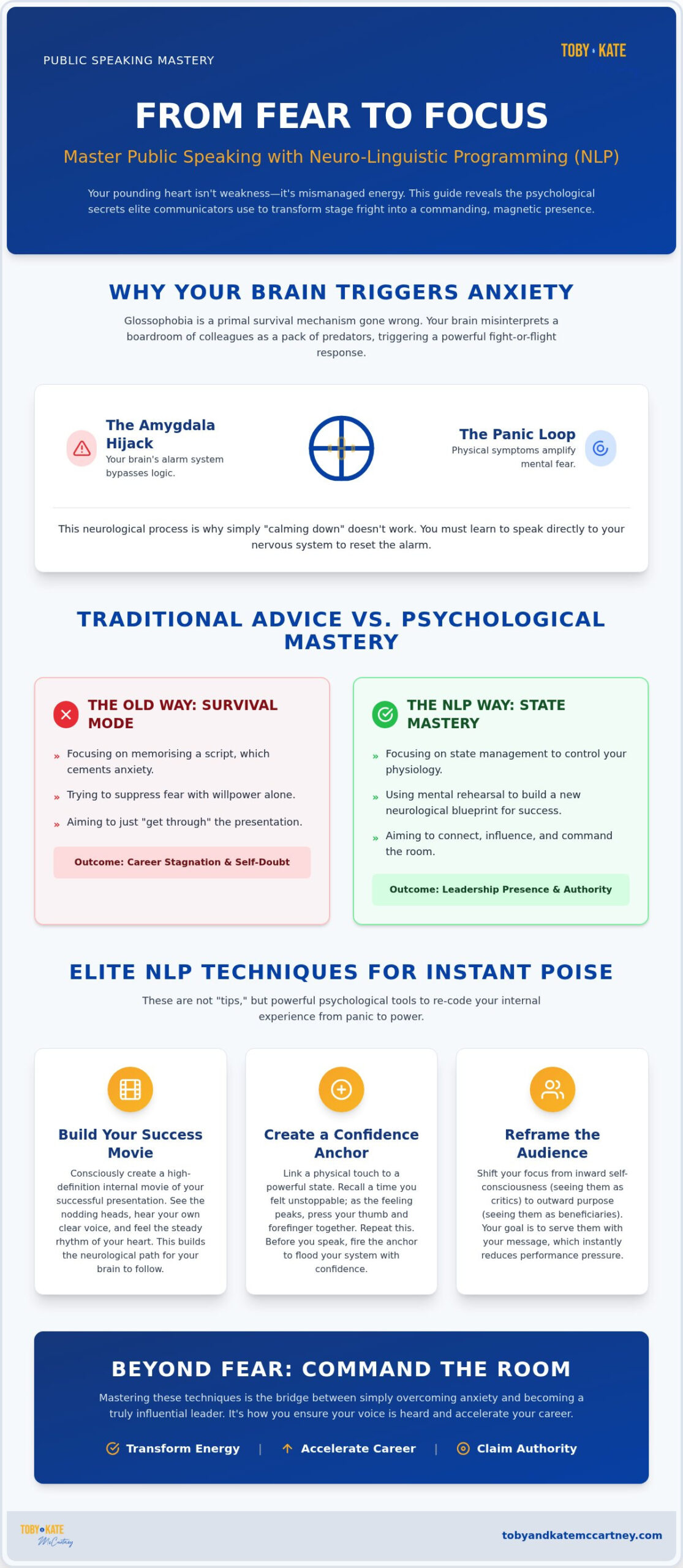
Glossophobia is more than just a case of the jitters. It’s a primal survival mechanism that has been misdirected. Whilst your logical mind knows a boardroom presentation isn’t a life-or-death situation, your primitive brain hasn’t received the memo. It perceives a room full of staring eyes as a pack of predators. This triggers a massive release of adrenaline and cortisol, shifting your body into a fight-or-flight state that feels impossible to control through willpower alone. Endlessly rehearsing your script whilst trapped in a state of high anxiety often does little more than neurologically cement the very fear you are trying to escape.
There’s a vital distinction between useful nervous energy and debilitating panic. Useful energy is the “spark” you can channel into a charismatic performance. Panic, however, is a closed neurological loop where physical symptoms like shaking or sweating feed your mental fear, which then amplifies the physical response. Understanding Neuro-linguistic Programming allows us to see how these internal maps are constructed. By applying specific nlp techniques for public speaking, you can learn to interrupt this loop and reclaim your composure.
The Role of the Amygdala in Stage Fright
The amygdala serves as your brain’s emotional alarm system. When it detects a perceived threat, it effectively hijacks your nervous system, bypassing the prefrontal cortex where logical thought and language are processed. This is why your mind suddenly goes blank even if you’ve memorised every slide. Your heart races and your breath becomes shallow because your body is preparing for a physical struggle. Once this hijack has begun, simply telling yourself to “calm down” rarely works because the logical part of your brain has been temporarily taken offline. You need a way to speak directly to the nervous system to reset the alarm.
The Cost of Avoiding the Spotlight
Playing small might feel like a safe harbour, but it’s an expensive career strategy. Every time you pass a presentation to a colleague or stay silent during a high-stakes meeting, you’re placing a ceiling on your leadership potential. The psychological toll of avoiding these moments is significant; it reinforces a self-image of being “less than” or incapable of influence. By 2026, the professional landscape demands more than just technical expertise. It requires the ability to inspire and command a room. Mastering nlp techniques for public speaking isn’t just about comfort. It’s about ensuring your voice is heard amongst the noise and reclaiming the professional space you’ve earned.
The NLP Approach to Overcoming Fear of Public Speaking
Neuro-Linguistic Programming is often described as the software manual for the human brain. It’s the science of re-coding your internal experience to produce different results. If you’ve spent years dreading presentations, you’ve essentially been running a “fear programme” that has become highly efficient. By using nlp techniques for public speaking, you can overwrite this outdated code. Your current anxiety isn’t a permanent personality trait. It’s simply a sequence of neurological events that can be updated for better performance.
Mental rehearsal is a primary tool in this transformation. Instead of subconsciously imagining a disaster, you consciously build a high-definition movie of your success. You don’t just “think” about your speech; you experience it. You see the nodding heads, hear the clarity in your voice, and feel the steady rhythm of your heart. This creates a neurological blueprint for your brain to follow. When you change your internal dialogue from “I am terrified” to “I am prepared,” you begin to overcome your fear of public speaking by shifting your biology from panic to poise.
Anchoring Confidence: Your Personal Success Trigger
Confidence should never be left to chance. You can create a physical anchor that triggers an instant state of flow. Start by recalling a moment when you felt completely unstoppable and powerful. As that feeling reaches its peak, press your thumb and forefinger together firmly. Repeat this process, stacking multiple memories of success onto that same physical gesture. When you are about to walk onto the stage, trigger your anchor. It floods your system with the exact resource you need. If you want to master these triggers at a professional level, you might consider an NLP Practitioner Certification UK to solidify your skills.
Reframing the Audience: From Critics to Beneficiaries
Stage fright is fuelled by self-consciousness. You’re focused inward, worrying about your own performance. Using the NLP technique of Perceptual Positions, you can shift your focus. Step out of your own shoes and view the room from the audience’s perspective. They aren’t there to judge you; they are there because they need the value you provide. When you reframe the audience as beneficiaries of your knowledge, the pressure to be “perfect” vanishes. You stop being a performer and start being a mentor, which is a far more powerful and stable state to operate from.
Traditional Advice vs. Psychological Mastery: What Actually Works?
Most traditional public speaking advice is remarkably unhelpful. You’ve likely been told to “picture the audience naked” or “look at the back wall” to avoid eye contact. These are avoidance tactics. They don’t solve the underlying neurological panic; they simply mask it whilst decreasing your presence and influence. Elite communicators don’t rely on gimmicks. Instead, they use nlp techniques for public speaking to master their internal state. Whilst deep breathing exercises can provide a temporary sticking plaster, they rarely address the core belief that “I am not enough.” True mastery comes from shifting your identity, not just your oxygen intake.
The difference between a mediocre presentation and a transformative one lies in state management. If you memorise a script word-for-word, you’re one forgotten sentence away from a total meltdown. When you master your presence, you become flexible. You can handle interruptions, technical glitches, or tough questions with total composure. You aren’t trying to survive a performance; you’re leading a room. Elite speakers still feel nerves. The difference is they have better systems to channel that energy into charisma rather than letting it turn into debilitating fear.
The Myth of The Natural Born Speaker
The idea that some people are simply “born” for the stage is a damaging fallacy. Charisma is a skill set that can be deconstructed and learned. Toby and Kate have spent over 20 years proving this. They’ve seen thousands of quiet introverts transform into commanding presences by applying the right psychological frameworks. Your unique personality isn’t a barrier to success. It’s actually your greatest asset. Once you remove the layers of fear, your authentic voice is what truly inspires an audience. You don’t need to become someone else; you just need to become the most confident version of yourself.
Why Practice Doesn’t Always Make Perfect
Repeating a speech whilst your heart is racing and your palms are sweating is dangerous. You aren’t practising your speech; you’re practising the panic. You’re literally training your brain to associate your content with a state of high anxiety. The McCartney method flips this. We teach you to access a state of attainable excellence before you even open your mouth. By rehearsing from a place of calm authority, you create a powerful neurological link between your message and your confidence. This is the foundation of public speaking for leaders, where influence becomes a natural extension of who you are.
Immediate Techniques to Calm Your Nerves Before You Speak
The final minutes before you walk onto the stage or into a high-stakes meeting are often the most volatile. This is where the 5-Minute Mindset Reset becomes your secret weapon. Instead of letting your focus narrow into a “tunnel of dread,” you can use nlp techniques for public speaking to widen your perception. One of the most effective tools is the Hakalau state, or peripheral vision. By consciously widening your gaze to take in the entire room, including the ceiling and the floor, you send a direct signal to your brain to switch off the sympathetic nervous system. You cannot remain in a state of high-alert panic whilst your eyes are in peripheral vision; it’s a neurological impossibility.
Grounding yourself amongst the chaos requires more than just standing still. You need to feel centred and immovable. Power Pose 2.0 takes the traditional idea of expansive posture and integrates it with internal neurological certainty. It isn’t just about how you look to others; it’s about how you feel to yourself. When you align your physical stature with a clear, calm internal state, you create a foundation of authority that the audience senses before you even speak. If you want to master these rapid-fire shifts, you can enrol in our NLP Practitioner Certification UK to gain total control over your state.
The Pre-Speech Identity Shift
You have 60 seconds to decide who you are going to be on that stage. Step into the persona of an elite communicator by using Future Pacing. Mentally jump to the end of your presentation and see yourself receiving a warm round of applause. Feel the satisfaction of a job well done. This “future memory” acts as a magnet, pulling you through the talk with confidence. The ultimate power of your talk lies in your intent: what specific emotion do you want your audience to feel when you finish? When your intent is clear, your message becomes unstoppable.
Handling the Physical Shakes and Voice Tremors
Excess adrenaline often manifests as shaking hands or a tight, trembling voice. Don’t fight it. Fighting adrenaline only creates more tension. Instead, use the Release technique: acknowledge the energy and imagine it flowing out through your fingertips and into the floor. Mask a voice tremor by focusing on projection from your diaphragm rather than your throat. Authority is built through tone and pace, not volume. Most importantly, reframe your physical sensations. A racing heart is the same physiological response for both fear and excitement. By telling yourself “I am excited,” you change your heart rate variability and turn that nervous energy into fuel for your performance.
From Overcoming Fear to Commanding the Room: Your Next Steps
Overcoming fear is just the baseline. It’s the foundation upon which you build a career defined by influence and impact. There is a profound difference between simply not being scared and being a master of interpersonal influence. Whilst many are content to just “get through” a presentation, elite leaders understand that every time they speak, they are either building or eroding their professional authority. This is why high-level UK business leaders invest in executive coaching and mentoring. They aren’t looking for basic tips; they are refining their public persona to command respect and drive change.
Mastering advanced communication via an NLP Practitioner Certification UK transforms your career trajectory. You stop being a passive participant in meetings and start becoming the catalyst for action. By integrating nlp techniques for public speaking into your leadership style, you gain the ability to read a room, build rapid rapport, and deliver messages that resonate at a neurological level. You move from being a speaker to being a visionary.
Developing the Empowering Master Persona
Leading from a place of deep conviction requires more than just knowing your facts. It requires a persona that projects professional authority and warmth simultaneously. Toby and Kate’s programmes provide the secret weapon for those ready to step into this role. You move beyond the mechanics of speech and into the art of transformation. You are no longer just speaking to a crowd. You are transforming a room, shifting the energy and the mindset of everyone present. This is the hallmark of a true master.
Your Journey to Mastery Starts Now
Your path to elite communication is flexible. You might start with targeted workshops or commit to the full NLP Master Practitioner Certification to achieve total psychological mastery. The promise is a new life where you no longer avoid high-stakes opportunities. Instead, you create them. You become the person others look to when a vision needs to be shared or a team needs to be inspired. The world is waiting for your voice. You are already enough; we just help you prove it to the world through every word you speak.
Step Into Your Power on Stage
You now possess the blueprint to dismantle public speaking anxiety at its neurological source. By moving beyond traditional avoidance tactics and embracing elite nlp techniques for public speaking, you’ve discovered how to transform primal fear into magnetic presence. You understand that your heart rate and internal dialogue are simply programmes you can update in real-time. Whether you are using the Hakalau state to calm your nerves in the wings or anchoring unshakeable confidence before a high-stakes board meeting, the tools for professional mastery are now in your hands.
Learn from world-class NLP masters Toby and Kate McCartney, whose accredited training has empowered elite UK CEOs and leaders for over two decades. Their proven methods are designed for measurable professional growth, ensuring you don’t just speak, but truly influence. Command the room and transform your career; explore our Public Speaking Programmes today.
Your voice is your greatest asset and your most powerful tool for leadership. It is time to let it be heard with the authority and conviction you deserve. Your journey to mastery has already begun.
Frequently Asked Questions
Is the fear of public speaking actually a phobia?
Yes, it is known as glossophobia. It frequently ranks as the top fear in many UK surveys, sometimes even above death. It’s a specific phobia involving intense anxiety or fear of being judged whilst speaking in front of a group. Whilst it feels like a permanent part of your personality, it’s actually a neurological pattern that can be updated through professional training and state management.
How can I stop my voice from trembling when I’m nervous?
A trembling voice is usually caused by shallow chest breathing and muscle tension in the throat. You can counteract this by engaging your diaphragm and consciously lowering your vocal pitch. Using specific nlp techniques for public speaking, such as the Release technique, helps dissipate the excess adrenaline that causes these physical tremors. Focus on projecting your voice to the back of the room to stabilise your tone.
Can an introvert really become a great public speaker?
Absolutely, and introverts often make the most impactful speakers because they tend to be more observant and prepared. Charisma isn’t an extroverted trait; it’s a skill set you can learn. By mastering your internal state, you can step into an “Empowering Master” persona that feels authentic to you. Introverts excel at building deep rapport and delivering thoughtful, high-value content that truly resonates with a sophisticated audience.
What is the fastest way to calm down before a presentation?
The fastest method is entering the Hakalau state by widening your gaze into peripheral vision. This physical shift sends an immediate signal to your brain to deactivate the fight-or-flight response. You can also trigger a confidence anchor by pressing your thumb and forefinger together, instantly flooding your system with resourceful feelings. These tools work in seconds, making them perfect for those final moments in the wings or the hallway.
How does NLP help with public speaking anxiety specifically?
NLP provides a toolkit to re-code the mental movies and internal dialogue that trigger panic. Instead of subconsciously rehearsing failure, you use nlp techniques for public speaking to build a high-definition blueprint of success. It addresses the root cause at a neurological level rather than just treating the symptoms. This shift in identity allows you to move from surviving a talk to commanding the room with genuine authority.
What should I do if I go blank in the middle of a speech?
First, pause and breathe; the audience usually perceives a pause as a deliberate moment of reflection. Use this time to step into your peripheral vision to reset your nervous system. You can also ask the audience a question or repeat your last point to buy time whilst your brain retrieves the next piece of information. Remember, your internal state is always more important than delivering a perfectly memorised script.
Is it better to memorise a speech or use notes?
It’s best to master your internal state and use structured prompts rather than memorising word-for-word. Rote memorisation often increases anxiety because forgetting one word can trigger a panic loop. Instead, focus on the key “anchors” of your message. This allows you to remain flexible and present, enabling you to adapt your delivery based on the audience’s real-time reactions and their level of engagement.
How long does it take to overcome the fear of public speaking for good?
Significant shifts often happen in a single session, but total mastery is a journey. Many UK professionals experience a complete transformation during an intensive NLP Practitioner Certification. Whilst immediate techniques provide relief, permanent confidence comes from identity-level change. Most of our students report feeling a profound sense of composure and even excitement for their next presentation within just a few days of focused psychological training.