Confidence isn’t something you either have or lack. In NLP, a state is the mix of your thoughts, emotions, bodily sensations and behaviour at a particular moment. NLP state management techniques use changes in physiology and attention to help shift that experience, rather than treating confidence as a fixed trait.
Public speaking is a useful place to explore these techniques because nerves can affect how clearly you think and communicate. The same ideas can also help in meetings, challenging conversations and everyday situations where you want to respond with more composure. You’ll learn what state means, how posture, breathing and attention can influence it, and how to apply these concepts at work and beyond.
We’ll also explore anchoring, mental rehearsal and practical ways to work with an unhelpful state without judging yourself for having it. The aim is to understand the tools clearly, so you can choose what fits the moment and communicate with greater intention.
Key Takeaways
- Notice how posture and movement shape your experience, then use small physical adjustments to support a more resourceful state.
- Explore how physiology, attention and mental imagery can influence the way you approach a demanding moment.
- Learn how an anchor can act as a cue to recall a state of confidence when you’re preparing to speak.
- Apply these ideas beyond presentations, adapting your communication and response in meetings, negotiations and challenging conversations.
Can I use these techniques without formal training?
Yes. Common NLP state management techniques include changing posture, shifting attention, mental imagery and anchoring. You can try simple actions on your own, such as standing tall before a meeting or focusing on one useful outcome.
Changing state through movement
Changing state through movement means adjusting your posture or activity to influence how you feel and respond. Straighten your body, look ahead and slightly upwards, or move around when appropriate. These actions can interrupt a withdrawn or tense stance before a presentation or difficult conversation. A posture shift can take under five seconds, making it a practical option before you speak. Treat it as an experiment: notice your state, change your position, then observe what feels different.
Shifting focus with NLP
NLP focus-shifting techniques redirect attention towards a chosen detail, image or outcome. If you’re dwelling on a presentation mistake, pause and identify the next point you want colleagues to understand. You can also picture yourself delivering it clearly, including your voice and body language. This mental rehearsal gives your attention a direction instead of letting it circle around a worry. The useful question is not whether the concern exists, but which action deserves your focus now.
During organisational change, influence starts with understanding the current reality before guiding people towards a new one. For example, a manager introducing a revised process can listen to staff concerns, clarify what will change and explain the next action. Language matters: vague phrases can increase uncertainty, while a specific example or metaphor can make an unfamiliar idea easier to grasp. Recognise what matters to stakeholders and adapt your communication to support engagement, not control. This makes conversations about change more responsive.
Resources for change include skills, supportive relationships and a clear reason to act. Before a challenging discussion, recall an occasion when you handled a similar task well, then identify the actions that helped. A mentor’s example can also offer a model to practise. NLP techniques are flexible, not a fixed regime; choose an approach that fits the situation. Notice an uncomfortable state without shame or anger, then decide whether movement, focus or preparation is the most useful next step.
Physiology, attention and internal representation
In Neuro-Linguistic Programming, internal representation means how you picture, hear and interpret an experience. A difficult meeting might bring an image of criticism, tense shoulders and anxious self-talk. Emotions can shape your physiology, while physical tension can influence the thoughts you notice. Treat mind and body as interacting parts of the same moment, not separate systems.
Physiology is a quick state-management lever: a posture or movement shift can take under five seconds. Attention-shifting exercises typically take five to fifteen seconds. Before a challenging conversation, widen your attention to include the whole room, then focus on the person speaking. This small change can interrupt tunnel vision and help you respond to what’s happening, rather than replaying an earlier concern.
The 7-38-55 Rule assigns 7% of a message to words, 38% to tone and 55% to body language. Use those figures as a prompt to notice delivery, not as a universal formula for decoding people. A colleague’s crossed arms could reflect discomfort, concentration or simply habit. Ask what a gesture means instead of assuming you can read someone’s emotions from their posture.
Build rapport through attentive listening, flexible language and awareness of non-verbal signals. If a colleague speaks quietly and pauses often, slow your pace and give them room to finish. Mirroring their energy can support connection, but copying gestures mechanically can feel unnatural. In coaching or negotiation, notice what changes as the conversation develops, then adapt your approach. This is linguistic programming in practice: noticing how language, attention and actions shape interaction.
For a speaking scenario, a public speaking programme can help you practise applying these ideas with greater awareness.
Does NLP state management work for fear of public speaking?
Anchoring can help you recall a resourceful state before a presentation by linking it to a deliberate cue. Its usefulness depends on practising the cue and choosing an approach that suits the moment.
Recalling a resourceful state
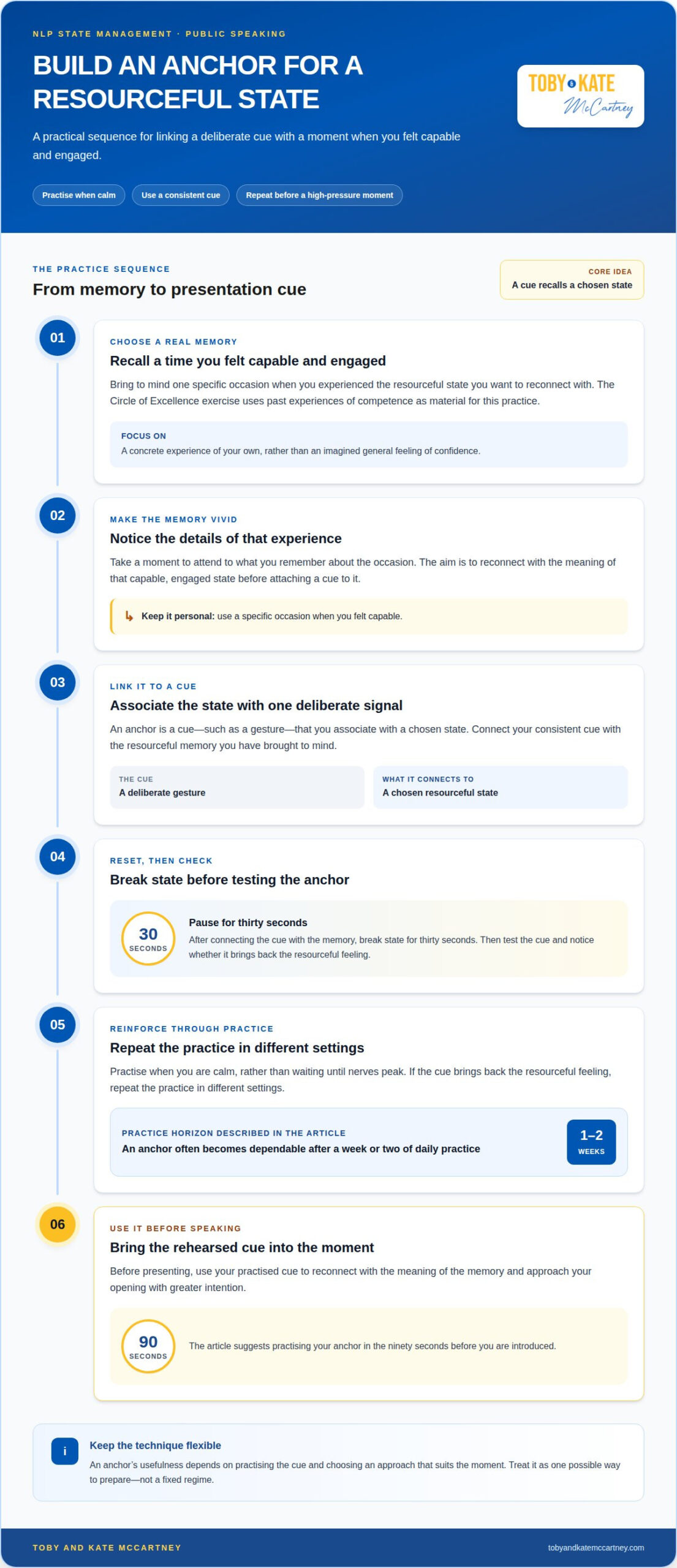
An anchor is a cue, such as a gesture, that you associate with a chosen state. To build one, recall a specific occasion when you felt capable and engaged, then notice the details of that memory. The Circle of Excellence exercise uses past experiences of competence as material for this practice. Before presenting, a rehearsed cue can help you reconnect with that meaning and approach your opening with greater intention.
Learning and reinforcing anchors
Practise anchoring when you’re calm, rather than waiting until nerves peak. Recall a vivid example of confidence, connect it with a consistent cue, then break state for thirty seconds before testing the anchor. If the cue brings back the resourceful feeling, repeat the practice in different settings. An NLP anchor often becomes dependable after a week or two of daily practice. Repetition helps make the pattern familiar before a high-pressure presentation.
Comparing state-management approaches
Anchoring offers a portable cue, while imagery lets you rehearse a presentation in detail. A posture change can be quick, but may not address the meaning attached to a specific speaking fear. Each approach directs attention differently, so combining them can be more adaptable than relying on one technique. Practise your anchor, then use it in the ninety seconds before you’re introduced. NLP training can help you understand when each approach fits, without treating any single method as a solution for every situation.
Anchoring cues can prompt desired states; Circle of Excellence draws on past experiences of competence; executives can use these approaches to access calm confidence. The Oxford English Dictionary defines a state as the particular condition someone or something is in at a specific time.
Using state management beyond public speaking
State management can support everyday workplace behaviour, not just presentations. Before giving difficult feedback, notice whether frustration is shaping your words. Pause, identify the outcome you want, then choose language that addresses the work rather than labelling the person. This can help you communicate with more confidence and keep the conversation focused on practical next steps.
In a team meeting, the same approach can help you respond thoughtfully when colleagues disagree. Separate the facts you’ve heard from the assumptions you’re making, then ask a clarifying question. If a proposal meets resistance, explore the concern behind it before defending your idea. These actions create space for shared problem-solving instead of letting a tense moment dictate the group’s behaviour.
Negotiations also benefit from managing your own state while staying attentive to others. If a supplier challenges a deadline, take a breath and clarify which requirement matters most. Listen for their priorities, then explore options that meet both sides’ needs. This is a useful communication skill, but it should support transparency and autonomy, not pressure someone into agreement. Mutual benefit is the aim.
During organisational change, leaders can use state awareness to respond constructively to uncertainty. For instance, when a team raises concerns about a new process, acknowledge the impact before explaining what happens next. Use clear language, specific examples and a defined action, such as inviting feedback on a draft workflow. This makes communication more considered and helps people engage with change rather than feel managed by it. To strengthen workplace communication through practical speaking skills, explore a public speaking programme.
These communication habits can be supported by a pre-speaking routine. The page describes a routine of Ten minutes for professional presenters: the recommended breathing pattern is roughly four in, six out, and the rehearsal focuses only on the first ninety seconds of a presentation. Tony Robbins began using incantations when he was 17.
The page also recommends reframing challenges, reducing ambiguity, aligning language with intent, and using stories and metaphors to improve communication. The public speaking training runs from 1 to 13 October 2026.
Toby and Kate McCartney: NLP Practitioner Certification
Toby and Kate McCartney’s NLP Practitioner Certification is a natural next step if you want to develop your understanding of NLP beyond informal practice. It offers a structured pathway for building skills you can apply to communication, personal development and professional situations.
If your focus is confident speaking, their Public Speaking programmes connect directly with presentations and communicating in front of others. For further NLP study, the NLP Master Practitioner Certification and NLP Trainer Training offer routes to explore more advanced learning and training others.
Choose the pathway that reflects what you want to develop, whether that’s applying NLP at work, strengthening your speaking or building towards training. To explore the options, contact Toby and Kate McCartney or visit tobyandkatemccartney.com.
Make your next conversation a chance to practise
Confidence grows through deliberate application. Choose an upcoming conversation where you want to be more composed, then decide how you’d like to show up. Practising NLP state management techniques can help you approach that moment with greater intention, rather than relying on a familiar reaction.
Afterwards, reflect on what you noticed. Did your attention stay on the other person? Did your words match your intention? Use those observations to shape your next attempt. This turns everyday interactions into opportunities to strengthen communication skills, whether you’re contributing in a meeting, handling feedback or speaking to an audience.
If you’d like to develop your NLP learning or build confidence speaking at work, explore a pathway that fits your aims. Contact Toby and Kate McCartney to discuss your next step. You already have the capacity to grow; begin with one purposeful action and keep building from there.
Frequently Asked Questions
What is State?
A state is the condition you’re in at a particular moment. Before a meeting, for example, you might feel alert, distracted or impatient, and each state can affect how you listen and make decisions. Your state can shift during the day as circumstances change. Naming what’s happening gives you a clearer starting point for choosing how to respond.
Can you ‘read’ someone else’s state?
You can notice cues, but you can’t know someone’s state from appearance alone. A colleague who looks away during a discussion might be thinking carefully, rather than feeling disengaged. Pay attention to changes in their voice, pace and posture, then check your interpretation with an open question. This keeps your response curious and respectful instead of turning a guess into a conclusion.
What if my anchor stops working?
If an anchor doesn’t bring back the response you want, treat that as feedback and adjust your practice. Choose a clearer memory, focus on what you specifically felt in that moment, and pair it with a consistent cue again. Test it in a calm setting before relying on it during a demanding conversation. A cue is a practice aid, not a substitute for preparation.