
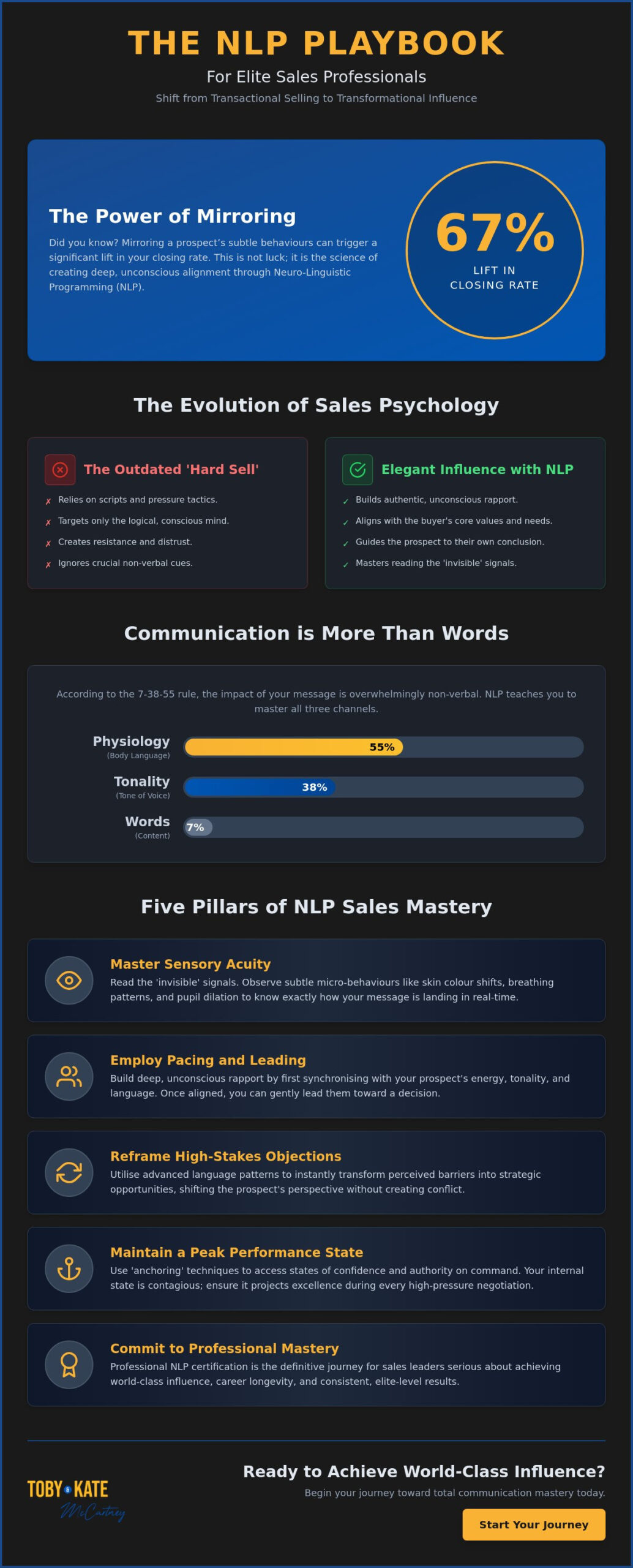
Did you know that mirroring a prospect’s subtle behaviours can trigger a 67% lift in your closing rate? This isn’t just a lucky streak; it is the result of mastering nlp techniques for sales professionals to create deep, unconscious alignment. You have likely felt that sinking sensation when a high-value deal slips through your fingers at the final hurdle, or perhaps you have experienced the anxiety of facing a resistant prospect who seems impossible to reach. It’s frustrating to know you have the perfect solution whilst failing to build the psychological bridge required to secure the win.
You are about to step into a more capable version of yourself. This guide reveals how to use elite psychological frameworks to build instant rapport and reframe objections with absolute certainty. We are moving beyond basic pitching. You will learn to align your internal state of excellence with your buyer’s unconscious needs. We will explore the master-level skill sets that ensure consistent peak performance and turn every high-stakes presentation into a showcase of your professional influence. Your journey toward total communication mastery starts now.
Key Takeaways
- Discover how to shift from transactional selling to transformational influence by using nlp techniques for sales professionals to align with your buyer’s unconscious needs.
- Master the art of sensory acuity to read subtle micro-behaviours whilst employing “pacing and leading” to build deep rapport with even the most resistant prospects.
- Learn to reframe high-stakes objections instantly using advanced language patterns that transform perceived barriers into strategic opportunities.
- Maintain a peak performance state through anchoring techniques, ensuring you project absolute confidence and authority during every high-pressure negotiation.
- Explore why professional NLP certification represents the definitive journey for sales leaders committed to achieving world-class influence and career mastery.
Beyond the Pitch: Why NLP is the Secret Weapon for Sales Professionals in 2026
The UK sales environment has shifted. Buyers in 2026 are more sophisticated than ever. They can spot a scripted “hard sell” before you’ve even finished your opening sentence. To thrive now, you must move beyond the pitch and embrace a more profound level of communication. Neuro-linguistic programming (NLP) provides the exact framework you need to bridge the gap between a standard presentation and a closed deal. It isn’t about manipulation; it’s about mastery. By using nlp techniques for sales professionals, you tap into the psychological drivers that actually govern decision-making.
Standard sales training often fails because it stays on the surface. It teaches you what to say, but it ignores how the prospect’s brain processes that information. Most buying decisions are made in the unconscious mind, driven by values, beliefs, and emotional triggers. If your approach only targets the logical, conscious mind, you’re fighting an uphill battle. Elite performers understand this. They use “Sales Modelling” to study and replicate the specific behaviours and internal states of the top 1% of earners. They don’t just copy words; they mirror the psychological blueprint of success.
The Evolution of Sales Psychology
By 2026, the traditional “hard sell” has become a liability. Prospects are resistant to pressure. They crave authenticity and psychological alignment. Modern commerce requires a high degree of emotional intelligence. You must be able to sense the subtle shifts in a client’s energy and adapt your style in real-time. This is where “Elegant Influence” comes in. It’s a framework that allows you to guide a conversation without ever making the client feel pushed. Standard training fails here because it often overlooks three critical factors:
- The Unconscious Filter: Every prospect filters your message through their own unique set of past experiences and biases.
- State Management: Your internal emotional state is contagious; if you’re anxious, your client will feel it.
- Sensory Acuity: Most salespeople miss the micro-behaviours that signal when a prospect is ready to buy or about to withdraw.
Breaking the “Hard Sell” Paradigm
Stop trying to convince people. Instead, start leading them. When you use advanced communication tools, you help the client arrive at their own conclusion that your solution is the only logical choice. This requires you to remain authentic whilst projecting absolute authority. It’s a delicate balance. You must be deeply invested in the client’s success whilst remaining detached from the immediate outcome. NLP in sales is the art of aligning your internal excellence with your client’s unconscious values. By mastering these nlp techniques for sales professionals, you transform from a vendor into a trusted advisor whose presence commands respect and results.
This shift to advisory status is essential in industries where bespoke solutions are the norm; for a perspective on how professional consultation is handled in the premium residential sector, you can check out Neil Norton Design.
Mastering the Art of Unconscious Rapport and Sensory Acuity
Most salespeople are blind to the most important data in the room. They focus entirely on their pitch whilst ignoring the subtle physiological shifts happening right in front of them. Sensory acuity is the ability to observe these micro-behaviours, such as changes in skin colour, breathing patterns, or pupil dilation. When you develop this level of awareness, you stop guessing and start knowing exactly how your message is landing. You begin to see the “invisible” signals that tell you when a prospect is withdrawing or when they are ready to commit. This heightened state of observation is one of the most transformative nlp techniques for sales professionals because it allows for real-time calibration.
Communication is rarely about the words you choose. According to the 7-38-55 rule, your words only account for 7% of the message received. The remaining 93% is split between your tonality and your physiology. If your body language is incongruent with your verbal offer, the prospect’s unconscious mind will flag you as untrustworthy. By mastering “Pacing and Leading,” you meet the client exactly where they are. You synchronise with their energy and rhythm first. Only after you have established this deep, unconscious bond can you effectively lead them toward a decision. When you apply Advanced NLP Language Patterns alongside this physical alignment, your influence becomes virtually effortless.
Calibrating to Your Client’s World
Every person processes information differently. Some need to “see” the big picture, others need to “hear” the right tone, and some need to “feel” a sense of security. These are Preferred Representational Systems. By spotting “Accessing Cues,” such as eye movements, you can identify if a client is Visual, Auditory, or Kinaesthetic. If they look up and left, they are likely visualising. Match your vocabulary to their style. Use words like “view” or “perspective” for visuals, and “resonate” or “clear” for auditories. This level of leadership training ensures you are speaking the same internal language as your prospect.
Mirroring vs. Mimicry: The Subtle Difference
Clunky mimicry is a deal-killer. If a prospect notices you copying their every move, trust evaporates instantly. Masterful mirroring is subtle and sophisticated. Use “cross-over mirroring” to build rapport without detection. If they tap their foot, you might subtly tap your pen to the same rhythm. Synchronise your breathing with theirs. Match their tempo and volume. This creates a powerful sense of familiarity at an unconscious level. You aren’t just a salesperson; you become a reflection of their own internal excellence, making it natural for them to say yes to your proposal.
Advanced NLP Language Patterns for Overcoming Objections
Objections are not stop signs. They are invitations to reframe the conversation. Most sales struggles occur because the professional meets resistance with more pressure. This creates a clash of wills that destroys rapport. By using the Agreement Frame, you acknowledge the prospect’s reality without necessarily agreeing with their conclusion. Phrases like “I appreciate that, and…” allow you to pivot smoothly without triggering their defensive mechanisms. This is a cornerstone of nlp techniques for sales professionals who want to maintain influence even when the client is hesitant.
To master these conversations, you must understand the balance between the Milton Model and the Meta Model. The Meta Model is about precision. It’s used to deconstruct vague objections like “It’s just not right for us” by asking specific questions that uncover the root cause. Conversely, the Milton Model uses artfully vague language to bypass the conscious mind’s critical filters. Using these NLP techniques to increase sales allows you to plant seeds of possibility whilst the client feels completely in control of their own decision-making process. Mastery of both models ensures you can be as specific as a surgeon or as persuasive as a visionary leader.
The Power of Sleight of Mouth
Sleight of Mouth consists of 14 distinct patterns designed to shift a client’s belief system during a negotiation. When a prospect says “It’s too expensive,” they have a fixed belief about value. You can use the “Redefine” pattern to shift the focus from cost to long-term capability. You might say, “The issue isn’t the price; it’s the level of support your team requires to hit next year’s targets.” Alternatively, the “Consequence” pattern highlights what happens if they don’t act. By reframing a price objection as a strategic investment, you move the conversation from a loss of capital to a gain in competitive advantage. You are changing the meaning they attach to the numbers.
Embedded Commands and Soft Influence
Your influence grows when you speak directly to the unconscious mind. Embedded commands are subtle directives woven into normal sentences. For instance, you might say, “As you begin to realise the benefits of this system…” This presupposes that the realisation is already happening. You aren’t asking them to think about it. You’re assuming they are already doing it. Temporal shifts take this further by helping the client imagine a future where the problem is already solved. When you ask a client to describe their business six months after implementing your solution, you bypass current resistance and anchor them to a positive outcome. These nlp techniques for sales professionals turn a hesitant “maybe” into a certain “yes” before the final pitch even begins.
The Inner Game: State Management and Anchoring for Sales Peak Performance
Your internal state is the most valuable asset you bring to a negotiation. In the high-pressure world of 2026, buyers don’t just purchase products; they buy into your certainty. If you carry anxiety or hesitation into a call, your prospect will sense it unconsciously and withdraw. Mastery of nlp techniques for sales professionals begins with managing your own psychology first. By using the “Circle of Excellence” technique, you can access a state of peak confidence in seconds. Simply imagine a circle on the floor in front of you, fill it with the colours and feelings of your most successful moments, and step into it before you dial. This mental rehearsal ensures you are operating from a place of power rather than reaction.
We often carry “sales call reluctance” from past failures. These are negative anchors that trigger a fight-or-flight response when we pick up the phone. You can neutralise these through a process called collapsing anchors. By intentionally triggering a powerful positive state whilst simultaneously acknowledging the old hesitation, you scramble the brain’s negative wiring. This allows you to maintain absolute certainty even when faced with rejection. Rejection is rarely personal. It’s simply a data point in your journey toward mastery.
Creating Your “Peak Performance” Anchor
Installing a kinesthetic anchor allows you to trigger a resourceful state on demand. Relive a moment where you felt completely unstoppable. See what you saw and hear what you heard. At the peak of that feeling, press your thumb and forefinger together firmly. Release the pressure as the feeling fades. Repeat this five times to “set” the anchor. You can now trigger this instant confidence whilst walking into a boardroom or dialling a difficult prospect.
If a call starts to go poorly, use a “State Interruption.” Change your physical posture or take a deep breath to break the negative loop. This prevents a bad moment from turning into a bad day. If you want to refine these skills further, engaging in One-to-One Coaching can accelerate your ability to stay in a peak state under pressure.
Building Resilience with the NLP Mindset
Resilience is built on the NLP pre-supposition that there is no failure, only feedback. Every “no” you receive is simply a request for more information or a signal that your current approach needs calibration. When you reframe rejection as feedback, you remove the emotional sting that causes burnout. This mindset is essential for maintaining high team morale in fast-paced sales departments. By implementing advanced communication skills training, you empower your entire team to view every interaction as an opportunity for growth. Mastering these nlp techniques for sales professionals ensures that your performance remains consistent, regardless of the external circumstances.
Elevating Your Sales Career with Professional NLP Certification
Tactical knowledge of nlp techniques for sales professionals is a powerful start, but true mastery requires a formal foundation. Obtaining an NLP practitioner certification UK is the gold standard for anyone serious about reaching the elite levels of sales leadership. It moves you beyond surface-level tips into a comprehensive understanding of human psychology. This isn’t just about closing more deals this quarter; it’s about building a sustainable career based on the science of influence. You aren’t just learning what to say. You’re learning how to think, lead, and transform every interaction into a strategic win. This level of accreditation provides a level of professional authority that generic sales workshops simply cannot match.
The ROI of professional training extends far beyond the immediate commission check. It’s an investment in your personal brand and your long-term capability. By mastering nlp techniques for sales professionals through an accredited path, you secure your position as an indispensable asset in the 2026 economy. You gain the clarity and communication skills to lead teams and dominate your sector. This is your pathway to attainable excellence. This excellence should also be reflected in your online sales platforms, where partnering with a specialist like NB eCommerce & Design can ensure your digital presence is as high-performing as your interpersonal skills.
From Practitioner to Master Practitioner
The journey toward mastery doesn’t end with the basics. An NLP master practitioner certification adds a sophisticated layer to your toolkit. This level of training focuses on “Values Elicitation,” which is critical for closing complex, multi-stakeholder corporate deals. When you understand the unconscious values driving a CEO or a board of directors, you can align your proposal with their deepest motivations. You learn to model the unconscious patterns of industry leaders, allowing you to replicate their success with precision. It’s the difference between being a high performer and being a visionary who shapes the market.
Why Leaders Choose Toby and Kate McCartney
Elite sales teams and ambitious individuals choose Toby and Kate McCartney because of our “Empowering Master” approach. We don’t just teach theory; we provide practical, high-energy strategies that drive immediate results. Our public speaking for leaders programmes complement your sales mastery by giving you the stage presence and command needed for high-stakes presentations. You’re joining a community of high-achievers who are dedicated to measurable success and personal growth. We act as the catalyst for your professional shift, helping you step into a version of yourself that commands respect and authority in any boardroom. Your journey to mastery starts here.
Step Into Your Future of Elite Influence
You now possess the blueprint to redefine your professional trajectory. By mastering nlp techniques for sales professionals, you’ve moved beyond standard pitching into the realm of psychological alignment. You understand how to calibrate your sensory acuity, deploy advanced language patterns, and maintain an unshakable internal state. These tools are your master keys to unlocking high-stakes deals and building lasting rapport. Now is the time to turn this knowledge into an unstoppable habit.
True excellence requires a dedicated journey into accredited mastery. With over 20 years of experience in transformative training, we offer elite mentorship from world-class NLP Trainers Toby and Kate McCartney. Our accredited programmes ensure your professional growth is both measurable and profound. You aren’t just gaining a skill set; you’re gaining a secret weapon for your entire career.
Ready to master the psychology of influence? Explore our NLP Practitioner Certification today. Your path to world-class sales leadership is open. Step forward and claim the authority you were meant to hold.
Frequently Asked Questions
Is NLP in sales manipulative or ethical?
NLP is fundamentally ethical when used to align your solution with a client’s genuine needs. It’s a tool for precision communication that ensures both parties achieve their desired outcomes through mutual understanding. Manipulation involves trickery; NLP involves deep psychological bridge-building to create a win-win scenario. When your intent is to provide value, these tools simply help you communicate that value more effectively.
How quickly can I see results from using NLP techniques in my sales calls?
You can experience an immediate shift in your internal state and confidence levels during your very first session. Whilst mastering advanced language patterns takes dedicated practice, basic nlp techniques for sales professionals like mirroring can yield noticeable improvements in rapport during your very next call. Consistent application typically leads to a significant increase in closing rates as your influence deepens.
What is the best NLP technique for building rapport with a cold prospect?
Mirroring is the most effective technique for building instant rapport with resistant or “cold” prospects. By subtly matching their speech tempo, tonality, and breathing patterns, you signal to their unconscious mind that you are “like them.” This bypasses their natural defensive filters and establishes a sense of familiarity and trust much faster than traditional scripted icebreakers.
Can NLP help me overcome the fear of public speaking during sales presentations?
Yes, NLP is exceptionally powerful for eliminating the anxiety associated with high-stakes presentations. By using state management and anchoring, you can replace fear with a feeling of absolute certainty and presence. Our specialised public speaking programmes help you command the room by mastering your internal psychology before you ever step onto the stage or open your first slide.
Do I need a full certification to start using NLP in my sales career?
You don’t need a full certification to begin applying basic principles, but it is essential for professional mastery and long-term career growth. A formal certification provides the structured framework and deep psychological understanding required to handle complex, multi-stakeholder deals with ease. It transforms you from someone who knows a few “tips” into a true master of human influence.
What is “anchoring” and how do I use it before a high-stakes meeting?
Anchoring is the process of associating a specific internal state, such as peak confidence, with a physical trigger. You can use it before a high-stakes meeting by recalling a moment of past success and “firing” your anchor, such as pressing your thumb and finger together. This allows you to step into the boardroom in a resourceful and authoritative state on command.
How does NLP differ from traditional sales training methods?
Traditional sales training focuses on what you say, whilst NLP focuses on how you and your prospect think. NLP addresses the unconscious drivers of behaviour, such as values and beliefs, which traditional methods often ignore. This shift from transactional pitching to transformational influence is what separates elite earners from those who merely follow a standard sales script.
Can NLP techniques be used in written sales proposals and emails?
Absolutely, you can integrate nlp techniques for sales professionals into every form of written communication. By using presuppositions and embedded commands in your emails and proposals, you guide the reader’s focus toward the inevitable benefits of your solution. This ensures your written message resonates with the client’s unconscious values just as effectively as a face-to-face negotiation.