
A certificate label alone can’t tell you whether NLP training belongs in your work with clients. If you’re searching for nlp trainer training uk as a therapist or counsellor, the key question is not which course sounds most impressive. It’s whether the learning is relevant to your goals, ethical boundaries and professional responsibilities.
It’s understandable to want clear answers. Course descriptions can be vague about practical application, while terms such as accreditation, certification and professional recognition are easy to confuse. NLP isn’t a government-regulated profession in the UK, and an NLP certificate doesn’t qualify you to practise as a therapist or counsellor.
This guide offers a practical framework for comparing providers and course structures. You’ll find questions to ask about the syllabus, practice opportunities, assessment and trainer support, as well as what certification can and can’t demonstrate. Before deciding whether NLP training complements your existing approach, check the requirements of your professional body, employer and insurer. A more informed choice starts with better questions.
Key Takeaways
- Decide what you want to develop, then compare training against that professional goal.
- Look beyond certificate labels. Check the syllabus, trainer experience, practical exercises and assessment.
- Compare online, in-person and blended options by the interaction, practice and feedback they provide.
- Before enrolling in nlp trainer training uk, verify recognition claims and check relevant professional, employer and insurer requirements directly.
- Use a consistent set of questions to identify what you still need to know about course content and support.
NLP Training for Therapists and Counsellors: What Are You Looking to Develop?
Before comparing courses, decide what you want to develop. Are you looking to refine communication skills, explore NLP ideas or follow a formal certification pathway, perhaps towards nlp trainer training uk? These are different aims. The right option depends on your existing training, role and professional context.
NLP training focuses on concepts and communication approaches associated with neuro-linguistic programming. If you’re new to the subject, this overview of neuro-linguistic programming introduces its history, core concepts and critical reception. Read about the subject with a questioning mindset, then compare a course’s actual syllabus with your learning goals.
Which professional development goals might NLP training support?
Start with a specific goal rather than a promise of transformation. You might want to explore rapport-building, language choices, goal-setting conversations or reflective communication. Write down what you hope to learn and where, if appropriate, it might fit alongside your current approach. Then ask providers how the course teaches and practises those skills.
Relevance depends on more than the topic. Consider your existing training, the needs of the people you work with and the boundaries of your role. A course covering a technique doesn’t establish that it’s clinically effective or suitable for every client. Look for clear learning outcomes and ask how the provider distinguishes skills practice from claims about client outcomes.
Is NLP training a therapy qualification?
An NLP course certificate records course completion or assessment. By itself, it doesn’t establish therapist status or confer a clinical, counselling or university qualification. Keep that distinction clear when reviewing course descriptions and deciding how to describe your training to clients, colleagues or employers.
Completing a course doesn’t automatically expand your scope of practice. Your responsibilities remain connected to your existing qualifications, professional standards and working context. Before applying any learning with clients, check your relevant professional code, workplace policies and applicable insurer terms. Contact those organisations directly if you’re unsure, as expectations can differ by membership and role.
If you’re considering a certification pathway, including practitioner, master practitioner or trainer-level study, ask what each certificate represents and what it doesn’t. For nlp trainer training uk, clarify whether the course prepares you to train others in NLP. Don’t assume that a trainer certificate changes your professional standing as a therapist or counsellor. That distinction gives you a clearer basis for comparing providers.
How to Assess NLP Training for Therapists: Syllabus, Practice and Recognition
A certificate title won’t show you how well a course prepares you to use or teach what it covers. Assess the learning itself: what’s taught, how skills are practised, what feedback is available and what successful completion confirms. This matters whether you’re considering practitioner study or nlp trainer training uk.
What should an NLP course syllabus show?
Look for specific learning outcomes and a syllabus that explains the material, rather than broad promises about influence or change. Check whether learners practise skills, observe demonstrations, reflect on their learning and receive constructive feedback. If a provider presents the course as relevant to counselling work, ask them to explain the connection without assuming the techniques have clinical application.
Use this checklist to compare evidence providers can show, rather than relying on how confidently they describe their courses.
| Evidence to request | Why it matters | Questions to ask |
|---|---|---|
| Learning outcomes and detailed syllabus | Shows what the course covers and whether it matches your development goals. | What will I be expected to know or demonstrate by the end? |
| Practice activities, observation and feedback | Clarifies how you’ll move beyond listening or reading and receive guidance on your skills. | How are practice and feedback built into the training? |
| Assessment requirements | Helps you understand what completion involves and what the certificate confirms. | Is assessment required, and what does successful completion demonstrate? |
| Trainer experience and support | Gives you information to check about who teaches and how learners can seek guidance. | What relevant experience can you share, and what support is available during the course? |
| Named awarding or accrediting organisation | Lets you check recognition claims and distinguish them from professional approval. | Which organisation recognises or awards this course, and what does that recognition mean? |
How can you verify certification and trainer credentials?
Marketing language and testimonials may describe learner experiences, but they don’t establish syllabus detail, assessment standards or external recognition. Check the exact organisation named by the provider, then confirm the course’s current status directly with that organisation. Ask what assessment is required and whether the certificate records attendance, assessed competence or another achievement. These terms don’t all mean the same thing.
Also request specific information about the trainer’s relevant experience and the support available to learners. A claim such as “leading expert” is less useful than a clear account of experience and teaching responsibilities. The British Journal of General Practice’s systematic review of NLP’s effects found little evidence that NLP interventions improve health-related outcomes. Keep evidence claims separate from course credentials when considering relevance to client work.
If you’re weighing up a certification pathway, you can explore NLP certification options and ask the provider directly about the syllabus, practice, assessment, trainer support and any current recognition claims.
Online, In-Person or Blended NLP Training: Compare the Learning Experience
A course’s format affects how you take part, practise and get support, but it doesn’t prove the training is high quality. For nlp trainer training uk, compare the teaching and assessment as carefully as the timetable. If you’re preparing to train others, ask whether you’ll have opportunities to rehearse explaining material and receive feedback on your delivery.
Providers don’t all offer the same formats. Confirm what’s available for the specific course, rather than assuming that online, classroom, blended or self-paced options are included. Use the table to focus your questions.
| Format, if offered | What to assess | Questions to ask |
|---|---|---|
| Live online | Real-time interaction, exercise observation and access to trainer feedback. | How do learners practise together, and how can the trainer observe and respond? |
| In-person | Whether teaching sessions make room for participation, practice and individual guidance. | What activities are included, and how is feedback provided? |
| Blended | How live and independent elements connect, including where practice and assessment take place. | Which parts require attendance, and how are the different elements coordinated? |
| Self-study | How learners can ask questions, receive guidance and demonstrate practical learning. | Is tutor support available, and how are progress and assessment handled? |
When might live or blended learning suit your goals?
If your learning outcomes involve discussion, demonstration or teaching practice, consider how a live element could support those activities. Ask how exercises are observed and whether feedback is individual or shared. For blended courses, clarify which skills you practise with a trainer or other learners and which you study independently. Check attendance expectations, session dates and access arrangements directly with the provider.
What should you check before choosing self-paced study?
Flexible study may help you organise learning around other commitments, but check what support and practical skill development the course includes. Can you ask questions? Is tutor guidance available? How is progress assessed, and can you practise and receive feedback? Choose a format based on the interaction you need, not just the schedule you prefer.
Assess the evidence behind course claims as well as the delivery method. BBC Science Focus discusses the scientific evidence for NLP, offering context as you consider what a course can responsibly claim. Choose a format that supports your learning goals, while assessing the syllabus, teaching approach and assessment separately.
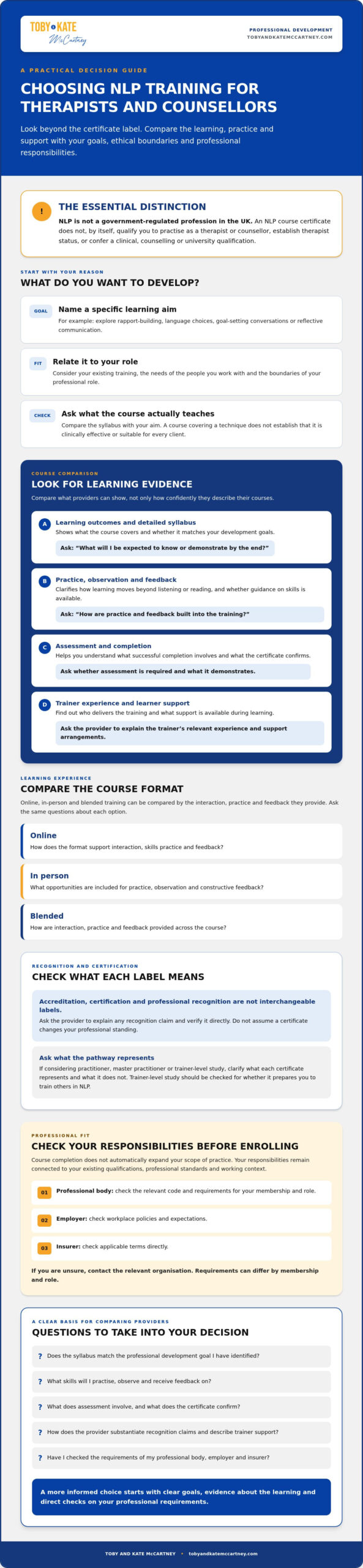
Professional Fit: Check Scope, Ethics and Workplace Requirements Before Enrolling
Before committing to nlp trainer training uk, check how the course fits your professional responsibilities, not just your development ambitions. Training may broaden your knowledge, but completing it doesn’t automatically authorise new interventions or expand your scope of practice. Your professional standards, workplace policies and insurance arrangements still matter.
What should therapists check with their professional body or employer?
Start with the organisations that shape your current role. Read the latest professional code and continuing-development guidance, then check whether your employer requires approval for external learning or sets limits on how new approaches are used. Be specific about your intended application and the client group you work with. Don’t infer endorsement from a provider’s logo or general accreditation statement. Verify any claimed recognition directly.
How should you assess insurance and scope-of-practice questions?
Ask your insurer how the training and any intended use of what you learn relate to your own cover. Describe the course accurately and explain how you’re considering applying it. Contact relevant professional or workplace representatives too, as requirements can differ by membership, role and setting. Keep a written record of who you contacted, what you asked and the response. This gives you something to refer back to, without treating general guidance as a definitive legal, clinical or insurance ruling.
Use this pre-enrolment check:
- 1. Professional code: Review current ethical standards and continuing-development expectations. Ask whether the learning and any planned application align with them.
- 2. Employer policy: Check approval processes and workplace guidance. Confirm whether your role and client population affect how you may apply new learning.
- 3. Insurer terms: Contact your insurer directly. Ask how the course and any intended use of its content relate to your individual policy.
- 4. Course claims: Ask the provider to clarify the syllabus, assessment, certificate and any claimed recognition. Check external recognition with the named organisation rather than relying on marketing language.
Keep the distinction clear: a course can provide professional development, but it doesn’t replace your existing qualification or grant permission to work beyond your competence. If you’re comparing levels and what a certification pathway represents, read the NLP Practitioner Certification UK guide for broader context.
Once you’ve checked your professional fit, take the next step by asking about NLP Trainer Training, including its content, assessment and learner support, before deciding whether it meets your goals.
Choose Your NLP Training Next Step: Compare Providers and Ask Better Questions
You’ve considered your goals, course structure and professional responsibilities. Now compare providers against the same decision framework, rather than letting a persuasive course title make the choice for you. For nlp trainer training uk, look for evidence that the programme fits your aims and explains what its certificate represents.
Use this checklist to identify what you can verify and where you need more information:
- Professional fit: Does the course make sense alongside your existing training, role and professional requirements?
- Transparent syllabus: Are learning outcomes and course content clearly described?
- Practice: Can the provider explain what practical activities learners complete?
- Feedback: Is it clear who gives feedback, how it is given and what it covers?
- Verified recognition: Is any awarding or accrediting organisation named, and have you checked the claim directly?
Questions to ask an NLP training provider before enrolling
Ask for specific answers you can compare across providers. For example:
- Can I review the current syllabus, learning outcomes and assessment requirements?
- What practical activities are included, and how are learners observed or given feedback?
- What trainer support is available during the course?
- What does successful completion confirm, and which organisation, if any, awards or recognises the certificate?
- Who is the intended learner, and what outcomes is the training designed to support?
Clear answers help you distinguish course structure from testimonials and broad promotional claims. If a detail affects your decision, ask for it in writing.
How can you decide whether Toby and Kate McCartney’s pathway fits?
Toby and Kate McCartney offer NLP Practitioner, NLP Master Practitioner and NLP Trainer Training certifications. These are options to investigate, not an automatic fit for therapists or counsellors. The available information doesn’t specify a therapist-specific syllabus, course format or professional-body recognition. Ask directly whether the content relates to your learning goals and what practice, assessment and support are currently included.
Compare each level with what you want to develop. Practitioner or Master Practitioner study may be relevant to your professional-development interests. Trainer Training is a pathway to investigate if your goal is to train others. None of these certificates, by itself, establishes therapist status or expands your scope of practice.
If your review points towards advanced study, explore the NLP Master Practitioner certification after checking your needs and professional requirements. Take your questions with you so you can make a considered decision.
Choose Your Next Step with Clarity
The strongest choice isn’t necessarily the course with the boldest claims or most impressive certificate title. Start with the learning you want, then compare each provider’s syllabus, practical learning, feedback and assessment. Verify what any accreditation or recognition means, and check professional, workplace and insurer requirements before applying new learning in practice.
Keep professional fit at the centre of your decision. nlp trainer training uk may be worth exploring if your goal is to develop as an NLP trainer, but course completion alone doesn’t establish therapist status or extend your scope of practice. Ask providers direct questions and weigh their answers against your responsibilities.
Toby and Kate McCartney offer NLP Practitioner, Master Practitioner and Trainer Training certifications, as well as professional coaching and mentoring. Consider these as possible development pathways, and clarify the syllabus, practice opportunities, assessment and support before deciding which, if any, suits your goals.
Explore Toby and Kate McCartney’s NLP training and ask which pathway fits your goals.
Frequently Asked Questions
Is NLP training suitable for therapists and counsellors?
NLP training may be suitable for professional development if its content aligns with your goals and professional context. Decide what you want to learn, then examine the syllabus and practical activities rather than relying on broad promises. Check your professional standards, employer expectations and insurer terms before applying what you learn in your work. NLP training shouldn’t be presented as a clinical qualification or a guarantee of therapeutic outcomes.
Does NLP certification qualify you to practise as a therapist or counsellor?
No. An NLP certificate alone shouldn’t be assumed to qualify you as a therapist or counsellor. NLP training is distinct from formal education, qualifications or other requirements that may apply to entry into a professional role. If you’re considering a career pathway or adding learning to your current practice, confirm the relevant requirements with professional bodies, employers and training organisations. Course completion doesn’t automatically establish therapist status or extend your scope of practice.
How do I choose an NLP course as a counsellor?
Start by defining what you want to develop, then compare each course’s syllabus, learning outcomes, practical exercises, feedback, trainer support and assessment. Check any claimed recognition directly with the named organisation, and consider whether the course fits your professional responsibilities. If you’re comparing nlp trainer training uk options, ask what the training prepares learners to do and what the certificate confirms. Don’t assume a course is clinically effective or suitable for every client.
Can I study NLP online whilst working as a therapist?
Online study may offer scheduling flexibility if the provider confirms that format for the course you’re considering. Before enrolling, check whether sessions are live or self-paced, how learners practise skills, what feedback is available, how assessment works and whether tutor support is available. Course availability and delivery arrangements can change, so confirm current details directly with the provider. Also check that the study pattern works alongside your existing professional commitments.
What accreditation should I look for in NLP training in the UK?
Identify the exact organisation named, the status the provider claims and what that recognition applies to. Ask whether it relates to the course, the trainer or another aspect of the programme, then verify the claim directly with the organisation. Recognition isn’t universal, and accreditation alone doesn’t establish clinical competence or professional-body approval. Check with your own professional body whether the course is relevant to your role and any requirements that apply to you.
What questions should I ask before enrolling on NLP training?
Ask for the current syllabus, learning outcomes, assessment method and precise details of the certificate. Find out what practical learning is included, how feedback is provided, what trainer support is available and which formats are currently offered. Request clarification of any external recognition claims. If you’re a therapist or counsellor, check relevance with your employer, professional body or insurer where appropriate. Written answers make it easier to compare providers than promotional claims alone.
Can NLP training replace counselling or psychotherapy training?
No. NLP training shouldn’t be treated as a replacement for counselling or psychotherapy education, qualifications or professional standards. It may be considered as additional learning, but whether it’s appropriate depends on your role, existing training and scope of practice. Before applying any learning with clients, seek guidance from the professional organisations relevant to you and check workplace expectations. A course certificate by itself doesn’t authorise you to practise as a counsellor or psychotherapist.