
What if the biggest obstacle standing between you and truly exceptional leadership isn’t your team, your organisation, or even your industry – it’s simply the absence of someone in your corner who genuinely understands your journey? One to one leadership mentoring exists precisely to close that gap, giving you the focused, personalised support that generic training programmes simply can’t deliver.
If you’ve ever felt isolated at the top, uncertain about your next move, or quietly frustrated that your leadership skills aren’t growing as fast as your responsibilities, you’re far from alone. That tension is real, and it’s one of the most common experiences amongst leaders at every level.
This article is your guide to understanding how personalised mentoring can transform the way you lead. You’ll discover the core benefits of working one-to-one with an experienced mentor, how combining NLP techniques with tailored coaching creates a powerful pathway to professional excellence, and what to look for when choosing the right mentoring approach for your unique goals. By the end, you’ll have the clarity and confidence to take your next step forward.
Key Takeaways
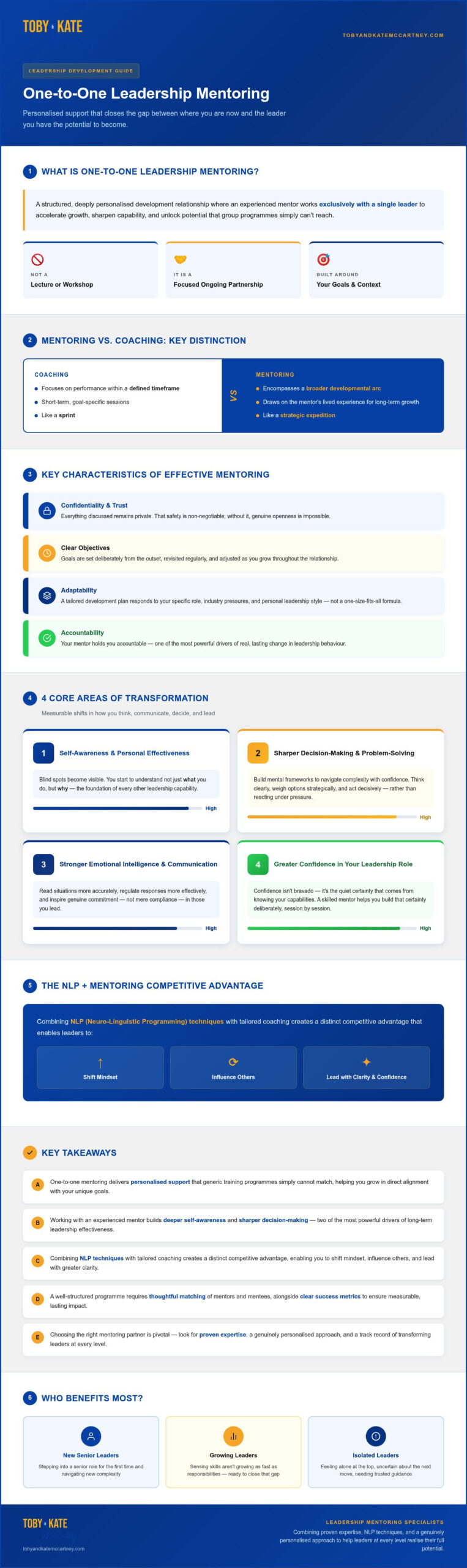
- One to one leadership mentoring delivers personalised support that generic training programmes simply cannot match, helping you grow your skills in direct alignment with your unique goals and challenges.
- Working with an experienced mentor builds deeper self-awareness and sharper decision-making – two of the most powerful drivers of long-term leadership effectiveness.
- Combining NLP techniques with tailored coaching creates a distinct competitive advantage, enabling you to shift mindset, influence others, and lead with greater clarity and confidence.
- A well-structured mentoring programme within your organisation requires thoughtful matching of mentors and mentees, alongside clear success metrics to ensure measurable, lasting impact.
- Choosing the right mentoring partner is pivotal – look for proven expertise, a genuinely personalised approach, and a track record of transforming leaders at every level.
Understanding One-to-One Leadership Mentoring
At its core, one to one leadership mentoring is a structured, deeply personalised development relationship in which an experienced mentor works exclusively with a single leader to accelerate growth, sharpen capability, and unlock potential that group programmes simply can’t reach. It’s not a lecture. It’s not a workshop. It’s a focused, ongoing partnership built entirely around you – your goals, your challenges, your context.
The purpose is straightforward but profound: to give leaders the dedicated space and expert guidance they need to evolve. Whether you’re stepping into a senior role for the first time, managing increasing complexity, or simply sensing that there’s a more effective version of yourself waiting to emerge, personalised mentoring creates the conditions for that transformation to happen.
The Role of Mentoring in Leadership Development
Mentoring fosters growth through a combination of honest challenge and genuine support. A skilled mentor doesn’t hand you answers; they help you develop the thinking, self-awareness, and decision-making capacity to find better answers yourself. Crucially, they hold you accountable. That accountability is one of the most powerful drivers of real, lasting change.
When you face a difficult situation – a team conflict, a strategic crossroads, a confidence dip – your mentor acts as a trusted facilitator. They bring perspective, ask the right questions, and help you navigate complexity without the noise of organisational politics clouding your judgement. The result is a supportive environment where honest reflection becomes possible and growth becomes inevitable.
Key Characteristics of Effective Leadership Mentoring
Not all mentoring relationships deliver equal results. The most effective ones share several defining characteristics:
- Confidentiality and trust: Everything discussed remains private. That safety is non-negotiable; without it, genuine openness is impossible.
- Clear objectives: Effective mentoring begins with a clear picture of where you are now and where you want to be. Goals are set deliberately, revisited regularly, and adjusted as you grow.
- Adaptability: Your context is unique. A tailored development plan responds to your specific role, industry pressures, and personal leadership style rather than applying a one-size-fits-all formula.
This is also where mentoring diverges meaningfully from traditional coaching. Coaching tends to focus on performance within a defined timeframe; mentoring encompasses a broader developmental arc, drawing on the mentor’s lived experience to guide your longer-term leadership journey. It’s the difference between a sprint and a strategic expedition.
This strategic expedition often requires a focus on what Arthur Barnes calls ‘Invisible Architecture’, which involves refining the internal mindset and leadership structures that allow entrepreneurs and executives to sustain high-level performance.
Benefits of One-to-One Leadership Mentoring
The difference between a good leader and a truly exceptional one often comes down to something surprisingly simple: the quality of support they receive. One to one leadership mentoring delivers benefits that ripple outward from the individual into their team, their organisation, and ultimately their entire career trajectory. These aren’t abstract gains. They’re measurable shifts in how you think, communicate, decide, and lead.
Four core areas of transformation stand out consistently:
- Increased self-awareness and personal effectiveness: When you work exclusively with a mentor who knows your context intimately, blind spots become visible. You start to understand not just what you do, but why you do it, and that self-knowledge is the foundation of every other leadership capability.
- Sharper decision-making and problem-solving: Personalised mentoring builds the mental frameworks you need to navigate complexity with confidence. Rather than reacting under pressure, you develop the capacity to think clearly, weigh options strategically, and act decisively.
- Stronger emotional intelligence and communication: Leadership is fundamentally relational. Mentoring helps you read situations more accurately, regulate your responses more effectively, and connect with others in ways that inspire genuine commitment rather than mere compliance.
- Greater confidence in your leadership role: Confidence isn’t bravado. It’s the quiet certainty that comes from knowing your capabilities and trusting your judgement. A skilled mentor helps you build that certainty deliberately, session by session.
Real-Life Examples of Successful Mentoring
The most compelling evidence for mentoring’s impact isn’t theoretical; it’s the stories of leaders who arrived uncertain and left transformed. Consider a mid-level manager stepping into their first director role, overwhelmed by the shift in scope and visibility. Through structured one-to-one sessions, they developed the executive presence and strategic clarity to lead a team of forty with confidence within six months. Or the senior leader who, despite years of experience, struggled with conflict avoidance. Targeted mentoring helped them reframe difficult conversations as opportunities rather than threats, fundamentally changing their team’s culture. These aren’t outliers. They represent what becomes possible when development is truly personalised.
Aligning Mentoring with Personal Goals
Effective mentoring starts with honest goal-setting. Not the goals you think you should have, but the ones that genuinely matter to you. What does leadership excellence look like in your specific role? Where do you feel most stretched? What feedback have you received repeatedly but not yet acted on?
Embracing a growth mindset is central to this process. Challenges stop being threats and start becoming data. Feedback, even when uncomfortable, becomes one of your most valuable tools. Your mentor holds the mirror; you decide what to do with what you see.
If you’re ready to start that process with experienced guidance, explore personalised leadership mentoring designed around your unique goals and ambitions.
Implementing One-to-One Leadership Mentoring in Your Organisation
Building a mentoring culture doesn’t happen by accident. It requires deliberate design, organisational commitment, and a willingness to treat leadership development as a strategic priority rather than an afterthought. When you get this right, the impact compounds: individual leaders grow, teams strengthen, and the organisation as a whole becomes more resilient and capable.
Matching mentors and mentees is one of the most consequential decisions in any programme. Compatibility matters enormously, but it’s rarely about personality alone. The most productive pairings share aligned goals, complementary experience levels, and a mutual commitment to honest dialogue. A mentor who has navigated the specific challenges a mentee is facing will always deliver more targeted, credible guidance than one who hasn’t.
Common implementation challenges are worth addressing directly:
- Time constraints: Leaders at every level cite time as their biggest barrier. Structure sessions in advance, protect them in diaries, and treat them as non-negotiable commitments.
- Unclear expectations: Both mentors and mentees need to understand what the relationship is designed to achieve. Ambiguity breeds disengagement.
- Inconsistent engagement: Momentum stalls when sessions become irregular. Build in accountability checkpoints from the outset.
Creating a Mentoring Framework
A robust framework anchors one to one leadership mentoring to your broader business objectives rather than leaving it as a standalone initiative. Design clear mentoring pathways that map to specific leadership levels and development stages. Incorporate regular feedback mechanisms so that both participants can flag what’s working and what needs adjusting. Technology can also play a useful supporting role, whether that’s scheduling tools, shared goal-tracking platforms, or secure communication channels that keep the relationship active between formal sessions.
Measuring the Impact of Mentoring
Without measurement, even the most well-intentioned programme risks losing its momentum and organisational support. Define your key performance indicators before the programme launches. These might include progression rates into senior roles, improvements in 360-degree feedback scores, or self-reported confidence levels gathered through structured participant surveys. Gather qualitative data alongside the numbers; the stories leaders tell about their growth often reveal insights that metrics alone can’t capture. Review outcomes at regular intervals and use what you learn to refine the programme continuously. A mentoring initiative that evolves based on real evidence is one that earns lasting credibility.
Measuring Success in One-to-One Leadership Mentoring
Growth without measurement is just hope. The most transformative one to one leadership mentoring relationships are built on a foundation of clear, honest assessment – not as a bureaucratic exercise, but as a genuine commitment to making every session count. Knowing where you started, tracking where you are, and seeing exactly how far you’ve come is what separates meaningful development from well-intentioned conversations that fade without lasting impact.
Start by establishing your success metrics before the mentoring relationship begins. These should be specific to your leadership context, not borrowed from a generic framework. Consider a combination of:
- Behavioural indicators: Changes in how you handle difficult conversations, delegate responsibility, or show up under pressure.
- Stakeholder feedback: Shifts in how your team, peers, and senior leaders perceive and respond to your leadership.
- Personal confidence benchmarks: Your own honest assessment of capability in areas you identified as development priorities at the outset.
- Role-specific outcomes: Tangible results tied to your current responsibilities, such as improved team performance, successful project delivery, or progression into greater scope.
Structured surveys at regular intervals, whether quarterly or at key programme milestones, give you comparable data across the arc of your development. Pair these with brief written reflections after each session to capture insights whilst they’re still fresh. That habit alone accelerates growth considerably.
Follow-up sessions are where measurement becomes meaningful. Revisiting previous goals, reviewing what’s shifted, and honestly confronting what hasn’t yet changed transforms assessment from a passive record into an active driver of progress. Don’t skip this step. It’s where the real accountability lives.
Celebrating milestones matters too. Not in a superficial way, but as a deliberate acknowledgement that growth has occurred. Recognising progress reinforces the behaviours and mindsets that produced it.
Feedback and Reflection
Effective feedback sessions create space for both challenge and recognition. Your mentor should invite you to assess your own progress before offering their perspective, building the habit of honest self-evaluation. Open dialogue, where you can surface what isn’t working without fear of judgement, is what makes reflection genuinely useful rather than performative. Structured reflection questions, revisited consistently, reveal patterns in your thinking and behaviour that single sessions rarely surface.
Identifying Long-Term Benefits of Mentoring
The ripple effect of sustained mentoring extends well beyond the individual. Leaders who have developed through structured mentoring consistently report stronger team cultures, higher trust levels within their teams, and greater confidence in navigating strategic complexity. Career advancement tends to follow naturally, not because mentoring is a shortcut, but because it builds the genuine capability that earns it. The changes in leadership style that emerge through this process tend to be durable precisely because they’re rooted in self-awareness rather than surface-level technique.
Ready to build a measurable development journey with experienced guidance? Discover personalised leadership mentoring with Toby and Kate McCartney and start tracking the progress that matters most to you.
Why Choose Toby and Kate McCartney for Your Leadership Mentoring?
Some mentoring relationships are transactional. You turn up, you talk, you leave. What Toby and Kate McCartney offer is something categorically different: a genuinely transformative partnership built on deep expertise, proven methodology, and an unwavering commitment to your individual growth. If you’re serious about becoming the leader you’re capable of being, the calibre of your mentor matters enormously.
What sets Toby and Kate apart is their integration of NLP techniques within a personalised leadership mentoring framework. NLP isn’t a buzzword here; it’s a practical toolkit for shifting the mental patterns that hold leaders back. Whether it’s self-limiting beliefs, communication habits that undermine authority, or emotional responses that cloud judgement under pressure, NLP-informed mentoring addresses the root causes rather than the symptoms. That’s a competitive advantage most leadership development programmes simply don’t offer.
Their approach is built on four pillars that consistently deliver results:
- Deep personalisation: Every mentoring journey is designed around your specific role, challenges, and ambitions. There’s no generic template applied to every client.
- NLP-enhanced insight: Techniques drawn from neurolinguistic programming accelerate self-awareness and enable lasting behavioural change at a level that traditional coaching rarely reaches.
- Proven leadership expertise: Toby and Kate bring a track record of developing leaders across sectors, giving their guidance the credibility that only real-world experience provides.
- Ongoing community and resources: The support doesn’t end when a session does. Mentees benefit from continued access to resources and a community of like-minded leaders committed to excellence.
Testimonials and Success Stories
The most honest measure of any mentoring programme is what happens to the people who go through it. Leaders who have worked with Toby and Kate consistently describe a shift that goes beyond skill acquisition; they report a fundamental change in how they see themselves and how they show up. The integration of NLP within one to one leadership mentoring creates breakthroughs that feel both profound and practical, the kind that stick long after the formal relationship ends. Trust is built not through promises, but through the shared experiences of leaders who arrived uncertain and left genuinely transformed.
Getting Started with Mentoring
Beginning your journey is straightforward. An initial conversation establishes where you are now, what you want to achieve, and how Toby and Kate’s approach aligns with your goals. From there, a tailored programme is designed specifically for you, with clear milestones, regular sessions, and built-in accountability from day one.
You don’t need to have everything figured out before you reach out. You just need to be ready to grow. Discover how our mentoring can transform your leadership journey!
Your Next Chapter in Leadership Starts Now
One to one leadership mentoring isn’t a luxury reserved for a select few. It’s a deliberate investment in the leader you’re becoming. Throughout this article, you’ve seen how personalised mentoring builds genuine self-awareness, sharpens the decisions that matter most, and creates measurable, lasting change that generic training simply can’t replicate.
The difference Toby and Kate McCartney bring is real and distinct. Their integration of NLP techniques with tailored coaching addresses the root of what holds leaders back, not just the surface symptoms. Across industries and leadership levels, their proven approach has helped individuals step into their full capability with clarity and confidence.
You don’t need to have everything figured out before taking the next step. You just need to be ready to grow. The right mentor won’t hand you a formula; they’ll help you build something far more valuable: a leadership identity that’s authentically and powerfully yours.
Start your journey to effective leadership with Toby and Kate McCartney today! Your most effective chapter is still ahead of you.
Frequently Asked Questions About One-to-One Leadership Mentoring
What is one-to-one leadership mentoring?
One to one leadership mentoring is a structured development relationship in which an experienced mentor works exclusively with a single leader to accelerate growth and unlock capability. Unlike group training, it’s built entirely around your specific context, goals, and challenges. Sessions are confidential, personalised, and focused on creating meaningful, lasting change rather than delivering generic content that may or may not apply to your situation.
How does mentoring differ from coaching?
Coaching typically focuses on performance within a defined, short-term timeframe, often around a specific skill or goal. Mentoring operates across a broader developmental arc, drawing on the mentor’s lived experience to guide your longer-term leadership journey. A coach helps you perform better now; a mentor helps you become a more capable, self-aware leader over time. The two can complement each other powerfully, but they serve distinct purposes.
What can I expect from a mentoring relationship?
Expect honest challenge, genuine support, and a safe space to explore the questions you can’t easily raise elsewhere. Your mentor will help you identify blind spots, sharpen your thinking, and hold you accountable to the goals you set together. Sessions are focused and purposeful, not open-ended conversations. You’ll leave each one with clarity, practical insights, and a clear sense of what to act on before you meet again.
How long does a mentoring programme typically last?
Programme length varies depending on your goals and development stage. Some leaders benefit from a focused six-month engagement targeting a specific transition or challenge; others work with a mentor over a year or longer to support sustained leadership growth. The most important factor isn’t the duration itself but the consistency of engagement. Regular sessions, protected in your diary and treated as non-negotiable, are what drive real progress.
Is there a cost associated with one-to-one mentoring?
Yes, professional one-to-one leadership mentoring is a paid service, and the investment varies depending on the mentor’s expertise, programme structure, and the depth of support included. We’d encourage you to contact Toby and Kate McCartney directly to discuss your specific needs and find out what’s included in their tailored programmes. Treat it as a strategic investment in your development rather than a discretionary expense.
Can mentoring help with specific leadership challenges?
Absolutely. One to one leadership mentoring is particularly effective precisely because it addresses your specific challenges rather than applying a generic framework. Whether you’re navigating a difficult team dynamic, stepping into a more senior role, struggling with confidence under pressure, or working to shift deeply ingrained communication habits, a skilled mentor can target the root cause. Toby and Kate’s integration of NLP techniques makes this even more effective by addressing the mindset patterns driving the behaviour.
How do I find a suitable mentor?
Start by identifying what you most need: relevant experience, a particular methodology, or expertise in your sector. Look for a mentor with a proven track record, a genuinely personalised approach, and the ability to challenge you as well as support you. Compatibility matters, but so does credibility. An initial conversation is usually the best way to assess fit. If you’re ready to explore what’s possible, reaching out to Toby and Kate McCartney is a straightforward place to start.