
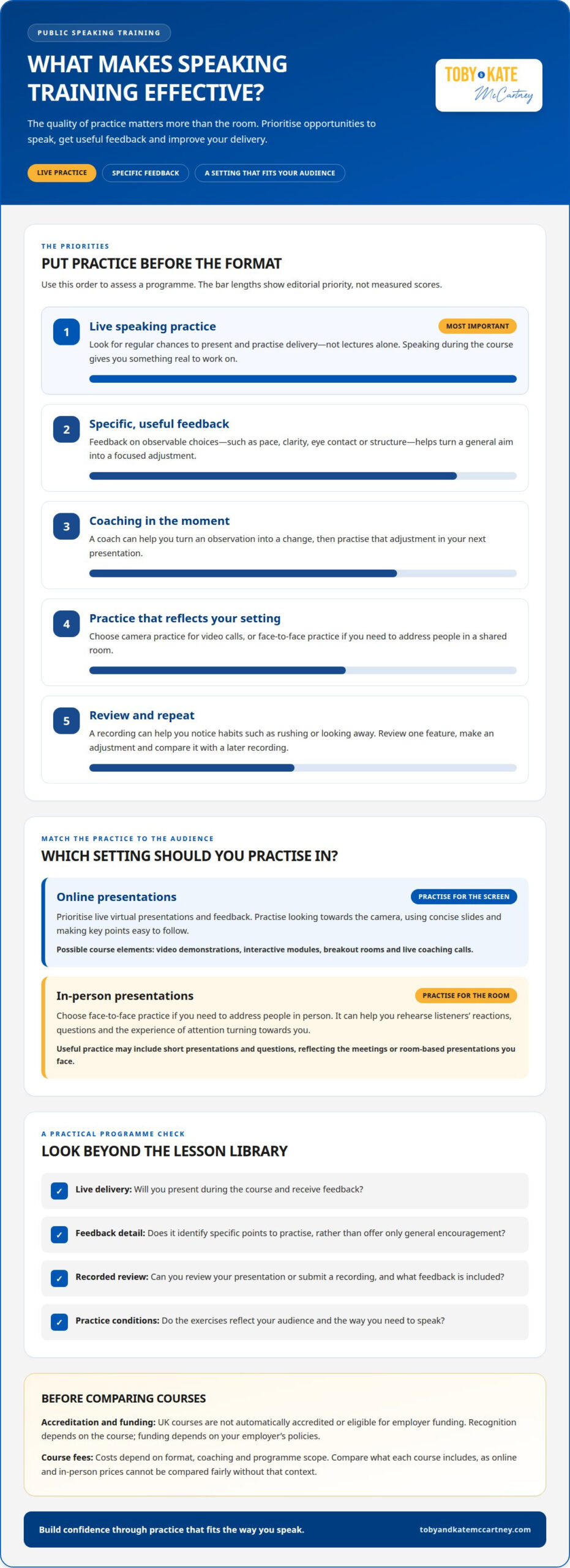
The quality of practice matters more than the room. Online vs in-person public speaking training can be equally effective when it includes live speaking, specific feedback and coaching in the moment. In-person training is useful when you need to practise addressing people in the same room; online practice may be a closer fit if you mainly present on video calls.
It’s natural to wonder whether a screen can help you build confidence or whether you need to speak in front of a group to make progress. The most useful training gives you regular opportunities to speak, receive honest feedback and strengthen your delivery, rather than relying on lectures alone.
This guide compares both formats for confidence, feedback and realistic practice. You’ll learn what each can prepare you for, what to look for in a programme and how to choose a learning environment that suits the way you need to speak.
Key Takeaways
- Choose training that reflects where you speak most, whether on video calls or in front of a room.
- Prioritise live practice and specific feedback to build confidence and improve your delivery.
- Use recorded feedback to notice patterns in your speaking and identify what to develop next.
- Look for a programme that gives you realistic practice conditions and support to keep progressing.
Is Online Public Speaking as Effective as Face-to-Face?
Online training can work well when it includes live presentations and feedback. Face-to-face practice more closely reflects speaking to people in the same room.
Adapting Delivery for Virtual Audiences
Speaking to a virtual audience calls for a delivery style designed for screens, not simply a room-based approach transferred to video. A trainer might coach you to look towards the camera, use concise slides and make key points easy to follow. Look for courses with live virtual presentations and feedback, so you can practise engaging an online audience rather than only study remote speaking techniques.
Online Course Delivery
Online courses may combine video demonstrations, interactive modules, breakout rooms and live coaching calls. The key question is whether you present and receive feedback during the course. Recording a presentation can also help you review eye contact, pace and structure. Find out what practice and feedback the course includes: a library of lessons alone prepares you differently from coached, live delivery.
Presentation structure matters in either format. A clear opening, connected main points and purposeful close help audiences follow your message. Video review makes your delivery easier to assess: notice whether you rush a key point or look away from the camera. A coach’s specific feedback can turn that observation into a focused adjustment for your next presentation.
To choose between online and in-person training, match the practice to your speaking setting. If you present on video calls, prioritise live camera practice; if you speak in conference rooms, practise addressing people face-to-face.
UK courses aren’t automatically accredited or eligible for employer funding. Recognition depends on the course, while funding depends on your employer’s policies. Check both before committing.
Training costs depend on format, coaching and programme scope; the fee is provided after a quote request. Online and in-person course prices can’t be compared fairly without considering what each includes.
There’s no single best online course for every speaker. Compare live practice, feedback and virtual-audience coaching. In-person courses are available through UK training providers; choose one whose practice reflects your audience and presentation setting.
Building confidence and managing nerves
The learning environment can affect how relaxed you feel during practice. Some introverts find it easier to contribute online, where speaking from a familiar space can feel less exposing. For example, a camera-on exercise lets you practise introducing an idea before sharing it with a larger group. Comfort can help you participate, but confidence still develops through speaking and receiving useful feedback.
In-person sessions bring a different challenge: people are physically present as you speak. This can make practice more relevant if you face colleagues in meetings or present to clients in a room. You can experience the pause after a question, notice listeners’ reactions and practise continuing when attention turns towards you. Choose this setting if those real-world conditions are what make you nervous.
Look for active practice, not a course built around lectures alone. A useful exercise might involve presenting a short update, then receiving feedback on pace, clarity and eye contact. Peer review can also help you notice how your message lands. Specific observations give you a clear skill to work on next, rather than a general instruction to “be more confident”.
Stage presence comes from observable behaviours, not volume or performance tricks. A coach might help you pause before answering, finish a sentence clearly or listen fully to a question before responding. Repeating that behaviour in live practice gives you a chance to apply feedback immediately. Online sessions offer camera-on speaking; in-person sessions add the experience of addressing a shared room.
Choose the format that makes you willing to practise whilst preparing you for your actual audience. If speaking in meetings is your priority, sessions that include short presentations and questions can help you rehearse that situation. For a structured route to practice and feedback, explore guided public speaking practice.
Self-paced courses and recorded feedback
Self-paced courses let you revisit presentation techniques when you need them. For example, replay a lesson on speech structure before drafting an opening. Some programmes also let you submit a recording for feedback. This adds an expert perspective to independent study, but differs from coaching while you speak. Check how the course handles submitted recordings and whether the feedback gives you specific points to practise.
Your own recording can reveal habits that are hard to notice in the moment. Watch a short speech and note one feature, such as rushed transitions or too few pauses. Then compare a later recording to see what has changed. K. Anders Ericsson’s work identifies deliberate practice, structured repetition with specific feedback, as important for improving performance skills. A clear review focus makes each practice attempt purposeful.
Small-group sessions provide interaction that recorded lessons can’t. In an online breakout room, you might deliver a short pitch, listen to another participant and receive focused feedback. This exchange helps you consider how your message lands with different listeners. Look for programmes where each exercise has a clear task and feedback addresses observable choices, such as pace, wording or structure.
Live peer feedback also gives you a chance to respond in real time. After a speech, a participant might say the opening was clear but the final request was easy to miss. You can clarify your intention, then try the closing again. For leaders preparing to brief colleagues, this kind of exchange can develop both speaking and listening skills.
Peer interaction can feel different online and in person. A virtual group can offer breakout discussions and live coaching calls; a room-based group can build camaraderie through shared practice. Neither format guarantees useful feedback on its own. Choose a course that makes room for repeated speaking, attentive listening and specific responses, rather than relying only on recorded lessons. This combination helps you turn review into a practical next step for your next speech.
Live online versus in-person practice conditions
Live online and in-person practice prepare you for different speaking environments. Class size affects how often each person presents and receives trainer feedback, so consider how much time is set aside for individual turns.
Practice Conditions Across Formats
Online practice is most relevant if you regularly present on video calls. A live, camera-on exercise lets you practise looking towards the lens, keeping gestures visible and pausing for remote responses. These techniques suit virtual audiences, where body language can appear differently on screen.
In-person practice more closely reflects presenting in a conference room, at a client site or on stage. You can rehearse moving through the space, reading audience reactions and projecting your voice across the room. Choose practice that reflects where you present most often.
Class Size and Trainer Feedback
Class size matters because speaking time and feedback must be shared among participants. A well-run online session can use breakout rooms for practice, then bring the group together for trainer observations. In person, participants can exchange feedback immediately after each presentation.
Look for a clear process: each speaker presents, receives specific feedback and gets a chance to apply it. For example, a trainer might suggest pausing after a storytelling point, then invite the speaker to try it again. The format matters less than the opportunity to practise and respond.
Feedback also depends on what the trainer can observe. Online, camera framing can limit visible movement; in person, the trainer can see how you use the room. Both settings can reveal strengths and areas to develop, provided presentations are live and feedback addresses delivery rather than offering general praise.
If your work involves both screens and rooms, practise in both conditions. Develop your live public speaking skills through focused practice that reflects your audience and setting.
Toby and Kate McCartney: Public Speaking programmes
Toby and Kate McCartney’s Public Speaking programmes are a natural next step if you want professional support to strengthen your speaking skills. After comparing online and in-person practice, consider where you most need to communicate, such as video meetings, team briefings or presentations to clients. That focus can help shape your training priorities.
Consider a programme when you’re ready to build confidence, refine your delivery and practise communicating with greater impact. Start with the situations you want to handle more effectively, then focus your development on those goals.
To discuss your public speaking goals, contact Toby and Kate McCartney.
Choose the setting that moves you forward
Connect your training choice with the speaking opportunities ahead. Think about the audience you need to reach and the situations you want to handle with greater control. This focus turns online vs in-person public speaking training from an abstract comparison into a practical development decision.
Toby and Kate McCartney offer Public Speaking programmes for adults who want to build their communication skills. For broader personal or professional development, their NLP Practitioner Certification and NLP Master Practitioner Certification provide further learning pathways.
Consider what you want to strengthen, then take a deliberate step towards it. Contact Toby and Kate McCartney to discuss your next step and move towards speaking with greater clarity and presence.
Frequently Asked Questions
What are the differences between online and in-person public speaking training?
Online training takes place through live video or self-paced materials, while in-person training happens in a shared room. Both can develop presentation structure and delivery, but the practice setting differs. For example, you might rehearse a remote team briefing online or practise a boardroom proposal face-to-face. Choose the format that reflects where you need to communicate, and consider how each session provides trainer feedback.
Is online or in-person public speaking training more effective?
Neither format is automatically more effective; progress depends on practice, feedback and fit with your speaking needs. Choosing between online vs in-person public speaking training is easier when you consider where you present most. Online sessions suit remote team presentations, while face-to-face practice brings listeners physically into the exercise. Compare how often you speak during sessions and whether feedback gives you a chance to try again.
What skills can online public speaking courses teach compared with in-person workshops?
Online vs in-person public speaking training can develop clear speech, storytelling, audience engagement and confident delivery. Online courses can focus on camera presence, concise screen-based messaging and engaging remote listeners. In-person workshops can address projecting your voice, using space and responding to people’s reactions in the room. For example, a client presentation may require both a strong online briefing and a persuasive face-to-face pitch.
What are the advantages and disadvantages of virtual public speaking practice?
Virtual practice is useful for rehearsing video-call presentations in the format you’ll use at work. Live coaching can help you refine your camera presence and respond to feedback during a presentation. One limitation is that the camera frame can make some movement and body language harder to assess than in a room. If you need to speak on stage, include practice that reflects that physical setting.
What are the best online public speaking courses in the UK?
There is no single best online course for every speaker. Compare live practice, specific feedback and coaching for virtual audiences, then choose a programme that reflects where you speak most.