
Toby and Kate

Strategic Leadership Skills: Mastering the Art of Influence and Vision in 2026

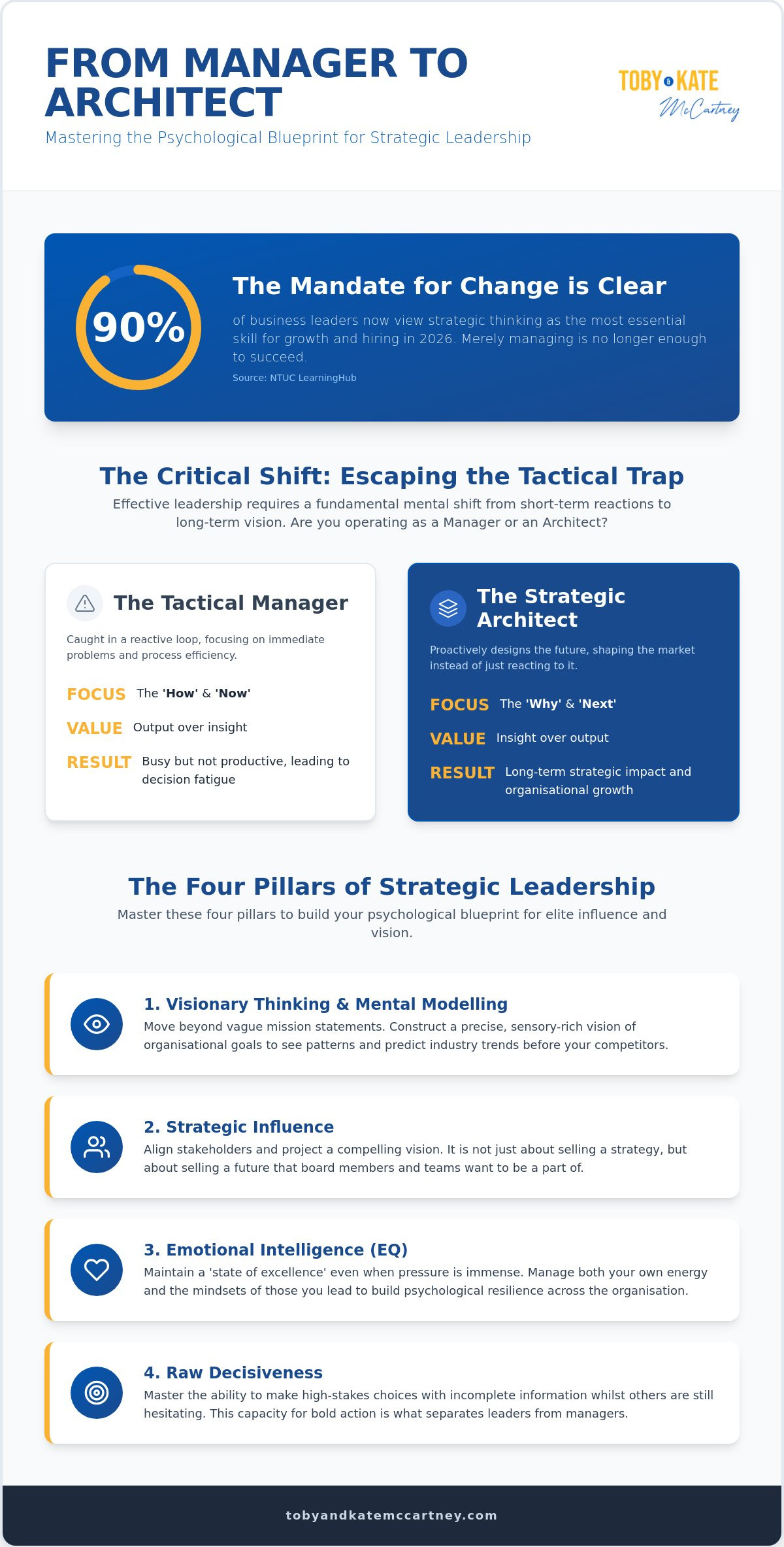
What if the reason you’re stuck in the operational weeds isn’t a lack of time, but a lack of psychological programming? You likely feel the daily grind of tactical management pulling you away from the high-level influence you know you’re capable of. It’s a frustrating place to be, especially when you’re struggling to articulate a vision that truly resonates with the board. You aren’t alone; in fact, recent data from NTUC LearningHub shows that 90% of business leaders now view strategic thinking as the most essential skill for growth and hiring.

You’re here because you’re ready to claim your seat at the table. This article will show you how to transcend the mundane and develop the psychological blueprint required for elite strategic leadership. We’ll explore the specific strategic leadership skills you need to master influence and vision in 2026. You’ll gain a clear framework for strategic thinking and the confidence to make bold decisions whilst others are still hesitating. It’s time to unlock your potential and become the visionary leader your organisation requires.

  • Recognise why 2026 demands a shift from standard management to a potent intersection of vision, influence, and execution.
  • Master the core strategic leadership skills. Transcend the ‘Tactical Trap’ and step into the role of a visionary Architect.
  • Utilise a psychological framework to audit your leadership behaviour. Apply ‘Strategic Reframing’ to every organisational challenge.
  • Harness elite influence techniques to align stakeholders and project a compelling vision that commands respect amongst the board.

What are Strategic Leadership Skills and Why Do They Matter in 2026?

When you start to understand What is Strategic Leadership, you realise it’s a departure from the safety of the ‘known’. Many leaders feel a sense of imposter syndrome when they try to step up, primarily because they’ve been trained to value output over insight. We’re moving away from the era of the ‘Doer’ and into the era of the ‘Visionary Strategist’. This shift requires a fundamental retooling of how you process information and lead your people. It’s about moving beyond the business plan and into the psychological blueprint of mastery.

The Distinction Between Management and Strategic Leadership

Management focuses on the ‘how’ and ‘now’, ensuring that current processes run smoothly. Leadership focuses on the ‘why’ and ‘next’. If you’re stuck in a tactical loop, you’re likely spending 90% of your day solving immediate fires. This creates a heavy psychological cost; it leads to decision fatigue and a sense of being ‘busy but not productive’. You aren’t leading; you’re just reacting at a higher level of intensity. Identifying this loop is the first step toward reclaiming your time and your authority. To break free, you must shift your focus from operational efficiency to strategic impact.

Why Strategic Thinking is Your Greatest Asset

The modern UK business landscape is complex and volatile. Success now depends on your ability to spot patterns before they become obvious to your competitors. It’s about predicting industry trends and aligning your team’s energy toward a future that doesn’t exist yet. Strategic leadership is the neurological ability to hold a long-term vision whilst managing short-term realities. By mastering this mental duality, you ensure that your organisation doesn’t just survive the changes of 2026 but actually thrives amongst them. This capacity for pattern recognition and forward-thinking is what separates the elite from the average.

The Core Pillars of Strategic Leadership: Beyond the Business Plan

Elite leadership isn’t found in the pages of a static business plan. It lives in your ability to command the room and the future simultaneously. To excel, you must anchor your approach in four non-negotiable pillars: visionary thinking, strategic influence, emotional intelligence, and raw decisiveness. These aren’t just abstract concepts; they’re the engine room of your professional impact. When you refine your strategic leadership skills, you stop reacting to the market and start shaping it. You become the person who makes high-stakes choices with incomplete information whilst others are still waiting for more data.

This level of command requires a shift in how you view your role. You aren’t just a manager of people; you’re a manager of possibilities. According to the Harvard Division of Continuing Education, mastering strategic leadership skills requires a blend of open-mindedness and clear communication to win over senior stakeholders. You aren’t just selling a strategy. You’re selling a future that they want to be part of. This requires an acute understanding of stakeholder psychology and the ability to pivot your message to meet their specific needs without compromising your core objectives.

Visionary Thinking and Mental Modelling

How do you actually ‘see’ the future? It isn’t magic. It’s mental modelling. By using Neuro-Linguistic Programming (NLP) ‘well-formed outcomes’, you can move beyond vague mission statements and construct a precise, sensory-rich vision of your organisational goals. A generic mission statement is a piece of paper; a compelling vision is a neurological reality that your team can feel. When you communicate this vision, you must use language that resonates at a deep level, ensuring your stakeholders aren’t just informed, but are fundamentally aligned with the journey ahead.

Emotional Intelligence and the Psychology of Resilience

Leadership is an endurance sport. You must maintain a ‘state of excellence’ even when the pressure is immense. This requires a high degree of emotional intelligence (EQ) to manage both your own energy and the mindset of your team. By understanding the ‘behavioural’ drivers of your staff, you can unlock their hidden potential and foster a culture of resilience amongst your department. If you find yourself struggling to maintain this balance, exploring executive coaching and mentoring can provide the high-level perspective needed to break through your current ceiling.

Mastery is a choice you make every single day. It’s about deciding that ‘good enough’ is no longer the standard for your career. If you’re ready to accelerate this transition, you might consider how bespoke leadership training can sharpen your edge. You’ve already done the hard work of building a career; now it’s time to build a legacy that lasts.

Tactical vs Strategic Leadership: Navigating the Mental Shift

Most leaders are stuck in a cycle of high-speed reaction. They operate with a ‘Doer’ mindset, measuring their value by the number of fires they extinguish each day. To truly master strategic leadership skills, you must abandon the role of the firefighter and step into the role of the Architect. The ‘Tactical Trap’ is a seductive place; it feels productive because you’re always busy. However, this busyness is often a psychological shield used to avoid the discomfort of deep, strategic thinking. True growth happens in the ‘Strategic Gap’, that critical space between your current operations and your ultimate organisational vision.

Navigating this shift requires more than just a change in schedule. It requires a neurological remapping of how you perceive your environment. In Neuro-Linguistic Programming (NLP), we use ‘Perceptual Positions’ to break through tactical tunnel vision. By consciously shifting your perspective to that of a customer, a competitor, or an objective observer, you gain a 360-degree view of your strategy. This allows you to identify blind spots that are invisible from the trenches of daily management. You aren’t just looking at the business; you’re looking through it.

The Psychological Transition to Strategic Thinking

Reclaiming your time starts with overcoming the fear of delegation. Many high-achievers believe that ‘if you want it done right, do it yourself’, but this mindset is the ultimate ceiling on your potential. You must reframe ‘thinking time’ not as a luxury, but as a high-value business activity. One powerful tool for this is the ‘Disney Strategy’, a three-stage creative process that separates the Dreamer, the Realist, and the Critic. By giving each phase its own mental space, you can develop robust, innovative strategies that are both visionary and practically sound.

Navigating High-Stakes Stakeholder Environments

Strategic leadership isn’t a solo journey. It’s a collaborative performance. You must map the influence landscape within your organisation to understand where the real power lies. This isn’t just about job titles; it’s about relational intelligence. When you’re in the boardroom, you must adapt your communication style to resonate with different personalities, from the data-driven analyst to the high-energy visionary. If you want to command the room with absolute authority, investing in advanced communication skills training is the master key to unlocking your influence. Stop talking at people and start communicating with their subconscious drivers.

The transition from a manager to a strategist is a journey of personal transformation. It’s about deciding to lead from the front of the mind, not the back of the queue. Once you master this shift, you’ll find that your ability to influence and persuade becomes almost effortless. You’re no longer pushing for results; you’re pulling your entire organisation toward a future you’ve already designed.
Strategic Leadership Skills: Mastering the Art of Influence and Vision in 2026

How to Develop Strategic Leadership Skills: A Psychological Framework

Transformation isn’t a happy accident. It’s the result of a deliberate, five-step psychological framework designed to move you from a manager to an Empowering Master. To truly elevate your strategic leadership skills, you must first conduct a ruthless audit of your current style. Identify the blind spots where your ego or outdated habits are limiting your impact. Once you acknowledge these gaps, you can begin the process of ‘Strategic Reframing’. This technique allows you to pivot your perspective, turning every organisational obstacle into a data point for growth and every challenge into a unique opportunity.

The third step involves developing a ‘Command Presence’. This isn’t about being the loudest person in the room; it’s about the neurological weight of your words. You then implement continuous feedback loops to ensure you never stagnate, whilst the final step involves seeking elite mentorship to accelerate your journey. By partnering with those who have already achieved high-level success, you gain access to a ‘secret weapon’ of experience that would take decades to acquire alone. This isn’t just about learning; it’s about downloading a blueprint for excellence.

Mastering Strategic Influence Through NLP

Influence is the currency of leadership. By using Neuro-Linguistic Programming (NLP), you can build trust instantly with key decision-makers through ‘Rapport’ and ‘Matching’. These techniques allow you to align your communication with the subconscious preferences of your stakeholders, making your proposals feel like their own ideas. You can also master ‘Language Patterns’ to bypass resistance during tough negotiations, ensuring your vision is accepted without friction. If you’re ready to master these psychological tools, exploring NLP practitioner certification UK is your next logical step toward professional mastery.

Commanding the Room: Public Speaking as a Strategic Tool

Every strategic leader must be a master communicator. Your ability to project presence and use persuasive storytelling is what translates a strategy into a movement. Whether you’re addressing a small board or a massive conference, your voice is your most potent strategic tool. You must learn to use techniques for projection and presence that command attention and inspire action amongst your peers. To refine this essential capability, consider how public speaking for leaders can transform your influence from a whisper into a roar.

The pathway to elite leadership is open to anyone willing to do the internal work. It’s a journey of self-worth and professional empowerment. If you’re looking for a catalyst to trigger this shift, our leadership training and mentoring services provide the pragmatic strategy and psychological depth you need to succeed in 2026.

Mastering Elite Influence: The Toby and Kate McCartney Approach

True mastery isn’t found in a textbook. It’s forged through a deep, psychological shift in identity. At the heart of our philosophy is the concept of the ‘Empowering Master’. This isn’t just someone who manages a team; it’s a leader who acts as a catalyst for excellence in everyone they encounter. By blending advanced Neuro-Linguistic Programming (NLP) with pragmatic business strategy, we help you develop the strategic leadership skills required to command respect and drive measurable results. You aren’t just learning new techniques. You’re becoming a more capable version of yourself.

Our programmes are designed to move you beyond the realm of theoretical knowledge. We focus on high-performance outcomes that show up in your board reports and your bottom line. Whether you’re navigating a complex merger or seeking to inspire a distributed team, the tools we provide act as your ‘secret weapon’ for influence. You’ll learn to read the room with surgical precision and communicate with a level of clarity that eliminates resistance. This is the art of elite influence, and it’s available to those ready to claim their seat at the strategic table.

The Pathway to Leadership Excellence

The journey toward mastery follows a proven, multi-modal development pathway. It begins with the NLP Practitioner and Master Practitioner certifications, where you dismantle the mental barriers holding you back. For those facing specific professional plateaus, our one-to-one coaching provides the bespoke focus needed to break through. We also offer intensive public speaking programmes that transform your professional authority. You’ll move from being a speaker who is heard to a leader who is followed, mastering the nuances of human influence along the way.

Your Journey Starts Here

Your ‘new life’ as an elite leader is closer than you think. We offer a flexible, hybrid learning approach that combines home study, live online sessions, and in-person classes to fit your demanding schedule. This isn’t just another course; it’s an 18-month pathway to professional and personal transformation. Toby McCartney works with only 10 exclusive mentorship clients each year, ensuring a level of focus and results that is truly world-class. You have the inherent potential to lead with vision and command with influence. The time for hesitation has passed. Step into your power, embrace the journey, and become the visionary architect of your own future today.

Claim Your Seat as a Visionary Architect

The transition from a reactive manager to an elite strategist is not just a career move; it is a profound identity shift. You now understand that strategic leadership skills are rooted in the ability to construct a compelling vision whilst mastering the psychological nuances of influence. By moving beyond the ‘Tactical Trap’ and embracing the ‘Architect’ mindset, you position yourself to lead with absolute clarity in an uncertain 2026 landscape. You have the tools to reframe obstacles and the language patterns to bypass resistance in any boardroom.

With over 20 years of expertise in leadership transformation, we provide the elite pathway you require. From our NLP Trainer Training Certification to specialised public speaking programmes for elite professionals, our approach is designed for measurable impact. You don’t have to navigate this journey alone. Begin your journey to leadership mastery with Toby and Kate McCartney today. Your potential is limitless. It’s time to step into the most capable version of yourself and command the future you deserve.

Frequently Asked Questions

What are the 5 most important strategic leadership skills?

Visionary thinking, strategic influence, emotional intelligence, decisiveness, and communication mastery are the five essential pillars. These skills allow you to transcend daily operations and begin designing the future of your organisation. By mastering these, you ensure that your team is aligned with long-term objectives whilst remaining agile enough to handle immediate market shifts. It is about moving from a reactive boss to a proactive architect of success.

How can I improve my strategic thinking as a manager?

You can improve your strategic thinking by reframing ‘thinking time’ as your most valuable business activity. Start by auditing your daily schedule to identify where you are stuck in the ‘Tactical Trap’. Use mental models like the Disney Strategy to separate your creative vision from realistic implementation. This discipline allows you to step back from the operational weeds and recognise the broader patterns that define your industry’s future.

Is strategic leadership the same as visionary leadership?

They are related but distinct concepts within the leadership landscape. Visionary leadership is primarily about the ‘where’, creating a compelling picture of the future that inspires others. Strategic leadership adds the ‘how’ and the ‘who’. It integrates that vision with pragmatic execution and the ability to influence key stakeholders. You need both to ensure your high-level ideas are actually translated into measurable, real-world results.

Can strategic leadership skills be taught, or are they innate?

These are learned behaviours, not innate talents that you are either born with or without. Whilst some people naturally gravitate toward big-picture thinking, the specific strategic leadership skills required for elite performance are developed through deliberate practice. By following a structured psychological framework and engaging in high-level mentorship, any manager can reprogramme their mindset to operate as a visionary architect of their organisation’s future.

How does NLP help with strategic leadership?

NLP acts as a catalyst for influence and personal transformation. It provides leaders with tools like ‘Rapport’ and ‘Matching’ to build instant trust with senior stakeholders and board members. Additionally, NLP techniques like ‘Strategic Reframing’ help you turn organisational obstacles into unique opportunities. It allows you to master your internal state, ensuring you remain in a position of excellence even when navigating high-stakes negotiations or complex organisational shifts.

What is the difference between a tactical and a strategic leader?

The primary difference lies in focus and mindset. A tactical leader is a ‘Doer’ who measures success by the volume of immediate tasks completed and fires extinguished. Conversely, a strategic leader is an ‘Architect’ who prioritises long-term vision and pattern recognition. Whilst the tactical leader reacts to the present, the strategic leader designs the future, ensuring the organisation is built to thrive amongst the complexities of 2026.

How long does it take to develop strategic leadership mastery?

Development is a continuous journey, but significant transformation usually requires a structured 18-month pathway. This timeframe allows for the deep integration of new psychological patterns and communication techniques. Our certification programmes are designed to move you from theory to measurable results, providing the coaching and mentoring needed to break through personal plateaus. True mastery comes when these strategic behaviours become your default response to any business challenge.

Why do strategic leaders fail most often?

Leaders often fail when they lose the ability to influence senior stakeholders or get pulled back into operational ‘weeds’. Even a brilliant strategy will collapse if the leader cannot articulate it with enough presence to win board-level support. Failure also occurs when a leader lacks the emotional intelligence to manage the energy of their team. Success in 2026 requires a balance of high-level visionary thinking and acute relational intelligence.

What if the reason you’re stuck in the operational weeds isn’t a lack of time, but a lack of psychological programming? You likely feel the daily grind of tactical management pulling you away from the high-level influence you know you’re capable of. It’s a frustrating place to be, especially when you’re struggling to articulate a vision that truly resonates with the board. You aren’t alone; in fact, recent data from NTUC LearningHub shows that 90% of business leaders now view strategic thinking as the most essential skill for growth and hiring.

You’re here because you’re ready to claim your seat at the table. This article will show you how to transcend the mundane and develop the psychological blueprint required for elite strategic leadership. We’ll explore the specific strategic leadership skills you need to master influence and vision in 2026. You’ll gain a clear framework for strategic thinking and the confidence to make bold decisions whilst others are still hesitating. It’s time to unlock your potential and become the visionary leader your organisation requires.

  • Recognise why 2026 demands a shift from standard management to a potent intersection of vision, influence, and execution.
  • Master the core strategic leadership skills. Transcend the ‘Tactical Trap’ and step into the role of a visionary Architect.
  • Utilise a psychological framework to audit your leadership behaviour. Apply ‘Strategic Reframing’ to every organisational challenge.
  • Harness elite influence techniques to align stakeholders and project a compelling vision that commands respect amongst the board.

What are Strategic Leadership Skills and Why Do They Matter in 2026?

When you start to understand What is Strategic Leadership, you realise it’s a departure from the safety of the ‘known’. Many leaders feel a sense of imposter syndrome when they try to step up, primarily because they’ve been trained to value output over insight. We’re moving away from the era of the ‘Doer’ and into the era of the ‘Visionary Strategist’. This shift requires a fundamental retooling of how you process information and lead your people. It’s about moving beyond the business plan and into the psychological blueprint of mastery.

The Distinction Between Management and Strategic Leadership

Management focuses on the ‘how’ and ‘now’, ensuring that current processes run smoothly. Leadership focuses on the ‘why’ and ‘next’. If you’re stuck in a tactical loop, you’re likely spending 90% of your day solving immediate fires. This creates a heavy psychological cost; it leads to decision fatigue and a sense of being ‘busy but not productive’. You aren’t leading; you’re just reacting at a higher level of intensity. Identifying this loop is the first step toward reclaiming your time and your authority. To break free, you must shift your focus from operational efficiency to strategic impact.

Why Strategic Thinking is Your Greatest Asset

The modern UK business landscape is complex and volatile. Success now depends on your ability to spot patterns before they become obvious to your competitors. It’s about predicting industry trends and aligning your team’s energy toward a future that doesn’t exist yet. Strategic leadership is the neurological ability to hold a long-term vision whilst managing short-term realities. By mastering this mental duality, you ensure that your organisation doesn’t just survive the changes of 2026 but actually thrives amongst them. This capacity for pattern recognition and forward-thinking is what separates the elite from the average.

The Core Pillars of Strategic Leadership: Beyond the Business Plan

Elite leadership isn’t found in the pages of a static business plan. It lives in your ability to command the room and the future simultaneously. To excel, you must anchor your approach in four non-negotiable pillars: visionary thinking, strategic influence, emotional intelligence, and raw decisiveness. These aren’t just abstract concepts; they’re the engine room of your professional impact. When you refine your strategic leadership skills, you stop reacting to the market and start shaping it. You become the person who makes high-stakes choices with incomplete information whilst others are still waiting for more data.

This level of command requires a shift in how you view your role. You aren’t just a manager of people; you’re a manager of possibilities. According to the Harvard Division of Continuing Education, mastering strategic leadership skills requires a blend of open-mindedness and clear communication to win over senior stakeholders. You aren’t just selling a strategy. You’re selling a future that they want to be part of. This requires an acute understanding of stakeholder psychology and the ability to pivot your message to meet their specific needs without compromising your core objectives.

Visionary Thinking and Mental Modelling

How do you actually ‘see’ the future? It isn’t magic. It’s mental modelling. By using Neuro-Linguistic Programming (NLP) ‘well-formed outcomes’, you can move beyond vague mission statements and construct a precise, sensory-rich vision of your organisational goals. A generic mission statement is a piece of paper; a compelling vision is a neurological reality that your team can feel. When you communicate this vision, you must use language that resonates at a deep level, ensuring your stakeholders aren’t just informed, but are fundamentally aligned with the journey ahead.

Emotional Intelligence and the Psychology of Resilience

Leadership is an endurance sport. You must maintain a ‘state of excellence’ even when the pressure is immense. This requires a high degree of emotional intelligence (EQ) to manage both your own energy and the mindset of your team. By understanding the ‘behavioural’ drivers of your staff, you can unlock their hidden potential and foster a culture of resilience amongst your department. If you find yourself struggling to maintain this balance, exploring executive coaching and mentoring can provide the high-level perspective needed to break through your current ceiling.

Mastery is a choice you make every single day. It’s about deciding that ‘good enough’ is no longer the standard for your career. If you’re ready to accelerate this transition, you might consider how bespoke leadership training can sharpen your edge. You’ve already done the hard work of building a career; now it’s time to build a legacy that lasts.

Tactical vs Strategic Leadership: Navigating the Mental Shift

Most leaders are stuck in a cycle of high-speed reaction. They operate with a ‘Doer’ mindset, measuring their value by the number of fires they extinguish each day. To truly master strategic leadership skills, you must abandon the role of the firefighter and step into the role of the Architect. The ‘Tactical Trap’ is a seductive place; it feels productive because you’re always busy. However, this busyness is often a psychological shield used to avoid the discomfort of deep, strategic thinking. True growth happens in the ‘Strategic Gap’, that critical space between your current operations and your ultimate organisational vision.

Navigating this shift requires more than just a change in schedule. It requires a neurological remapping of how you perceive your environment. In Neuro-Linguistic Programming (NLP), we use ‘Perceptual Positions’ to break through tactical tunnel vision. By consciously shifting your perspective to that of a customer, a competitor, or an objective observer, you gain a 360-degree view of your strategy. This allows you to identify blind spots that are invisible from the trenches of daily management. You aren’t just looking at the business; you’re looking through it.

The Psychological Transition to Strategic Thinking

Reclaiming your time starts with overcoming the fear of delegation. Many high-achievers believe that ‘if you want it done right, do it yourself’, but this mindset is the ultimate ceiling on your potential. You must reframe ‘thinking time’ not as a luxury, but as a high-value business activity. One powerful tool for this is the ‘Disney Strategy’, a three-stage creative process that separates the Dreamer, the Realist, and the Critic. By giving each phase its own mental space, you can develop robust, innovative strategies that are both visionary and practically sound.

Navigating High-Stakes Stakeholder Environments

Strategic leadership isn’t a solo journey. It’s a collaborative performance. You must map the influence landscape within your organisation to understand where the real power lies. This isn’t just about job titles; it’s about relational intelligence. When you’re in the boardroom, you must adapt your communication style to resonate with different personalities, from the data-driven analyst to the high-energy visionary. If you want to command the room with absolute authority, investing in advanced communication skills training is the master key to unlocking your influence. Stop talking at people and start communicating with their subconscious drivers.

The transition from a manager to a strategist is a journey of personal transformation. It’s about deciding to lead from the front of the mind, not the back of the queue. Once you master this shift, you’ll find that your ability to influence and persuade becomes almost effortless. You’re no longer pushing for results; you’re pulling your entire organisation toward a future you’ve already designed.

Strategic Leadership Skills: Mastering the Art of Influence and Vision in 2026

How to Develop Strategic Leadership Skills: A Psychological Framework

Transformation isn’t a happy accident. It’s the result of a deliberate, five-step psychological framework designed to move you from a manager to an Empowering Master. To truly elevate your strategic leadership skills, you must first conduct a ruthless audit of your current style. Identify the blind spots where your ego or outdated habits are limiting your impact. Once you acknowledge these gaps, you can begin the process of ‘Strategic Reframing’. This technique allows you to pivot your perspective, turning every organisational obstacle into a data point for growth and every challenge into a unique opportunity.

The third step involves developing a ‘Command Presence’. This isn’t about being the loudest person in the room; it’s about the neurological weight of your words. You then implement continuous feedback loops to ensure you never stagnate, whilst the final step involves seeking elite mentorship to accelerate your journey. By partnering with those who have already achieved high-level success, you gain access to a ‘secret weapon’ of experience that would take decades to acquire alone. This isn’t just about learning; it’s about downloading a blueprint for excellence.

Mastering Strategic Influence Through NLP

Influence is the currency of leadership. By using Neuro-Linguistic Programming (NLP), you can build trust instantly with key decision-makers through ‘Rapport’ and ‘Matching’. These techniques allow you to align your communication with the subconscious preferences of your stakeholders, making your proposals feel like their own ideas. You can also master ‘Language Patterns’ to bypass resistance during tough negotiations, ensuring your vision is accepted without friction. If you’re ready to master these psychological tools, exploring NLP practitioner certification UK is your next logical step toward professional mastery.

Commanding the Room: Public Speaking as a Strategic Tool

Every strategic leader must be a master communicator. Your ability to project presence and use persuasive storytelling is what translates a strategy into a movement. Whether you’re addressing a small board or a massive conference, your voice is your most potent strategic tool. You must learn to use techniques for projection and presence that command attention and inspire action amongst your peers. To refine this essential capability, consider how public speaking for leaders can transform your influence from a whisper into a roar.

The pathway to elite leadership is open to anyone willing to do the internal work. It’s a journey of self-worth and professional empowerment. If you’re looking for a catalyst to trigger this shift, our leadership training and mentoring services provide the pragmatic strategy and psychological depth you need to succeed in 2026.

Mastering Elite Influence: The Toby and Kate McCartney Approach

True mastery isn’t found in a textbook. It’s forged through a deep, psychological shift in identity. At the heart of our philosophy is the concept of the ‘Empowering Master’. This isn’t just someone who manages a team; it’s a leader who acts as a catalyst for excellence in everyone they encounter. By blending advanced Neuro-Linguistic Programming (NLP) with pragmatic business strategy, we help you develop the strategic leadership skills required to command respect and drive measurable results. You aren’t just learning new techniques. You’re becoming a more capable version of yourself.

Our programmes are designed to move you beyond the realm of theoretical knowledge. We focus on high-performance outcomes that show up in your board reports and your bottom line. Whether you’re navigating a complex merger or seeking to inspire a distributed team, the tools we provide act as your ‘secret weapon’ for influence. You’ll learn to read the room with surgical precision and communicate with a level of clarity that eliminates resistance. This is the art of elite influence, and it’s available to those ready to claim their seat at the strategic table.

The Pathway to Leadership Excellence

The journey toward mastery follows a proven, multi-modal development pathway. It begins with the NLP Practitioner and Master Practitioner certifications, where you dismantle the mental barriers holding you back. For those facing specific professional plateaus, our one-to-one coaching provides the bespoke focus needed to break through. We also offer intensive public speaking programmes that transform your professional authority. You’ll move from being a speaker who is heard to a leader who is followed, mastering the nuances of human influence along the way.

Your Journey Starts Here

Your ‘new life’ as an elite leader is closer than you think. We offer a flexible, hybrid learning approach that combines home study, live online sessions, and in-person classes to fit your demanding schedule. This isn’t just another course; it’s an 18-month pathway to professional and personal transformation. Toby McCartney works with only 10 exclusive mentorship clients each year, ensuring a level of focus and results that is truly world-class. You have the inherent potential to lead with vision and command with influence. The time for hesitation has passed. Step into your power, embrace the journey, and become the visionary architect of your own future today.

Claim Your Seat as a Visionary Architect

The transition from a reactive manager to an elite strategist is not just a career move; it is a profound identity shift. You now understand that strategic leadership skills are rooted in the ability to construct a compelling vision whilst mastering the psychological nuances of influence. By moving beyond the ‘Tactical Trap’ and embracing the ‘Architect’ mindset, you position yourself to lead with absolute clarity in an uncertain 2026 landscape. You have the tools to reframe obstacles and the language patterns to bypass resistance in any boardroom.

With over 20 years of expertise in leadership transformation, we provide the elite pathway you require. From our NLP Trainer Training Certification to specialised public speaking programmes for elite professionals, our approach is designed for measurable impact. You don’t have to navigate this journey alone. Begin your journey to leadership mastery with Toby and Kate McCartney today. Your potential is limitless. It’s time to step into the most capable version of yourself and command the future you deserve.

Frequently Asked Questions

What are the 5 most important strategic leadership skills?

Visionary thinking, strategic influence, emotional intelligence, decisiveness, and communication mastery are the five essential pillars. These skills allow you to transcend daily operations and begin designing the future of your organisation. By mastering these, you ensure that your team is aligned with long-term objectives whilst remaining agile enough to handle immediate market shifts. It is about moving from a reactive boss to a proactive architect of success.

How can I improve my strategic thinking as a manager?

You can improve your strategic thinking by reframing ‘thinking time’ as your most valuable business activity. Start by auditing your daily schedule to identify where you are stuck in the ‘Tactical Trap’. Use mental models like the Disney Strategy to separate your creative vision from realistic implementation. This discipline allows you to step back from the operational weeds and recognise the broader patterns that define your industry’s future.

Is strategic leadership the same as visionary leadership?

They are related but distinct concepts within the leadership landscape. Visionary leadership is primarily about the ‘where’, creating a compelling picture of the future that inspires others. Strategic leadership adds the ‘how’ and the ‘who’. It integrates that vision with pragmatic execution and the ability to influence key stakeholders. You need both to ensure your high-level ideas are actually translated into measurable, real-world results.

Can strategic leadership skills be taught, or are they innate?

These are learned behaviours, not innate talents that you are either born with or without. Whilst some people naturally gravitate toward big-picture thinking, the specific strategic leadership skills required for elite performance are developed through deliberate practice. By following a structured psychological framework and engaging in high-level mentorship, any manager can reprogramme their mindset to operate as a visionary architect of their organisation’s future.

How does NLP help with strategic leadership?

NLP acts as a catalyst for influence and personal transformation. It provides leaders with tools like ‘Rapport’ and ‘Matching’ to build instant trust with senior stakeholders and board members. Additionally, NLP techniques like ‘Strategic Reframing’ help you turn organisational obstacles into unique opportunities. It allows you to master your internal state, ensuring you remain in a position of excellence even when navigating high-stakes negotiations or complex organisational shifts.

What is the difference between a tactical and a strategic leader?

The primary difference lies in focus and mindset. A tactical leader is a ‘Doer’ who measures success by the volume of immediate tasks completed and fires extinguished. Conversely, a strategic leader is an ‘Architect’ who prioritises long-term vision and pattern recognition. Whilst the tactical leader reacts to the present, the strategic leader designs the future, ensuring the organisation is built to thrive amongst the complexities of 2026.

How long does it take to develop strategic leadership mastery?

Development is a continuous journey, but significant transformation usually requires a structured 18-month pathway. This timeframe allows for the deep integration of new psychological patterns and communication techniques. Our certification programmes are designed to move you from theory to measurable results, providing the coaching and mentoring needed to break through personal plateaus. True mastery comes when these strategic behaviours become your default response to any business challenge.

Why do strategic leaders fail most often?

Leaders often fail when they lose the ability to influence senior stakeholders or get pulled back into operational ‘weeds’. Even a brilliant strategy will collapse if the leader cannot articulate it with enough presence to win board-level support. Failure also occurs when a leader lacks the emotional intelligence to manage the energy of their team. Success in 2026 requires a balance of high-level visionary thinking and acute relational intelligence.

Leave a Comment

Your email address will not be published. Required fields are marked *

Don't leave without having a chat with like-minded people in our NLP community.

Click here to join our Skool...