
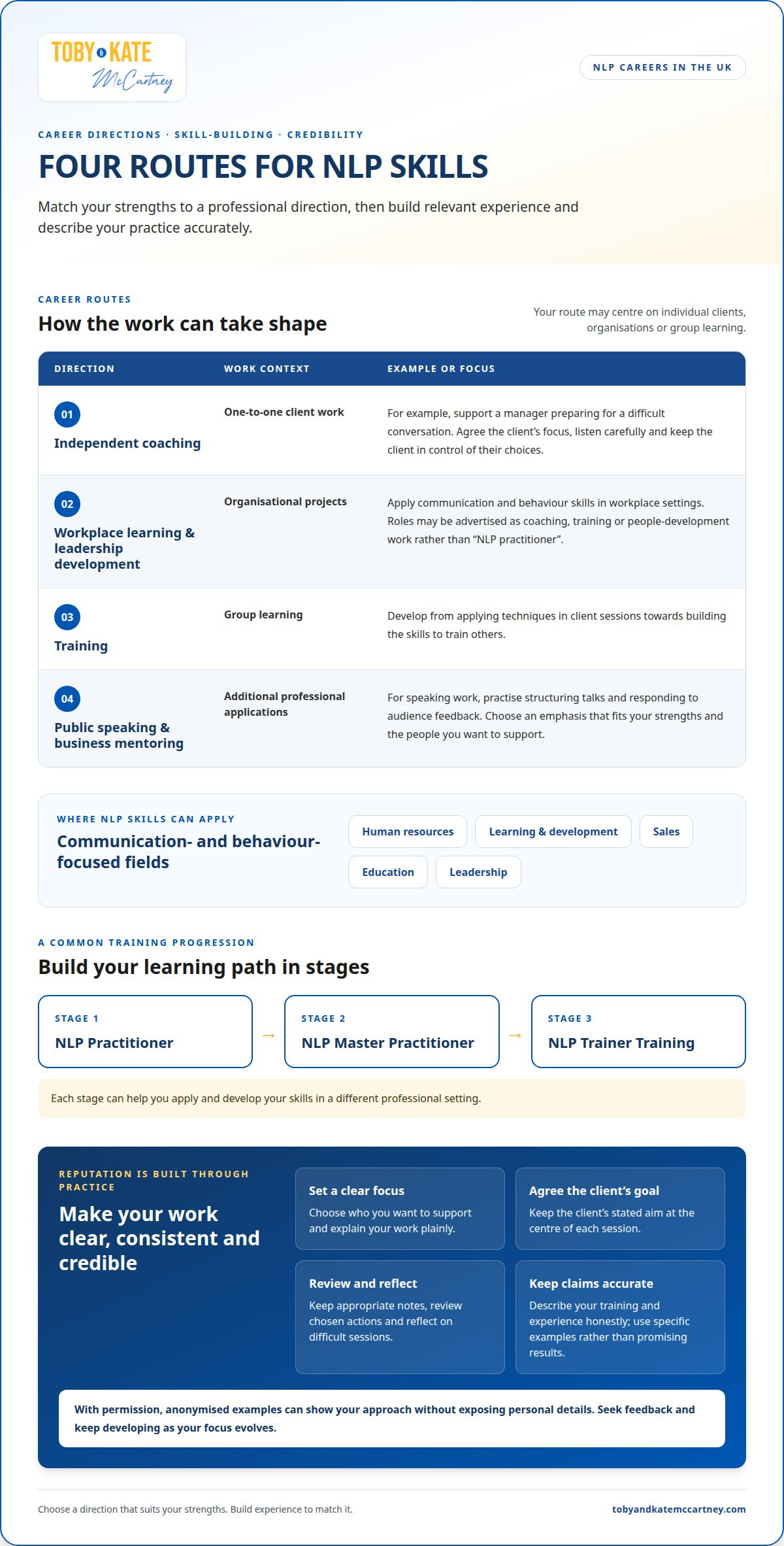
Career paths for NLP practitioners in the UK include one-to-one coaching, leadership and business development, training, and public speaking. A common training progression moves from NLP Practitioner to NLP Master Practitioner, then NLP Trainer Training. Each stage can help you apply and develop your skills in a different professional setting.
Certification alone does not build a lasting career. Your reputation grows through how you use your skills, the people you support, and the way you continue developing your practice. Choose a direction that suits your strengths, then build relevant experience and credibility.
This guide explores four career routes across the UK, ways to build your reputation and continue learning, and the typical training progression. You’ll get a clearer sense of the options and practical next steps for turning NLP training into purposeful professional work.
Key Takeaways
- Match your NLP skills to a clear direction, such as coaching, leadership, training or public speaking.
- Build a professional reputation through consistent practice, clear communication and trust with the people you support.
- Keep developing beyond initial training by reflecting on your work and strengthening the skills your chosen path demands.
- Use the traditional progression from NLP Practitioner to Master Practitioner and Trainer training to shape your next learning steps.
1. NLP practitioner and coach responsibilities
NLP practitioners help clients examine communication patterns, clarify goals, and practise alternative responses. For example, a coach might support a manager preparing for a difficult conversation. The work begins by agreeing on the client’s focus, then asking questions and listening carefully to how they describe the challenge. NLP techniques can guide reflection, while the client remains in control of their choices.
Emotional intelligence coaching can focus on recognising emotions, managing reactions, and understanding other people’s perspectives. A client who feels defensive during feedback, for example, could explore what triggers that response and rehearse a calmer reply. Useful skills include active listening, clear questioning, building rapport, and recognising when a client’s needs fall outside a coaching conversation.
Starting an independent practice takes more than coaching ability. Define who you want to support, such as managers or people developing presentation skills. Set out your coaching scope, session format, and cancellation arrangements in writing. Create a straightforward process for enquiries, initial conversations, session notes, and follow-up. A clear focus helps prospective clients understand your work without promising a particular outcome.
Ethical practice starts with explaining your role and methods before coaching begins. Agree on confidentiality and its limits, protect personal information, and never present coaching as clinical mental health care. Don’t diagnose or promise to resolve a client’s difficulties. If a conversation moves beyond your competence, pause and discuss an appropriate next step. Clear boundaries protect the client’s autonomy and your professional credibility.
Workplace risks include scepticism about NLP, pressure to promise quick change, and blurred boundaries between coaching and management. A practitioner may also face sensitive disclosures or conflicts when an employer sponsors sessions. Clarify who the client is, what information stays confidential and what progress updates may be shared. No special knowledge or specific training is needed to begin NLP training, but practising responsibly requires honest communication and continued development. There is no single global authority for NLP certification; the International Association for NLP is one certification organisation. Check that your own training and public claims accurately describe your experience.
2. Building a career and reputation using NLP
Across the UK, career paths for NLP practitioners include independent coaching, workplace learning, leadership development, and training. Practitioners may also apply their skills in public speaking or business mentoring. Your route depends on whether you prefer one-to-one client work, organisational projects, or group learning. For example, you could focus on helping managers prepare for challenging conversations.
NLP skills can be applied in UK industries where communication and behaviour matter, including human resources, learning and development, sales, education, and leadership. Roles are not always advertised under the title “NLP practitioner”. Employers may instead look for coaches, trainers, or people-development professionals who can support clearer communication. Tailor your experience to the role: a sales example might show how you help people listen actively and respond to customer needs.
A common training progression moves from NLP Practitioner to NLP Master Practitioner, followed by NLP Trainer Training. Each stage can support a broader professional focus, from applying techniques in client sessions to developing the skills to train others. Build your reputation by aligning your role, training, and public claims. Describe your experience accurately and use specific examples rather than promising particular results.
To move into an NLP career in the UK, start by mapping the transferable skills you use in your current work. A teacher might bring experience listening and explaining ideas; a manager might be practised at setting goals and giving feedback. Then choose a training route, practise techniques in a learning environment, and identify the clients or organisations you want to support. A clear focus makes it easier to explain your work.
Build credibility through consistent professional habits. Agree each client’s goal before sessions, keep appropriate notes, and review what actions they chose to take. With permission, use anonymised examples to explain your approach without exposing personal details. Seek feedback, reflect on difficult sessions and keep learning as your focus develops. These steps give prospective clients and employers clearer evidence of your practice. A structured NLP development pathway can help you build skills for your next career step.
3. Ongoing professional learning
Ongoing learning helps keep NLP practice responsive to each client’s goals, rather than relying on familiar techniques. After a session, record the client’s stated aim, the method used, and the agreed next action. If someone rehearses a presentation, for example, note which communication pattern they chose to change. Review the result at your next meeting and adapt your questions based on their experience. This creates a practical learning loop.
Choose learning activities that strengthen the work you do. A coach supporting managers might study workplace communication, while someone focused on speaking could practise structuring talks and responding to audience feedback. Read relevant books, attend workshops, and discuss challenging sessions with trusted peers. Write down one idea to test after each activity, then assess whether it helped clients move towards their own stated goals.
Peer discussion can sharpen your judgement, especially when a session feels stuck. Bring a specific example, such as a client repeatedly postponing an agreed action, and examine your questions and assumptions. Protect confidentiality by sharing only what is appropriate for learning. Ask peers to challenge your interpretation, not simply endorse it. This helps separate what the client said from what you inferred, improving your next conversation.
Practitioners who complete Train the Trainer qualify as Licensed Behavioural Trainers recognised by IAPCCT. For those interested in teaching, this offers a defined development direction beyond individual client sessions. Whatever your focus, revisit your learning goals as your work changes. A coach moving into team development, for example, may need to strengthen facilitation and group communication skills. Track progress through practical evidence: techniques applied, feedback received and areas still needing development. Keep claims about your expertise aligned with your training and experience. That discipline supports trust as your professional focus evolves.
4. The traditional NLP career training route
A structured route for advancing an NLP career moves through NLP Practitioner, NLP Master Practitioner, and NLP Trainer Training. Each stage has a different development focus. Practitioner training builds a foundation for applying NLP methods. Master Practitioner training extends that foundation, while trainer training prepares practitioners to teach. This progression offers a learning pathway, not a promise of a particular job or outcome.
Connect each training stage to the work you want to do. If you want to coach individuals, consider how practitioner skills could support your sessions. If you aim to train colleagues or lead workshops, explore how trainer development fits that direction. A clear goal helps you decide what you want from each course and how you’ll apply the learning afterwards.
Certification organisations differ. The Society of NLP, associated with Richard Bandler, is one organisation in this field. The International Association for NLP is another. As there is no single global authority for NLP certification, compare the organisation named on a programme with the training content and your intended career direction. Be precise about the credential you hold when describing your background to clients or employers.
Put your training into practice between stages. A practitioner working on presentation confidence, for example, could reflect on which questions helped a client clarify their goal, then identify skills to deepen through further study. Someone planning to teach can practise explaining a concept, responding to questions, and adapting examples for different audiences. These experiences make the next learning step more purposeful.
Progression can also connect with broader professional goals. A practitioner interested in workplace development might combine NLP learning with leadership training, then apply those skills in team settings. Keep a record of courses completed, methods practised and feedback received. That gives you concrete examples for describing your development, without overstating what a qualification represents. If your next aim is to teach NLP, explore NLP trainer development as a pathway towards that role.
Toby and Kate McCartney: NLP Practitioner Certification
Toby and Kate McCartney’s NLP Practitioner Certification offers a practical next step for building foundational NLP skills to use in your professional work. To deepen your practice, NLP Master Practitioner Certification provides a further learning pathway. Choose a next step that reflects the role you’re working towards, whether you plan to apply NLP in coaching or develop expertise for a broader career direction.
If you want to communicate ideas to an audience, Toby and Kate McCartney’s Public Speaking programmes can help you develop that capability. If your aim is to teach NLP, NLP Trainer Training supports that progression. These options offer distinct ways to develop your practice, strengthen your communication, or move towards training others. Choose the route that best matches the work you want to do next.
Contact Toby and Kate McCartney to discuss the learning route that best fits your professional goals.
Choose your next step with intention
Your next move doesn’t need to define your entire career. Choose a direction you can act on now, then let experience shape what comes next. Career paths for NLP practitioners can evolve as your interests develop, whether you’re strengthening your practice, communicating with greater confidence, or preparing to guide others.
Toby and Kate McCartney offer NLP Practitioner Certification and NLP Master Practitioner Certification, alongside Public Speaking programmes. Consider which option best supports the capability you want to build next. A focused learning choice gives your ambition a practical starting point, while your ongoing work helps clarify the direction that suits you.
If you’re ready to explore a learning route aligned with your goals, contact Toby and Kate McCartney. Take the next step with purpose, and keep building a professional path that reflects the work you want to do.
Frequently Asked Questions
How can I build a stronger NLP career in the UK?
Build a stronger NLP career in the UK by connecting your training to a specific professional need. If you work in recruitment, for example, develop an approach to helping candidates prepare for interviews and explain how you use it. Gather feedback, refine your materials, and keep clear examples of your work. This helps prospective clients or employers understand the value you bring.
What skills and qualifications do UK NLP roles require?
UK roles that use NLP commonly call for clear communication, attentive listening, and the ability to adapt your approach to different people. Qualification requirements depend on the position and employer. A learning and development role may value experience facilitating workplace sessions, while independent coaching calls for a clear explanation of your training and professional scope. Use relevant examples to show how you apply your skills.