
Business coaching for small business owners in the UK offers one-to-one support to clarify your direction, work through challenges and shape a practical plan. It helps turn broad ambitions into clear priorities and purposeful action. Good coaching is not a ready-made formula; it gives you space to examine what is working and decide what to do next.
Running a small business can leave little room to step back and see the bigger picture. You may know you want to grow, but feel unsure which opportunity to pursue or how to make progress without losing focus. This guide explains what business coaching involves, how one-to-one support can help, what to consider when choosing a coach and how to approach the investment. You’ll also learn how coaching can support strategic planning, stronger leadership and more confident decisions, so you can move forward with a clearer pathway for your business.
Key Takeaways
- Explore how online, hybrid and in-person sessions can fit around the way you run your business.
- Use one-to-one coaching to examine your challenges, strengthen decision-making and focus on your priorities.
- Clarify the value your business brings and the direction you want it to take.
- Turn your growth ambitions into a practical strategy, with clear actions to move forward.
What is Business Coaching?
Business coaching for small business owners in the UK gives you structured support to examine decisions, set priorities and take purposeful action. You might use it to assess a major project, refine an offer or rethink how you spend your working week.
Coaching session formats
One-to-one sessions focus on your business and the decisions you face. Online meetings can suit a business owner working from different locations, while in-person sessions offer face-to-face discussion. Hybrid coaching combines both. Choose a format that fits your schedule and the work you want to tackle. Ask how sessions are structured, what preparation is useful and how you’ll review progress.
Online business courses offer a different experience: you work through materials independently rather than discussing each decision live. A marketing course, for example, can build knowledge of a specific subject; coaching can help you apply ideas to a current business challenge.
Coach, mentor and consultant roles
A coach uses questions to guide your thinking, helping you identify options and decide on actions. A mentor shares relevant experience and perspective, while a consultant typically analyses a defined problem and recommends a solution. These roles can overlap. Before starting business coaching for small business owners in the UK, clarify whether you want guided reflection, experienced advice or specialist recommendations.
To choose a coach for your small business, match their approach to a specific need, such as planning a team restructure. Ask about relevant experience, session structure and how you’ll review progress. Look for a clear process that leaves decisions and responsibility with you.
Coaching fees vary according to factors such as the coach’s experience, session format and scope. Before committing, ask what the fee covers and how the work is structured.
Before hiring a coach, ask how they’ll understand your business, agree objectives and handle confidentiality. Clarify how you’ll adapt the work if your priorities change.
Warning signs include guaranteed results, vague objectives or pressure to commit before discussing your needs. Expect clear boundaries, a defined purpose and practical next steps.
One-to-one coaching for founders, entrepreneurs and executives
Focused coaching can help you step back from daily demands and examine decisions shaping your business. For founders, entrepreneurs and executives, the value lies in applying each discussion to a real leadership challenge.
Individual coaching for business leaders
One-to-one coaching centres on your responsibilities, goals and current challenges. You might use a session to weigh a new market opportunity or prepare for a difficult team conversation. Bring a specific decision, relevant context and the outcome you want. Then agree on an action to test before your next session. This keeps the work connected to your leadership role rather than drifting into general discussion.
Entrepreneurial mindset and motivation
An entrepreneurial mindset shows in how you respond to uncertainty, setbacks and competing priorities. A coach can help you examine assumptions behind a decision, separate urgent tasks from strategic work and turn a broad ambition into a next step. If motivation dips during a demanding launch, for example, review what is within your control and choose one achievable action.
Ellen Donnelly spent 10 years in talent, startup advisory and executive headhunting. That background spans people, early-stage businesses and leadership appointments. For a founder, these perspectives can help frame questions about hiring, team capability or leadership choices, while keeping the discussion anchored to the business’s immediate needs.
Finding a reputable small business coach
In the UK, look for a coach whose approach fits your business stage and the challenge you want to address. Ask for a clear explanation of their process, relevant experience and how they’ll help you assess progress. A strong first conversation should make the goals, responsibilities and boundaries of the coaching relationship understandable.
Before committing, bring a current example, such as a staffing decision or stalled growth plan. Notice whether the coach listens closely, asks focused questions and distinguishes coaching from advice or mentoring. Agree on what you’ll work towards and how you’ll review actions. This helps you judge the fit by the quality and relevance of the conversation, not bold promises.
Clarifying a business’s direction and unique contribution
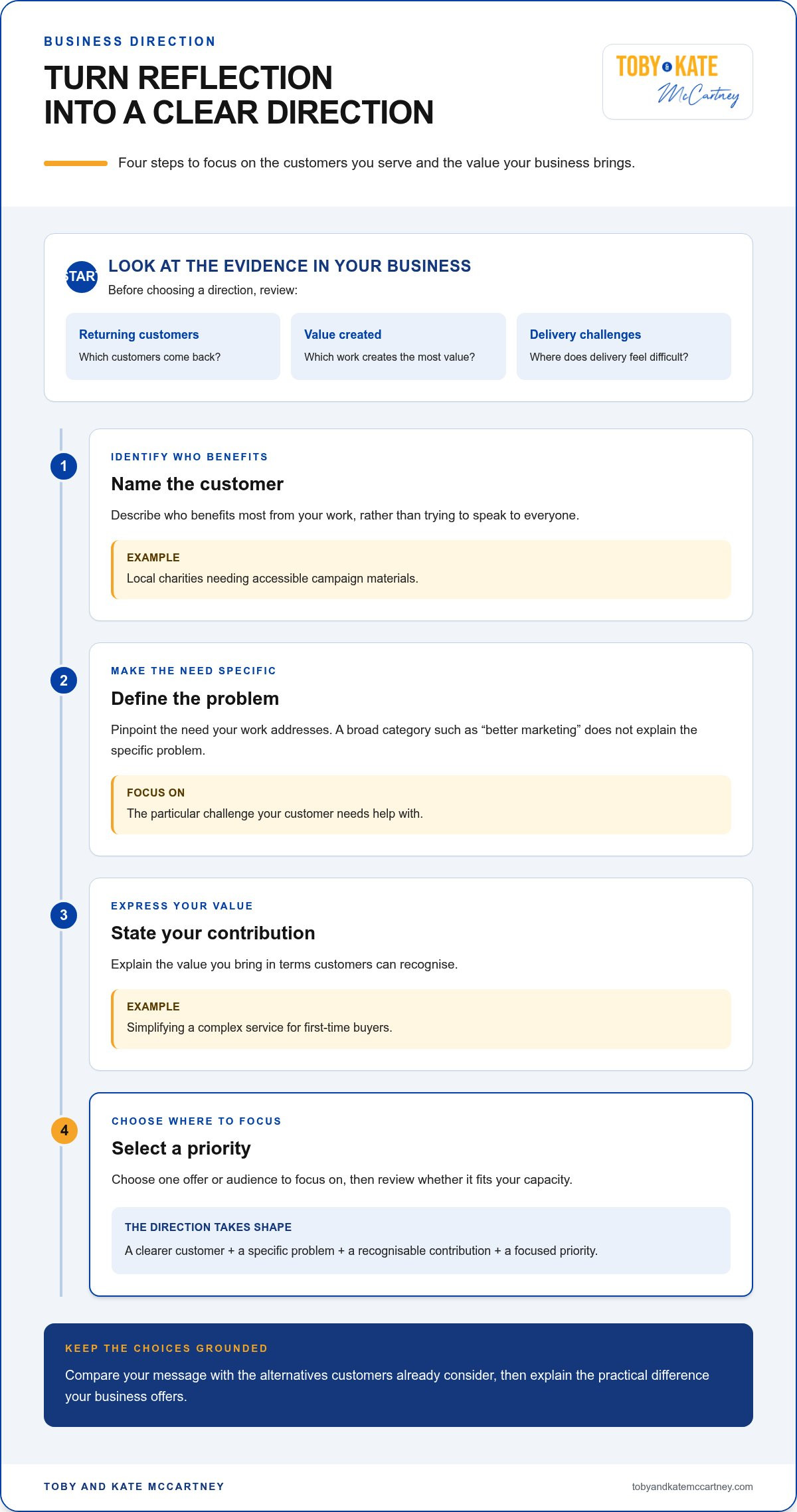
A clear direction helps you decide which opportunities deserve attention and which distract from your purpose. Coaching can help you examine the choices behind that direction and express what your business contributes in terms customers recognise. For example, a catering business might focus on workplace lunches rather than trying to serve every occasion.
Start with evidence from your own operations. Review which customers return, which work creates the most value and where delivery feels difficult. A freelance designer might discover that clients value clear brand messaging more than a broad menu of design services. That insight can sharpen both the offer and the audience it serves.
Use these steps to turn reflection into a workable direction:
- Name the customer: Describe who benefits most, such as local charities needing accessible campaign materials.
- Define the problem: Identify the specific need your work addresses, not a broad category like “better marketing”.
- State your contribution: Explain the value you bring, such as simplifying a complex service for first-time buyers.
- Choose a priority: Select one offer or audience to focus on, then review whether it fits your capacity.
These choices make it easier to communicate what sets your business apart. Compare your message with the alternatives customers already consider, then explain the practical difference. A bookkeeping firm, for instance, might emphasise clear monthly reporting for sole traders. The aim is not to claim superiority, but to identify the intended customer and benefit.
Finally, test your direction against real decisions. Does it guide which enquiries to accept, which services to refine and what to explain on your website? If a new project falls outside your priorities, consider whether it supports your strategy or pulls attention away. A concise direction statement can help you and your team make consistent choices while adapting as customer needs change.
Strategic planning and growth
A growth strategy turns your business direction into choices about priorities, resources and action. Coaching can help you test whether a goal fits your capacity, customers and current operations. For example, a bakery considering wholesale orders should weigh production demands against expected demand and existing commitments.
Build your plan on evidence, not ambition alone. Review sales patterns, customer feedback and the work that takes the most time. Then identify the main constraint on growth. A consultancy might find that personally approving every proposal limits its capacity, making clearer decision-making responsibilities a more useful priority than attracting additional enquiries.
Shape the strategy into actions you can review:
- Set a direction: Define the outcome you want, such as serving more repeat customers.
- Choose a priority: Focus on one change that supports that outcome, such as improving follow-up after a first purchase.
- Assign responsibility: Decide who will take each action and what support they need.
- Review evidence: Track relevant indicators, such as repeat orders, delivery delays or customer feedback.
Use regular reviews to learn and adjust. If a new service attracts interest but strains delivery, examine capacity before expanding promotion. If enquiries remain low, revisit the offer, audience and how you explain its value. This turns setbacks into information for your next decision, rather than a reason to abandon the wider goal.
Growth also needs a realistic view of resources. Consider staff time, cash flow, supplier capacity and the effect of change on existing customers. A business case study headline reports a 208% increase in turnover. Treat this as a reported example, not a forecast for your business. Your strategy should reflect your circumstances and the actions you can sustain.
To translate a growth ambition into a focused plan, explore one-to-one coaching as a way to work through priorities, decisions and next steps.
Toby and Kate McCartney: NLP Practitioner Certification
Toby and Kate McCartney’s NLP Practitioner Certification supports personal and professional development, including communication and personal effectiveness. It may suit you if you want to build skills in how you lead, influence and work with people alongside your business planning.
For further development, NLP Master Practitioner Certification builds on the learning pathway. Public Speaking programmes may suit you if presenting your ideas with greater confidence is a priority. These are distinct options: choose according to the capability you want to develop, rather than assuming a certification replaces business-specific planning or advice.
If you’re ready to explore personal and professional development through NLP, you’re welcome to visit tobyandkatemccartney.com.
Choose your next step with intention
Growth starts with a decision you can act on. If business coaching for small business owners in the UK has helped you identify a need for clearer leadership, stronger communication or a new development pathway, choose a next step that fits. That might mean refining your business plans, developing your capabilities or communicating your ideas with greater confidence.
Toby and Kate McCartney offer NLP Practitioner Certification, NLP Master Practitioner Certification and Public Speaking programmes. Each supports personal and professional development through a distinct pathway you can explore alongside your business priorities. Consider which capability you want to develop and how it connects with the way you lead and work.
You don’t need to have every detail mapped out before starting a conversation. Bring the goal you’re working towards and the question you want to resolve. Contact Toby and Kate McCartney to explore a suitable next step. Your direction is yours to shape, and one clear choice can set your progress in motion.
Frequently Asked Questions
What does a business coach do for small business owners in the UK?
A business coach helps you work through decisions and turn priorities into actions. If you’re considering changing your pricing, for example, a session could help you examine your reasons, the impact on customers and your options before deciding what to test. Between sessions, record the action you chose and what happened. This gives your next discussion useful evidence rather than relying on memory or general impressions.
What qualifications or accreditations should UK business coaches have?
Assess a coach’s relevant training, practical experience and professional approach, then ask what each qualification involved. Find out who awarded it, whether learning was assessed and how the coach keeps their skills current. Ask about confidentiality, professional boundaries and how they handle situations beyond their expertise. These questions help you understand what their credentials represent and whether their working style suits your needs.
What results can small business owners expect from business coaching, and how are they measured?
Coaching can help you make clearer decisions and follow through on agreed actions, but assess progress against goals set for your business. Choose indicators before you start: for delegation, track which decisions your team handles independently; for customer retention, review repeat bookings. Keep a simple record of starting conditions, actions taken and changes observed, so you can distinguish meaningful progress from activity alone.