
What if your next high-stakes meeting turned on how well you understand people, not how forcefully you make your case? NLP for business success is about more than communication techniques. It offers ways to build rapport, lead with greater clarity and respond more deliberately under pressure. Here, NLP means Neuro-Linguistic Programming, not the artificial-intelligence field of Natural Language Processing.
Strong ideas do not always win stakeholder support, and communication breakdowns can affect team motivation. Stress can also cloud judgement when leadership matters most. Practical skills such as setting clear outcomes, noticing how people respond and choosing your language carefully can help you handle conversations, decisions and working relationships more intentionally.
This guide explores how NLP can support influence and leadership, help you work on your mindset and provide a pathway from Practitioner to Master Practitioner certification. Toby and Kate McCartney offer NLP Practitioner, Master Practitioner and Trainer Training certifications, alongside public speaking programmes, leadership training, mentoring and one-to-one coaching. The focus is on developing skills you can put to work in professional situations.
Key Takeaways
- Explore how NLP’s focus on subjective experience can help you notice patterns behind workplace behaviour and decision-making.
- Learn to build sensory awareness and rapport, then use both to communicate more effectively in high-pressure situations.
- Compare NLP with traditional leadership training and consider how practising specific behaviours can help you apply new skills at work.
- Try practical ways to prepare before a pitch and use perceptual positions to consider different perspectives in a disagreement.
- See how nlp for business success can support a development pathway from Practitioner foundations towards Master Practitioner and Trainer Training.
Redefining NLP for Business Success in 2026
A strategy can be sound, targets clear and processes well organised, yet progress still depends on people. How a leader interprets a challenge, communicates priorities and responds under pressure affects what happens next. Management systems set direction and structure; NLP offers a way to examine the human responses that influence how work gets done.
NLP is most useful when you treat it as a framework for noticing behaviour, testing communication choices and reviewing relevant outcomes. A technique cannot guarantee better performance. Instead, build awareness, practise adapting your approach and assess whether the change supports clearer decisions, stronger working relationships or a defined business goal.
What is NLP in a Corporate Context?
Neuro refers to thought and perception, Linguistic to language, and Programming to learned patterns of behaviour. Together, these ideas offer a lens for considering how you interpret a negotiation, present a proposal or make a decision. For a neutral overview of its history, concepts and criticisms, see Neuro-linguistic programming.
NLP for business is a practical framework for noticing and adapting the thought, language and behavioural patterns that shape how you work with others. In a meeting, for example, you can observe how your message lands, ask a clarifying question and adjust your explanation if the response suggests that a concern remains. Then check whether the discussion is moving towards its intended outcome.
The ROI of Psychological Mastery
Developing communication and leadership skills is a professional investment, but its return depends on how those skills are applied and on the working context. More considered conversations may help managers understand what motivates people, address friction earlier and communicate a direction that teams can act on. These capabilities can support business priorities such as retention, sales conversations and organisational alignment, but results should be assessed rather than assumed.
Start with observable questions. Are expectations clearer after your one-to-ones? Are decisions progressing with fewer misunderstandings? Do team members know what they own and what happens next? These indicators connect personal development with business performance without promising a guaranteed return.
For Toby and Kate McCartney, development starts with the individual leader. A personal breakthrough can involve recognising a response that is not helping, choosing a more useful alternative and practising it consistently. This does not replace sound strategy. It can help you communicate and lead that strategy with greater composure and clarity, creating a stronger basis for working towards business goals.
The Core Pillars of Business Influence and Impact
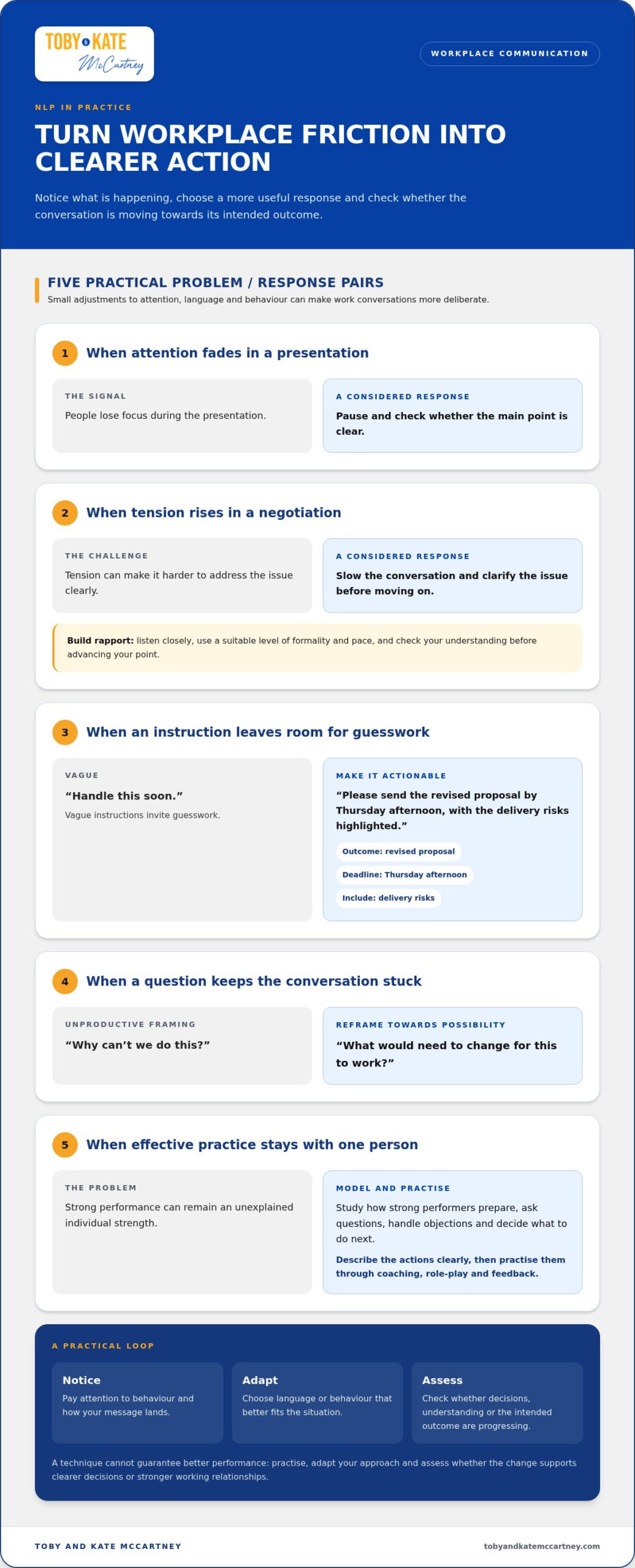
Influence starts before you speak. Noticing changes in tone, pace, posture and attention can help you respond to what is happening, not just to the words being said. For example, if people lose focus during a presentation, pause and check whether the main point is clear. If tension rises in a negotiation, slow the conversation and clarify the issue before moving on. Sensory awareness helps you be attentive, intentional and responsive.
That awareness can also make rapport more practical. In a high-pressure meeting, listen closely, use a suitable level of formality and pace, and check your understanding before advancing your point. Rapport is not agreement or a trick. It means building enough mutual understanding for people to consider what comes next. The emphasis on persuasion and impact also appears in the University of Pennsylvania’s Executive Influence programme.
High-performing teams rely on repeatable behaviours: how people prepare, share information, respond to setbacks and follow through. These actions can shape trust and execution. Language matters. Vague instructions invite guesswork, while blame can discourage people from raising risks. Specific, respectful feedback makes it easier to discuss accountability and learning. Workplace culture is shaped by these everyday exchanges.
Mastering the Language of Leadership
Precise language turns intention into action. Instead of saying, “Handle this soon”, specify the outcome, owner and deadline: “Please send the revised proposal by Thursday afternoon, with the delivery risks highlighted.” You can also reframe an unproductive question. Replace “Why can’t we do this?” with “What would need to change for this to work?” For a deeper focus on influence through communication, explore advanced communication skills training.
Modelling Excellence: The Blueprint for Success
In NLP, modelling means studying how someone achieves a result and identifying behaviours and thinking patterns that others can learn from. Look at how your strongest performers prepare, ask questions, handle objections and decide what to do next. Describe their actions in observable terms, then practise them through coaching, role-play and feedback. For example, a team could practise how to clarify a client’s concern before responding to it. This makes effective behaviours easier to share, rather than leaving them as unexplained individual strengths.
That is the practical potential of nlp for business success: turning awareness and communication into behaviours a team can practise and review. To develop these capabilities further, explore NLP and leadership development with Toby and Kate McCartney.
NLP vs Traditional Leadership Training
Traditional leadership training often provides models, processes and management tools to apply in your role. NLP takes a different route by focusing on how perception, language and habitual responses influence the way you lead. Both perspectives can be useful. Knowing a feedback framework helps, but under pressure you still need to notice your reaction, choose your words and adapt to the person in front of you.
NLP does not make every conventional course ineffective, and it is not a replacement for business education. An MBA or management programme can build strategic and operational knowledge. NLP can complement that foundation by helping you develop the human behaviours through which plans are communicated and carried out. Its value depends on practice: identify a response that is not serving you, rehearse an alternative, then observe what changes in your conversations and decisions.
Training is more likely to be useful when you apply ideas repeatedly in relevant situations. Rather than expecting instant transformation, choose one behaviour to practise and review. For instance, focus on clarifying expectations in one-to-ones. After each conversation, note whether the other person can describe the next steps. This makes development a focused experiment rather than a vague aspiration.
Why Management Skills Aren’t Enough
Clear responsibilities and delivery monitoring matter, but relying on authority and task oversight alone may miss why people hesitate, disengage or resist change. NLP encourages leaders to examine the assumptions, emotional cues and communication patterns that may influence behaviour. You can put this into practice by asking what is getting in the way, listening for the concern beneath an objection and agreeing a clear next action. Explore business leadership training UK for a related perspective on developing leadership capability.
The Shift from Manager to Empowering Master
The shift is from overseeing tasks to helping people take ownership. An empowering leader sets direction, builds trust and uses influence rather than relying solely on authority. This is relevant when teams work flexibly and managers cannot depend on constant supervision. Lead through clear outcomes, purposeful conversations and consistent follow-through.
For leaders seeking practical development, nlp for business success provides a structured way to work on the personal patterns behind professional behaviour. Toby and Kate McCartney offer leadership training and NLP certifications, from learning core tools to developing them in greater depth. Set a specific goal, practise the relevant skills and review how they affect your leadership conversations over time.
Practical NLP Strategies for High-Stakes Business
High-stakes moments call for more than a clever script. Your state of mind influences what you notice, how you speak and whether you can adapt when a conversation changes direction. NLP strategies offer ways to prepare, reset and choose your response. Treat them as skills to practise, not buttons that guarantee a particular result.
Before a major pitch, try an anchoring exercise to reconnect with a confident state. Recall a specific occasion when you felt focused and capable. Bring to mind what you saw, heard and felt, then, at the strongest moment, press your thumb and forefinger together for a few seconds. Release, reset and repeat. Before presenting, use the same gesture as a cue to recall that moment. Practise beforehand and notice whether it helps you feel more composed.
Commanding the Room: NLP for Public Speaking
Presence comes through non-verbal communication as well as content. Stand with a balanced posture, let your gaze include the whole room and use purposeful gestures. Avoid rushing through the opening. This simple five-minute reset can help organise your attention before you speak:
- Minute one: Plant your feet and take a few steady breaths, allowing your exhale to slow.
- Minute two: Recall a confident moment and use your chosen anchor.
- Minute three: Name the audience’s main concern and the outcome you want to offer.
- Minute four: Rehearse your opening sentence aloud at a measured pace.
- Minute five: Settle your posture, look around the room and focus on the first person you’ll address.
This is not about eliminating every nerve. It is a repeatable way to direct your attention towards your message and the people receiving it. Toby and Kate McCartney’s public speaking programmes help individuals develop communication skills, presentation techniques and confidence for professional settings.
Mindset Resilience for Executive Performance
In a boardroom disagreement, use perceptual positions to consider more than one viewpoint. First, describe the situation from your perspective, separating observable facts from your interpretation. Next, consider what the other person may be prioritising. Finally, step back and view the exchange as a neutral observer. Ask what outcome both sides need and what question could move the discussion forward. This creates space for a considered response, though it does not guarantee agreement.
To prepare a team for a new vision, use future pacing. Describe a realistic scene in which the change is working, then identify the first visible behaviours that would show it. Invite the team to consider likely obstacles and agree practical next steps.
If a recurring cue triggers stress or self-doubt, a “collapsing anchors” exercise pairs awareness of that response with a deliberately recalled resourceful state. Practise gently and stop if it feels uncomfortable. During prolonged negotiations, use brief pauses, clear notes and one defined objective for the next exchange. That is nlp for business success in action: organise your thoughts, regain perspective and choose your next move. Explore NLP public speaking and leadership training to build these skills into your professional practice.
Your Pathway to Professional Mastery: NLP Certifications
NLP certification provides a structured way to develop, apply and deepen skills that can support your work as a leader, coach or communicator. The pathway can progress from Practitioner to Master Practitioner, with Trainer Training for those who want to teach NLP. Each level builds on the previous one, moving from core techniques towards more advanced practice.
Choose a programme for the learning and practice it offers, not the title alone. Consider whether the training includes opportunities to practise, receive feedback and apply skills to professional situations. NLP certifications are private credentials, and standards can vary, so a certificate should not be presented as a universally regulated qualification. Consider how the training develops skills you can explain and demonstrate in your work.
The NLP Practitioner: Building the Foundation
Practitioner training develops foundations such as rapport, anchoring and language patterns. You learn to pay closer attention to how people respond, communicate with greater intention and practise techniques in everyday conversations. These skills can be applied to one-to-ones, team discussions and challenging interactions. Toby and Kate McCartney offer NLP Practitioner Certification. Explore the NLP Practitioner Certification UK guide for more detail on this first stage.
The Master Practitioner: Elite-Level Influence
Master Practitioner study develops your toolkit with advanced approaches, including values alignment, meta-programmes and breakthrough sessions. These approaches can help you explore what drives different responses and tailor your communication. For CEOs, founders and senior executives, this level may be relevant to complex leadership challenges involving people, priorities and organisational direction. Toby and Kate McCartney offer NLP Master Practitioner Certification. Read the NLP Master Practitioner Certification guide to explore the next step.
Executive Coaching and Mentoring for Accelerated Growth
Certification offers a learning framework. One-to-one coaching and mentoring can help you apply learning to the realities of your role. A tailored session can focus on a current challenge, such as preparing for a high-stakes presentation, leading change or strengthening your influence with stakeholders. Toby and Kate McCartney provide one-to-one coaching, leadership training and business mentoring for professional development. Discover executive coaching and mentoring.
For nlp for business success, a qualification is most useful when it supports genuine capability: skills you can practise, reflect on and bring into your professional life. Toby and Kate McCartney offer NLP Practitioner, Master Practitioner and Trainer Training certifications, alongside public speaking programmes and coaching and mentoring. Explore the stage that aligns with your goals and build your skills step by step.
Put Your Leadership Potential into Practice
NLP can help you pay closer attention to the patterns behind influence, communication and decision-making. With practical strategies for high-pressure conversations, presentations and team alignment, you can develop a more intentional leadership approach. Progressing from Practitioner to Master Practitioner gives you a structured way to build from core techniques towards more advanced applications.
That is the opportunity behind nlp for business success: not a shortcut to guaranteed outcomes, but a way to strengthen the capabilities you bring to important professional moments. Toby and Kate McCartney provide NLP training and certification, public speaking programmes, leadership training, mentoring and one-to-one coaching for people across the UK.
Your next step can begin with a decision to develop your influence, clarity and confidence. Begin your journey to professional mastery with Toby and Kate McCartney today. Choose a skill to practise, apply it in a real conversation and reflect on what you learn.
Frequently Asked Questions
How exactly does NLP improve business communication?
NLP can help you communicate more deliberately by drawing attention to how language, perception and behaviour affect an exchange. You might clarify what a colleague means before responding, adjust an explanation to address a stakeholder’s concern or replace a vague instruction with a clear outcome and deadline. These skills can support understanding when you practise them thoughtfully and adapt them to the people and situation.
Can NLP help with employee motivation and team dynamics?
NLP can give leaders practical ways to explore what motivates individuals and how communication affects team relationships. For example, ask what support would help someone take ownership of a task, then agree clear next steps together. Paying attention to different perspectives can help surface misunderstandings and support collaboration. It is not a substitute for fair working practices, clear expectations or addressing genuine workplace concerns.
Is an NLP certification recognised in the corporate world?
NLP certifications are private credentials, and recognition can vary between organisations and training providers. There is no government licensing body that regulates NLP certification, so a certificate alone does not guarantee professional standing or a particular career outcome. In a corporate setting, employers may also consider the quality of your training and how effectively you apply the skills. Be ready to explain what you learned and how it informs your work.
How long does it take to see results from NLP training in a business setting?
There is no fixed timeline for seeing results from NLP training. You can begin practising a communication technique in an upcoming meeting, but developing confidence and consistency takes continued application. Choose one behaviour to work on, such as checking understanding before closing a discussion, and note what happens over time. Outcomes depend on the skill, your practice and the working context, so assess progress against relevant, observable goals rather than expecting instant change.
What is the difference between an NLP Practitioner and a Master Practitioner for business?
An NLP Practitioner programme builds foundational skills, such as rapport, anchoring and language patterns, that can be applied in everyday professional interactions. Master Practitioner training develops more advanced approaches, including work with values and thinking patterns. The right stage depends on your experience and goals: Practitioner offers a foundation, while Master Practitioner provides a deeper pathway for applying NLP to more complex leadership and communication challenges.
Is NLP for business success suitable for introverted leaders?
Yes. NLP for business success does not require you to become louder or adopt an extroverted leadership style. It can help you prepare for important conversations, notice how others respond and communicate with greater intention. An introverted leader might rehearse a presentation, set a clear outcome for a meeting or ask considered questions to understand a team member’s perspective. The aim is to build on your strengths, not replace your natural style.
How does NLP help with high-stakes public speaking and presentations?
NLP can support presentation preparation by helping you focus on your intended outcome, rehearse key language and practise ways to manage your state under pressure. For instance, visualise delivering your opening calmly, practise it aloud and use a steady breathing routine before taking the stage. These techniques may help you feel more prepared, but they do not guarantee that nerves will disappear or that every presentation will go to plan.
Can NLP techniques be used for ethical negotiation and sales?
Yes. NLP techniques can support ethical negotiation and sales when used to understand needs, communicate clearly and seek an outcome that works for all parties. Build rapport by listening attentively and checking your understanding, rather than using it to manufacture agreement. Be transparent about what you can offer, respect a person’s decision and avoid pressure or misleading claims. Influence is most sustainable when grounded in honesty and mutual respect.