
Could your next goal be easier to act on if you could picture what progress looks and feels like? If your ambition still feels too broad to tackle, or your motivation dips when progress is hard to measure, you’re not alone. Setting effective goals with NLP offers a practical way to turn a desired outcome into clear, meaningful steps. Here, NLP means Neuro-Linguistic Programming, a model for personal development and communication, not Natural Language Processing, the field of artificial intelligence.
This approach isn’t a magic formula or a guarantee of success. It’s a framework for making your goal specific enough to guide action, while leaving room to adapt as circumstances change. In this guide, you’ll learn how to define an outcome that matters to you, identify observable signs of progress and break the journey into manageable actions. You’ll also learn how to review and adjust your plan while keeping sight of what you’re working towards.
Key Takeaways
- Use setting effective goals with nlp to shape an ambition into a personally meaningful outcome, with clear signs that help you recognise progress.
- Focus on what you want to achieve, then identify a manageable first action rather than trying to solve the whole journey at once.
- Use future pacing to mentally rehearse how you might respond in a future situation, while remembering that rehearsal can’t control every outcome.
- Build momentum by scheduling an action, noticing what happens and reviewing your plan so you can adapt without losing sight of your goal.
- Decide whether independent practice, structured NLP training or one-to-one coaching best fits the way you want to develop your goal-setting skills.
What does setting effective goals with NLP involve?
A meaningful ambition can still leave you wondering what to do first. “I want to make a difference at work” may matter deeply, but it doesn’t yet tell you what action to take or how you’ll recognise progress. Setting effective goals with NLP gives you a structured way to clarify the outcome you want, notice your responses as you work towards it, and plan actions you can review and adapt.
A desired outcome is a specific change you can describe and look for; a vague aspiration names a direction without showing what progress would look like. This distinction doesn’t make success certain. It makes your intention easier to think through and translate into practical steps. Treat NLP goal-setting as a framework for reflection and planning, not a promise that a particular result will follow.
How is an NLP goal different from a general ambition?
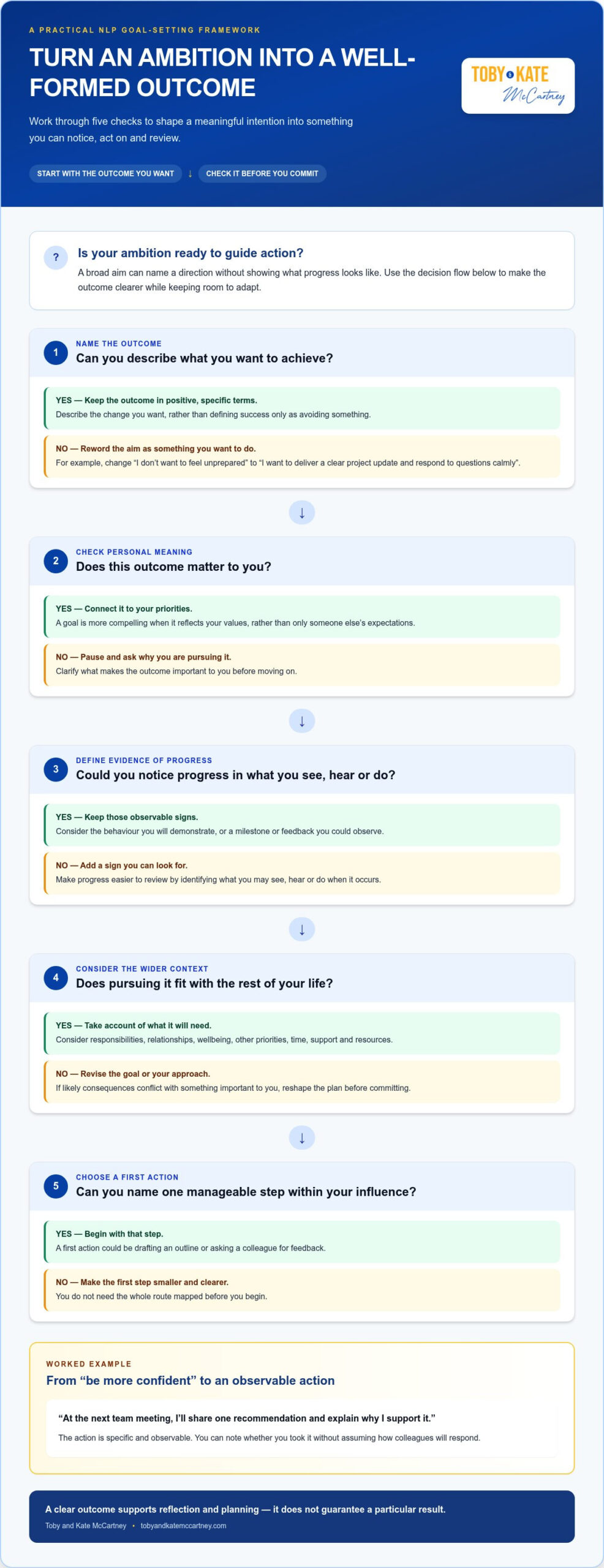
“Be more confident” is a useful starting point, but confidence can mean different things to different people. A clearer goal might be: “At the next team meeting, I’ll share one recommendation and explain why I support it.” You can then note whether you took that action without assuming how colleagues will respond. The goal should matter to you, rather than being something you pursue only to meet someone else’s expectations.
In NLP, a well-formed outcome is a goal described in terms of what you want, how you’ll recognise progress and what actions are within your influence. The phrase points you towards clarity and personal responsibility, not a guarantee of achievement.
What does NLP contribute to goal-setting?
NLP, or Neuro-Linguistic Programming, encourages you to pay attention to the language you use, the details you notice, the perspective you take and the behaviour you plan. For example, ask yourself what you’ll see or hear when you’ve spoken up, what you might be thinking beforehand and what words could help you begin. These prompts can make an abstract aim more concrete. They’re tools for reflection, not proof that a particular psychological effect or outcome is assured. For a broader overview of the model and its history, see Neuro-Linguistic Programming.
Keep the process grounded: describe the outcome in your own words, identify an observable sign of progress and choose behaviour you can practise. You don’t need elaborate terminology. The value lies in turning an important intention into something you can examine, act on and refine as you learn.
How to shape an NLP goal into a clear, well-formed outcome
A clear goal gives you more than a destination. It helps you decide what to notice, what to do next and how to check whether your approach is working. Use this process to turn an intention into an outcome you can act on, while leaving room to adjust as you learn.
- 1. Name what you want. Describe the change you’d like, rather than defining success only as avoiding something. Instead of “I don’t want to feel unprepared”, try “I want to deliver a clear project update and respond to questions calmly”.
- 2. Make it personally meaningful. Ask why this outcome matters to you and how it connects with your priorities. A goal is more compelling when it reflects your values, not just someone else’s expectations.
- 3. Describe evidence you can notice. Identify what you may see, hear or do when progress occurs. What behaviour will you demonstrate? What milestone or feedback could you observe?
- 4. Check your wider context. Consider how pursuing the goal may affect your responsibilities, relationships, wellbeing and other priorities. What time, support or resources might it need? Are there trade-offs? Revise the goal if its likely consequences conflict with something important to you.
- 5. Choose a first action. Pick a manageable step within your influence, such as drafting an outline or asking a colleague for feedback. You don’t need the whole route mapped before you begin.
How can you describe success in observable terms?
For example, if you want to strengthen your presentation skills, you might aim to prepare and deliver a short briefing to your team. Evidence could include having an organised outline, explaining your main points aloud and noting the questions you receive. These are illustrative markers, not a promise that the presentation will go a particular way. Observable evidence makes a goal easier to review because you can compare what you intended to do with what you actually notice.
In research on well-formed outcomes, University of Bath authors explore a broader approach to goal-setting that considers the outcome and its wider context. Use sensory detail as a prompt for defining evidence, not as proof that an imagined result will happen.
How do you check that the goal fits your wider life?
Pause before committing. Ask what pursuing the goal could require from you and who else might be affected. A development goal that needs regular practice, for instance, may call for protected time or support from others. If the cost to your wellbeing or relationships feels out of step with your values, reshape the goal or your approach. For support applying NLP to professional development, explore structured NLP training and coaching.
How can NLP visualisation and future pacing help you prepare?
Once you’ve defined an outcome, mental rehearsal can help you explore how you might respond when a relevant moment arrives. In NLP goal-setting, future pacing means imagining yourself in a future situation, noticing what may happen and rehearsing the behaviour you intend to use. It’s a planning prompt, not a prediction. Setting effective goals with NLP can include this step to help you consider a practical response before you need it.
What is future pacing in NLP goal-setting?
Choose a specific situation connected to your goal. Picture where you are, what’s happening and what you’d like to do next. For example, if you’re preparing to contribute in a meeting, imagine a colleague challenging your suggestion. You might rehearse pausing, asking what concern they have, then explaining your reasoning. Finish by identifying a realistic next step, such as preparing one key point beforehand.
Notice what comes up as you imagine the scene. Perhaps you realise you need more information, a shorter opening or support from someone you trust. Use that insight to update your plan. Mental rehearsal lets you practise a possible response; it isn’t evidence that the goal has already been achieved.
- It can support preparation: Rehearsing a response may help you clarify what you intend to do and spot questions you want to address.
- It has limits: You can’t rehearse every variable or control how other people will behave. A visualised scenario doesn’t guarantee a particular result.
- It works best alongside action: Pair the mental run-through with a concrete step, such as preparing notes or arranging a practice conversation.
How can you plan for obstacles without losing flexibility?
Think of one likely barrier and separate it from what you can influence. If you expect to feel nervous before speaking, you could practise your opening and take a moment to breathe before you begin. You can’t control whether others agree with you, but you can choose to explain your point clearly and ask a follow-up question.
Support can also be part of the plan. You might ask a colleague to listen to a practice run or make time to prepare with a mentor. Keep the broader outcome in view, but treat your route as adjustable: if a meeting is postponed, use the time to refine your notes; if your first approach doesn’t fit, choose another action that moves you forward.
Changing course isn’t the same as abandoning your goal. Future pacing is most useful when it helps you prepare, learn and respond to real conditions, rather than insisting that events unfold exactly as imagined.
How do you turn an NLP goal into daily action and review?
A well-defined goal needs a practical place in your day. Break the outcome into milestones that feel manageable alongside your existing responsibilities, then focus on the next action rather than trying to tackle everything at once. There’s no universal timeline: choose a pace that fits the goal and your circumstances.
- Choose one action: Decide what you’ll do first, not simply what you hope to achieve.
- Schedule it: Choose a realistic time and place, or connect it to an existing routine.
- Notice evidence: Record what you did and observed, including useful feedback or obstacles.
- Review and adapt: Use what you’ve learned to select the next step or adjust your approach.
How can you make the first step specific enough to start?
“Work on my goal” leaves too much room for delay. If your aim is to contribute more confidently at work, a clearer action could be: “Before my next team meeting, I’ll write down one point I want to raise.” It names an observable behaviour and a context. Check that the step is realistic alongside your commitments. If the meeting is cancelled or time runs short, have an alternative ready, such as practising the point aloud or sending it to a colleague for feedback.
Longer-term aims can be divided into milestones that mark meaningful progress. For example, you might move from preparing a contribution, to sharing it in a meeting, to reflecting on how it went. Let the pace respond to your workload and what each step teaches you.
How often should you review and adjust your goal?
Choose a review rhythm you can maintain, rather than following an arbitrary schedule. A simple journal or progress tracker can help you capture the action taken, what you noticed, any changed circumstances and the next useful step. Keep the record brief; it should support your progress, not become another demanding task.
During each review, ask: What did I do? What evidence did I notice? What got in the way, and what was within my control? Does this goal still fit my priorities? If circumstances have changed, revise the action, milestone or timing. Adjusting the route isn’t the same as abandoning an important outcome. In setting effective goals with NLP, review turns experience into information you can use to keep moving.
If you’d like to develop your practical understanding of NLP alongside your own goal-setting, explore NLP Practitioner Certification UK.
How can NLP training or coaching deepen your goal-setting practice?
You can practise independently or add structure if you want a broader understanding or a space to think through your goals with another person. The right next step depends on what you want to develop. Are you exploring NLP for your own personal or professional growth, or do you want to build skills you can apply in your work with others? Training and coaching offer different pathways, but neither guarantees a particular result.
When might structured NLP learning be a useful next step?
Structured learning may suit you if you want to study NLP concepts in more depth and practise applying them beyond goal-setting. Toby and Kate McCartney offer NLP Practitioner, NLP Master Practitioner and NLP Trainer Training certifications. These are distinct levels of professional development, not a promise of specific personal or career outcomes. Consider what you want to learn and how you hope to use it. The NLP Practitioner Certification UK guide is a relevant next read if you’re exploring the Practitioner level.
Independent practice can still be a good fit if you have a clear goal and are comfortable reviewing your own progress. Training may make more sense if you’re looking for guided learning, structured development or a wider grasp of NLP applications.
When might one-to-one coaching support goal progress?
Coaching offers an individual setting to clarify a professional or personal-development goal, review the actions you’ve taken and consider what to try next. For example, you might use sessions to explore a leadership objective, prepare for a communication challenge or assess whether your current plan still fits your priorities. Executive coaching and mentoring can also be useful topics to explore if you’re considering individualised support for a work-related goal.
Coaching isn’t the same as working through a framework alone: a conversation can help you examine your thinking, options and next steps. It’s still your goal and your decisions. You remain responsible for choosing actions that fit your circumstances and reviewing what happens.
There’s no need to rush into a particular route. Start with the approach that matches your aims, whether that’s independent practice, structured study or one-to-one support. If you’d like to explore how NLP development could fit your goals, take a look at Toby and Kate McCartney’s NLP training and coaching.
Make your next step count
An important ambition becomes easier to work with when you define what you want, identify evidence of progress and choose an action you can take. That’s the practical heart of setting effective goals with NLP: clarify the outcome, prepare for possible challenges and review your approach as you go. Mental rehearsal can help you consider how you might respond, but your plan should stay flexible as real circumstances unfold.
You can continue independently or explore further development if you’d value structured learning or individual support. Toby and Kate McCartney offer NLP Practitioner, Master Practitioner and Trainer Training certifications, alongside one-to-one coaching, leadership training and mentoring. These are pathways for developing your practice, not guarantees of a particular outcome.
Explore NLP training and coaching with Toby and Kate McCartney to consider which approach fits your goals. Start with one meaningful action, learn from what happens and keep shaping a path that works for you.
Frequently Asked Questions
What is a well-formed outcome in NLP?
A well-formed outcome is a goal described clearly enough to guide your actions and help you notice progress. It focuses on what you want, how you might recognise movement towards it and which steps are within your influence. For example, instead of “be better at meetings”, you might aim to prepare one point and share it at your next team meeting. The outcome should matter to you and fit your wider priorities.
How do you set an effective goal using NLP?
Start by stating what you want to achieve, rather than only what you want to avoid. Make the outcome specific, identify evidence you could observe, consider how it fits your responsibilities and priorities, then choose a manageable first action. For example, if you want to develop your presentation skills, you could plan a short practice session and ask a colleague for feedback. Review what happens and adjust your next step based on what you learn.
Can NLP help you achieve your goals?
NLP goal-setting prompts can help you clarify an outcome, plan actions and consider how you might respond to challenges, but they can’t guarantee achievement. Progress also depends on your circumstances, resources and factors outside your control. Evidence for NLP’s effectiveness is mixed, so treat its concepts as practical prompts rather than proven solutions. Focus on actions you can take, track what happens and adapt your plan if the approach isn’t helping you move towards what matters.
How does visualisation work in NLP goal-setting?
Visualisation in NLP goal-setting involves imagining a relevant future situation and mentally rehearsing the behaviour you intend to use. If you’re preparing to speak up in a meeting, you might picture yourself explaining your point and responding calmly to a question. Use the exercise to identify preparation you may need, such as writing notes or practising aloud. Imagining a response can help you plan, but it doesn’t prove you’ll achieve the goal or control others’ reactions.
What is the difference between NLP goals and SMART goals?
SMART goals use five prompts: specific, measurable, achievable, relevant and time-bound. NLP goal-setting can also clarify the outcome and evidence of progress, while prompting reflection on your perspective, intended behaviour and how the goal fits your wider life. The approaches needn’t compete. You could use SMART criteria to sharpen a goal, then apply NLP-style questions to explore what progress may look like and which actions you can take. Neither framework guarantees a particular result.
What should you do when an NLP goal stops feeling right?
Pause and review why the goal no longer fits. Your priorities, responsibilities or circumstances may have changed, or the outcome may reflect someone else’s expectations more than your own. Ask what you want now, what consequences pursuing the goal could have and whether a different route would better support your priorities. You can revise the outcome, change your next action or set the goal aside. Adapting thoughtfully isn’t failure; it’s a way to make a deliberate choice.